


Sun Protection
Mineral Sunscreen Stick: The Best Sun Protection 2026
The most popular advice about a mineral sunscreen stick is also the least complete: “It's mineral, so it's automatically the safer and better choice.” After 16 years in the pharmaceutical and personal-care sector, I believe that advice leaves out the detail that determines real-world protection.
Mineral describes the UV filter, not a standardized product strength, and a high SPF label can overstate what reaches your skin if the stick is applied too thinly.
A stick can be an excellent tool for the nose, ears, lips, hairline, and quick reapplication. It can also encourage a rushed swipe that leaves gaps. This is the complete guide to choosing and using one with a pharmacist's practical perspective, including what the label means, where sticks work best, and why application density matters more than packaging promises.
The Mineral Sunscreen Stick Myth vs Reality
A shopper once showed me a sunscreen stick she'd bought for a holiday. She liked the compact case, the clean-looking ingredient story, and the fact that she could apply it without spilling lotion in her bag. After a day outdoors, though, she was frustrated by uneven coverage and a pale film around her nose. She had treated the stick as a quick fix, not as a sunscreen that still needed a complete, continuous layer.
That experience is common. Convenience changes behavior, and behavior changes protection. A mineral sunscreen stick may make reapplication easier, but it doesn't make the required amount smaller or turn one fast pass into a tested application.
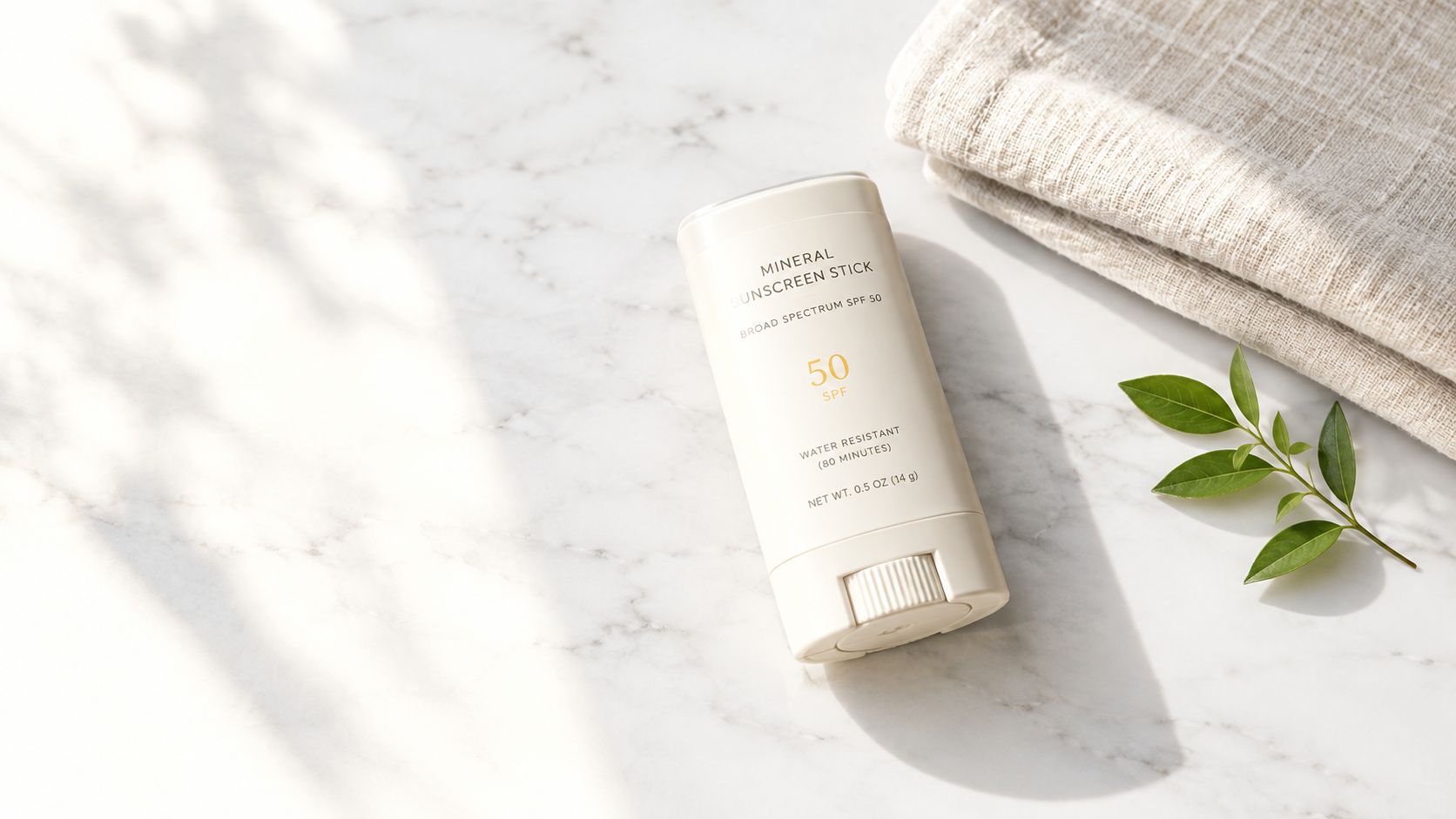
What “mineral” actually tells you
The word mineral generally identifies inorganic UV filters, principally zinc oxide and titanium dioxide. It doesn't tell you the finished product's SPF, UVA performance, water-resistance duration, texture, tint, or suitability for full-face use. Those details belong to the product label and its testing, not to the category name.
In the United States, the FDA's sunscreen monograph recognizes zinc oxide and titanium dioxide as eligible active ingredients at concentrations of up to 25% by weight. The 1999 framework remains the principal U.S. monograph structure, while the FDA's more recent assessment has proposed GRASE support, meaning “generally recognized as safe and effective,” for these filters based on available safety data. The regulatory history is described in the FDA's overview of sunscreen regulatory actions.
That status supports confidence in the ingredients, but it doesn't certify every stick as equally protective. Particle characteristics, dispersion, the wax and oil base, film formation, and the amount applied all influence the result.
Practical Rule
Treat “mineral” as the beginning of label reading, not the end.
The useful part of the format
Sticks are particularly handy where lotion is awkward. A compact product can reach the bridge of the nose, upper lip, ears, temples, hairline, and exposed scalp without making your hands greasy. It's also easier to keep beside sunglasses, in a travel pouch, or in an outdoor bag.
The limitation is surface area. A stick usually lays down a narrow track, and dense formulas may resist spreading. That makes it less practical as the only product for a large face, shoulders, arms, or legs. For a fuller explanation of the category, see what mineral sunscreen means.
My professional view is straightforward: a mineral sunscreen stick is a delivery format, not a permission slip to apply less. I'm certain this distinction solves much of the confusion shoppers bring to the counter. Choose the filter type for your preferences, then judge the product by its tested claims and by whether you can apply it evenly enough to use consistently.
Understanding Zinc Oxide and Titanium Dioxide Filters
At the center of a mineral formula are two established inorganic filters. A simple way to picture them is as a fine protective screen distributed across the skin. The screen interacts with incoming ultraviolet radiation, but it only works well when the finished formula creates a sufficiently continuous film.
That analogy is more useful than calling one filter “better.” Zinc oxide and titanium dioxide overlap, but they don't cover ultraviolet wavelengths in exactly the same way.
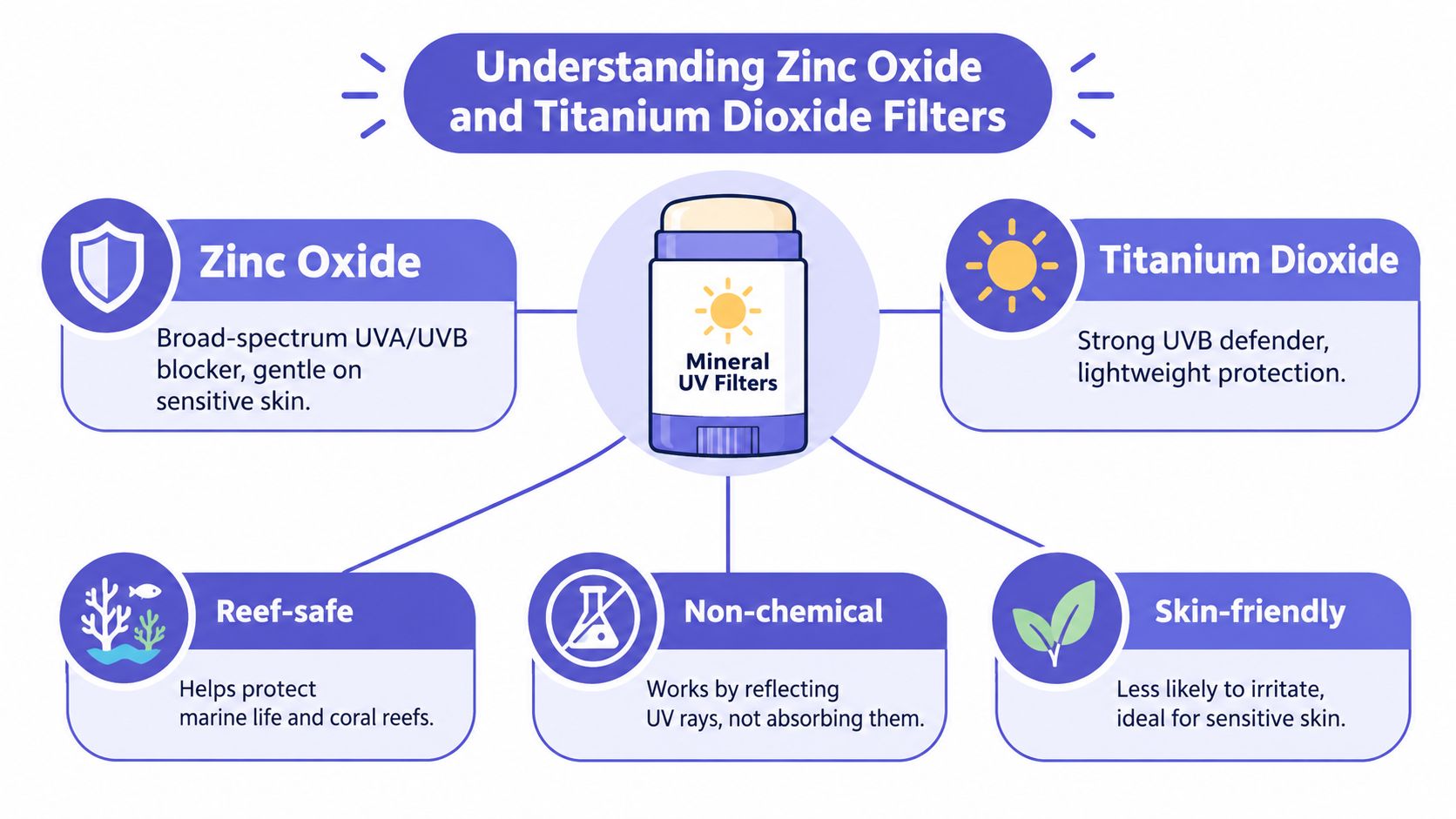
Zinc oxide and titanium dioxide in plain language
Titanium dioxide absorbs UV radiation up to approximately 400 nanometres, whereas zinc oxide extends to about 370 nanometres. A formula combining both can therefore provide more balanced coverage across UVB and UVA wavelengths than a formula relying on titanium dioxide alone, as explained in the FDA guidance on sunscreen labelling and effectiveness testing.
SPF mainly communicates protection against sunburn-producing UVB. It doesn't, by itself, describe the complete UVA profile. That's why the front of a package should be read alongside the active-ingredient panel and the broad-spectrum statement.
Zinc oxide is often selected for formulas intended for sensitive skin because it can be formulated without some of the ingredients that trouble reactive users. Titanium dioxide can contribute useful UV coverage and may appear alone or alongside zinc oxide. Neither ingredient makes a poorly dispersed, patchy, or under-applied product reliable.
What the active-ingredient panel can tell you
Turn the package over and look for zinc oxide, titanium dioxide, or both among the active sunscreen ingredients. Then check:
- The labelled SPF: This communicates tested sunburn protection, but only under the product's stated application conditions.
- Broad-spectrum wording: This indicates that the product addresses UVA as well as UVB under the applicable standard.
- Water-resistance information: If present, it applies only under the conditions and duration stated on the label.
- Directions: The manufacturer's application and reapplication instructions are part of using the product correctly.
The percentage of an individual filter isn't a complete substitute for finished-product testing. Two formulas with similar active ingredients can behave differently because their particles, oils, waxes, dispersion, and film-forming properties differ. For a broader comparison of filter categories, mineral and chemical sunscreen explains the distinction without reducing it to a simple good-versus-bad message.
Mineral Sunscreen Sticks vs Chemical Sunscreens
The mineral-versus-chemical debate often becomes too absolute. In practice, the better sunscreen is usually the one that suits your skin, fits your routine, and gets applied generously and repeatedly. A mineral stick may be ideal for targeted touch-ups, while a fluid chemical sunscreen may be easier for uniform coverage across a large area.
The formulation also changes the experience. Many mineral sticks are waxier and more visible, while many chemical sunscreens spread more easily and leave less residue. That doesn't mean one category is universally superior.
| Consideration | Mineral sunscreen stick | Chemical sunscreen |
|---|---|---|
| Main filters | Zinc oxide, titanium dioxide, or both | Organic UV filters, depending on the product |
| Typical format | Solid, portable, targeted application | Often fluid, cream, spray, or lotion |
| Sensitive-skin appeal | Can suit people who prefer inorganic filters | Some formulas may irritate individual users |
| Cosmetic finish | May leave a pale or white film | Often less visible, though formula-specific |
| Best practical use | Reapplication on small exposed areas | Larger areas when the texture spreads easily |
| Main application risk | A narrow, thin, uneven track | Skipping areas because the product feels light |
The protection gap is about film thickness
A mineral sunscreen stick is tested against a target application density of 2 mg/cm², but published application studies report real-world use of approximately 0.11 to 1.48 mg/cm². The evidence is summarized in EWG's discussion of imperfect sunscreen protection. When the film becomes thinner, UV attenuation can fall substantially, and uneven coverage creates additional unprotected areas.
This is why a labelled SPF isn't a fixed property of the stick alone. It describes the tested product film, not the result of a quick swipe across a cheek. A thick, wax-based formula may feel as though enough has been applied when only a narrow layer is present.
Choosing based on your routine
A fluid sunscreen can make sense for the first morning application over the face, neck, and other larger areas. A stick can then sit in your bag for the nose, ears, lips, hairline, and other places you touch, sweat, or rub during the day. For reactive skin, compare the complete ingredient list and choose a product you can tolerate consistently. Face sunscreen for sensitive skin can help frame that decision.
I don't recommend choosing purely by finish. A nearly invisible product isn't automatically stronger, and a visible product isn't automatically better. The winning combination is a tested formula, a suitable texture, and a routine that makes thorough application realistic.
Mastering Application for Maximum Protection
The most important technique is simple: slow down enough to build a continuous film. SPF testing uses an application density of 2 mg/cm², so the labelled value assumes more product than many people deposit with one quick stroke. A stick can be convenient and still underperform in daily life if the application is narrow or patchy.
The following method works well for targeted areas and smaller facial zones. Follow the product's own directions where they differ, particularly for reapplication and water exposure.
A practical application sequence
- Start with clean, dry skin when possible. If you're applying over skincare, allow the preceding layer to settle so the stick doesn't drag or lift it.
- Expose enough product to make controlled passes. Don't press hard enough to irritate the skin. A dense formula should leave visible product that can then be spread across the intended area.
- Use multiple slow, overlapping passes. Guidance compiled in 2025 recommends at least four back-and-forth passes, followed by even blending, as described in this practical sunscreen-stick application guidance. The exact number isn't universal because stick dimensions and formulas differ, so use the manufacturer's directions and inspect the result rather than counting mechanically.
- Blend the edges and gaps. Pay attention to the sides of the nose, upper lip, eyelids where directed, ears, hairline, and the border between the face and neck. These areas are easy to miss because the stick doesn't naturally travel across them.
- Check by sight and touch. Look for uncovered strips and feel for abrupt dry areas. Blending isn't about making the product disappear at any cost. It's about distributing it into a continuous layer without wiping most of it away.
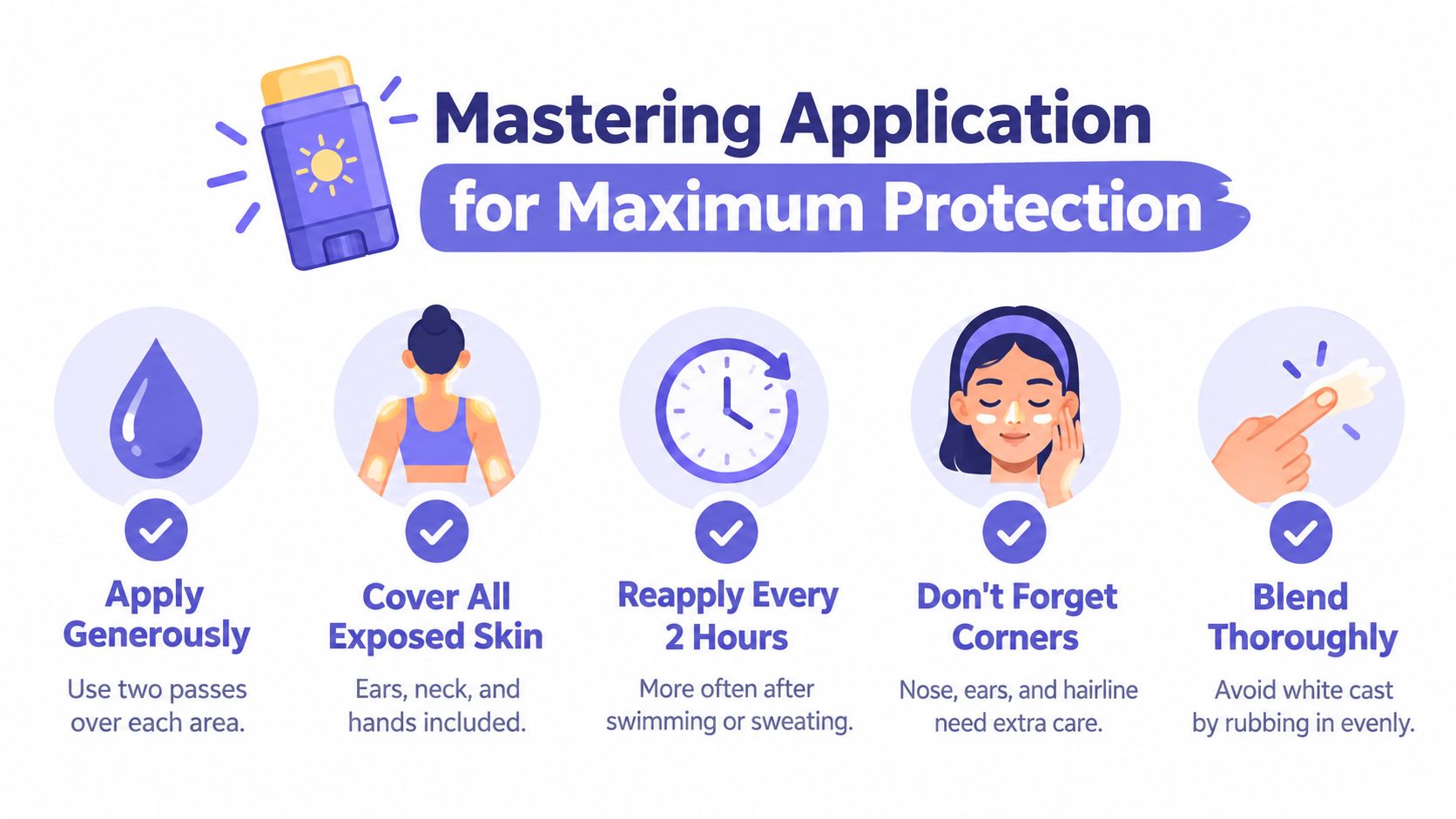
Reapplication is part of protection
Rubbing, sweating, swimming, and towel drying can interrupt the film. Reapply according to the label, and pay special attention to areas you've touched or wiped. A stick is useful here because it removes some of the friction that makes people postpone reapplication.
A portable sunscreen only helps if it gets used before the skin is exposed, and again when the protective film has been disturbed.
Don't assume a stick is enough for every exposed area. Use a lotion or cream where it spreads more reliably, then reserve the stick for targeted sites and touch-ups. This approach usually gives better coverage than trying to drag a solid product across a large surface.
For a visual demonstration of face application, see this guide:
You can also review how to apply sunscreen on the face when adapting the method to cheeks, eyelids, facial contours, and the neck. I believe that a mineral stick becomes dependable, not through a single perfect swipe, but through deliberate passes and regular checks.
SPF and UVA Guidance for International Buyers
International shoppers often compare products by the largest number on the front. That number matters, but it doesn't tell the complete protection story. SPF primarily describes protection against erythema, chiefly associated with UVB, while UVA information requires a separate claim or test.
European guidance recommends that UVA protection should be at least one-third of the labelled SPF, measured with standardized testing. The European Commission recommendation on sunscreen products provides that framework. For European products, look for the standardized UVA symbol or clear UVA information alongside the SPF.
Comparing labels across markets
A shopper comparing an SPF 30 or SPF 50 stick should ask more than “Which number is higher?” Check the following:
- Is the product broad spectrum, or does it provide clear UVA information?
- Are zinc oxide, titanium dioxide, or both listed as active filters?
- Does the product state water-resistance performance and directions?
- Can you apply enough product without unacceptable drag or visible residue?
The last question is practical rather than regulatory, but it matters. A formula that feels unpleasant may be used sparingly, while one that feels comfortable may encourage better reapplication. Neither finish nor ingredient category removes the need to follow the label.
Sensitive skin and children
For sensitive skin, assess the whole formula rather than relying on “mineral” alone. Fragrance, botanical extracts, preservatives, and the base can affect comfort. For children, parents should choose a product appropriate for the child's age and follow the manufacturer's directions, while also using clothing, shade, hats, and other sun-protective measures.
The FDA's recognition of zinc oxide and titanium dioxide as eligible sunscreen actives provides useful context for US shoppers, but it doesn't replace product-specific label reading. Regulatory terminology, permitted claims, and packaging conventions vary by jurisdiction. The difference between UVA and UVB is worth understanding before comparing products sold in different countries.
Choosing the Right Mineral Stick for Your Skin Type
The right stick is the one you can apply thoroughly, tolerate comfortably, and carry when exposure is likely. Skin type matters, but so do finish, shade, area of use, and the amount of rubbing you're prepared to do. A product selected only because it says “mineral” may disappoint if it feels too stiff, leaves an obvious film, or doesn't suit the areas you need to cover.
Sensitive and easily irritated skin
Zinc oxide and titanium dioxide are often attractive to people who prefer inorganic filters, particularly when they're trying to keep a routine straightforward. Still, check the entire ingredient list. A mineral filter doesn't guarantee that every supporting ingredient will suit reactive skin.
Test a small area according to the product's directions before committing to extensive use. If the stick drags over dry patches, apply it over a compatible moisturizer once that layer has settled. Avoid vigorous rubbing around the eyes, nose, and other areas that already feel tender.
Oily or combination skin
A solid stick can feel more substantial than a fluid, especially when waxes and oils create a firm glide. Look for a finish that doesn't leave you feeling coated, and apply only enough to create coverage rather than repeatedly polishing the surface. Product choice should focus on the complete texture, not just the filter.
Readers comparing options for shine-prone skin can use mineral sunscreen for oily skin as a starting point. Remember that even a product described as lightweight still needs enough application to meet its stated directions.
Dry skin
A wax-based stick may feel comfortable on dry areas, but a stiff formula can catch on flakes and produce uneven coverage. Prepare the skin with a suitable moisturizer, allow it to settle, then apply the sunscreen in overlapping passes. If the product pills, separates, or lifts the moisturizer, the combination isn't practical for your routine.
For dry skin, a lotion may be easier for the first full-face layer, with the stick reserved for the nose, ears, lips, and hairline. That division of labor often produces a more even result than forcing one format to do every job.
Deeper skin tones and visible cast
Zinc oxide and titanium dioxide can leave a visible white or pale film, particularly in high-protection formulas and on deeper skin tones. The appearance depends on particle size, pigment dispersion, the amount applied, and whether the product is tinted. A visible film is a cosmetic issue, but removing it by applying too little can create a protection issue.
Tinted products may reduce the visible cast, but a single “universal” shade won't suit every undertone. Look for shade information, application photographs, or swatches on skin tones close to your own. A less visible finish doesn't prove stronger UV performance, while an opaque finish may only show that more product has been deposited.
The best role for a stick
Dermatology guidance describes sticks as especially useful for targeted sites such as the ears, nose, lips, and hairline, but less practical as the only format for uniform facial coverage. That distinction is important for shoppers who want one compact product to replace a lotion.
My recommendation is to build a two-part routine when needed:
- For broad areas: Use a lotion or cream that spreads evenly across the face, neck, shoulders, and body.
- For precise areas: Keep the mineral sunscreen stick available for the nose, ears, lips, hairline, scars, and reapplication.
- For travel: Choose a compact format you'll carry and use, while checking the local label for SPF, broad-spectrum or UVA claims, and water resistance.
- For appearance: Select tinted or untinted according to your skin and preferences, but never sacrifice continuous coverage for invisibility.
Healtsy offers European pharmacy and parapharmacy products, including the Avène Solar SPF50 Sunsistick 20g, for international shoppers comparing European sun-care formats. Product availability and shipping details can change, so check the current listing and label information before ordering.
After 16 years watching sunscreen products come and go, I believe the mineral sunscreen stick remains a reliable, portable choice when its role is understood. It isn't automatically stronger than lotion, and it isn't automatically suitable for the whole face. Used deliberately, with enough overlapping product and sensible reapplication, it can solve a very real problem: keeping protection available for the small, exposed areas people most often forget.
Find Original European Sun Care
Healtsy helps international shoppers find original European pharmacy and parapharmacy products, including specialist sun care, with product information focused on active ingredients, suitability, and use. Compare available European options and check delivery information for your country before ordering.
Visit Healtsy