


What Is Mineral Sunscreen and How Does It Actually Work
Mineral sunscreen is a sunscreen whose UV protection comes from the inorganic filters zinc oxide and titanium dioxide, with U.S. FDA discussions allowing concentrations up to 25% for these core ingredients (FDA). Modern formulas don't have to leave the chalky white cast associated with older beach-block products.
You may be standing in a pharmacy aisle with a toddler, a sensitive complexion, or a tube marked “mineral” in your hand, wondering whether that label tells you enough. After 16 years working with skincare, I believe the most useful answer isn't just that mineral sunscreen is “natural” or “safer.” You need to know which filters it contains, how those filters absorb UV, how the formula will look on your skin, and whether you'll apply enough of it consistently.
That practical knowledge changes the buying decision. A sheer tinted face fluid may suit daily wear, while a richer zinc-based cream may be more comfortable during an eczema flare. This complete guide to mineral sunscreen will help you make that distinction without relying on vague green claims or the old mirror myth.
What Mineral Sunscreen Really Means
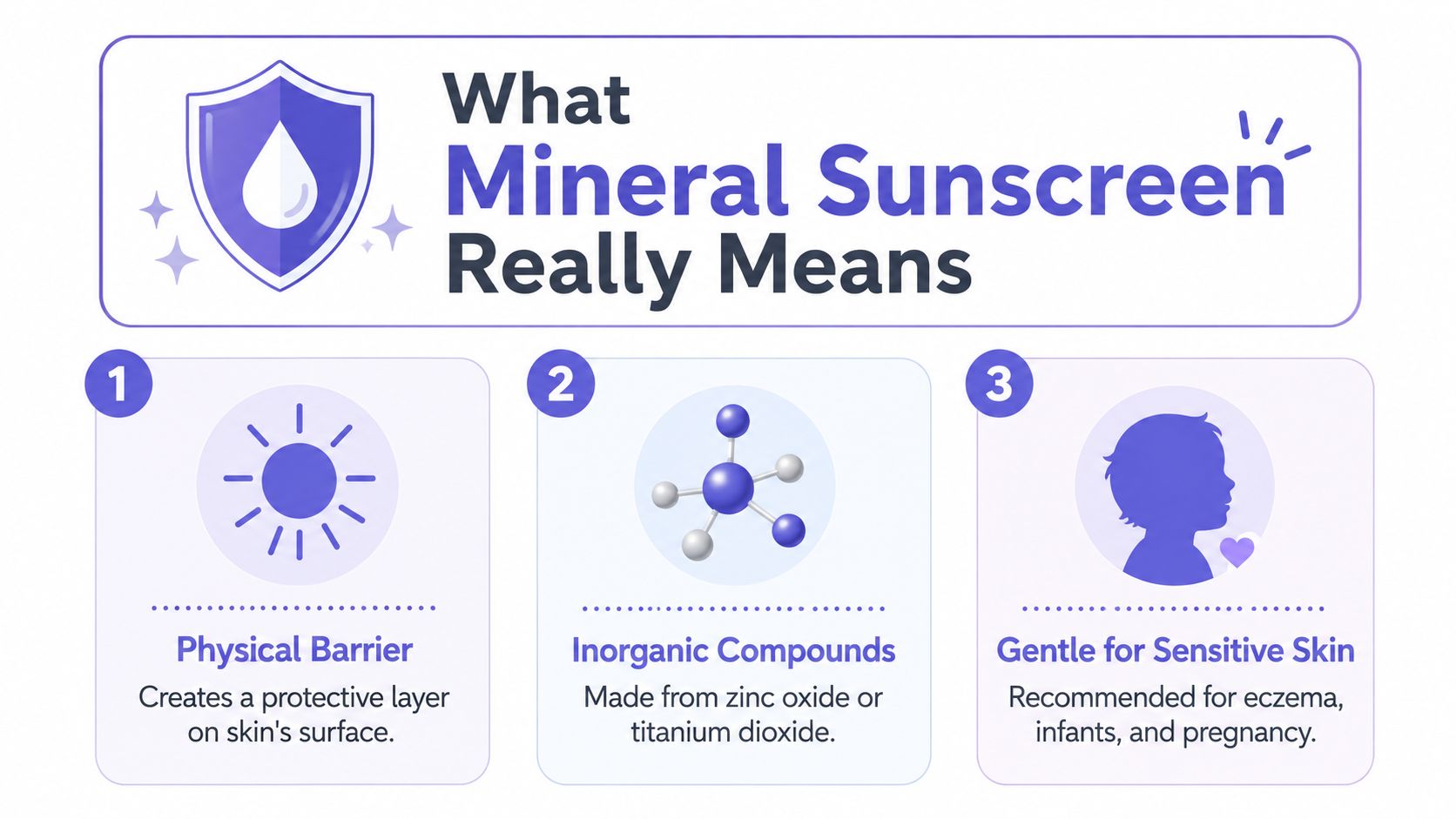
At the pharmacy counter, a parent may hold up a pastel tube and ask, “Which sunscreen is suitable for my toddler's eczema?” I usually begin with the active ingredients, not the colour of the packaging. Mineral sunscreen is a topical product whose UV protection comes from zinc oxide, titanium dioxide, or both, rather than from organic UV filters used in chemical sunscreen.
In everyday skincare language, you may also hear “physical sunscreen.” That name is convenient, but technically incomplete. Zinc oxide and titanium dioxide don't form a passive wall that blocks every ray. They interact with UV energy, mainly by absorbing it, as detailed in this review of mineral sunscreen technology.
Why older formulas looked chalky
Early mineral products often used relatively large particles. Historical formulations commonly used zinc oxide particles around 200–400 nm and titanium dioxide particles around 150–300 nm, which made them visible on the skin, particularly on darker complexions (technical review). Modern particle engineering, coatings, emollient bases, and iron-oxide tints can reduce that visible cast.
The result isn't always completely invisible, and no formula looks identical across every skin tone. Still, a modern tinted lotion or fluid can blend far more naturally than the thick white creams many people remember.
Mineral filters are often considered first for children, pregnancy, reactive skin, and skin recovering from a procedure or flare-up. Your clinician's advice should take priority for a specific condition, but the active-ingredient panel gives you a useful starting point. For broader sun-care fundamentals, this guide to sun protection can sit alongside your product-specific decision.
The choices ahead are practical: zinc oxide or titanium dioxide, particle design, untinted or tinted finish, face or body texture, and a reapplication routine. Once you understand those variables, “mineral” becomes more than a marketing word.
How Zinc Oxide and Titanium Dioxide Block UV
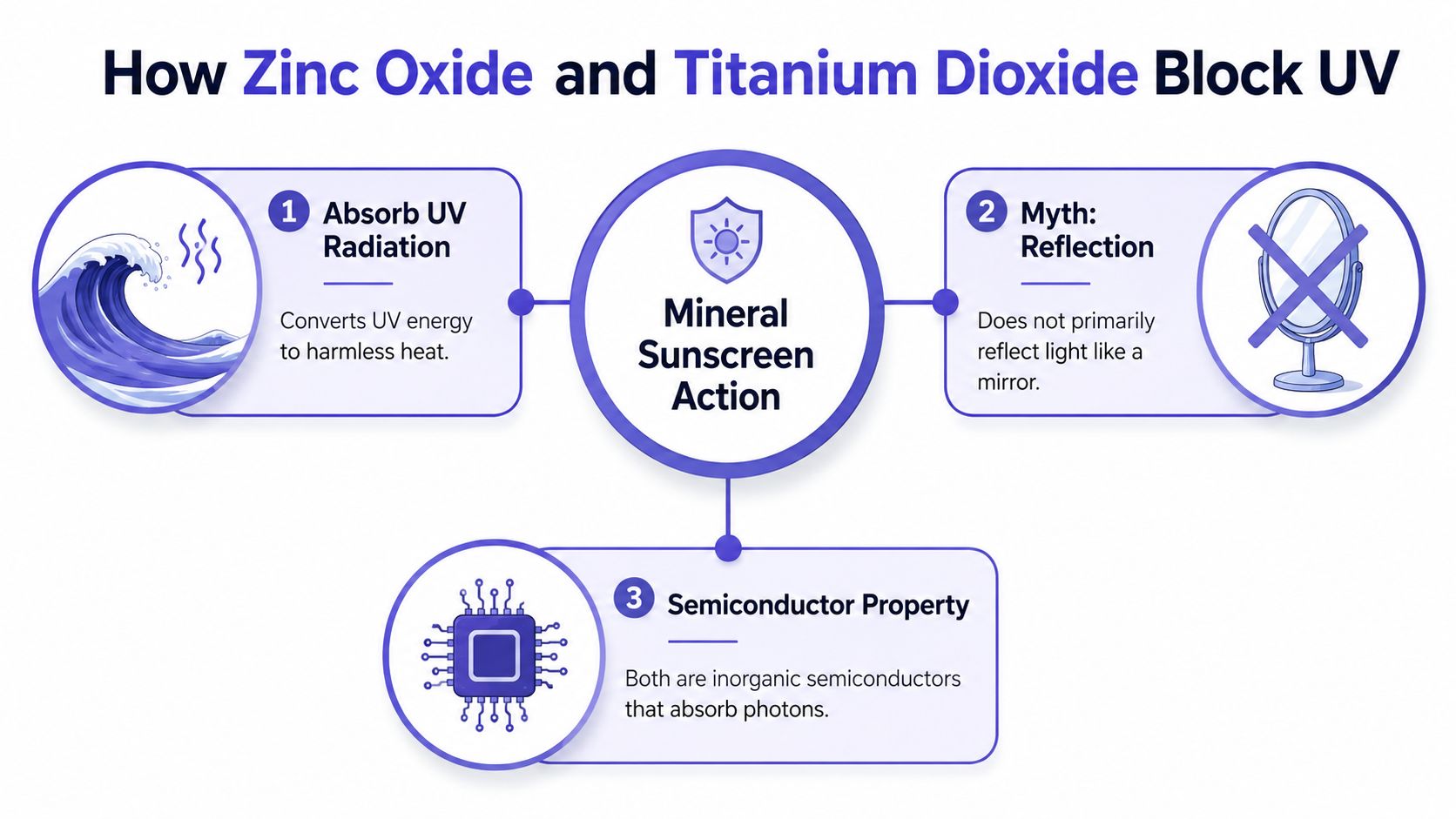
A customer may hear that mineral sunscreen works like thousands of tiny mirrors. That picture is easy to remember, but it leaves out the main chemistry. Zinc oxide and titanium dioxide are inorganic semiconductor materials whose band gaps interact with ultraviolet energy.
When a UV photon reaches one of these particles, its energy can excite an electron across the band gap. The absorbed energy is then dissipated as a very small amount of heat. In normal sunscreen use, that amount is harmless. It also explains why describing mineral sunscreen as purely “physical” can create the wrong expectation.
Science in plain language: The particles do not need to bounce every UV ray away. They absorb damaging energy before it reaches living skin cells.
A review of mineral sunscreen optics found that UV reflection is relatively limited, while reflection of visible light is much higher. This difference connects directly to product performance and appearance. Protection depends on particle design, coatings, the surrounding formula, and how thickly the product is applied. Visible light can still interact with the product, which helps explain a white cast even when UV absorption is doing much of the protective work.
The roles of the two filters
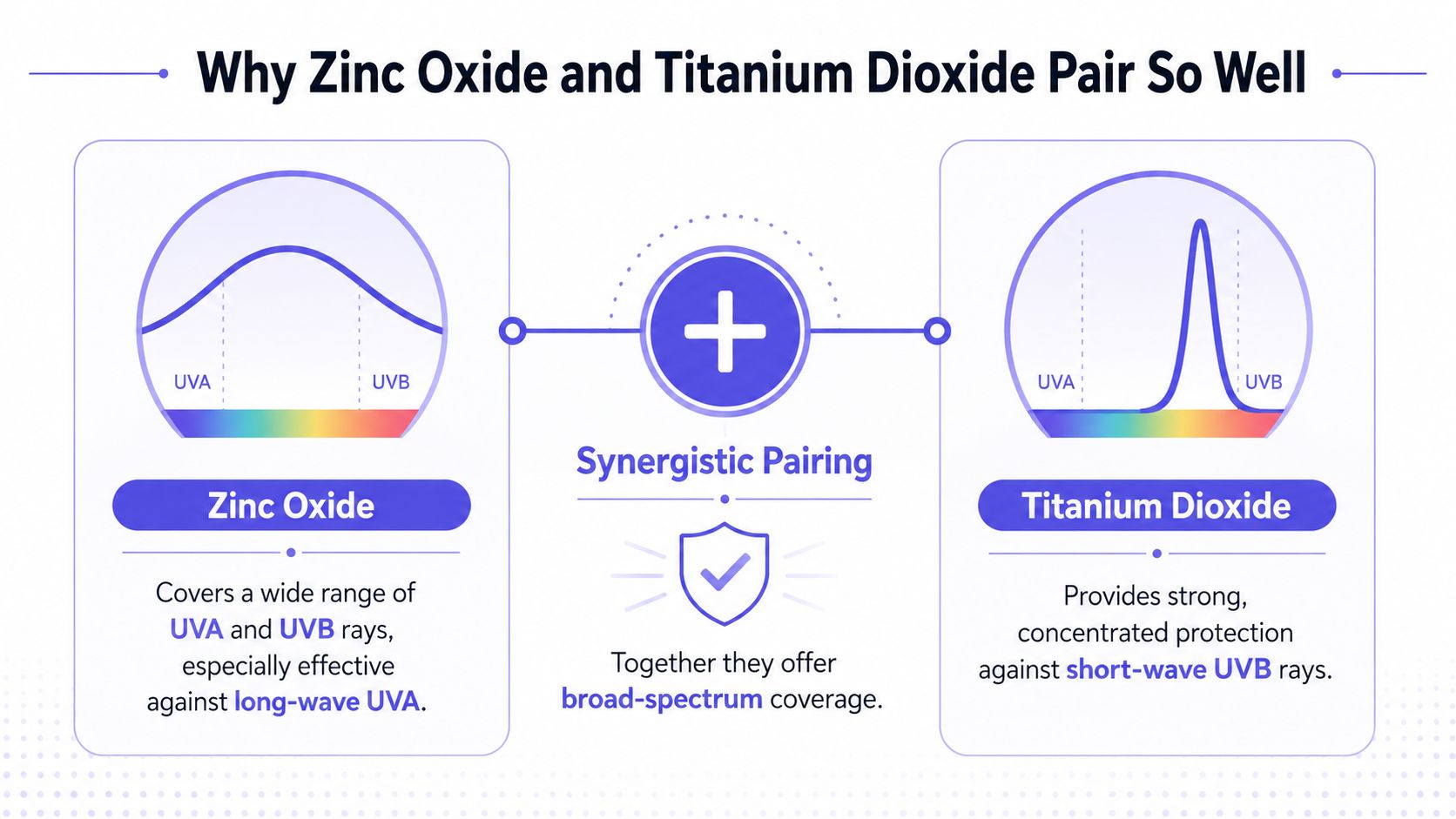
The two filters have different optical strengths because their particles interact with photon energy across different parts of the UV range. Titanium dioxide absorbs strongly in shorter UV wavelengths, while zinc oxide has broader absorption that extends further into longer-wave UVA. Their band-gap behaviour determines which photons are absorbed rather than reflecting them.
Particle size and coating also affect how the sunscreen behaves. Smaller, well-dispersed particles can reduce visible-light scattering, while the formula still needs enough active material to form an even protective film. A product that looks elegant but is applied too thinly cannot provide the labelled protection.
Regulatory classification and real-world suitability are separate questions. Zinc oxide and titanium dioxide are the key inorganic filters discussed within the relevant regulatory framework, but a finished sunscreen also contains a base, preservatives, and sometimes fragrance. Those ingredients, along with texture and application habits, can determine whether someone uses the product consistently.
For shoppers, the practical lesson is to look beyond the word “mineral.” A sheer fluid, a richer cream, and a tinted lotion may contain similar filter types but feel and appear very different. Tinted formats use colour pigments to reduce visible contrast, while an oil-control formula may suit skin that becomes shiny during the day. This mineral sunscreen guide for oily skin discusses that product-selection angle.
Mineral vs Chemical Sunscreen
A parent may choose sunscreen for a child with reactive skin, while another shopper may care most about an invisible finish under makeup. Both are making reasonable choices. The better category is the one that provides suitable protection and feels comfortable enough for generous, consistent application and reapplication.
Mineral formulas use zinc oxide and titanium dioxide. Chemical formulas may use organic filters such as avobenzone, octinoxate, octisalate, homosalate, octocrylene, or Mexoryl. Here, “chemical” describes the filter category, not the safety or quality of the finished product. For a fuller mineral versus chemical sunscreen comparison, consider the entire formula and your routine.
| Criteria | Mineral (Zinc Oxide / Titanium Dioxide) | Chemical (Avobenzone, Octinoxate, etc.) |
|---|---|---|
| Filter type | Inorganic zinc oxide and/or titanium dioxide | Organic UV filters |
| Skin feel | Can feel richer or thicker, although fluids, gels, and tints have improved the finish | Often lighter and more transparent |
| White cast | More likely, especially in older or untinted formulas | Usually less visible |
| Sensitive skin | Often a practical first option for reactive skin | May sting or irritate some users |
| Coverage | Depends on the filter pairing and complete formula | Depends on the combination of organic filters |
| Photostability | Zinc oxide and titanium dioxide are generally photostable | Some filters, including avobenzone, need stabilising support |
| Best match | Sensitive skin, children, pregnancy, or post-procedure routines | Users prioritising an invisible finish or a lightweight cosmetic feel |
Where the differences matter
A darker skin tone can make a pale residue more noticeable, so a tinted mineral product may be easier to use at the labelled amount. Tints add colour pigments that soften visible contrast. Clearer fluids can offer another option, though texture and finish still vary between products.
A runner may prefer a lightweight formula that stays comfortable during activity. Someone with rosacea may focus on avoiding fragrance and essential oils, regardless of filter category. A richer cream might suit dry skin, while a fluid or gel may feel better on skin that becomes shiny during the day.
Older guides often recommend applying chemical sunscreen 15 to 20 minutes before exposure. That timing rule is tied to forming an even protective film and should not be treated as a reason to delay protection. Mineral products also need careful spreading. Applying any sunscreen before going outdoors gives you time to cover missed areas and reduce gaps caused by rushed application.
The practical trade-off is clear: mineral filters may suit reactive skin but can pill under makeup, feel dry, or leave visible residue. Chemical formulas may feel lighter and simplify reapplication, yet still sting the eyes or bother sensitive skin. Ingredient category matters, but the finish, supporting ingredients, and your willingness to apply enough matter just as much.
Why Zinc Oxide and Titanium Dioxide Pair So Well
A sunscreen that uses both zinc oxide and titanium dioxide is designed around their complementary behaviour. Zinc oxide supports broader UVA coverage, while titanium dioxide contributes strong UVB and shorter-UVA absorption. Combining them can help formulators build broad-spectrum protection without asking one mineral filter to perform every role alone.
The pairing is similar to using two panes with different light-control properties. Each filter absorbs and scatters ultraviolet energy according to its material and particle design. Together, they can create a more balanced protective film across the UV range, provided the particles are dispersed evenly throughout the formula.
That balance does not come from the active ingredients alone. Coating, particle size, concentration, dispersion, and the complete vehicle all influence performance. A well-designed formula can spread more evenly and resist clumping, while a poorly matched base may leave gaps or feel difficult to apply at the labelled amount.
Why the label still needs checking
Two mineral filters on the active-ingredient panel do not automatically make a sunscreen effective or pleasant to wear. The finished product must form a stable, continuous layer on skin. Its texture also affects whether you apply enough and reapply when needed.
Cosmetic finish is part of that practical equation. Coated particles may improve spread, and a tint can reduce the pale appearance caused by visible-light scattering. Modern tinted formats can therefore make mineral protection easier to incorporate into a daily routine, particularly when an untinted product leaves noticeable residue.
A single filter name cannot predict the whole experience. Check for broad-spectrum wording, a texture you'll tolerate, a suitable tint, and directions you can follow. The active panel identifies the UV filters, while the rest of the formula helps determine spread, comfort, appearance, and whether regular use feels realistic.
Reading a Mineral Sunscreen Label Like a Pro
The active-ingredient panel is the first place I look. In a genuine mineral-only sunscreen, zinc oxide and/or titanium dioxide should be the UV filters, rather than appearing alongside organic filters. Their listed concentrations offer clues about the formula's design, but concentration alone can't predict the final result because particle treatment and the complete base also influence performance.
The terms “micronized” and “nano” describe particle dimensions and optical behaviour, not a guarantee of quality. Older, larger particles create more visible scattering and a stronger white cast. Smaller particles scatter less visible light, which can improve cosmetic elegance, but the finished formula still needs appropriate testing and transparent labelling.
A label decoder
| Label term | What it really means |
|---|---|
| Zinc oxide | A mineral filter with particularly useful long-wave UVA coverage |
| Titanium dioxide | A mineral filter that is strong in UVB-heavy protection |
| Broad spectrum | The product has been designed and tested to cover both UVA and UVB |
| Micronized | Particles have been engineered to improve spread and reduce visible whiteness |
| Non-nano | A particle-size description that may indicate larger particles, depending on the market definition |
| Coated particles | Particles have a surface treatment that can reduce clumping and alter feel or performance |
| Tinted mineral sunscreen | Pigments, often including iron oxides, add colour and can help reduce visible cast |
| Reef-safe | A marketing phrase without one universal legal definition |
Silica, dimethicone, and stearic acid may appear as coating or formulation components that help particles remain dispersed and improve skin feel. They don't turn an ordinary product into a better sunscreen by themselves.
The phrase “mineral filter” can also be confusing. A product may contain a mineral filter but combine it with organic filters, making it a hybrid rather than a mineral-only sunscreen. If you want a purely mineral formula, read the complete active panel rather than relying on the front label. This sunscreen selection guide can help you build a more deliberate label-reading habit.
For visible-light concerns such as pigmentation, a tinted formula with iron oxides may be worth considering. Tint isn't merely cosmetic. It can improve the match between the product and your complexion, which often makes generous application more realistic.
Why Mineral Sunscreen Is the Gentle Choice
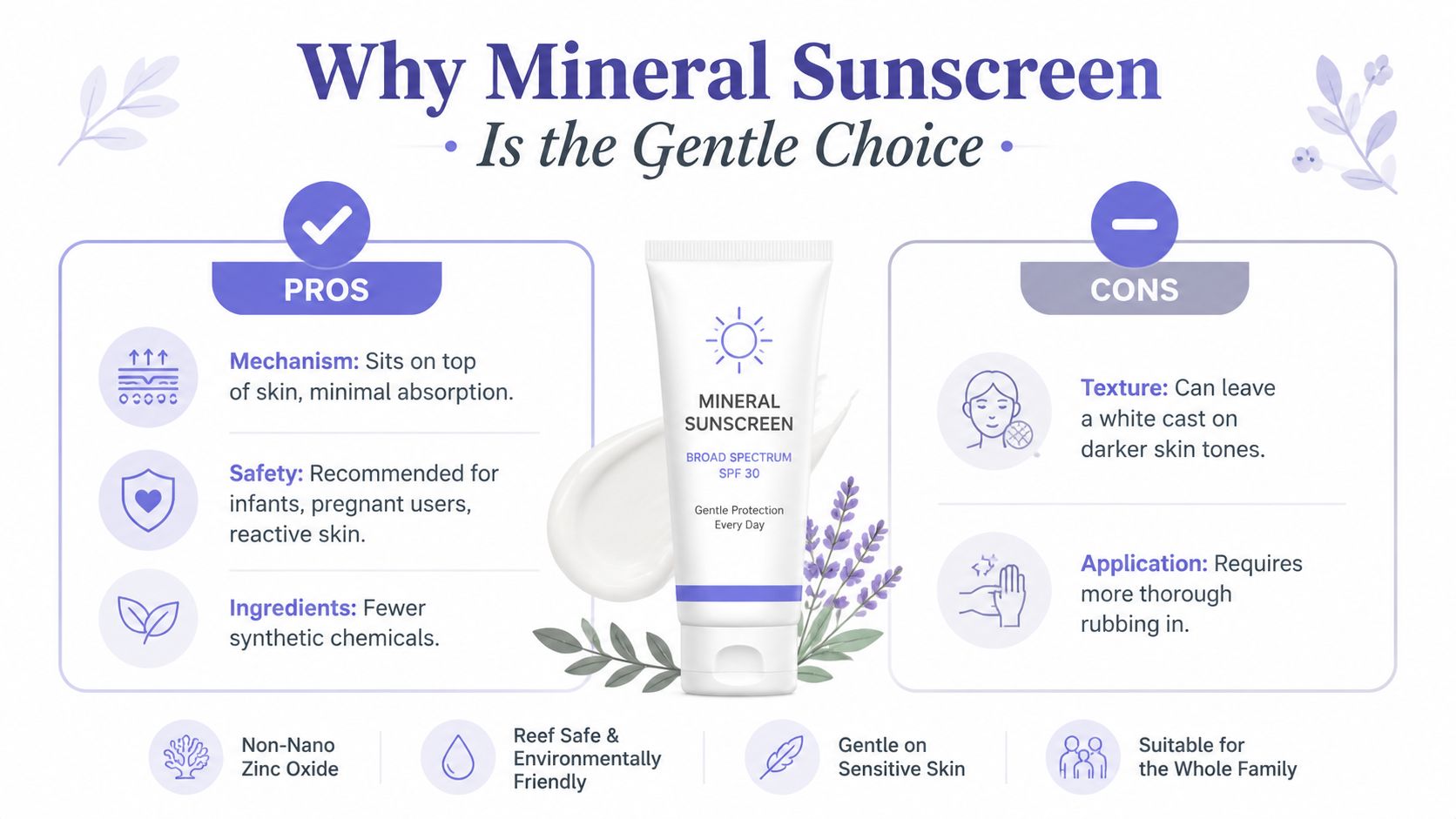
When someone has eczema, rosacea, post-procedure sensitivity, or a history of stinging from sunscreen, I usually start by considering mineral filters. Zinc oxide and titanium dioxide work at the skin's surface rather than requiring the same type of molecular interaction with deeper skin layers, which can make them a sensible first choice for reactive users.
The FDA identifies these two inorganic filters in its GRASE discussions (FDA sunscreen information). That supports their place in a careful skincare conversation, but “gentle” describes a complete product, not only its UV actives.
A mineral sunscreen can still include fragrance, essential oils, botanical extracts, or preservatives that irritate an individual user. Patch testing a new product on a small area is sensible, especially after a flare or procedure.
Family decisions need nuance
For babies under six months, shade, protective clothing, and avoiding direct sun are the priority. For older babies and children, many clinicians prefer mineral sunscreen because it can be easier to tolerate around sensitive skin and eyes. Pregnant users may also choose mineral filters to reduce uncertainty around certain organic filters, while still following their own medical advice.
Choose the gentlest formula your family will apply thoroughly, not the formula with the most impressive front-label promise.
A heavy zinc paste may be appropriate for a small irritated area, but it may frustrate a teenager with acne-prone skin who needs a lightweight product for daily wear. In that situation, a well-designed tinted mineral or hybrid formula may encourage better consistency. I believe that is a more responsible recommendation than insisting on one category for everyone.
For persistent flushing, burning, or eczema, sunscreen isn't a substitute for diagnosis and treatment. A focused resource on sunscreen for rosacea-prone skin can help you think through texture and ingredient choices without assuming every reaction comes from the UV filter itself.
Myths Around Reef Safety and Green Claims
“Mineral” and “reef-safe” describe different things. Zinc oxide and titanium dioxide may suit some users, yet their marine impact still depends on particle size, coatings, concentration, how much product reaches the water, and the local ecosystem.
Marketing language adds another layer of uncertainty. “Reef-friendly” has no single universal legal definition, so products using similar wording may follow different standards. A mineral-only label also leaves important questions unanswered: are the particles nano or non-nano, are they coated, and do added SPF-boosting ingredients affect the formula's environmental profile?
Some newer products use boosters such as hydroxypropylcellulose or ethylhexyl methoxycrylene to raise labelled performance. Their presence does not automatically make a sunscreen unsafe, but it also does not give shoppers a simple environmental answer. Current discussions examine possible effects on coral larvae, sea urchins, and other marine organisms. A confident front-label claim cannot settle every one of those questions.
A more careful travel rule
Before swimming, limit runoff instead of treating a green badge as proof of environmental safety.
- Use shade first: A canopy, umbrella, or protective clothing reduces the sunscreen needed during extended outdoor exposure.
- Choose a cream over a spray: This also avoids inhalation exposure. EU rules restrict zinc oxide applications that could expose the lungs through inhalation (EU regulation).
- Read the active panel: Check for zinc oxide and titanium dioxide, then review the rest of the ingredient list. “Mineral” does not answer every reef-safety question.
- Follow local rules: Coastal destinations may restrict particular filters or product formats, and requirements can vary by location.
If you are planning a snorkeling trip to Hawaii, the best sunscreen for coral reefs can help you prepare for local conditions and protected-area regulations. My pharmacy rule is straightforward: protect exposed skin properly, reduce runoff where practical, and treat environmental language as a reason to investigate, not as proof.
Applying Mineral Sunscreen the Right Way
A beautifully formulated mineral sunscreen can't protect skin if you apply a thin swipe and stop. At the pharmacy counter, I explain that the product needs a continuous, even film across exposed areas. The formula may feel thicker than a moisturiser, so work in sections and give it time to settle before adding makeup or clothing.
For the face, many people use the two-finger approach, dispensing a strip along two fingers for the face and neck. A quarter-teaspoon is another practical face-and-neck reference used in skincare guidance. The exact amount varies with finger size and product texture, but the principle doesn't change: a small dab isn't enough for labelled protection.
A reliable application routine
- Apply to clean, moisturised skin: Let heavy skincare settle so the sunscreen doesn't roll into flakes.
- Divide the face into zones: Dot the product across the forehead, cheeks, nose, chin, ears, and neck before blending.
- Spread, then smooth: Mineral products often look more visible while first applied. Use an even layer rather than rubbing aggressively until almost nothing remains.
- Cover overlooked areas: Ears, hairline, eyelids when appropriate for the product, lips with a suitable SPF product, and the back of the neck are commonly missed.
- Reapply: FDA labelling calls for reapplication every two hours, and after swimming, sweating, or towelling. Water-resistance claims are tested for either 40 or 80 minutes, so they don't mean the product lasts all day (FDA sunscreen guidance).
Sweat and towels disturb the protective film. If you wipe your face or dry your arms, reapply a proper layer rather than making a quick transparent touch-up that leaves gaps.
The best mineral sunscreen is the one you can apply generously without dreading the texture.
A hat, sunglasses, shade, and UPF clothing can reduce the burden on sunscreen, especially during outdoor activities. If you're planning a long walk or hike, this guide to sun protection for hikers offers useful clothing-focused context.
Pharmacy-counter questions
Does mineral sunscreen leave a white cast? It can, particularly in untinted or poorly dispersed formulas, but micronized particles, coatings, and iron-oxide tints can make modern products much less visible.
Is zinc oxide better than titanium dioxide? Zinc oxide generally offers stronger long-wave UVA coverage, while titanium dioxide is particularly efficient for UVB. Many formulas use both.
Can I use mineral sunscreen under makeup? Yes. Choose a fluid or tinted texture, apply enough protection first, and allow it to settle before makeup.
Is mineral sunscreen automatically reef-safe? No. Check local rules, avoid inhalable formats where relevant, and don't treat “reef-safe” as a regulated guarantee.
What if my sunscreen stings? Stop using it if irritation persists, check for fragrance and other potential triggers, and ask a pharmacist or dermatologist for an alternative.
Build a routine you'll actually keep up
Healtsy offers skincare, sunscreen, pharmacy items, and family health products that you can browse by concern, including sensitive skin and sun protection. Compare suitable formulas and build a routine that makes daily protection easier to maintain.
Shop Healtsy