


Sun Protection
Face Sunscreen for Sensitive Skin: A Complete Guide
You've bought the “gentle” sunscreen, applied it carefully, and still ended up with stinging cheeks, tiny bumps, or a hot, tight feeling by lunchtime. Then you switch to another tube, hoping the next mineral, fragrance-free, or dermatologist-tested formula will behave differently. That cycle is exhausting, especially when you know daily sun protection matters but your skin seems to reject every option.
After 16 years in the pharmaceutical sector, I believe the best advice I can give is this: choosing face sunscreen for sensitive skin isn't a simple mineral-versus-chemical decision. Filter type matters, but so do preservatives, fragrance, texture, tint, layering, and whether you can comfortably reapply the product. The sunscreen that protects you best is the one your skin tolerates well enough to use consistently.
Why Sensitive Skin Makes Sunscreen a Personal Decision
A reader once came into a pharmacy with three half-used sunscreens in her bag. One made her eyes water, another left her face flushed, and the third felt so thick that she stopped applying it after a few days. Every product had promised sensitivity-friendly protection. None had solved her actual problem, which was finding a formula she could live with every morning.
Sensitive skin isn't one single diagnosis. It's a lower tolerance threshold shaped by the skin barrier, immune reactivity, existing inflammation, and the way your facial skin responds to repeated exposure to ingredients. A compromised barrier can make ordinary products sting. Rosacea can make heat and flushing more noticeable. Acne-prone skin may react less to the filter itself than to a rich vehicle that feels occlusive or causes congestion.
Why the face needs a different approach
The face is the area most frequently exposed to sunlight during daily routines, and it's also the area most likely to react to fragrance, preservatives, and some chemical UV filters. Epidemiological reviews report sensitive-skin prevalence ranging from 50% to 61% in women and 30% to 44% in men, with expert consensus indicating that sensitivity is more common among younger people. The same review notes that allergic contact dermatitis affects about 15% to 20% of the general population, while a French photopatch clinic linked 15.4% of positive reactions to sunscreens, with 72% judged clinically relevant. These figures are discussed in the review of sunscreen-related contact dermatitis and sensitive skin.
That doesn't mean sunscreen is automatically unsuitable for reactive skin. It means the product needs to be selected like a small clinical decision. You're balancing UV protection against the chance of stinging, redness, breakouts, pilling, or abandonment.
Practical rule: A theoretically excellent sunscreen has little value if you stop wearing it because it burns, flakes, or looks uncomfortable.
I recommend separating the decision into layers: first the UV filters, then the non-active ingredients, then the finish and tint, followed by a patch test. Helpful background on recognising triggers and caring for reactive complexions is available in this guide to sensitive skin symptoms and care, while readers interested in botanical routines can compare those ideas with these plant-based sensitive skin tips.
How Mineral and Chemical Filters Actually Work on Your Face
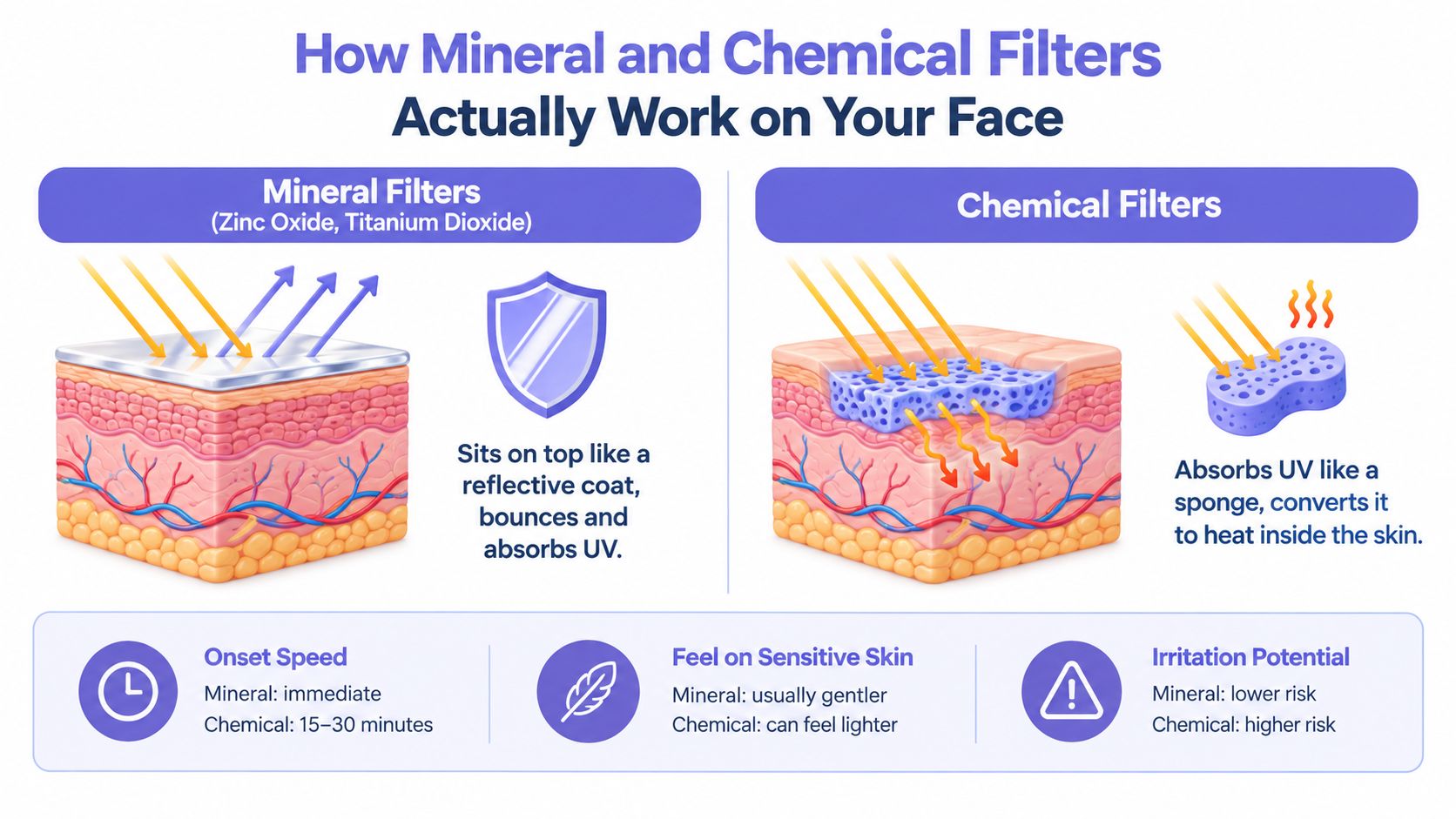
Think of sunscreen as a protective layer with a job to do before ultraviolet radiation reaches vulnerable skin. Mineral filters are commonly compared with a reflective coat. Chemical filters are more like a sponge that captures incoming UV energy and changes it into a lower-energy form, including heat, within the upper skin.
Mineral formulas use zinc oxide and titanium dioxide. They sit largely at the skin surface and provide protection by interacting with UV before it penetrates further. This surface-based behaviour helps explain why dermatology guidance often considers them less likely to trigger stinging, burning, redness, or allergic-type reactions than several common chemical filters, particularly on rosacea-prone, eczema-prone, or barrier-impaired faces. The trade-off is familiar: the particles can create a visible white cast or a thicker feel, especially when the formula hasn't been well dispersed.
Why chemical filters can feel different
Chemical, also called organic, filters include ingredients such as avobenzone, octinoxate, octisalate, homosalate, and oxybenzone. Newer filter systems may include Tinosorb S, Tinosorb M, and Uvinul A Plus, depending on the market. These molecules absorb UV energy and convert it into a less damaging form. On reactive skin, that process can sometimes be experienced as warmth or discomfort, although irritation may also come from the rest of the formula rather than the filter family itself.
The history of sunscreen development shows why today's options vary so widely. Formulators moved from early ingredients such as tannic acid in 1925 and benzyl salicylate in 1931 through PABA derivatives, cinnamates, and benzophenones. In an analysis of 52 widely sold high-SPF sunscreens, fragrance appeared in 30 products, propylene glycol in 8, methylisothiazolinone in 7, and avobenzone, octocrylene, and oxybenzone appeared in 41, 40, and 36 products, respectively. Those findings appear in the historical review of sunscreen ingredients and formulation development.
Mineral-first is a sensible starting point for very reactive skin, but “mineral is always best” is too blunt. A heavy, chalky mineral cream that you refuse to wear may protect you less in real life than a carefully formulated hybrid or chemical product that feels comfortable and gets reapplied. A fuller comparison of the two categories is available in this explanation of mineral versus chemical sunscreen.
Ingredients That Trigger Reactions and What to Look for Instead
The active UV filter is only one part of a sunscreen. When someone tells me a product “burned,” I look beyond zinc oxide or avobenzone and examine the whole ingredient list. A label-reading habit is more useful than keeping a rigid blacklist because irritation, allergy, and poor cosmetic tolerance aren't identical reactions.
Scan the formula in layers
Start with fragrance. Look for parfum, limonene, linalool, citronellol, geraniol, citralisciliate, essential oils, and masking fragrances. “Natural” fragrance can still be troublesome on a sensitised face. A product may also smell clean or barely noticeable while containing aromatic compounds that don't suit your skin.
Preservatives deserve equal attention. DMDM hydantoin, quaternium-15, and methylisothiazolinone can be problematic for some reactive users, particularly when the barrier is already damaged. This doesn't mean every preservative is unsuitable. Sunscreens need preservation to remain safe during use, so the practical aim is to identify systems your skin tolerates rather than demand an impossible preservative-free product.
Drying alcohol is another common issue. If denatured alcohol appears high on the INCI list, the product may feel quick-drying and elegant but can leave a tight, irritated finish on a fragile barrier. Acne-prone readers should also assess heavy occlusive silicones and rich film-formers in context. They aren't automatically comedogenic, but a dense vehicle may feel congested or cause pilling when layered over moisturiser.
Don't judge a sunscreen by the size of its “free from” list. Judge what the formula is built around and how your skin behaves after repeated use.
Ingredients that may support comfort
Some formulas include niacinamide, panthenol, allantoin, madecassoside, bisabolol, ceramides, cholesterol, and fatty acids to support comfort and the skin barrier. Lighter emollients such as squalane or caprylic/capric triglycerides can improve spreadability without creating the same rich feel as a heavy cream for some users.
I'd scan the top ten INCI entries first, then look for fragrance and a high placement of drying alcohol. After that, consider the product's texture, tint, and intended finish. A soothing botanical extract may suit one person and sensitise another, so don't assume that “calming,” “herbal,” or “clean” on the front of the tube predicts tolerance.
Understanding SPF, Broad-Spectrum and Water Resistance Labels
Sunscreen labels become easier to use once you separate the jobs of each claim. SPF primarily describes protection against UVB, the radiation most associated with sunburn. Broad-spectrum means the formula also protects against UVA, which penetrates further and contributes to photoageing and the persistence of some redness and post-acne discolouration.
The FDA's consumer sunscreen guidance advises choosing broad-spectrum sunscreen with an SPF of at least 15 for regular use. For facial use, independent consumer-health guidance commonly recommends SPF 30 or higher, especially for daily wear, as explained in this face sunscreen selection guide.
Decoding Sunscreen Labels at a Glance
| Label Claim | What It Actually Means | Sensitive-Skin Takeaway |
|---|---|---|
| SPF | Indicates the product's tested level of protection against sunburn-causing UVB | Choose a level you can apply generously and wear consistently |
| Broad-spectrum | Indicates protection against both UVA and UVB | Essential for facial skin, particularly when redness or uneven tone is a concern |
| PA rating | An Asian labelling convention that grades UVA protection from PA+ through PA++++ | Higher plus ratings can help when UVA protection is a priority; compare with the European UVA circle |
| Water-resistant | Indicates that tested protection remains after a stated period of swimming or sweating | It isn't an all-day shield. Reapply after towel-drying and water exposure |
Water resistance is a timed claim, commonly 40 or 80 minutes of swimming or sweating, rather than permission to apply once and forget the bottle. Outdoor wearers should choose water resistance when swimming or exercising, then reapply after towel-drying. The FDA's proposed U.S. sunscreen order would cap the maximum labelled SPF at 60+ and require products with SPF 15 and above to meet broad-spectrum criteria, including a UVA I/UVA ratio of 0.7 or higher. Those proposed regulatory details are set out in the FDA questions and answers on sunscreen regulatory actions.
For most sensitive faces, the practical target is SPF 30 to 50, broad-spectrum, with water resistance when you'll be outdoors, and a higher level only when a doctor recommends it for a specific photosensitivity concern. Guidance on timing and repeat application is also available in this resource on how often to reapply sunscreen.
Applying and Layering Face Sunscreen the Right Way
A good sunscreen can fail just because too little reaches the skin or because another product disrupts its film. I prefer a routine that is generous, calm, and repeatable rather than one that involves aggressive rubbing or multiple incompatible layers.
Build the morning routine in order
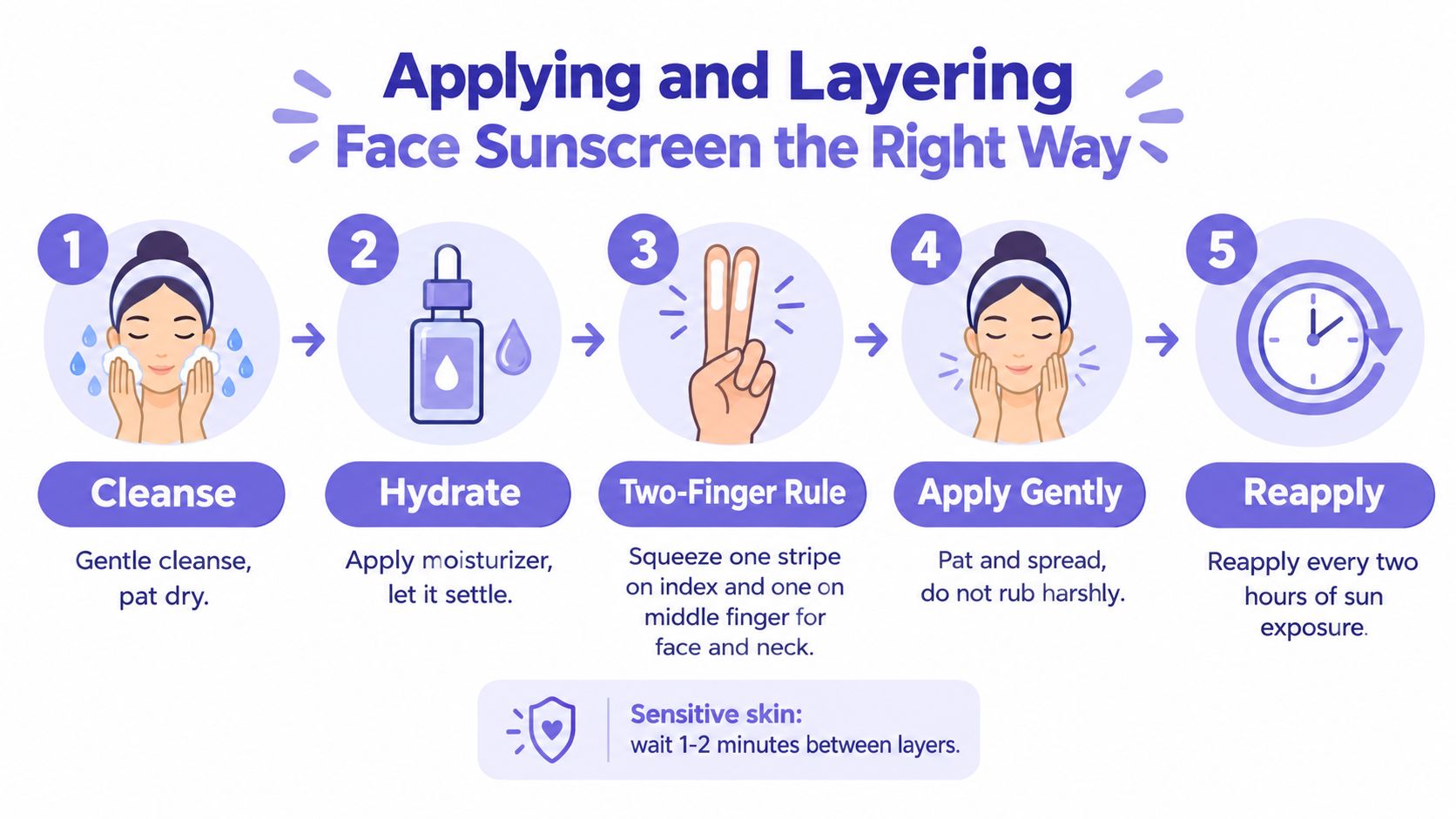
Use a gentle cleanser, then apply a hydrating serum or a prescribed active if your clinician has told you to use it in the morning. Follow with moisturiser if needed, allow the layers to settle, and apply sunscreen last. The sunscreen needs to form an even film on top, so give each layer a short pause if your face tends to pill or sting.
Use the two-finger rule for the face and ears: squeeze one stripe along the index finger and one along the middle finger. Spread it over the face, ears, and any exposed areas without scrubbing. Apply sunscreen 15 minutes before sun exposure, then reapply every two hours while exposed, or sooner after swimming, sweating, or towel-drying.
Vitamin C can often fit into a morning routine, but sensitive skin may not tolerate acids or retinoids layered into the same routine. Many people do better using retinoids and exfoliating acids at night, introducing them gradually, and avoiding combinations that leave the barrier tender under daytime UV exposure.
Reapply without disturbing your face
Over makeup, a mineral powder SPF, sunscreen stick, or pat-and-press method can be more practical than rubbing a liquid across the face. Apply in sections, press rather than drag, and remember that a powder or stick still needs adequate coverage to provide meaningful protection. If makeup makes reapplication unrealistic, choose a sunscreen finish that works comfortably under your usual products from the beginning.
A short video can help you visualise the application sequence:
Small habits matter year-round. Don't skip sunscreen on cloudy days, consider reapplying after prolonged time beside bright windows, and store the bottle away from heat. For children who spend active days outdoors, physical protection adds useful coverage around the face, ears, and neck.
You can also review this practical guide to applying sunscreen on the face.
Tailoring Your Choice to Rosacea, Acne, Eczema and Children
The same sunscreen can be comfortable for one person and unworkable for another. I've seen this most clearly when a patient with rosacea borrows the product that suited an acne-prone partner, or when a parent uses an adult facial fluid on a child because the packaging looks gentle. The filter, vehicle, and application method need to match the skin profile.
Rosacea-prone skin
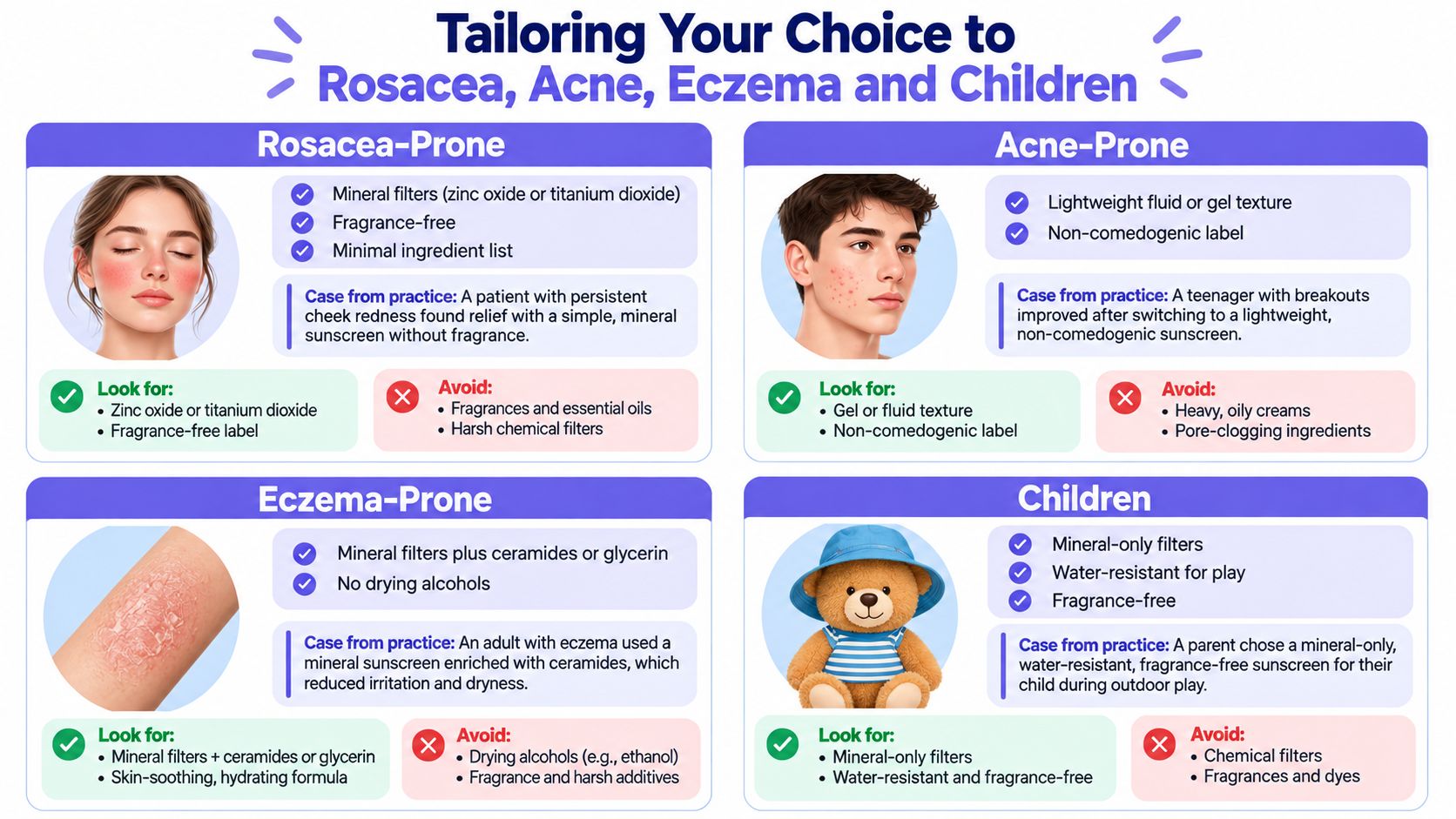
A mineral sunscreen with zinc oxide or titanium dioxide, no fragrance, and a short ingredient list is a sensible starting point. A tinted formula containing iron oxides can help reduce the visible contrast of redness, and tint may also make a mineral product easier to wear across different skin tones. Avoid alcohol-heavy textures if they leave your face hot or tight, and stop using anything that reliably triggers flushing.
A gentle broader routine can be explored alongside sunscreen through this resource on gentle skincare for rosacea. The important point is consistency. A slightly less elegant product that never burns is more useful than a beautiful formula that causes a flare.
Acne-prone skin
Look for non-comedogenic, oil-free, lightweight fluid, gel, or hybrid textures. Mineral formulas may be suitable, but don't assume every mineral cream is light enough for blemish-prone skin. Check whether the product layers cleanly over moisturiser and whether it leaves a film that feels congested.
If a chemical filter repeatedly causes stinging, consider avoiding that individual product rather than assuming every chemical formula will behave identically. Conversely, if a mineral sunscreen is thick, greasy, or impossible to spread, a well-formulated hybrid may be more realistic for daily use.
Eczema-prone skin
Eczema-prone faces usually need a simpler formula with minimal preservatives, no fragrance, and barrier-supportive ingredients such as ceramides or allantoin. Apply to comfortably moisturised skin rather than rubbing sunscreen into a dry, cracked surface. If even bland products burn, pause experimentation and ask a dermatologist whether the eczema is active enough to require treatment before sunscreen selection.
Children
For children, I generally favour mineral-only formulas with zinc oxide or titanium dioxide, fragrance-free packaging, and a format that an adult can apply thoroughly. A water-resistant stick can make repeat application easier during active outdoor days, although it still needs to be spread evenly rather than swiped once over the nose and forgotten.
The same framework applies to all four groups: choose the filter with the lowest irritation risk for that person, remove obvious triggers, match the texture to the skin, and test before committing. More guidance for redness-focused routines is available in this resource on sunscreen for rosacea skin.
A Simple Patch Test You Can Run Before You Commit
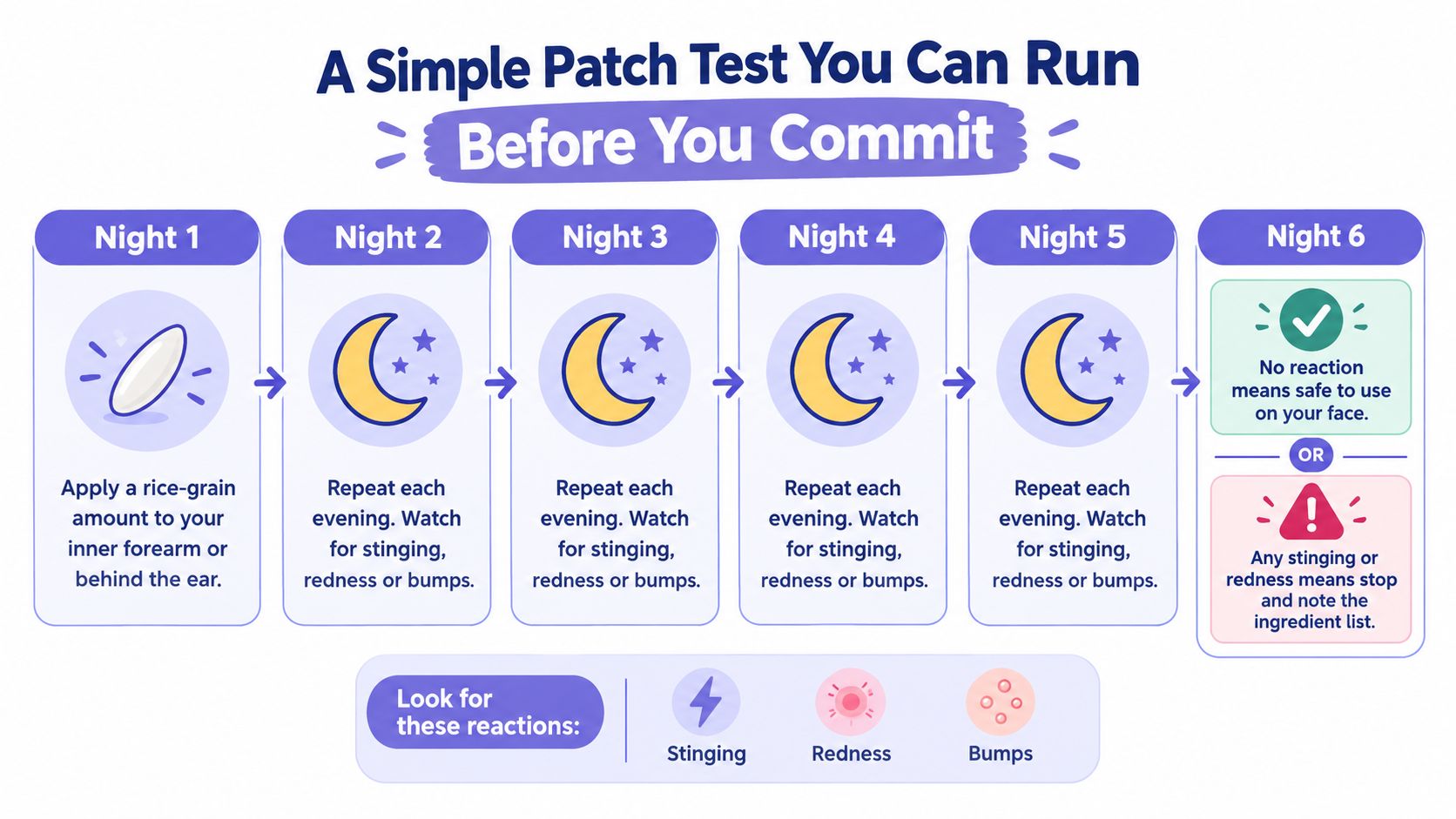
Patch testing is not a guarantee, but it can prevent you from covering your entire face with a product that was never going to suit you. I treat it as a six-night commitment, especially when the sunscreen is expensive or your previous reactions have been intense.
Use a controlled routine
- Choose the inner forearm or the area behind the ear. These sites are convenient, easy to observe, and less exposed to daily cleansing, makeup, and environmental triggers than the face.
- Apply a rice-grain amount of the sunscreen to a small area each evening.
- Leave the area alone and observe it over the next 24 hours.
- Repeat the application each evening through Night 6, unless a reaction appears sooner.
- Note immediate tingling, delayed redness, itching, swelling, or new bumps.
- If the test remains comfortable, try a small amount along the jawline before applying the product across the full face.
Immediate tingling that fades quickly may indicate irritation, while delayed bumps can reflect congestion or a developing sensitivity. Neither response should be ignored just because the product is labelled hypoallergenic. A clean-looking ingredient list can still behave poorly on compromised skin because the vehicle, fragrance precursors, and preservative system work together in ways that aren't obvious from the front label.
Stop using the product and consult a dermatologist if you develop hives, swelling, or persistent burning. Don't repeat a test on the face to prove a point. For a person with a history of contact allergy, formal patch or photopatch testing may provide a more reliable answer than home experimentation.
Your Confident Daily Routine and Final Takeaways
A workable routine doesn't need to be elaborate. In the morning, cleanse gently, apply any compatible hydrating products, moisturise if your skin needs it, and finish with a generous layer of SPF 30 or higher, broad-spectrum face sunscreen. For very reactive skin, begin with a mineral formula, fragrance-free vehicle, and a finish you can tolerate. A tinted option may be preferable if it reduces white cast and encourages daily use.
Reapply during prolonged sun exposure, after swimming, sweating, or towel-drying, and use a powder, stick, or pat-and-press method when makeup makes liquid application difficult. Rosacea-prone skin may benefit from a mineral tint and minimal fragrance exposure. Acne-prone skin usually needs a lighter, non-comedogenic texture. Eczema-prone skin needs barrier consideration and fewer potential triggers. Children need simple mineral protection, practical water resistance, and adult supervision.
I believe adherence beats perfection. A sunscreen with slightly less elegant protection that you apply correctly every day is more protective in real life than a high-SPF product abandoned in a bathroom cabinet. The best choice is the formula that clears your ingredient screen, passes your patch test, feels acceptable on your skin, and remains comfortable enough to reapply.
Screenshot-friendly checklist
- Filter: Start mineral-first with zinc oxide or titanium dioxide if your skin is highly reactive.
- Formula: Choose fragrance-free where possible and inspect preservatives, drying alcohol, botanicals, and the rest of the vehicle.
- Label: Select SPF 30 or higher with broad-spectrum protection. Consider a PA rating such as PA+++ when comparing UVA-focused products.
- Amount: Use the two-finger amount for the face and ears.
- Finish: Choose a tint, fluid, gel, or cream texture you'll wear.
- Timing: Apply 15 minutes before exposure and reapply every two hours during exposure, or sooner after water, sweat, or towel-drying.
- Patch test: Test a rice-grain amount over six nights before full-face use.
- Escalation: Stop and seek medical advice for hives, swelling, or persistent burning.
Find a sunscreen your skin can live with
Healtsy offers pharmacy-focused skincare, facial sunscreens, and products organised around concerns such as sensitive skin, acne, eczema, rosacea, and sun protection. Compare suitable formulas, use the skincare quiz for personalised recommendations, and build a routine you can apply consistently.
Visit Healtsy