


Sun Protection
How to Apply Sunscreen on Face the Right Way
Many reading this are doing what I see at the pharmacy counter every summer. You washed your face, maybe applied a serum, squeezed out a little sunscreen, spread a light veil over your cheeks and forehead, and assumed you were covered. Then the day happened. A coffee run, bright pavement, lunch outside, driving with sunlight on one side of the face, and suddenly that quick morning layer didn't hold up the way you expected.
After 16 years of counselling patients, I believe sunscreen advice often goes wrong. People get pushed toward product hunting when the bigger issue is usually dose and coverage. This is the complete guide to how to apply sunscreen on face in a way that works in real life, with the same practical care I'd give across the counter. I'm certain this will solve the most common mistakes I see because the pattern is always the same: too little product, rushed blending, and forgotten zones.
Why Most People Under-Protect Their Face
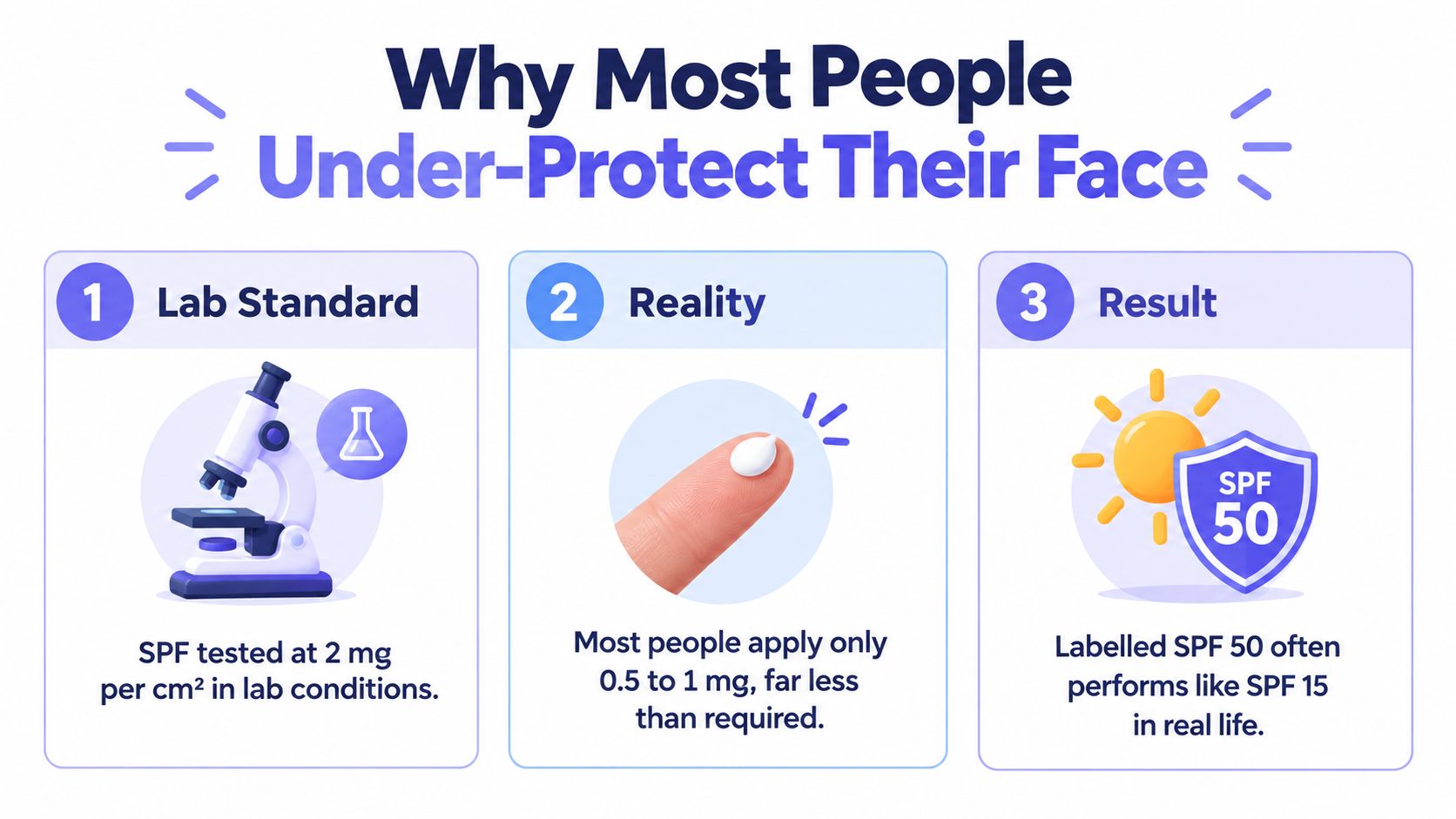
The most common mistake I see isn't choosing the wrong SPF. It's applying a thin, uneven smear and trusting the number on the bottle to do the rest.
In practice, facial sunscreen is a dosing problem first. A practical face-application benchmark is 2 mg/cm², but real-world studies found typical facial application ranging from 0.39 to 0.96 mg/cm². One controlled study reported a median of 0.60 mg/cm² after a single application versus 1.10 mg/cm² after a double-application method, which shows why a second pass can move people closer to the tested thickness, even if they still often fall short of ideal according to this review in Photochemical & Photobiological Sciences.
What this looks like in real life
A patient will often pull a half-used bottle from a handbag and show me how they apply it. It's usually a small amount, rubbed quickly over the centre of the face. The cheeks get something. The forehead gets something. The sides of the nose, temples, jawline, and ears get whatever is left on the hands.
That's why people are surprised when pigment, redness, or burning still happens despite “wearing SPF every day.” If you're also dealing with visible sun damage, treatment options can help, and Athena Plastic Surgery sun damage treatments gives a useful overview of procedures people often ask about after years of inconsistent protection.
Practical rule: A labelled sunscreen can only perform close to its stated SPF when you apply enough of it, evenly, over the whole area you want to protect.
Product choice matters less than people think
I'm not saying formula never matters. Texture, sting, cast, and finish all affect whether you'll use a sunscreen daily. But technique is where protection usually breaks down. If two people use the same excellent formula and one applies a proper film while the other uses a rushed trace amount, they are not getting the same result.
That's why I focus so much on how to apply sunscreen on face rather than chasing a miracle tube.
Preparing Your Skin Before the First Layer
Sunscreen behaves better on skin that isn't slippery, tacky, or overloaded. That sounds simple, but it fixes a lot of pilling complaints.
Start with a gentle cleanse to remove overnight oil, sweat, and residue from the evening before. If you wake up with an intact, comfortable barrier, your sunscreen spreads more evenly and is less likely to catch on flakes or cling to dry patches.
Keep the morning routine calm
After cleansing, use a hydrating layer that suits your skin type. For some people that's a light serum. For others it's a moisturiser. The point isn't to pile on products. The point is to create a smooth base and then give it a brief moment to settle.
If your skin feels irritated, tight, or over-exfoliated, sunscreen often stings more and sits worse. If that sounds familiar, this guide on how to repair a damaged skin barrier is worth reading before you worry about changing sunscreens again.
Related Guide How to repair a damaged skin barrier →What tends to go wrong
Morning routines become messy when too many active products are layered under SPF. I've seen this with strong acids, retinoid residue from the night before, and overly sticky vitamin C textures. The sunscreen then pills, streaks, or migrates around the nose and mouth.
A steadier approach usually works better:
- Clean skin: Remove oil and residue first so the sunscreen can grip the skin rather than slide over it.
- Simple hydration: Use enough moisture for comfort, not so much that the surface stays wet.
- Brief wait: Let each layer absorb before the next one goes on.
If your sunscreen rolls into little flakes, the answer often isn't a new sunscreen. It's less product underneath, more drying time, and gentler spreading.
I believe a stronger actives are kept for the evening and mornings are reserved for cleansing, hydration, and sun protection. That leaves you with a clean, dry canvas across the forehead, cheeks, nose, chin, neck, and ears.
The Right Amount and the Right Motion
If the amount is off, the rest doesn't matter much. Protection gets built here.
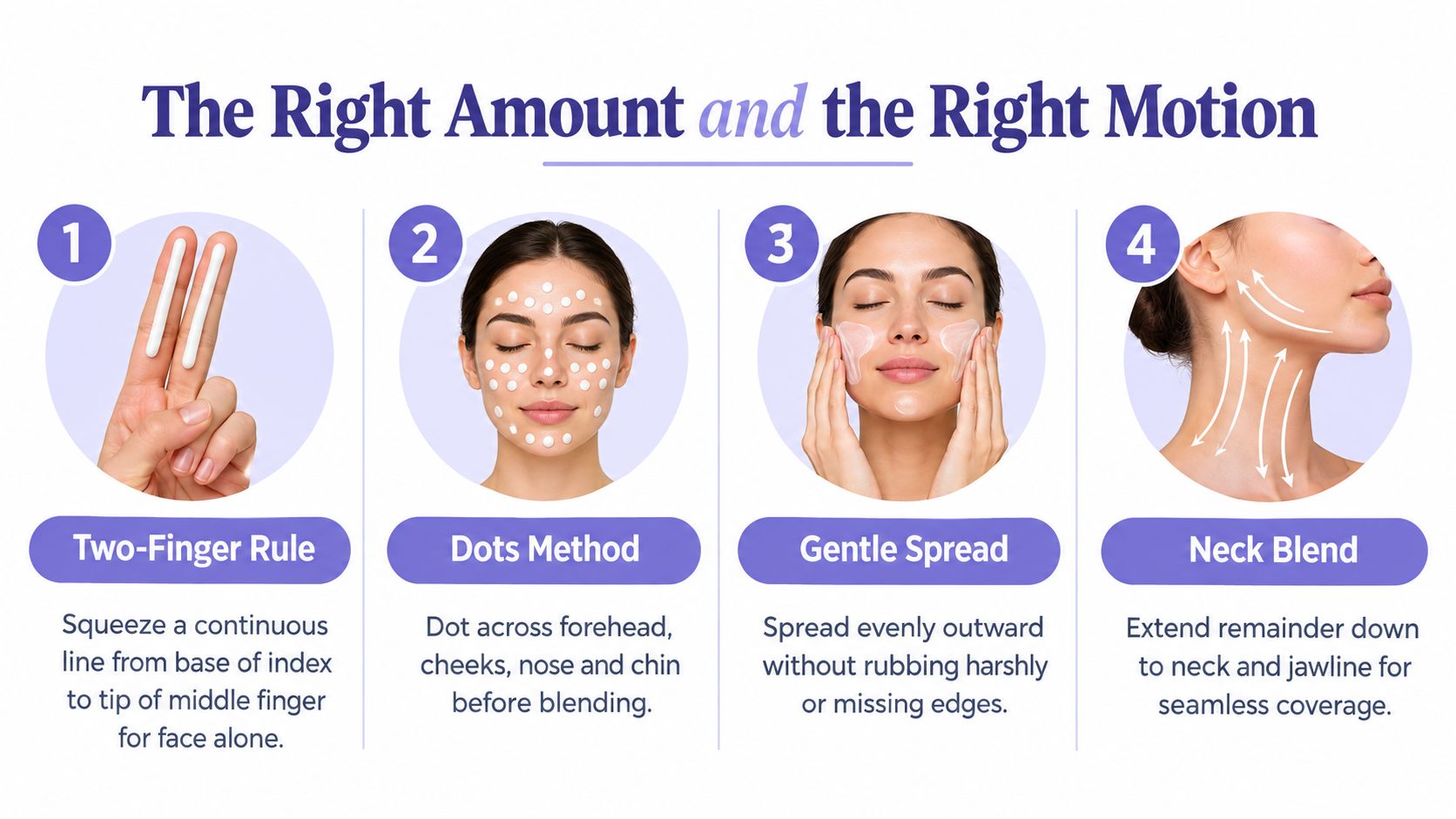
For facial sunscreen, the American Academy of Dermatology says to use at least 1 teaspoon, which it equates to roughly the amount needed to cover the length of your index and middle fingers in its sunscreen application guidance. In day-to-day counselling, that finger-length rule is one of the easiest ways to stop underapplication.
Dose first
If you prefer visual cues, use the two-finger rule as your daily benchmark. Squeeze a continuous line along the length of the index and middle fingers, then apply that to the face. If you're also covering the front of the neck and ears, you may need more depending on face size, beard coverage, and formula texture.
Some people prefer a spoon measure because it feels more exact. Consumer Reports frames facial application as about 1 teaspoon for the face, head, and neck combined in its practical sunscreen dosing article. I find this helpful for patients who consistently use too little because they can picture it more clearly.
Then use the right motion
Don't dump the whole amount in one area and start scrubbing. Warm it lightly between the fingertips, then dot it across the forehead, both cheeks, nose, chin, and front of the neck.
From there, use a press-and-spread motion. Press the product into place, then smooth it outward in short, controlled movements. This usually gives a more even film than vigorous rubbing, and it's kinder to reactive skin.
A hard rub causes three common problems:
- It thins the layer where you first started blending.
- It transfers product into the hands instead of leaving it on the face.
- It triggers pilling if you've layered skincare underneath.
Here's a helpful visual demonstration of technique:
A pharmacist-tested routine
What I've seen work best is a two-pass habit. Apply your full amount carefully. Then use whatever remains on the fingertips for a short second pass over the nose, cheeks, and upper forehead, where people often shear product away while blending.
Counter advice: If your sunscreen disappears instantly, you probably haven't used enough. A proper layer should feel present for a moment before it settles.
That small shift changes the result more than switching brands every month.
The Zones Everyone Forgets
The face isn't a flat sheet. It has folds, borders, curves, and areas where product naturally gets skipped during a rushed morning routine.
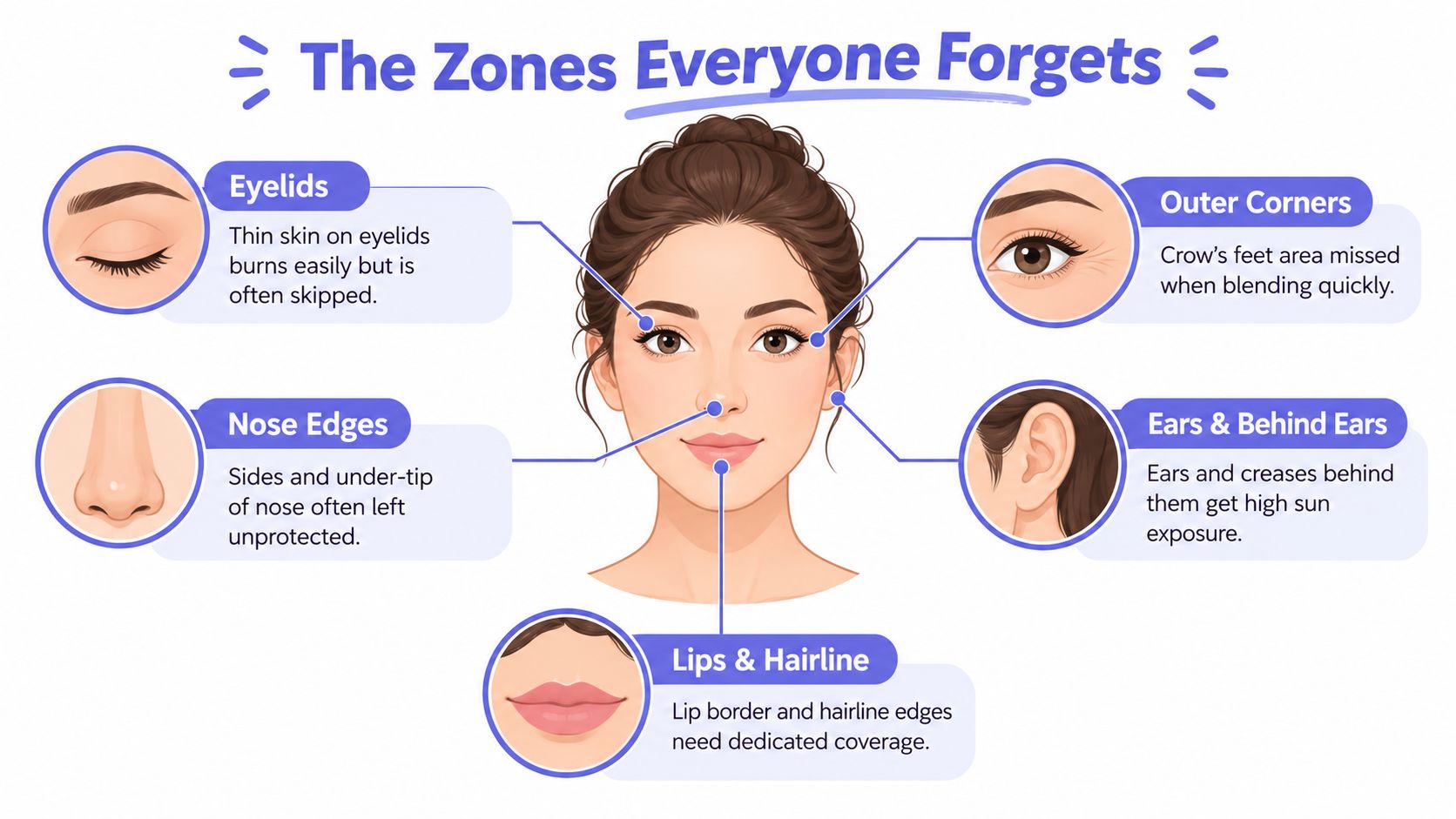
UV-imaging research found that people missed a median of 10% of the whole face during routine application. The eyelid and periorbital area were the most undercovered. One study reported 14% missed in the eyelid region versus 7% in the rest of the face, and another found complete absence of coverage was most common on the lower eyelid margin (84%), upper eyelid margin (82%), medial canthus (71%), and upper eyelid (66%) in this review of sunscreen coverage studies.
The places that need a slower pass
Most missed spots are predictable:
- Eyelids and eye contour: Use the ring finger and pat gently along the orbital area if your sunscreen is suitable there.
- Sides of the nose: Frames and frequent touching make this area easy to miss.
- Hairline and parting: Blend up to the edge, not just to the middle of the forehead.
- Ears: Tops, rims, and the tragus often burn first.
- Jawline and under the chin: Tilt your chin up and check the border in the mirror.
For lips, use an SPF lip product and tap a small amount onto both lips instead of dragging roughly. For the eye area, if a formula stings, switch to one that's better tolerated there rather than skipping the area altogether.
If you want a practical guide focused on lip protection, this sunscreen lip balm article is useful because it addresses a spot people almost always forget.
Related Guide Sunscreen lip balm: protecting a spot everyone forgets →The single most common summer sunburn I hear about on the face and head is still the ears.
A quick self-check
Before you leave the mirror, look straight on, then turn side to side, then lift the chin slightly. That simple check catches patchy blending at the jawline, nostrils, temples, and hairline. It takes a few extra seconds and prevents the most obvious misses.
Mineral or Chemical and What SPF Really Means
People often ask me which type is “better.” The more useful question is which one you'll apply properly, in a full dose, every morning.
How they differ on the skin
From a patient's point of view, mineral filters are often the easier choice for sensitive, reactive, or post-procedure skin. They can feel thicker and may leave a visible cast, but many people appreciate that sturdier, more buffered feel.
Chemical filters usually win on cosmetic elegance. They tend to spread more easily, disappear faster, and sit better under makeup. The trade-off is that some people notice eye sting or warmth, especially around the orbital area.
If textured skin is part of the decision, the Neutralyze textured skin guide is a sensible companion read because finish and slip really do affect whether someone applies enough product.
For a broader breakdown of filter types, this mineral vs chemical sunscreen guide can help you match formula style to skin needs.
Related Guide Mineral vs chemical sunscreen: matching formula to skin needs →Mineral vs Chemical Sunscreen Filters
| Feature | Mineral Filters | Chemical Filters |
|---|---|---|
| Skin feel | Often creamier, denser, more noticeable | Often lighter, more fluid, less visible |
| Best suited to | Sensitive, reactive, post-procedure skin | People who want easier layering under makeup |
| Common drawback | White cast or heavier finish | Eye sting or irritation in some users |
| Application rhythm | Benefits from patient blending in thin sections | Spreads quickly but still needs full, even coverage |
What SPF actually means
The Skin Cancer Foundation explains that SPF testing is based on applying about 2 milligrams per square centimeter of skin, which is why a thin cosmetic layer doesn't give you the same protection as the label suggests in its sunscreen amount explainer.
SPF numbers also have limits. SPF 30 blocks about 97 percent of UVB, while SPF 50 blocks about 98 percent, so the gain is real but smaller as numbers rise. That's why I tell patients not to obsess over chasing the highest number while ignoring broad-spectrum coverage, finish, comfort, and application habits.
I believe the best sunscreen is the one you'll use generously, evenly, and consistently.
Timing, Reapplication and Layering With Makeup
A beautifully applied morning sunscreen can still fail by lunchtime if it isn't timed and renewed properly.
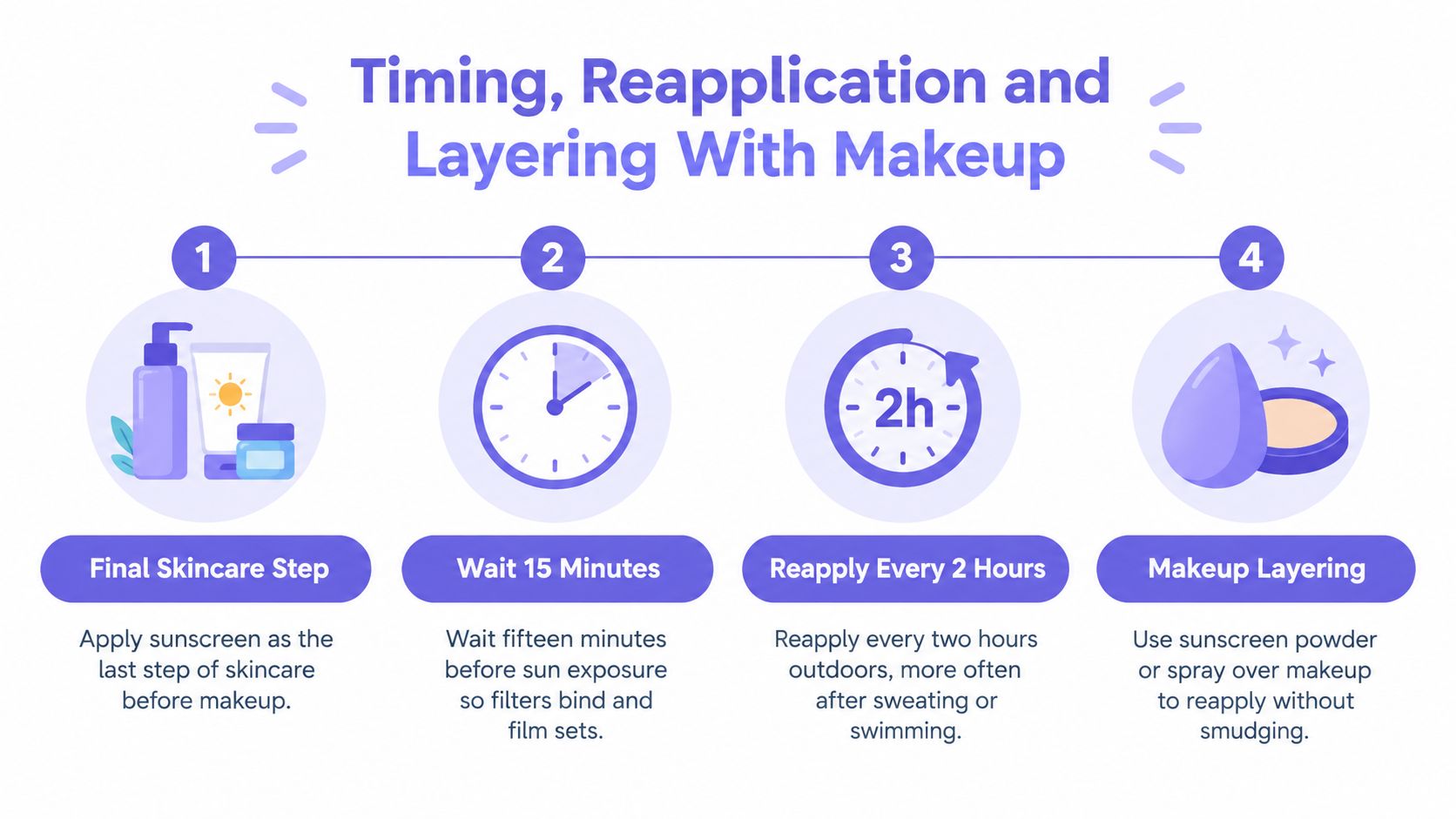
The FDA recommends applying sunscreen 15 minutes before sun exposure and reapplying at least every 2 hours, or more often if you're sweating or swimming in its sunscreen guidance. That timing rule matters because sunscreen needs to form a proper film on the skin before the day starts wearing it down.
The order that works
Use sunscreen as the last step of skincare and before makeup. Serum first, then moisturiser if you need it, then sunscreen. Primer and foundation go on after the sunscreen has had time to settle.
Don't mix sunscreen into moisturiser or foundation to make it “easier.” In practice, that dilutes control over coverage and usually leads to a patchy film.
A realistic day outside
A lot of people apply sunscreen at 8 a.m. and assume they're done. But if your day includes a morning walk, errands in bright light, lunch outdoors, driving, sweat, mask friction, or constant face touching, that original layer won't stay intact.
A simple office-to-outdoor routine looks like this:
- Morning application: Apply as your last skincare step, then let it set before sun exposure.
- Midday check: If you've been outdoors, reapply rather than relying on the first coat.
- After sweat or friction: Reapply sooner if you've been sweating, swimming, or wearing a mask that rubs the nose and cheeks.
If you want a deeper refresher on frequency, this reapplication guide explains when “everyday wear” stops being enough.
Related Guide How often to reapply sunscreen →Reapplication isn't a sign your sunscreen is weak. It's simply how sunscreen works in real life.
Over makeup without making a mess
For makeup wearers, reapplication doesn't need to mean starting over. A stick, compact, or cushioned formula can be pressed onto the T-zone, cheeks, jawline, and ears, then blended with a damp sponge. Pressing works better than rubbing because it disturbs foundation less.
Tinted SPF and powder SPF can also help on office days when your main goal is topping up without moving everything underneath. I've seen this work especially well for people who otherwise skip reapplication entirely because they think makeup makes it impossible.
Your Daily Facial Sunscreen Routine by Skin Type
By the time people reach the pharmacy counter, the usual complaint is not, “I cannot find an SPF I like.” It is, “Every face sunscreen feels wrong by lunchtime.” In practice, that is often a dosing problem first and a skin-type problem second. The formula should fit your skin, but the goal is to get a full, even layer on the face day after day.
A pharmacy-style retailer like Healtsy can be useful for comparing textures across face SPFs, but the routine matters more than chasing a perfect label.
If your skin is oily or acne-prone
Choose a lighter fluid, gel-cream, or matte-finish lotion that lets you apply a full dose without feeling coated. If the sunscreen pills, slides, or turns greasy within an hour, the base underneath is often the issue. Cut the morning skincare back to what you need for comfort, then let the sunscreen do the main protective work.
If breakouts are part of the picture, this sunscreen for acne-prone skin guide is a good place to compare textures that are easier to keep using. I also advise blotting before reapplication rather than adding powder too early, because powder can dull shine while leaving you under-covered.
Related Guide Sunscreen for acne-prone skin →If your skin is dry, mature, or easily dehydrated
Dry skin usually tolerates a creamier sunscreen better, especially around the cheeks, under-eyes, and sides of the mouth where product tends to catch. A light hydrating layer underneath can help, but too much skincare reduces grip and makes it harder to spread the right amount evenly.
I have seen this routine work well. Apply moisturiser sparingly, wait until the skin no longer feels wet, then put on the full sunscreen dose in a deliberate pass. Comfort matters here because dry skin often leads people to use less than they need.
If your skin is sensitive or combination
Sensitive skin often does better with fragrance-free formulas and fewer extra actives underneath. Mineral sunscreens can be easier around the eyes for some people, although the trade-off is that richer mineral textures may need more careful blending at the hairline, brows, and jaw.
Combination skin needs a split approach. Use a thinner layer of moisturiser, or none, on the T-zone if you get shiny there, and give the drier outer face a little more cushion underneath. The sunscreen dose stays the same. What changes is how you prepare the different areas so you can still get even coverage.
Here is the routine I give patients who want something practical and repeatable:
- Cleanse without stripping: Remove overnight oil, sweat, and residue so sunscreen sits evenly.
- Prep only where needed: Use enough moisturiser for comfort, not so much that the sunscreen slips.
- Measure your dose: Aim for a full facial amount rather than estimating by feel.
- Apply in sections: Forehead, cheeks, nose, chin, then neck and ears, so coverage stays even.
- Use controlled motions: Press on, then spread to the edges instead of sweeping most of the product into the centre.
- Check your weak spots: Sides of the nose, hairline, around the brows, jawline, and ears.
- Adjust the texture, not the amount: Skin type changes the vehicle you tolerate best, not the protection your face needs.
That is the routine I trust because it closes the gap between the lab standard and what people manage in real life. Better face protection usually comes from better coverage and a repeatable dose, not from switching products every few weeks.
Find a face SPF you'll actually reach for every morning
Compare textures and finishes across face sunscreens at Healtsy, then put this dose-and-coverage routine to work.
Explore the Healtsy guides