


What Is the Difference Between UVA and UVB Rays
UVA spans 320–400 nm and is the longer-wave ray that penetrates the skin, contributing to ageing and tanning, while UVB spans 280–320 nm and is the shorter, higher-energy ray that burns the skin's surface. Both can damage skin, so effective protection must cover both.
The popular advice that “UVA ages and UVB burns” is useful, but incomplete. It can leave you thinking that avoiding redness means you've avoided harm, or that a high SPF automatically shields you from every kind of ultraviolet exposure. In my 16 years working in pharmacy and advising people on skincare, I've seen how easily that misunderstanding shapes daily routines.
I believe the most helpful way to understand what is the difference between UVA and UVB is to connect the science with ordinary moments. A car journey, a cloudy walk, a desk beside a window, and a sunny holiday don't expose your skin in exactly the same way.
This is the complete guide to UVA and UVB, including where each ray reaches, what it does, how it relates to sunburn and long-term change, and how to read sunscreen labels without relying on one number. I'm certain it will solve the confusion that often surrounds SPF and broad-spectrum protection.
Why You Can Damage Skin Without Ever Burning
You can accumulate meaningful skin damage without seeing a single patch of redness. A long drive on a bright winter morning or a daily commute under cloud may leave your skin looking normal, while UVA continues to reach it. UVA is the quieter part of sun exposure because it doesn't produce the obvious immediate warning of a burn.
UVA has the longer wavelength, penetrates more, and is linked with tanning, pigmentation, and photoageing. UVB has the shorter wavelength, carries more energy per photon, and is strongly associated with sunburn and surface injury.
I often explain this to someone who says, “I don't burn, so I don't need sunscreen every day.” Skin tone, tanning response, and individual sensitivity all differ, but the absence of redness doesn't prove the absence of exposure. A person sitting beside a window or driving with one side of the face closer to the glass may notice gradual uneven tone or pigmentation rather than an acute burn.
The everyday exposure people overlook
UVA is the dominant type of ultraviolet radiation reaching Earth's surface. It represents roughly 90%–95% of incoming ultraviolet radiation, while UVB accounts for about 5%–10%, as described in this review of UVA and UVB biology (review of UVA and UVB radiation).
That doesn't make UVB unimportant. UVB is the band most likely to make your skin sting, redden, and peel after too much sun. UVA, however, is present more consistently across the day and year, so ordinary exposure can add up even when you aren't at the beach.
Practical rule: A lack of sunburn tells you very little about the amount of UVA your skin has received.
The right question isn't “Which ray should I fear more?” It's “Does my protection cover both?” That shift helps you choose a sunscreen based on balanced protection rather than the largest SPF figure on the bottle.
Wavelengths and How Deep Each Ray Reaches Your Skin
Wavelength is the first piece of the puzzle. UVA covers approximately 320–400 nm, while UVB covers approximately 280–320 nm (wavelength and biological differences between UVA and UVB). The shorter UVB waves carry more energy per photon, while the longer UVA waves travel farther into skin tissue.
A useful analogy is the sea. Think of UVA as long, rolling ocean swells that move farther inland, while UVB is shorter, sharper chop that strikes the shoreline with greater intensity but doesn't travel as far. It isn't a perfect physical model, but it gives you the essential idea: wavelength influences how radiation interacts with skin.
A simple skin-layer map
Your skin isn't a single flat surface. For this topic, picture three broad levels:
The outer layer, where UVB deposits much of its energy and where sunburn begins.
The deeper layer containing structures affected by UVA exposure, including collagen and elastin.
Tissue beneath the dermis that longer-wave UVA can reach in some circumstances.
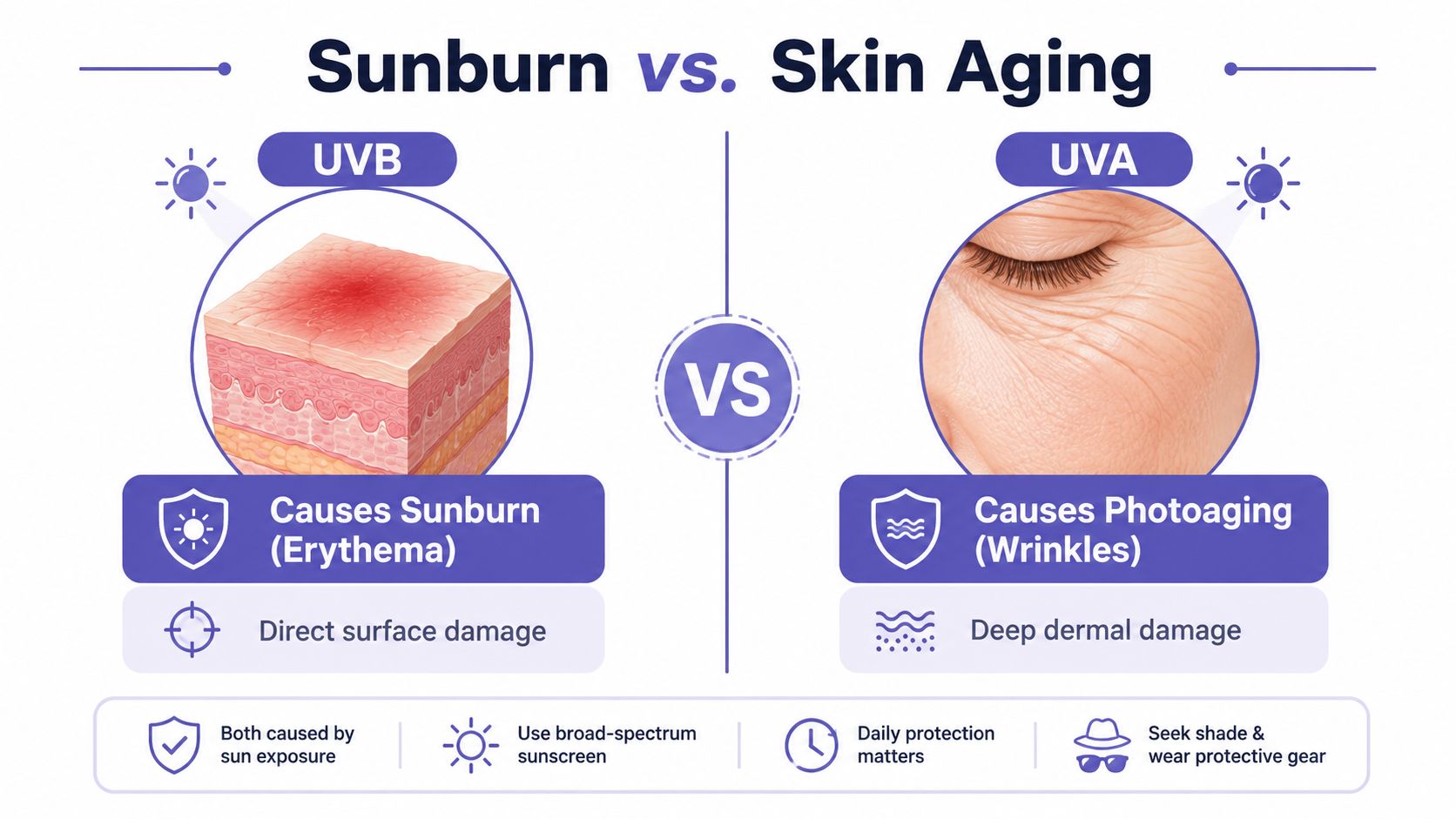
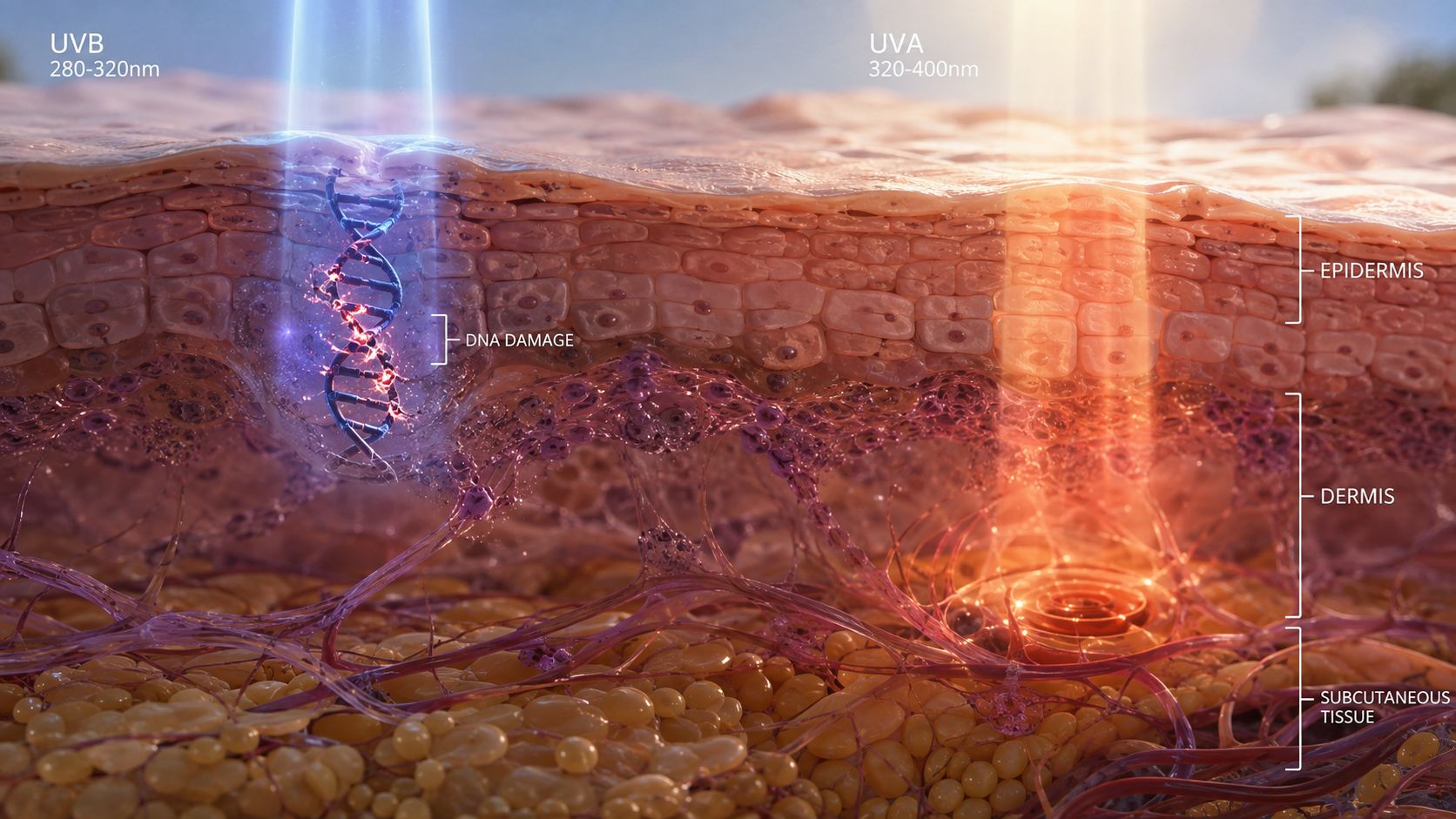
The FDA explains that UVB mainly reaches the epidermis, whereas UVA can penetrate into the dermis (FDA explanation of ultraviolet radiation). The longer UVA wavelength is one reason it can travel deeper into the skin, reaching the dermis and even subcutaneous tissue, while UVB is absorbed more superficially.
Why depth changes the type of damage
UVB concentrates energy close to the surface. That exposure activates inflammation, which is why skin becomes hot, tender, and red after too much sun. UVA reaches further and is associated with oxidative stress, a process that can affect lipids, proteins, and DNA in deeper layers.
This is also why people sometimes compare mineral and chemical products without considering the actual protection offered by the finished formula. If you're exploring how mineral filters work, this guide to what mineral sunscreen is can help, but the label still needs to indicate coverage appropriate for both UVA and UVB.
The practical takeaway is easy to remember: the burn you feel and the damage you don't feel can occur in different layers of the skin. Surface comfort isn't a complete measure of protection.
Sunburn Versus Skin Ageing and What Each Ray Really Does
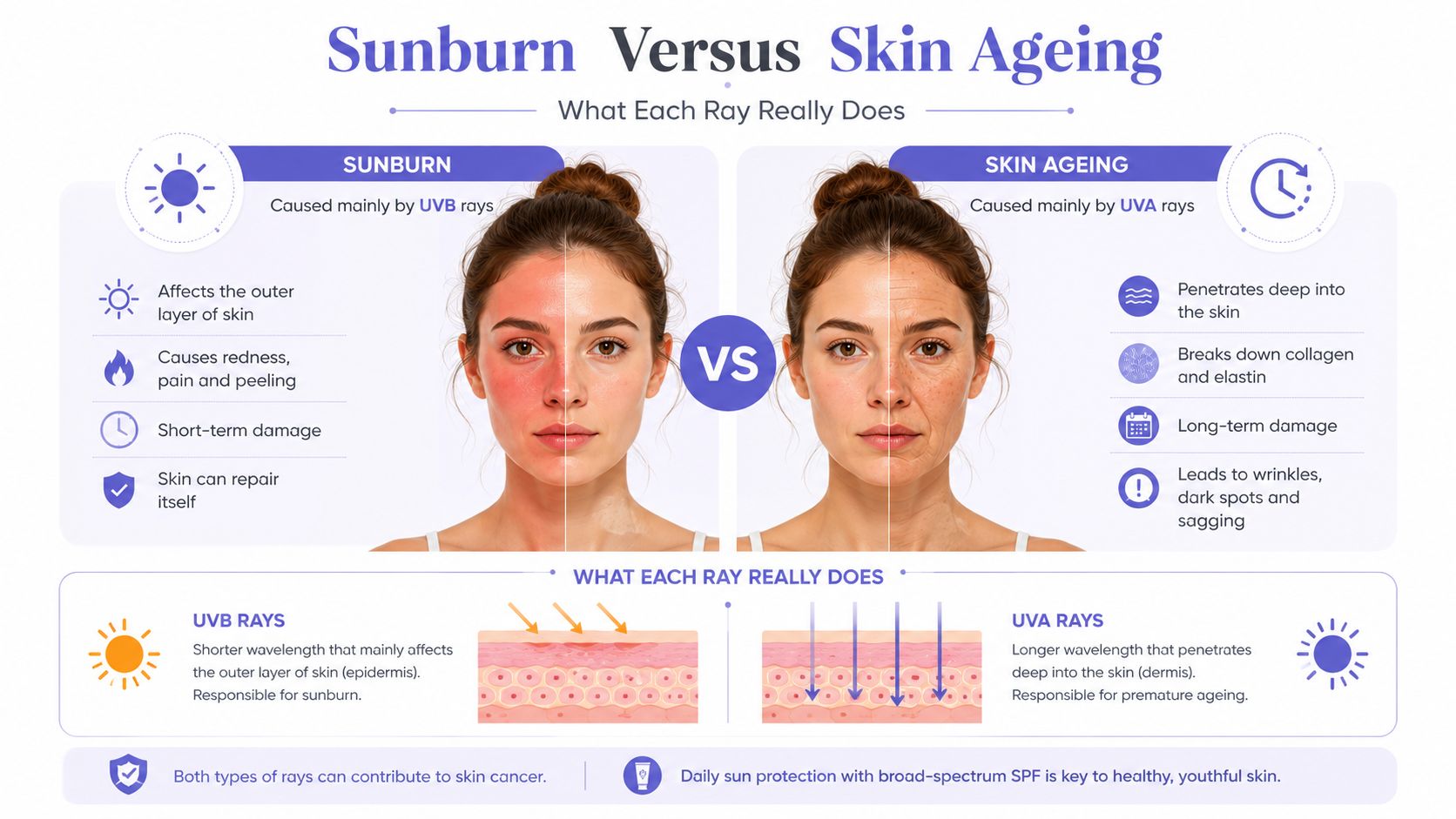
UVB announces itself. After too much exposure, the skin may become red, warm, sore, and sensitive. This reaction is called erythema, and UVB is strongly linked to it because the band concentrates energy near the skin's surface (research on UVA, UVB, pigmentation, and photoageing).
UVA behaves differently. It can generate reactive oxygen species that oxidize lipids, proteins, and DNA. Over time, that oxidative stress contributes to photoageing, uneven tone, wrinkles, and pigmentation changes, including immediate pigment darkening and deeper melanogenesis.
The comparison at a glance
| Feature | UVA | UVB |
|---|---|---|
| Wavelength | About 320–400 nm | About 280–320 nm |
| Share of UV at ground level | Roughly 90%–95% | Roughly 5%–10% |
| Main penetration | Dermis and deeper tissue | Mainly epidermis and upper dermis |
| Main acute effect | Tanning and pigmentary change | Erythema and sunburn |
| Main long-term effect | Photoageing, uneven tone, and oxidative stress | Direct DNA injury and contribution to skin cancer |
A familiar real-life example is the driver who notices more pigmentation, fine lines, or uneven tone on the side of the face closest to the window. Another is the person whose holiday tan fades but leaves darker marks behind. These changes don't necessarily arrive with the dramatic pain that follows a UVB-heavy burn.
You can also watch this visual explanation of how UVA and UVB affect the skin:
“Less energetic” doesn't mean harmless
UVA is less energetic per photon than UVB, but it reaches the skin in much larger amounts and travels deeper. That combination makes it highly relevant to cumulative ageing and pigmentation. If you're building a routine around long-term skin appearance, this overview of how to prevent the signs of ageing offers useful context, but the protection principle remains the same: don't trade UVA coverage for a high UVB number.
How UVA and UVB Each Contribute to Skin Cancer
Both UVA and UVB can contribute to skin cancer, but they damage cells through different routes. UVB is absorbed more directly by DNA and is efficient at producing specific forms of photodamage, including cyclobutane pyrimidine dimers and thymine dimers. Those lesions can create mutations when damaged cells reproduce.
NIH-based material describes UVB as overlapping with DNA and protein absorption spectra and as the main contributor to direct photochemical DNA damage, while UVA is weakly absorbed by DNA but strongly involved in oxidative free-radical damage (NIH overview of ultraviolet radiation and skin cancer mechanisms).
Two pathways, one protection need
- UVB: Delivers concentrated energy near the surface and directly damages DNA, helping initiate abnormal cellular changes.
- UVA: Reaches deeper layers and creates reactive oxygen species that can oxidize DNA, proteins, and other cellular components.
- Both bands: Contribute to cumulative biological stress, which is why broad-spectrum protection matters.
One review estimates that UVA may require around 1000-fold higher doses to trigger similar mutagenic effects to UVB. That figure shouldn't be interpreted as permission to ignore UVA. It shows that energy, dose, penetration, and biological mechanism all matter when assessing risk.
Why burning easily isn't the only question
People with darker skin tones may be less likely to develop visible redness after some exposures, but that doesn't make UVA-related pigmentation or cumulative deep-skin damage irrelevant. Someone managing melasma, post-inflammatory marks, or uneven tone may care more about preventing pigment changes than avoiding a painful burn.
I don't want this information to make anyone fearful of normal outdoor life. I want it to make protection more intelligent. A tan isn't a guarantee that skin has been protected, and avoiding burns isn't the same as avoiding ultraviolet injury.
Seasons, Latitude, and Why UVA Never Takes a Day Off
Sun protection isn't only a summer or beach-day concern. The atmosphere filters ultraviolet radiation unevenly, and that difference helps explain why UVA remains relevant during ordinary activities throughout the year.
The WHO states that all UVC and most UVB are absorbed by ozone and other atmospheric components, while UVA isn't filtered as significantly and reaches the surface in much larger amounts (WHO explanation of ultraviolet radiation and ozone filtering). This uneven filtering changes the balance of rays that reach ground level.
What changes with the sun's position
UVB varies more with solar angle and atmospheric filtering. It tends to be more influential when the sun is higher, particularly around the middle of the day, during summer, and at lower latitudes. That's why a beach holiday near the equator can bring a much greater risk of rapid sunburn than a cool winter morning in a northern city.
UVA is steadier by comparison. A grey sky doesn't remove it, and a cooler temperature doesn't tell you that your skin is safe. The same applies to a winter walk, a school run, or a commute when the sun feels weak.
A cool day can still be a skin-exposure day. Temperature is not a reliable guide to ultraviolet intensity.
Windows and reflective surroundings
UVA remains relevant around windows, including a car or office seat. Glass can reduce some ultraviolet exposure, but it isn't sensible to treat every window as a complete barrier against UVA. Snow and other bright surfaces can also reflect radiation, which matters during winter sports.
For a practical routine that combines sunscreen with shade, clothing, and sensible timing, see this guide to sun protection. I believe daily protection makes the most sense when you connect it to your actual schedule, not just the forecast.
Reading Sunscreen Labels and Why SPF Alone Is Not Enough
The number that looks most reassuring on a sunscreen bottle may answer only one question. SPF primarily measures UVB protection, especially the protection that delays UVB-related redness and sunburn. It does not, by itself, show how well the product protects against UVA.
That distinction matters in ordinary situations. You can drive without developing a visible burn while UVA still reaches exposed skin through daylight and contributes to deeper penetration, photoageing, and pigmentary change. A high SPF can therefore reduce burning without providing equally strong UVA protection.
What broad-spectrum tells you
Broad-spectrum means the product is intended to protect against both UVA and UVB. The wording and symbols used to show UVA performance differ between markets. In UK and EU-linked guidance, an SPF 30 product should have a UVA protection factor of 10 or more, as described in this BBC coverage of SPF and UVA labeling confusion.
A UK survey found that one in five adults did not know SPF fails to cover all sun damage. The finding was reported in the same BBC coverage. The confusion is understandable because SPF is often the largest, clearest number on the package, even though it is not a complete summary of protection.
The market is also changing. FDA filter approvals have progressed for bemotrizinol in 2026, a broad-spectrum filter that absorbs both UVA and UVB, as covered by that source. Newer filters may give manufacturers more formulation choices, but the practical habit stays the same: read beyond SPF.
A more sensible shopping question
I would check four things before buying:
- Does the label clearly state broad-spectrum protection?
- Does it provide meaningful UVA information for your market?
- Is the texture comfortable enough for regular application?
- Can you reapply after sweating or swimming?
If filter types are confusing, this mineral versus chemical sunscreen guide explains the categories in practical terms. During bright commutes, sunglasses can add physical coverage. These polarized sunglasses recommended by Style Site Optical may also help reduce glare as part of a broader protection routine.
Your Daily Protection Plan for Both UVA and UVB
After 16 years advising customers, I believe the strongest routine is the one you can repeat without resentment. Use broad-spectrum SPF 30 or higher for daily exposure, apply enough to cover exposed skin, and reapply after sweating or swimming.
Windows deserve attention too. If you drive, work beside glass, or spend long periods near bright windows, remember that UVA exposure can remain relevant even without a burn. Children, babies, people with sensitive or acne-prone skin, and people with darker skin tones may need different textures or routines, but everyone benefits from protection suited to their circumstances.
A checklist for real mornings
- Choose broad-spectrum SPF 30+: Look for protection against both UVA and UVB.
- Apply generously: Studies show many people apply less than the recommended amount, so cover the face, ears, neck, and other exposed areas carefully.
- Reapply when conditions change: Sweat, swimming, towel drying, and prolonged outdoor time all call for renewed coverage. This guide explains how often to reapply sunscreen.
- Add physical barriers: Sunglasses, shade, protective clothing, and a wide-brimmed hat reduce reliance on sunscreen alone. If you're looking for a practical accessory, this velvet lined sun hat guide from Pandemonium Millinery offers one option to consider.
I'm certain these habits can solve the daily-damage problem without turning sun care into a lecture. Choose protection you'll use, keep both UVA and UVB in mind, and adjust the routine for your commute, windows, children, sport, and skin concerns.
Make Broad-Spectrum Protection Easier
Healtsy offers pharmacy-focused skincare, sunscreen, and other health and beauty products for routines built around concerns such as pigmentation, sensitivity, acne, and daily sun exposure. Explore dermatologist-approved SPF options and choose products that make broad-spectrum protection easier to maintain.
Shop Healtsy