


You leave home with sunscreen on, then catch your reflection in a shop window before lunch: your forehead and nose are shiny, your glasses keep slipping, and you're reaching for blotting paper. If that's familiar, you may be looking for a protetor solar oil control product that feels comfortable enough to use every day.
I'm a pharmacist with 16 years of experience in the sector, and I believe the most useful guidance I can offer is to separate a sunscreen's finish from its protection. This is the complete guide to choosing and using an oil-control sunscreen: how the finish works, what to check on the label, which textures may suit your skin, and how to apply enough without making your face feel heavy. The aim isn't to find a promise on the front of the pack. It's to choose protection you'll wear properly.
Why Oil Control Sunscreen Matters for Shiny Skin
A common routine problem goes like this: you apply sunscreen before your commute, then your forehead looks slick by the time you sit down at work. You blot, powder over it, or decide to use less the next morning. That discomfort matters because a sunscreen that feels unpleasant can be harder to wear consistently.
But oil control is a formulation and wearability category, not a separate protection standard. The label generally points to a lighter feel, a less shiny finish, or a formula positioned for oily and combination skin. It doesn't mean that the sunscreen provides stronger ultraviolet protection than another product with the same tested SPF and UVA performance.
Why sun protection still comes first
Sunscreen protects against ultraviolet radiation, which is a significant public-health concern. The World Health Organization reported more than 1.5 million skin-cancer cases and over 120,000 associated deaths worldwide in 2020. That total included approximately 1.2 million non-melanoma skin cancers and 325,000 melanomas of the skin, according to the WHO's ultraviolet radiation guidance.
The WHO recommends broad-spectrum sunscreen on exposed skin that clothing can't cover, alongside shade, protective clothing, and less time in the midday sun. Its advice is to choose broad-spectrum protection at SPF 30 or higher and reapply about every two hours, especially after sweating, swimming, exercising, or playing outdoors.
The real value of a comfortable finish
For someone with oily skin, a matte finish can make daily sunscreen feel more manageable. That's a practical benefit, not a measure of UV performance. If you're comparing a light fluid with a richer cream, look beyond the words “dry touch” or “anti-shine” and check the protection claims and directions.
A useful shopping question is: Will this feel comfortable when I apply enough of it? Then check broad-spectrum coverage, SPF, any water-resistance instructions, and whether the finish works with your routine. That framework is more dependable than treating “oil control” as proof of extra protection.
How Oil Control Sunscreens Actually Work
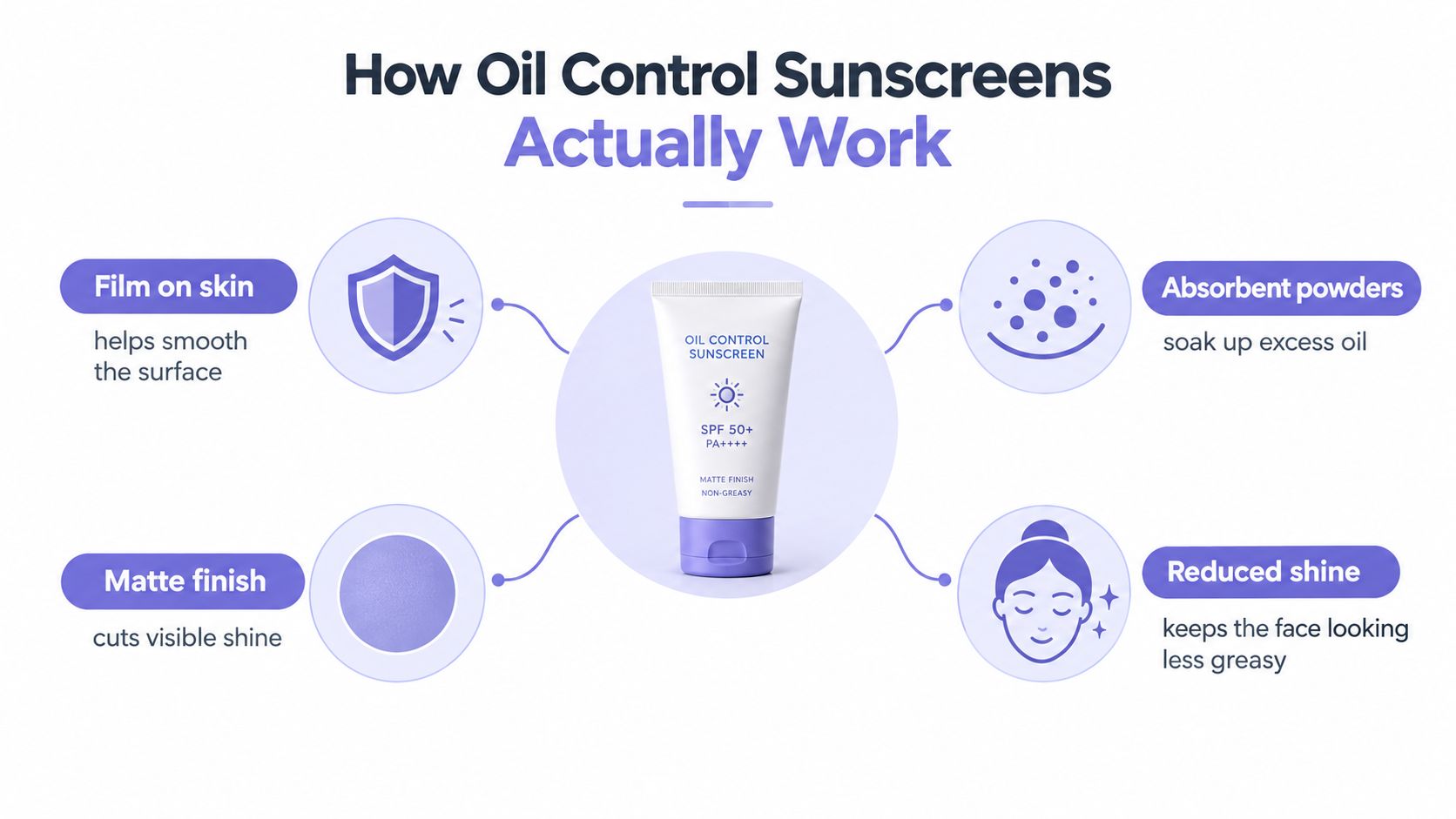
Think about the difference between wiping oil from a surface and changing how much oil the surface produces. A mattifying sunscreen can reduce visible shine by forming a particular film on the skin, using absorbent powders, or relying on a lighter-feeling texture. That doesn't establish that it changes your baseline sebum production.
When you read “oil control,” ask what result the claim appears to describe. Immediate mattifying, fewer blotting episodes, and measurable reduction in sebum are different outcomes. A formula may look less shiny after application without proving that your skin produces less oil over time.
What the finish can tell you
A product's texture and film can affect how it looks and feels as you apply it. Absorbent ingredients can help reduce surface shine, while a light fluid may feel less occlusive than a richer cream. These are useful cosmetic properties, but they don't tell you how the product performs on your skin later in the day or whether it changes oil output.
That distinction matters if you're judging a sunscreen by a quick test on the back of your hand. One clinical-trial protocol assesses oiliness, shine, pore appearance, hydration, and skin-barrier integrity separately, with measurements at 12 hours, 7 days, and 28 days. It uses Sebumeter readings and includes adults with instrument-confirmed oily skin of at least 100 μg/cm²; those details are available in the trial record. A protocol isn't a result, so don't read it as proof that a particular sunscreen reduces sebum.
Practical rule: A matte look describes how the sunscreen wears. It doesn't switch off your oil glands.
Don't trade comfort for an overly dry finish
If you have acne-prone skin or use retinoids, an aggressively mattifying product may feel tight, sting, or add to dryness. The aim is a non-greasy sunscreen you can tolerate, not the driest finish you can find. A dermatology review recommends pleasant, aqueous, non-greasy textures and discusses sunscreen use alongside acne therapies; for a related explanation of filter types, see this guide to mineral versus chemical sunscreen.
Pay attention to your skin after the product settles. If the surface looks less shiny but feels uncomfortable, or you find yourself using too little, it isn't solving the daily-use problem. A balanced finish that lets you apply a full layer is usually a more sensible choice than a formula that feels perfect for a few minutes and unpleasant after that.
Reading the Label on a Mattifying Sunscreen
Start with the protection information, not the finish claim. SPF primarily describes protection against sunburn, which is mainly associated with UVB radiation. It doesn't tell the whole story about UVA protection, so read the product's UVA information separately. For a fuller explanation of the distinction, see this guide to UVA and UVB.
European sunscreen labels use a separate UVA symbol and protection categories such as low, medium, high, and very high. The European Commission explains that the UVA logo indicates a quantified minimum level of UVA protection that rises in parallel with the product's SPF, based on a standardized test method. In the European framework, the recommended UVA protection level is linked to SPF through a minimum UVA-to-UVB protection ratio of approximately 1:3. The Commission also cautions that no sunscreen provides complete or total protection, as explained in its consumer guidance on sunscreen labelling.
A pharmacy-aisle label check
A product can say “matte,” “dry touch,” and “SPF 50,” but those terms don't mean the same thing. SPF is a sunburn-protection rating, the UVA symbol communicates a separate protection claim, and oil-control wording generally describes finish or sebum-management positioning. Water-resistance instructions and directions for use are also part of the decision.
| Label element | What it tells you | Why it matters for oily skin |
|---|---|---|
| SPF | The stated sunburn-protection rating, mainly relating to UVB | Helps you compare protection claims, but doesn't describe finish |
| UVA marking | A separate indication of UVA protection | Keeps a matte claim from being mistaken for complete UV coverage |
| Water-resistance wording | Whether the product has water-resistance directions on its label | Helps you choose for swimming, sweating, or outdoor activity |
| Application instructions | How the manufacturer directs you to use the product | A comfortable texture still needs to be applied as directed |
| “Oil control” or “matte” | Cosmetic finish or sebum-management positioning | Helps you judge feel, but doesn't replace SPF or UVA information |
When comparing products from different markets, read the complete label rather than comparing SPF numbers alone. Finish, SPF, and UVA information each answer a different question. If you're uncertain about a claim or direction, rely on the product's actual packaging rather than guessing from a marketing phrase.
Choosing the Right Texture for Oily and Acne-Prone Skin
Texture is often the deciding factor. A sunscreen may have the protection information you want, but if it feels greasy, pills under makeup, or makes your skin uncomfortable, you may apply too little or skip it later. The American Academy of Dermatology recommends that people with oily skin look for a moisturizer with broad-spectrum sunscreen at SPF 30 or higher. For people prone to breakouts, it advises considering products with zinc oxide or titanium dioxide and avoiding formulas containing fragrance or oils, as described in its guidance for oily skin.
Compare the feel, not just the name
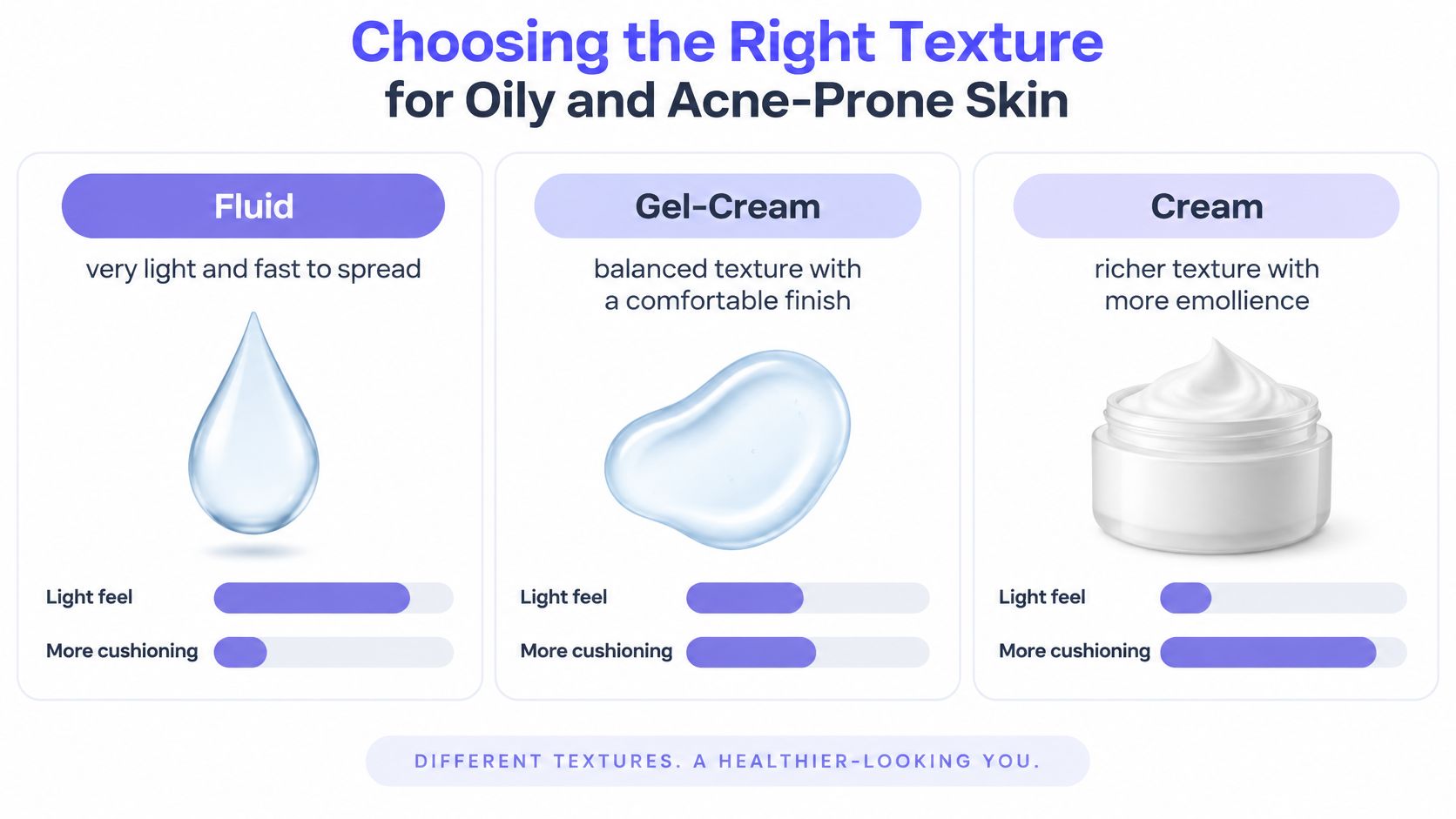
A fluid spreads easily and may suit someone who dislikes a noticeable layer. It's worth checking whether the finish stays comfortable once you've applied enough, rather than judging from a small dab.
A gel-cream can be a middle ground for combination skin: lighter than a rich cream but with more cushioning than a very thin fluid. If your cheeks feel tight while your forehead gets shiny, a balanced texture may be more comfortable than a formula designed to feel extremely dry.
A cream can suit skin that needs more emollience, even if the T-zone tends to shine. Oily skin doesn't automatically mean every part of the face prefers the lightest formula. Let comfort and how the product behaves across your whole face guide you.
For breakout-prone skin, consider the full ingredient list and your own tolerance. The words “oil control” don't guarantee that a formula is non-comedogenic or suitable for sensitive skin. You can also compare routine compatibility in this overview of sunscreen for acne-prone skin.
The useful compromise
The right texture is the one that makes full, consistent application realistic. A lightweight fluid or gel-cream may help if a heavy product puts you off using enough, while a richer texture may be preferable if the lightest options leave your skin feeling uncomfortable. Don't pursue a powder-dry finish at the expense of stinging, tightness, or a routine you can't maintain.
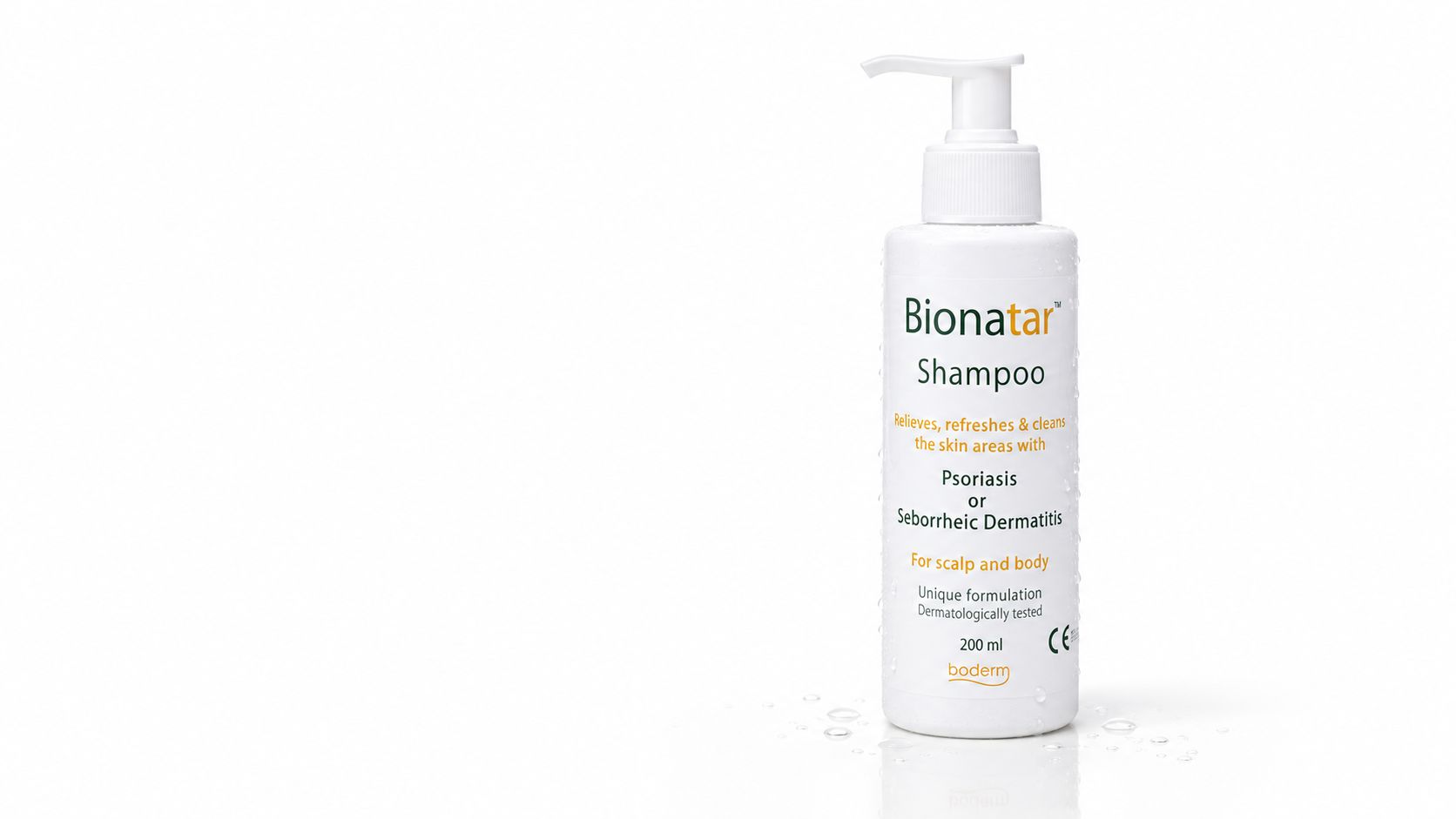
A separate scalp-care example shouldn't be mistaken for face sunscreen advice: Boderm Bionatar Shampoo - 200ml is described as a shampoo developed for exfoliation, cleansing, and soothing of the scalp and skin in people experiencing symptoms of psoriasis or seborrheic dermatitis. It's a different product category, with a different purpose.
Applying and Layering Without the Shine
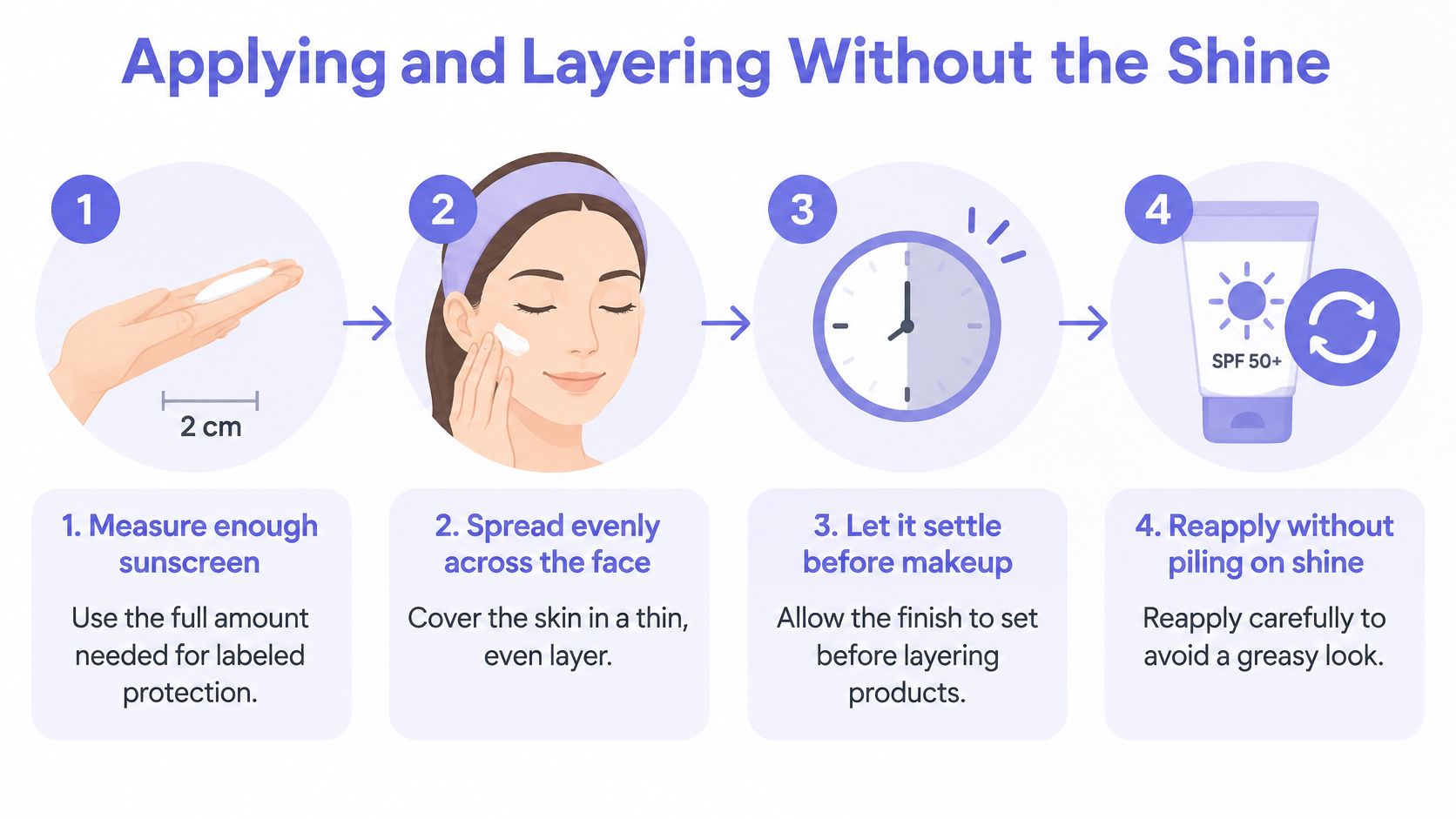
The amount you apply affects the protection you get. In the United States, the FDA's SPF test uses a defined application amount of 2 mg/cm² and compares the ultraviolet exposure needed to produce sunburn on protected skin with the amount needed on unprotected skin. That's a controlled test application, not a thin cosmetic layer. The FDA's sunscreen testing guidance explains the procedure.
If you deliberately use less to avoid shine, you shouldn't assume you're getting the labelled SPF performance. Instead, choose a finish you can apply evenly and follow the product directions.
Make the morning layer work
Apply moisturizer first if your routine needs it, then sunscreen as the final skincare layer before makeup. If your sunscreen already feels moisturizing enough, you may not need to add a separate moisturizer beneath it. Let the layers settle before applying makeup, especially if you've had problems with pilling.
Spread sunscreen evenly across the face, neck, and ears. Don't stop at the forehead and cheeks: the edge of the jaw, hairline, and ears are easy to miss when you're rushing. Use the product's directions to judge the amount, and make sure the layer covers the skin rather than disappearing after a quick swipe. This face sunscreen application guide offers another practical reference.
Reapply in a way you'll stick with
A commute, lunch outside, and an afternoon walk can mean your morning application isn't the last step. Reapply according to the product directions after sweating, swimming, or prolonged outdoor exposure. The WHO also advises reapplication about every two hours, particularly after sweating or swimming, as noted in the earlier section.
Over makeup, avoid rubbing a thick layer across the face if that makes you abandon reapplication. Work in manageable sections and gently press or smooth the sunscreen in a way that keeps the coverage even. If you're outdoors for an extended period, prioritise getting the product back onto exposed skin; preserving a freshly powdered finish isn't the main goal.
The best application strategy is the one that leaves an even layer on your skin, not a perfect-looking sunscreen streak on your hand.
Common Myths About Oil Control Sunscreen
Myth: A matte finish means my skin will produce less oil. It doesn't. A product can make shine less visible through its film, absorbent ingredients, or texture without changing baseline sebum output. If your main concern is looking shiny by midday, assess the finish and how long it stays comfortable. Don't assume a cosmetic claim proves a lasting change in oil production.
Myth: A high SPF makes a small amount enough. It doesn't. SPF testing uses a defined application, so applying a very thin layer to avoid shine can mean less protection than the labelled rating suggests. Pick a product you can apply evenly and follow its directions. For reminders about timing, use this guide to how often to reapply sunscreen.
Compare products by evidence, not origin
Myth: European sunscreens are automatically stronger or safer. A product's country of origin doesn't replace checking its label, protection claims, directions, and suitability for your skin. A 2025 review discusses newer filters used in international markets, including bemotrizinol, bisoctrizole, drometrizole trisiloxane, and terephthalylidene dicamphor sulfonic acid. Several remain unavailable in the United States because of regulatory delays, according to the review of international sunscreen filters. That difference is relevant to availability and formulation, but it doesn't establish that newer filters are automatically superior or safer.
For an international comparison, check the labelled SPF and UVA information, water-resistance directions, filter names, fragrance and alcohol placement, finish, eye comfort, pilling under makeup, and how practical reapplication will be. A European formula may feel different from a domestic option, but judge the specific product rather than assuming its origin guarantees a better result.
Myth: Mattifying sunscreen can replace shade or clothing. It can't. Sunscreen is one part of sun protection; the WHO also recommends shade, protective clothing, and reducing midday exposure. A comfortable finish may help you keep sunscreen in your routine, but it doesn't turn sunscreen into total protection.
The practical takeaway is straightforward: check finish, SPF, and UVA coverage independently. A product that controls visible shine can still require the same careful label reading and application as any other sunscreen.
Your Next Step Toward Shine-Free Protection
Make your choice with three checks. First, look for broad-spectrum protection with SPF 30 or higher. Second, find the product's separate UVA information, especially when you're comparing products from different markets. Third, choose a texture that lets you apply the recommended amount and repeat application when needed.
Then consider how it fits into an ordinary day. If you wear makeup, check whether the sunscreen pills underneath it. If you exercise or spend time outdoors, read the water-resistance directions and think about how you'll reapply. If your skin feels tight or stings, don't ignore that discomfort just because the finish looks matte. A sunscreen you can wear comfortably is more useful than one you avoid.
Browse with your routine in mind
Healtsy sells sunscreen options across categories including face and body sunscreen, baby and kids sunscreen, lip sunscreen, after sun, self-tanners, hair sunscreen, and sun supplements. Its pharmacy and skincare brands include Avène, Bioderma, Isdin, La Roche-Posay, SVR, Uriage, Eucerin, and others. Healtsy ships from Europe, with import duties already included for its main non-EU markets.
I believe this is the most useful way to shop: start with the protection label, match the texture to your skin and routine, then apply it properly. I'm certain this framework will help you narrow the choice without expecting “oil control” to do a job it doesn't promise. The best sunscreen is the one you'll wear consistently and use as directed.
Explore Healtsy's range of face, body, and family sun-care products, then compare the label and texture against the checks in this guide. Visit Healtsy to find European pharmacy sun care that fits your routine.