


Sun Care
Sunscreen for Acne Prone Skin: A Practical Guide
You apply sunscreen over a fresh breakout, feel the sting, see a thick white cast settle across the inflamed area, and decide you've had enough. By lunchtime, the formula feels greasy, your makeup has shifted, and the pimple looks more noticeable than it did that morning. Many people with acne-prone skin stop using sunscreen at exactly that point.
I've worked in dermatology and skincare for 16 years, and I believe the most useful advice I can give is also the least dramatic. Sunscreen probably won't clear your acne, but the right formula can help prevent the marks left behind from becoming darker, more persistent, and harder to treat. This is the complete guide to choosing, layering, and using sunscreen for acne prone skin without turning your routine into another source of irritation.
Why Sunscreen Matters When You Have Acne
The breakout you're protecting may be temporary. The brown, red, or purple mark it leaves behind can last much longer. Ultraviolet exposure can intensify inflammation and encourage post-inflammatory hyperpigmentation, particularly in skin that already tends to develop dark marks after acne heals. Clinical guidance highlights this concern for people with higher PIH risk, including Fitzpatrick skin types IV to VI, and for those with significant sun exposure. Clinical guidance on sun protection and acne recommends broad-spectrum protection because UVA can worsen pigmentation in acne-prone skin.
That's why I don't frame sunscreen as an acne medicine. I frame it as a mark-prevention tool. It helps healing skin avoid the daily UV exposure that can deepen discoloration and make an otherwise improving complexion look uneven for longer.
The moment people usually give up
A patient may be using a retinoid, benzoyl peroxide, or another active treatment. The skin is already dry or sensitive, and the sunscreen adds another layer that pills, stings, or feels occlusive. The patient then assumes the sunscreen caused every new blemish and abandons it.
Sometimes the formula isn't suitable. Heavy textures, irritating ingredients, poor removal, or an incompatible routine can all create problems. But skipping protection leaves healing lesions exposed, and the resulting marks may become more visible even after the original acne settles.
A 2022 randomized, double-blinded, split-face study found that one sunscreen formulation produced a significant reduction in inflammatory acne lesions as early as week 2, with statistically significant improvements sustained at weeks 4 and 6, with p=0.017, p<0.001, and p<0.001, respectively. The study is useful because its controlled split-face design supports a more credible observation than an anecdote, although it doesn't turn sunscreen into a replacement for acne treatment. The study details and discussion support the idea that a carefully formulated sunscreen can fit into acne management.
Practical rule: If a sunscreen stings or leaves a heavy film, change the formula before abandoning daily protection.
Protection has to be usable
The American Academy of Dermatology recommends broad-spectrum sunscreen with SPF 30 or higher, meaning protection against both UVA and UVB rays. This practical summary of AAD sunscreen guidance explains why both parts of the label matter.
Daily use also depends on realistic reapplication. If you're outdoors, sweating, or swimming, learn how often to reapply sunscreen and choose a format you'll tolerate. People seeking a more polished appearance after acne marks have settled may also benefit from expert advice on refreshed looks, particularly when uneven tone affects confidence. In my experience, the best sunscreen is the one that protects consistently without making the wearer feel punished for having acne.
Mineral vs Chemical Filters Explained
Mineral and chemical sunscreens can both work for acne-prone skin. The important distinction is less about declaring one category universally superior and more about matching the filter system to sensitivity, texture preference, skin tone, and routine compatibility.
Mineral sunscreens use zinc oxide and titanium dioxide. They remain largely on the skin's surface and are generally well tolerated by reactive users. They can feel reassuring when the skin is irritated, but thicker formulas may feel heavy, emphasize dryness, or leave a visible cast. Chemical formulas use filters such as avobenzone, octisalate, octocrylene, and newer Mexoryl-type molecules. They often spread more thinly and disappear more easily, although some users notice warmth, tingling, or pilling when they apply them over active treatments.
| Factor | Mineral Filters | Chemical Filters |
|---|---|---|
| Main filters | Zinc oxide and titanium dioxide | Avobenzone, octisalate, octocrylene, and newer Mexoryl-type molecules |
| Sensory feel | Can feel protective but heavier | Often lighter and more invisible |
| Common drawback | White cast or thicker finish | Possible warmth, tingling, or layering issues |
| Sensitive skin | Usually a gentle starting point | May be comfortable if well formulated |
| Deeper skin tones | Tinted versions can improve appearance | Often easier to wear without visible residue |
| Reapplication | May build up visibly | Usually layers discreetly |
Where mineral formulas earn their place
For reactive acne, a modern mineral lotion or fluid can be a sensible first trial. Zinc oxide is often chosen when the user wants a formula that feels less likely to sting. The trade-off is cosmetic. A heavy white film can make someone touch, rub, or remove the product, which undermines the intended protection.
Tinted mineral products can solve part of that problem. They may also make post-acne discoloration less conspicuous while the skin heals. Still, tint doesn't guarantee that a product will suit every pore type, so patch testing remains worthwhile.
Why chemical formulas can be easier to live with
A well-designed chemical sunscreen may be the better option for someone who dislikes visible residue, needs frequent reapplication, or wears makeup. Modern filters can produce an elegant finish that encourages adherence, especially for darker skin tones where a white cast can be particularly discouraging.
I don't consider mild warmth an automatic sign that a sunscreen is harmful, but persistent burning is a reason to stop and reassess. For a broader discussion of the best sunscreen for skin sensitivity and eco, consider the formula as a whole rather than judging it by filter category alone. You can also review this mineral versus chemical sunscreen comparison before choosing between the two families.
Reading the Label Like a Pharmacist
The front of a sunscreen bottle is designed to make a quick impression. The back tells you whether the formula is likely to fit your skin. I read labels in a fixed order because marketing language can distract from the details that affect comfort and adherence.
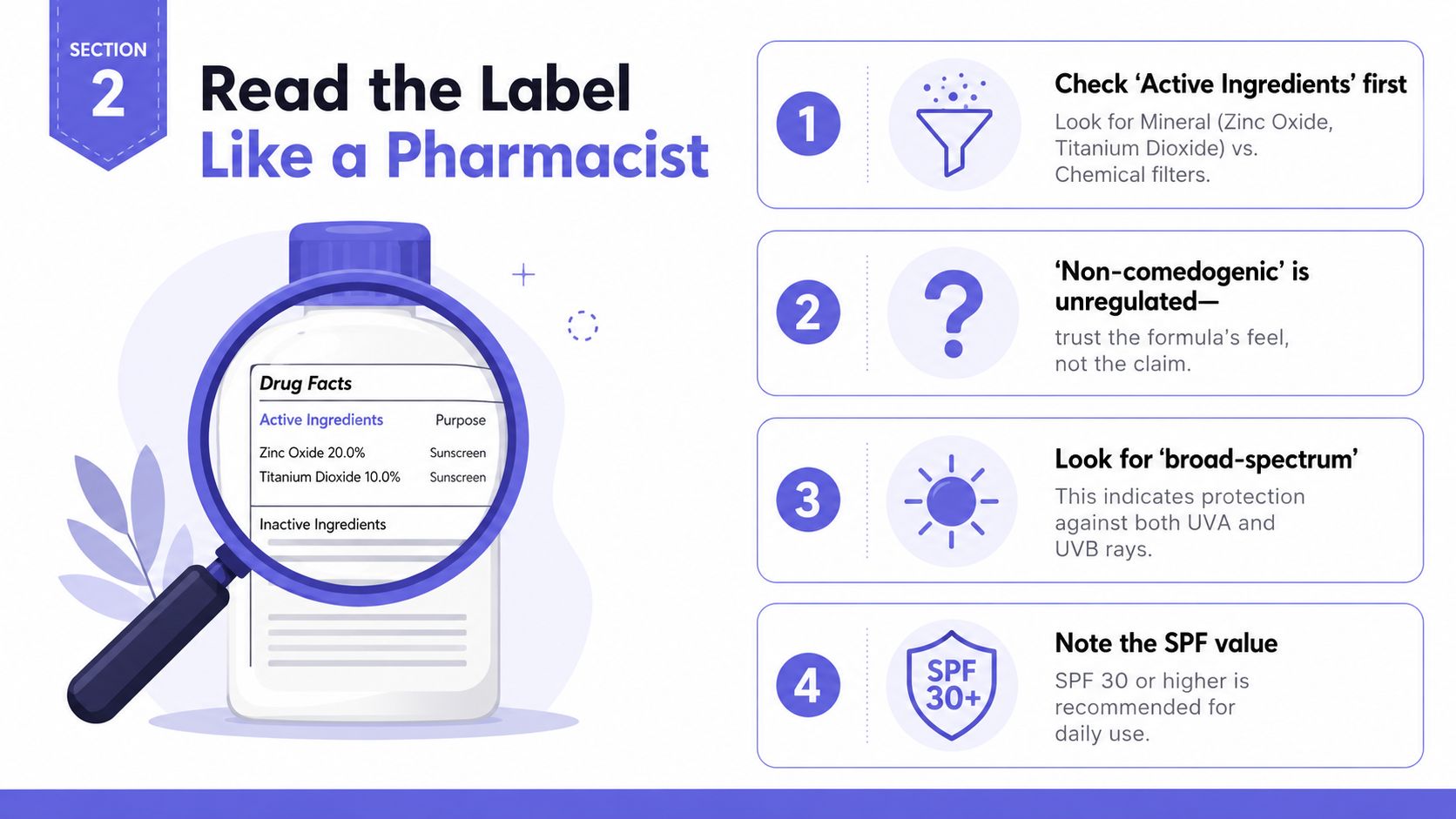
Start with the protection claim
Look for broad-spectrum coverage before you get attached to a finish or brand. SPF mainly communicates UVB protection, while broad-spectrum labeling confirms that the product addresses both UVA and UVB. Clinical guidance recommends SPF 30 or higher for acne-prone skin, with stronger protection particularly relevant when PIH risk or sun exposure is high. The clinical recommendations for acne and photoprotection place emphasis on UVA protection because UVA can worsen pigmentation and acne sequelae.
SPF 50 isn't a license to apply less product or stay outside indefinitely. It offers a higher labeled protection level when applied correctly, but coverage still depends on using enough product and reapplying when exposure continues.
Treat non-comedogenic as a clue
“Non-comedogenic” means the product is presented as less likely to clog pores, but the term isn't a guarantee that it will suit your skin. Its value depends on the formula and the testing behind the claim. A prospective randomized comedogenicity study involving 30 healthy adults aged 18 to 55 found that the tested sunscreen had a significantly lower mean comedone grade than the positive control, 0.86±0.95 versus 2.07±0.84, p=0.001, with no adverse events reported. The published study supports the point that some sunscreens can be formulated to be non-comedogenic, not that every product carrying the phrase will behave identically.
Scan for ingredients your skin has previously disliked, including isopropyl myristate, heavy coconut derivatives, and formulas overloaded with rich occlusives. Silicones aren't automatically problematic, but a dense combination can feel congested on some users.
Notice useful supporting ingredients
Niacinamide may suit skin prone to redness and uneven tone. Ceramides can support a compromised barrier, while antioxidants such as vitamin E can contribute to formula support and skin conditioning. These ingredients are helpful additions, but they don't compensate for a sunscreen that burns, pills, or feels impossible to wear.
My under-one-minute rule is simple: confirm broad-spectrum SPF 30 or higher, check the texture description, scan for known personal triggers, then test a small area before applying it across the face.
Textures and Finishes for Breakout-Prone Skin
The best texture depends on what your skin and your day are doing. A gel that feels perfect after a gym session may leave dry, retinoid-treated cheeks uncomfortable, while a rich cream that rescues winter dryness may feel oppressive in humid weather.
A gel usually suits oily skin, warm climates, and post-exercise application because it absorbs quickly and leaves less of an occlusive sensation. A fluid or lotion is often more versatile for normal-to-combination skin, especially when you need to layer moisturizer, sunscreen, and makeup without creating friction.
| Format | Best For |
|---|---|
| Gel | Oily skin, humid weather, and post-gym routines |
| Fluid | Normal-to-combination skin and makeup layering |
| Lotion | Flexible daily use when you need moderate hydration |
| Cream | Dry acne-prone skin or drying acne treatments |
| Stick | Targeted reapplication over makeup |
| Mist | Neck, chest, scalp, and convenient touch-ups |
| Tinted mineral | White-cast concerns and light complexion evening |
Match the finish to your treatment
Benzoyl peroxide and retinoids can leave the skin dry, tight, or flaky. In that setting, a cream sunscreen may be more comfortable than a matte gel, provided it doesn't feel congested or trigger new lesions. A lighter lotion can work well for combination skin where the cheeks need comfort but the forehead becomes shiny.
Stick sunscreens are practical around the nose, temples, and hairline, particularly over makeup. They're easy to over-apply, though, and repeated swiping across oily areas can create a layered film. Use a clean, controlled application rather than rubbing the stick aggressively over active lesions.
Build a small format rotation
Mists can be useful for the neck, chest, and scalp, but I wouldn't rely on one as the only facial application unless the product is applied generously and evenly. The same principle applies to powder formats. They're convenient for top-ups, but a morning liquid or cream application creates the foundation of coverage.
Tinted mineral sunscreen is especially useful when a white cast makes daily use unacceptable. It may give light coverage and help the skin look more even, but it still needs to be selected for comfort and pore compatibility. For water exposure, review practical advice on water-resistant sunscreen for swimming, then remember that swimming and sweating can still require reapplication.
What Sunscreen Can and Cannot Do for Acne
Sunscreen isn't an acne treatment. It won't unclog pores, reduce sebum, or replace ingredients such as retinoids, benzoyl peroxide, or salicylic acid. Promising that it will “clear” acne confuses the product's role and can leave people disappointed.
Its strongest contribution is protecting healing skin from UV-driven changes. A pimple can flatten while leaving behind a red, brown, or purple mark. Sun exposure can make that mark look darker and can prolong the uneven appearance of the complexion, especially when the skin has a higher risk of PIH.
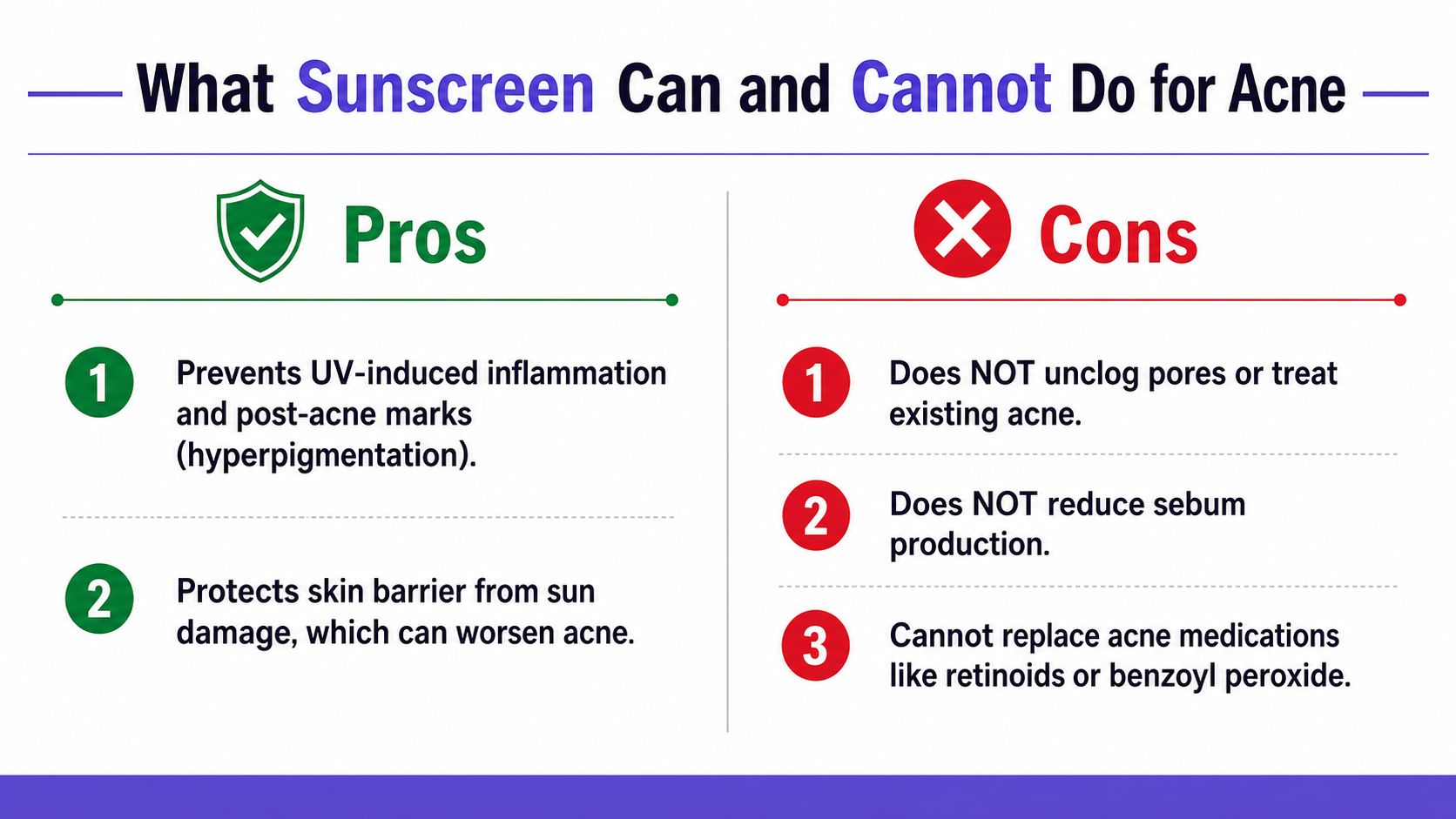
The evidence supports a supporting role
A controlled study of 54 patients with grade I or II acne vulgaris found that combining 0.1% tretinoin with an SPF 15 sunscreen didn't reduce acne-treatment effectiveness. Among 46 evaluable patients, papules fell 25.9%, closed comedones 49.1%, and open comedones 36.3% over eight weeks. The PubMed record for this study supports a practical conclusion: sunscreen can coexist with acne treatment rather than interfering with it.
The sunscreen protects against unnecessary UV exposure while the medication addresses acne biology. That distinction helps patients keep expectations realistic and routines sustainable.
What it protects against
Acne therapies can increase sensitivity, dryness, or irritation. Daily photoprotection helps reduce the chance that exposed, treatment-compromised skin becomes more uncomfortable. It also supports the barrier during recovery from inflammation and limits the visual worsening of marks.
A randomized, double-blind, active-comparator trial in 51 adults with mild-to-moderate acne vulgaris found that adding a sunscreen containing licochalcone A improved acne severity and post-acne hyperpigmentation parameters, while also improving tolerability measures such as dryness, burning, and stinging compared with the comparator. The trial information summarized in this product-focused clinical review supports choosing formulas that combine UV protection with ingredients intended to support inflamed or sensitized skin.
I'm confident this framing helps: use sunscreen to protect the progress made by your acne treatment, not to ask sunscreen to perform the treatment's job.
Layering Sunscreen With Acne Treatments
A routine can contain excellent products and still fail if the layers interact badly. Pilling, stinging, and uneven application often come from applying too many textures too quickly rather than from sunscreen itself.
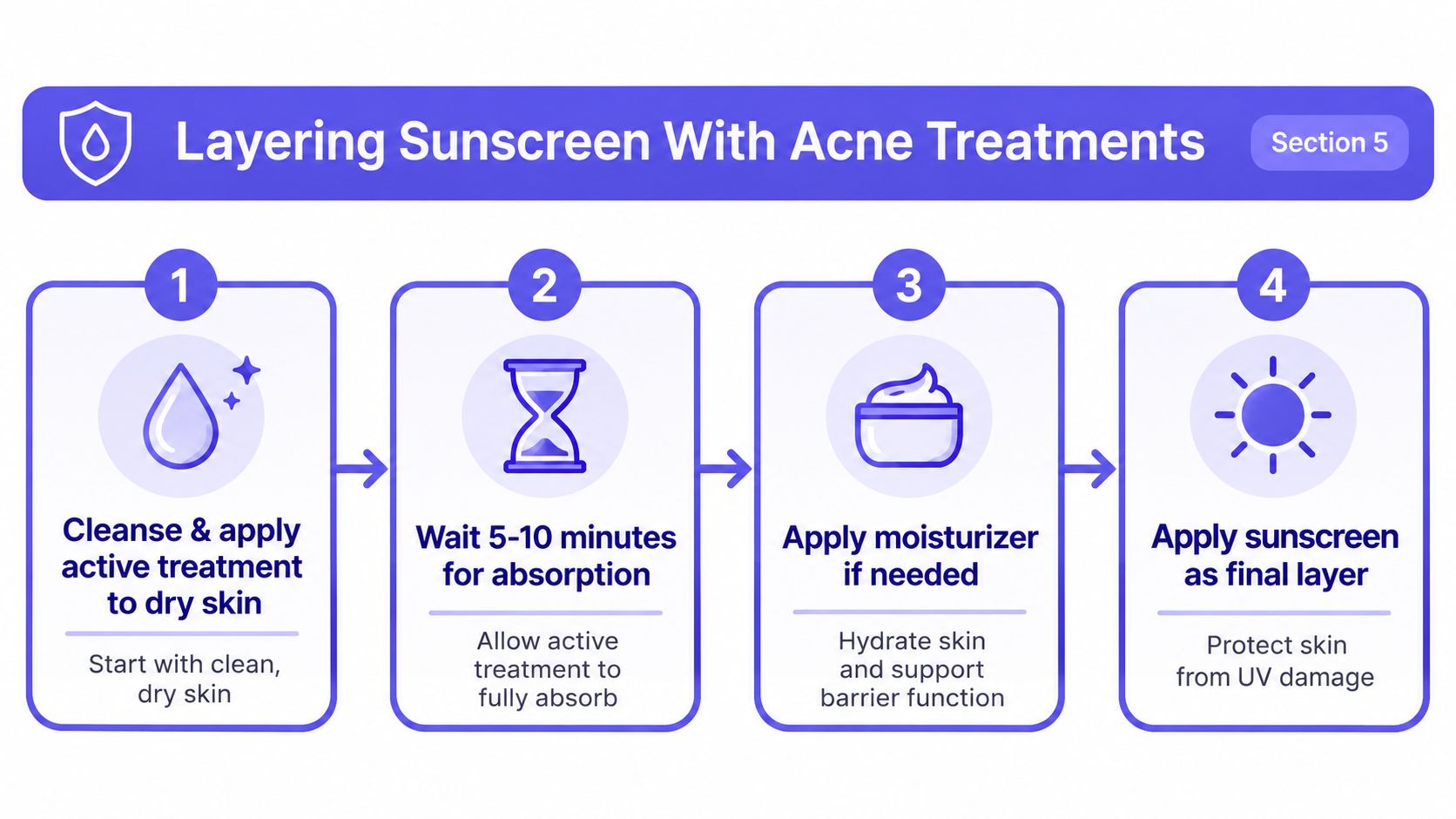
Use a calm morning order
Start with a gentle cleanse, then apply the morning active to clean, dry skin if your treatment plan includes one. Allow roughly five to ten minutes for absorption before adding the next layer. Apply moisturizer only if your skin needs it, then finish with sunscreen as the final skincare step.
Water-based gel sunscreens usually sit more comfortably over humectant serums. Silicone-fluid sunscreens may glide over a richer moisturizer, while a thick cream underneath a fast-setting gel can create rolling. If pilling appears, simplify the layers before changing every product.
Match common acne medicines carefully
Retinoids and benzoyl peroxide are often easier to reserve for the evening, leaving the morning routine less crowded. Salicylic acid can sit under a fluid SPF for some users, but stronger preparations may sting, especially when the barrier is already dry. A light moisturizer can provide a useful buffer.
Azelaic acid may pair neatly with mineral filters, although heavier chemical fluids can pill over it. The answer isn't automatically to stop the active. Reduce friction, let each layer settle, and test the combination on a limited area first.
Layering insight: The sunscreen should be the final protective film, not the first product competing with your treatment.
Outdoor reapplication is a separate task from the morning application. Follow a practical guide to layering niacinamide, vitamin C, and sunscreen when combining antioxidant serums, and choose a mist, powder, or stick for touch-ups over makeup when appropriate. This short video also demonstrates a simple sunscreen routine:
At night, remove sunscreen thoroughly with a cleanser that suits your skin. Persistent residue combined with oil, sweat, and makeup can make congestion more likely, so gentle but complete cleansing matters.
Your Sunscreen Selection Checklist and Final Thoughts
Choosing sunscreen becomes easier when you stop judging the bottle by one attractive claim. I use a short sequence that prioritizes protection first, then tolerability, then finish.
Work through the bottle in order
- Choose the filter family. Mineral filters, particularly zinc oxide and titanium dioxide, can be a sensible starting point for sensitive or reactive skin. Chemical filters may offer a lighter, less visible finish when comfort and reapplication are priorities.
- Confirm broad-spectrum coverage. You want UVA and UVB protection, not an SPF number considered in isolation. UVA coverage matters when your main concern is post-acne discoloration.
- Select SPF 30 or higher. This aligns with daily-use clinical guidance for acne-prone skin. Higher labeling doesn't correct poor application, so the product must also feel comfortable enough for consistent use.
- Assess the finish. Gel and fluid textures often suit oily or combination skin, while creams may be more appropriate when acne medication has caused dryness. Tinted mineral formulas can reduce the frustration of a white cast.
- Treat non-comedogenic as a starting point. Check the complete formula, consider your own history with ingredients, and patch test before committing to full-face use. A claim can guide your search, but your skin's response completes the evaluation.
Keep the purpose clear
Sunscreen for acne prone skin is primarily about preventing post-inflammatory hyperpigmentation and protecting treatment-compromised skin, not clearing an existing breakout. If a product pills, stings, feels greasy, or leaves a cast, that's a formulation problem to solve, not proof that your skin cannot tolerate sunscreen.
In my experience, the right product exists for nearly every routine, although it may take a few trials to find it. For more practical selection guidance, use these best practices for choosing a safe sunscreen. I believe this is the best knowledge I can offer from 16 years in dermatology and skincare: prioritize protection, choose a texture you'll wear, and let your acne treatment handle the acne.
Find sunscreen your skin will actually wear
Healtsy offers a broad selection of skincare and sun-care products, including formulas for acne, dark spots, sensitive skin, and daily UV protection. Compare pharmacy-grade options, use the skincare quiz for personalized recommendations, and build a routine that makes consistent sunscreen use easier.
Visit Healtsy