


Anti-Aging Strategies
Anti Aging Serum for Sensitive Skin: A Practical Guide
The advice to buy the strongest anti-aging serum you can tolerate gets sensitive skin care backward. The better starting point is the least irritating routine that addresses your main concern, not the highest concentration on the shelf. Burning is not proof that a serum is working.
This guide takes a pharmacy-style approach to choosing an anti aging serum for sensitive skin. It covers the active, the whole formula, and the pace of change. I believe clear limits and realistic expectations help more than promises that any serum will suit everyone.
Why Sensitive Skin Changes Your Serum Choice
Say you buy a well-reviewed serum, use it enthusiastically, and feel stinging by the third night. You might assume you've applied it incorrectly or that your skin needs to toughen up. I believe the more useful explanation is often a mismatch between the formula, your skin's condition, and how quickly you introduced it.
Sensitive skin isn't an unusual shopping concern. A 2021 survey of 3,050 adults discusses global estimates of self-reported sensitive skin ranging from 12.79% to 68.4%, with an overall estimate of approximately 50%. Those estimates come from different populations and methods, not a single worldwide clinical diagnosis.
Your face also faces a demanding combination: cleansing, cosmetics, weather, ultraviolet exposure, and sometimes several active ingredients in the same routine. A serum that feels comfortable on someone else's skin may be too much for yours, especially when your cheeks already feel tight after washing.
Start with your skin's behavior
If you're unsure whether your reactions fit a sensitive-skin pattern, Healtsy's guide to identifying, caring for, and relieving sensitive skin offers useful context. A focused checklist of what sensitive skin serums should avoid from Mesoderm RX can also help you organize label questions rather than shop by wrinkle claims alone.
I believe a sound choice should help you do three things:
- Match the active to your concern, rather than collect ingredients.
- Introduce one change at a time, so you can identify what suits you.
- Recognize a stop signal, instead of treating every reaction as adjustment.
A serum that you can keep using beats a stronger one you abandon in week one.
Choosing Actives and Strength for Sensitive Skin
Anti-aging actives for sensitive skin by purpose
| Active | Main anti-aging job | Sensitive-skin evidence | Concentration note |
|---|---|---|---|
| Retinol | Fine lines and uneven texture | Irritation-prone; dryness common | Start at the lowest strength and check the label |
| Retinal | Renewal and texture | Limited sensitive-skin data; approach cautiously like retinol | Lowest available strength |
| Niacinamide | Barrier support and tone | Plausible barrier mechanism; controlled sensitive-skin studies sparse | Check the percentage; consider daily use once settled |
| Vitamin C | Photoaging and brightness | Tolerance is formulation-specific; stinging is possible | Compare strength and vehicle; consider a lower-strength morning formula |
| Peptides | Firmness-support positioning | Limited evidence for sensitive skin; not equivalent to retinol evidence | No universal percentage benchmark; consider as a daily base layer if tolerated |
| Bakuchiol | Marketed as a wrinkle-support alternative | Insufficient sensitive-skin evidence here to promise efficacy or superior tolerance | Consider every-other-day introduction, following product directions |
| Azelaic acid | Tone-and-texture positioning | Insufficient evidence here for a sensitive-skin anti-aging efficacy claim | Consider alternate-day introduction, following product directions |
Retinoids offer a clear purpose, with a tolerance trade-off
Retinol is worth considering when fine lines and uneven texture matter most, but I believe it's a poor first experiment while skin is already uncomfortable. The liquid or cream carrying the active, often called the vehicle, matters alongside the percentage.
A clinical review of retinol formulations reports that people with a history of sensitivity experienced more irritation and dryness than those with normal skin, while all tested retinoid formulations increased dryness to some degree. That supports choosing a fragrance-free, moisturizing formula rather than judging the bottle by strength alone.
Retinal belongs in the renewal category, but it shouldn't automatically be treated as a gentler escape route. I believe the sensible comparison is the complete formula, its stated strength, and its directions, not an assumption that a different vitamin A name guarantees comfort.
For someone whose skin already stings after cleansing, my recommendation would be to settle the basic routine before considering either option. More activity isn't always more progress.
Niacinamide supports the conditions for a workable routine
Niacinamide has a different role. A dermatology review describes its ability to increase epidermal ceramides and other barrier lipids, reduce water loss, and increase the thickness of the outer skin layer.
That gives a reasonable basis for including niacinamide in a barrier-oriented routine. It doesn't establish that every niacinamide serum prevents irritation, or that a stronger formula gives a better outcome.
I believe niacinamide for sensitive skin makes most sense as a practical option when comfort and uneven-looking tone both matter. If your moisturizer already contains it and feels good, a separate serum may add complexity without solving a new problem.
Vitamin C isn't one standardized formula
A review of topical vitamin C covers concentrations from 3.75% to 20%, with study durations ranging from two weeks to six months. Different concentrations, vehicles, and outcomes make it unhelpful to treat all vitamin C serums as interchangeable.
I believe a lower-concentration formula used on its own is a reasonable starting point for reactive skin. That makes it easier to judge whether the whole product suits you before adding another active.
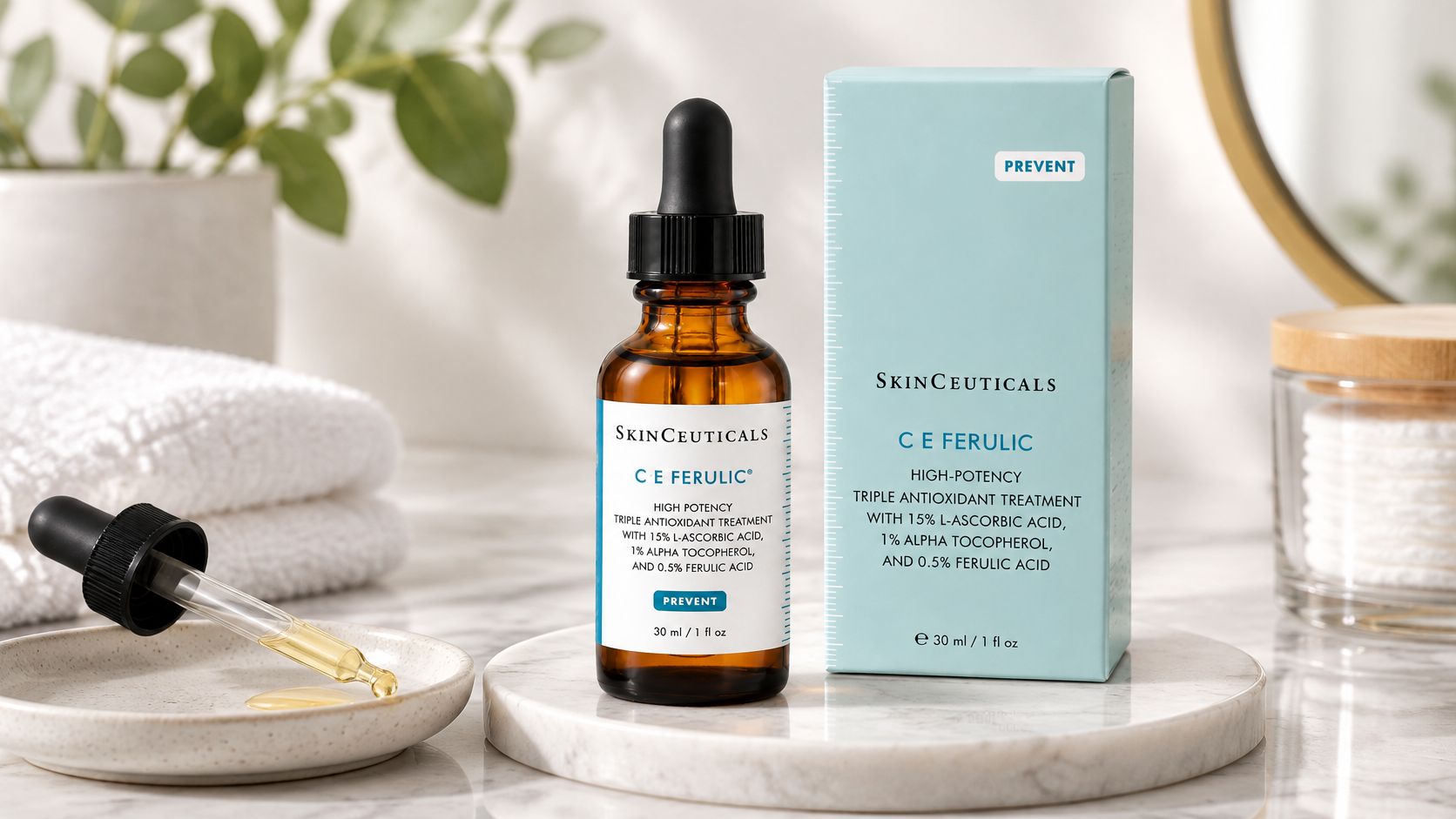
SkinCeuticals C E Ferulic Antioxidant Serum 30ml is a fragrance-free daytime vitamin C option positioned for normal, dry, and sensitive skin. It's an example of a targeted antioxidant serum, not a guarantee of tolerance or an automatic first choice for highly reactive cheeks.
Separate evidence from reassuring ingredient names
Peptides can fit a simple daily base layer, but firmness-support marketing shouldn't be confused with strong sensitive-skin clinical evidence. A review of sensitive-skin product ingredients found that clinical studies were sparse and methodologically limited, with only a small group of commonly featured ingredients studied directly in sensitive volunteers.
Bakuchiol and azelaic acid also deserve measured language here. I wouldn't promise that either is irritation-free or equivalent to retinol for wrinkles on the evidence available.
For the supporting cream, REVETIX's overview of key ingredients in anti-aging moisturizers offers additional label-reading context. I believe its most useful application is distinguishing a moisturizing role from a treatment-active role, rather than adding every ingredient mentioned.
Layer by purpose, not enthusiasm
I believe keeping retinol and strong exfoliating acids on separate nights is the more manageable starting strategy. Vitamin C can occupy the morning, while retinol stays at night; a fragrance-free moisturizer can cushion the routine, but it doesn't make excessive active layering harmless.
For example, consider a hypothetical adult with reactive cheeks who already tolerates a morning vitamin C serum. A later retinol trial might use Tuesday and Friday evenings, leaving other evenings for moisturizer alone.
Start with one of those active routines, not both together. Visible cosmetic changes develop gradually, and a comfortable, repeatable routine gives you a better basis for evaluating them than overnight expectations.
How to Introduce a Serum Without a Flare
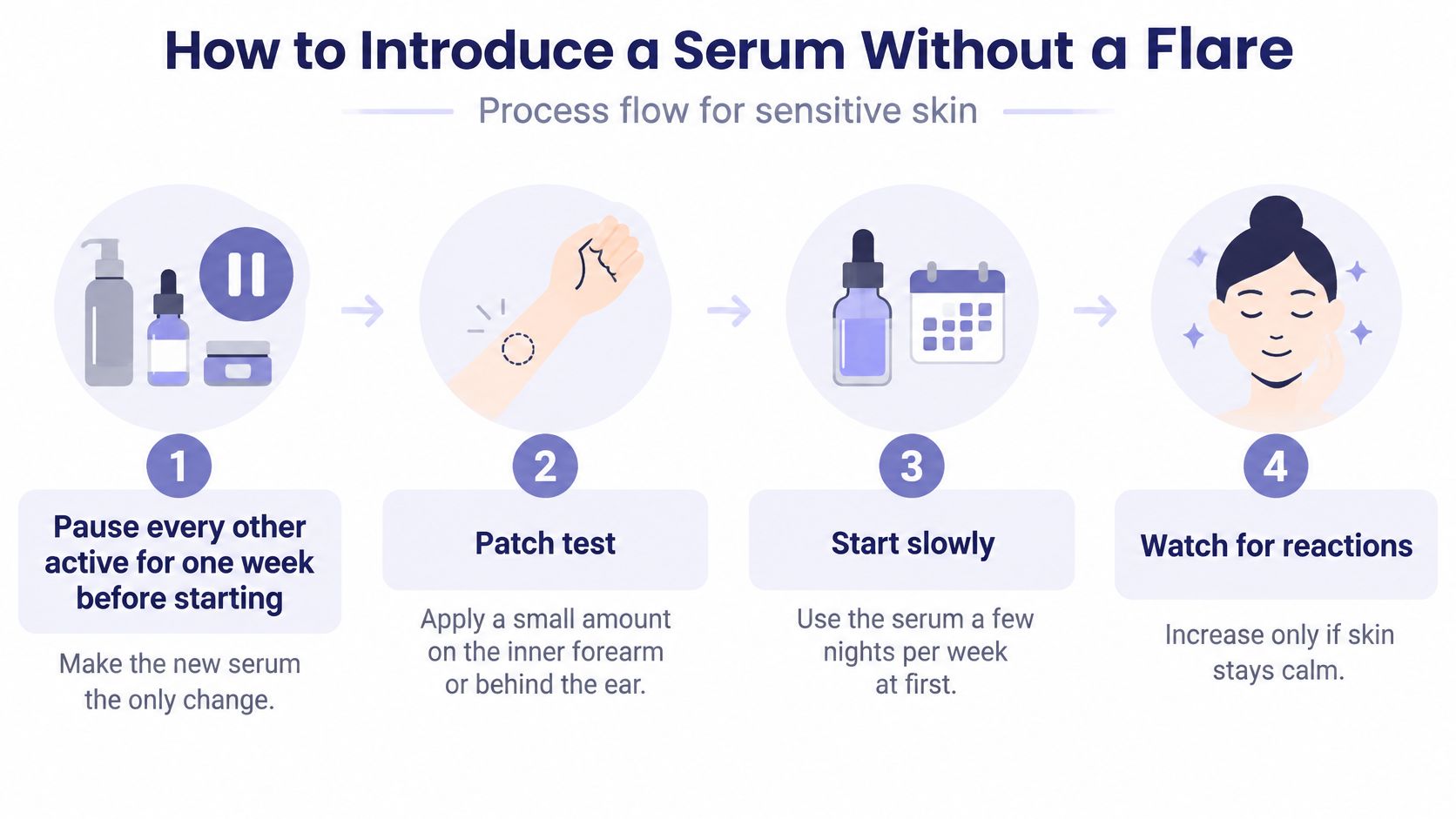
I believe the safest introduction is an observation exercise, not a challenge to reach daily use. The following is a conservative example for a nighttime treatment serum, particularly retinol, rather than a universal dosing schedule for daytime antioxidants.
Make the new serum the only variable
- Simplify before starting. I would pause other nonessential cosmetic actives for a settling-in week while keeping a comfortable cleanser, moisturizer, and sunscreen. Prescribed treatments are different, so changes to those belong with your clinician.
- Test a limited area first. A small amount on the inner forearm or behind the ear offers an initial tolerance check before broader use. The American Academy of Dermatology's sunscreen guidance supports testing a new product on a small area first; a brief home test doesn't guarantee full-face tolerance or rule out delayed allergy.
- Use a restrained amount on dry skin. For a retinol-style facial product, I believe a thin, pea-sized application on nonconsecutive evenings is a reasonable starting approach, unless its directions specify otherwise. A dropper serum may have different instructions, so the same amount shouldn't be transferred to every bottle.
- Keep the supporting products unchanged. Changing cleanser and sunscreen at the same time makes a reaction harder to trace. Familiar products give you a clearer comparison.
- Increase only after comfortable use. I would look for a sustained period without tightness, peeling, or daytime sensitivity before considering another application. There's no benefit in advancing just because the calendar says to.
- Pause when symptoms persist. Burning or lingering redness is a reason to stop the experiment and reassess, not add another soothing active over it. Returning to the familiar basics makes the next decision clearer.
Treat the calendar as an example, not a target
Four-week introduction schedule for a new serum
| Week | Frequency | Check before moving on |
|---|---|---|
| Week 1 | Two nights a week, pea-sized amount on dry skin for a suitable retinol product | No burning or persistent redness |
| Week 2 | Three nights a week if week 1 was comfortable | No peeling or tightness |
| Week 3 | Every other night only if comfortable and consistent with directions | Comfortable skin by day |
| Week 4 | Nightly only if skin stays comfortable and directions allow | Return to fewer nights if any reaction returns |
These frequencies illustrate a possible introduction, not a clinically validated timetable for every serum. I believe staying at the first comfortable frequency is preferable to reaching nightly use with irritated skin.
For readers concerned about irritation and uneven-looking tone, the guide to introducing retinol for dark skin without irritation adds practical context. Throughout the trial, keeping moisturizer and sunscreen stable matters more than completing the schedule quickly.
Routine Examples for Sensitive, Combination and Mature Skin
A useful routine should fit what your skin does during an ordinary day. Dry cheeks that tighten after washing need a different texture from a shiny forehead with reactive areas around the nose.
The American Academy of Dermatology's dry-skin guidance supports fragrance-free care and daily broad-spectrum, water-resistant SPF 30 or higher. I believe moisturizer and sunscreen deserve the most dependable places in an anti-aging routine, with serum chosen around them rather than replacing them.
Choose the closest starting profile
Example routines by skin profile
| Skin profile | Morning | Evening | Serum rhythm |
|---|---|---|---|
| Sensitive, dry | Fragrance-free moisturizer, SPF 30 or higher | Gentle cleanser, serum, moisturizer | Serum on alternate nights once tolerated |
| Sensitive, combination | Optional tolerated vitamin C, light moisturizer, SPF 30 or higher | Cleanser, niacinamide serum, moisturizer | Serum nightly only once tolerated |
| Mature sensitive | Vitamin C or peptide serum, moisturizer, SPF 30 or higher | Cleanser, retinol on selected nights, moisturizer | Retinol two nights a week to start |
| Redness-prone sensitive | Fragrance-free moisturizer, SPF 30 or higher | Cleanser, anti-redness serum, moisturizer | Serum nightly only if comfortable |
The frequencies are example starting patterns, not requirements. In the combination-skin routine, vitamin C belongs before moisturizer and sunscreen, and it remains optional.
Sensitive, dry skin often benefits from fewer application steps and a more cushioning moisturizer. If tightness remains after cleansing, I believe improving that foundation takes priority over adding a renewal serum; this dry, sensitive skin routine guide helps organize those choices.
Sensitive, combination skin doesn't need an aggressive serum merely because the forehead looks oily. A lighter moisturizer can improve wearability without asking the reactive cheek area to tolerate more active ingredients.
Mature skin and redness need different priorities
For mature sensitive skin, I believe a daytime antioxidant or peptide-focused routine can be easier to manage than immediately combining several renewal products. Retinol evenings can remain limited, with moisturizer-only evenings between them.
For redness-prone skin, Uriage Roseliane Anti-Redness Serum - 30ml is a fragrance-free option described by its manufacturer as targeting visible redness and as dermatologically tested on sensitive skin with couperose and rosacea tendencies. Those are cosmetic suitability statements, not a promise to treat rosacea or prevent every reaction.
Choose the routine for the skin you have today, not the age category printed on a package.
If chemical sunscreen formulas repeatedly irritate, I believe considering a formulation with zinc oxide or titanium dioxide is reasonable. The complete sunscreen formula still matters, and a comfortable finish helps make daily application sustainable.
Irritation Signals to Reduce or Stop
The instruction to push through discomfort is particularly unhelpful for sensitive skin. Tingling does not establish efficacy, and a reaction does not need to look severe before pausing a cosmetic.
A Dutch survey of dermatologists found irritant eczema and allergic contact dermatitis were common skincare complaints, with retinoids and fragrances among the frequently implicated ingredients. 88.1% regularly encountered skincare complaints, with irritant eczema reported by 69.6% and allergic contact dermatitis by 52.4% in that Dutch survey of dermatologists. Those figures describe dermatologists' reports, not the probability that an individual serum user will react.
Mild symptoms still deserve attention
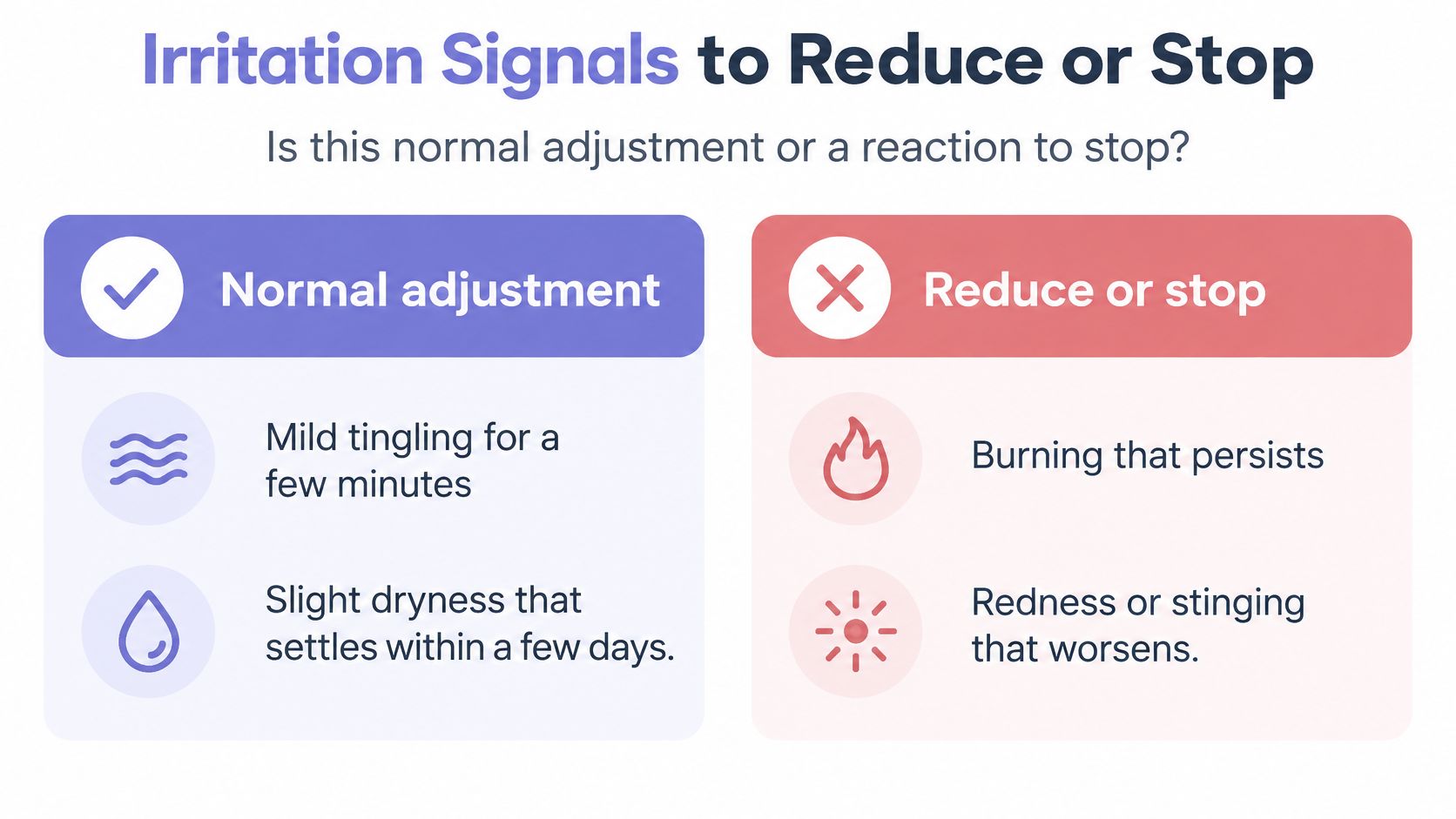
- Brief, mild tingling: Tingling occurs with some formulas, but it is not required for results. Watch the pattern over the next uses instead of assuming it is harmless.
- Slight dryness: If dryness settles with moisturizer and does not worsen, hold the same low frequency and reassess after a week.
- Minor flaking: Do not increase use while flaking is present. Pause if it persists or spreads.
The important distinction is not whether a symptom appears. It is whether it persists, intensifies, or changes how skin feels during the day.
A routine that stays comfortable enough to use consistently will usually deliver more visible benefit than a stronger formula that keeps causing interruptions.
Reduce, stop, or seek advice
- Pause and reassess: Persistent burning, marked redness, scaling, or stinging from previously comfortable products.
- Stop and seek medical advice: Swelling, blistering, a spreading rash, or severe or lasting discomfort.
- Seek urgent help: Trouble breathing or swelling affecting the lips, tongue, or throat.
Simplifying back to familiar, comfortable basics is preferable to applying another corrective serum. The guide to repairing a damaged skin barrier can support that reset, but it does not replace assessment of a persistent rash.
Avoid three misleading shortcuts
Adding another strong active before the first has settled makes the culprit harder to identify. Buying an unscented product also is not the same as choosing fragrance-free, because masking fragrance may still be present.
Finally, the word retinol does not tell you the strength. The AAD's retinoid guidance notes that over-the-counter products are not required to disclose their retinol percentage and that significant dryness or skin allergies can make retinoids unsuitable.
I believe a dermatology appointment is appropriate when symptoms continue after stopping, reactions recur, or you cannot identify the responsible product. Home experimentation has limits.
Confirm Your Serum Choice and Start Slowly
A good buying decision should leave you with a clear purpose and a manageable routine, not a shelf full of backup products. That clarity matters more than concentration. A milder serum used consistently will tell you more in a month than a stronger formula you have to pause every few days.
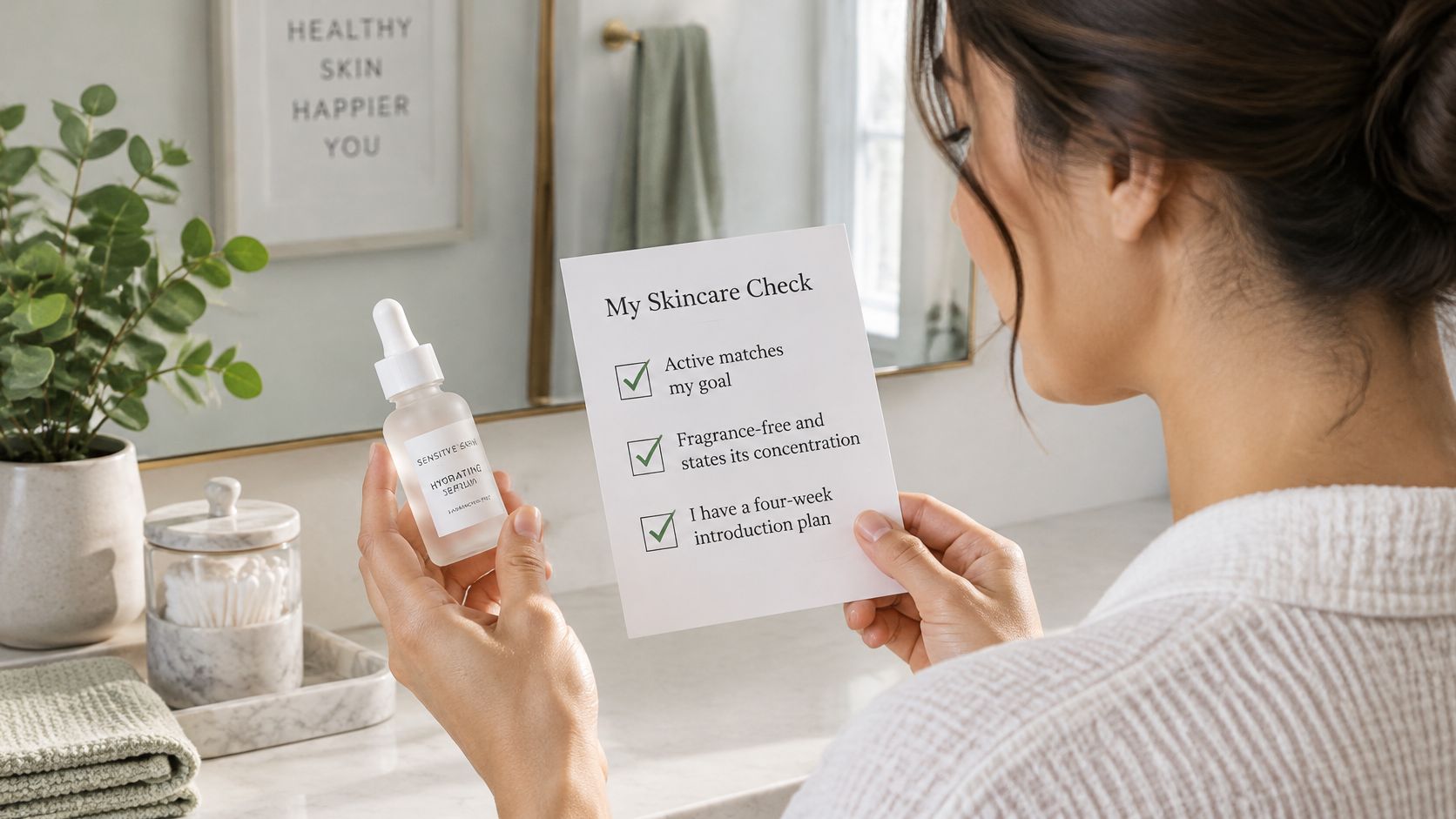
Check the goal, formula, and introduction plan
- Confirm the job: Choose for your main concern, whether that's fine lines, uneven-looking tone, or visible redness.
- Confirm the formula: Look for fragrance-free positioning and a disclosed active concentration where relevant. An undisclosed strength isn't evidence of gentleness.
- Confirm the plan: Decide how you'll test, introduce, and pause the product before opening it.
The daytime antioxidant example and the redness-focused example suit different profiles. I believe choosing between those roles is more useful than ranking them as universally better or worse, and neither needs to be started alongside another new serum.
Healtsy's catalog lists active ingredients, intended users and application methods for each serum, with pharmacist-reviewed product information.
The video below walks through a four-week serum introduction schedule for sensitive skin.
I believe the most useful next step is a single-serum trial. Choose one suitable formula, use the introduction schedule conservatively, and keep a short daily note of comfort, tightness, redness, and flaking during the first month. Your observations should determine the pace, not the ambition to reach daily application.
European pharmacy dermocosmetics, chosen with care
At Healtsy, we offer European pharmacy dermocosmetics, including a vitamin C antioxidant serum for firmer, brighter-looking skin and options for sensitive-skin concerns. Visit our catalog to compare a serum's purpose and directions, then choose one formula you can introduce patiently into your existing routine.
Explore the Healtsy catalog