


Reach for the gentle bottle first. I believe a fragrance-free niacinamide formula around 2% is the kindest starting point for sensitive skin, with 4–5% a sensible step up once your face stays calm. A higher percentage is not the better buy: 10% has not been shown to suit reactive skin better, and the rest of the formula can sting as much as the number on the label.
The popular advice to pick the strongest serum ignores what surrounds the active. Fragrance, a rich cream base or a second active in the same bottle often decides whether an evening application stays comfortable or ends with everything washed off, especially when your face already feels tight, itchy or easily flushed. The best recommendation is the one your skin tolerates.
This is the complete guide to choosing and introducing niacinamide for sensitive skin, with comfort as the first test of whether it earns a place in your routine.
Which Niacinamide Strength Sensitive Skin Should Start With
I believe a lower-strength, fragrance-free formula is the sensible first purchase. That doesn't mean stronger products are always unsuitable. It means sensitive skin needs a reason to increase strength, rather than treating a bigger number as an upgrade.
A 2024 dermatology review describes commercial formulations commonly containing up to 5%, with some reaching 10%, and reports that concentrations below 5% are generally well tolerated, although mild irritation, redness and itching can occur. Notice the distinction: generally well tolerated isn't the same as irritation-proof, and “below” doesn't establish a universal safety cutoff.
Niacinamide strengths for sensitive skin
The starting schedules below are conservative introduction choices, not proof that a particular strength will suit every face.
| Strength | Best starting case | How often at first | What to expect |
|---|---|---|---|
| About 2% | Eczema-prone, very dry or previously stinging skin, once calm and intact | Every other evening | Conservative start inside the generally well-tolerated band |
| 4–5% | Sensitive skin that already feels calm | Once daily, preferably nightly if comfortable | Common commercial range; the whole formula still determines comfort |
| 10% | Only after a lower strength feels easy, and there's a reason to change | Not a first bottle | Not shown to be better for sensitive skin; brief stinging, warmth, redness or itching remain possible |
These are shopping bands, not treatment prescriptions. If your cheeks currently burn after washing, settle that discomfort before testing an optional active. A modest percentage won't make application to inflamed or broken skin a good experiment.
Read beyond the headline percentage
Consider winter cheeks that feel sore after a foaming cleanser. That face may need a richer, simpler cream more than a concentrated serum. Fragrance, alcohol, preservatives and the total active load deserve attention alongside the niacinamide percentage.
If the label doesn't disclose the concentration, don't assume that means it's gentle. Look at the product's purpose, its other actives and whether you can establish a clear introduction routine.
Buying rule: Choose the formula that fills a gap in your routine. Don't buy a stronger serum simply because it appears to offer more ingredient for the money.
For redness-prone shoppers, our guide to niacinamide serum for rosacea helps frame the choice around tolerance rather than strength.
The product image below shows a different category of active care, not a suggested niacinamide starter.
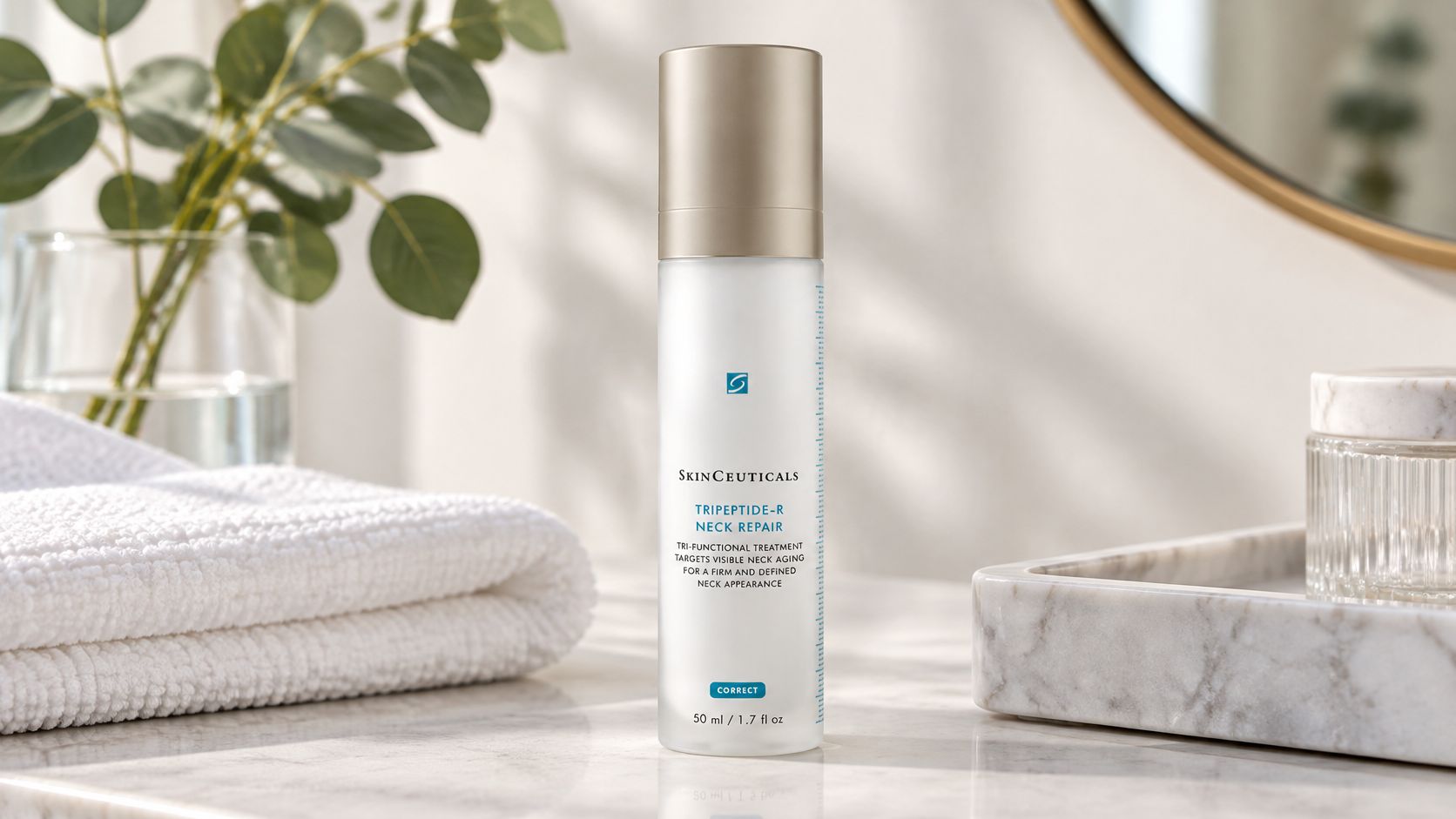
Skinceuticals Tripeptide-R Neck Repair - 50ml is a retinol-containing neck corrective care. Its different purpose illustrates why products shouldn't be treated as interchangeable just because they sit in the same skincare category.
How Niacinamide Supports a Reactive Barrier
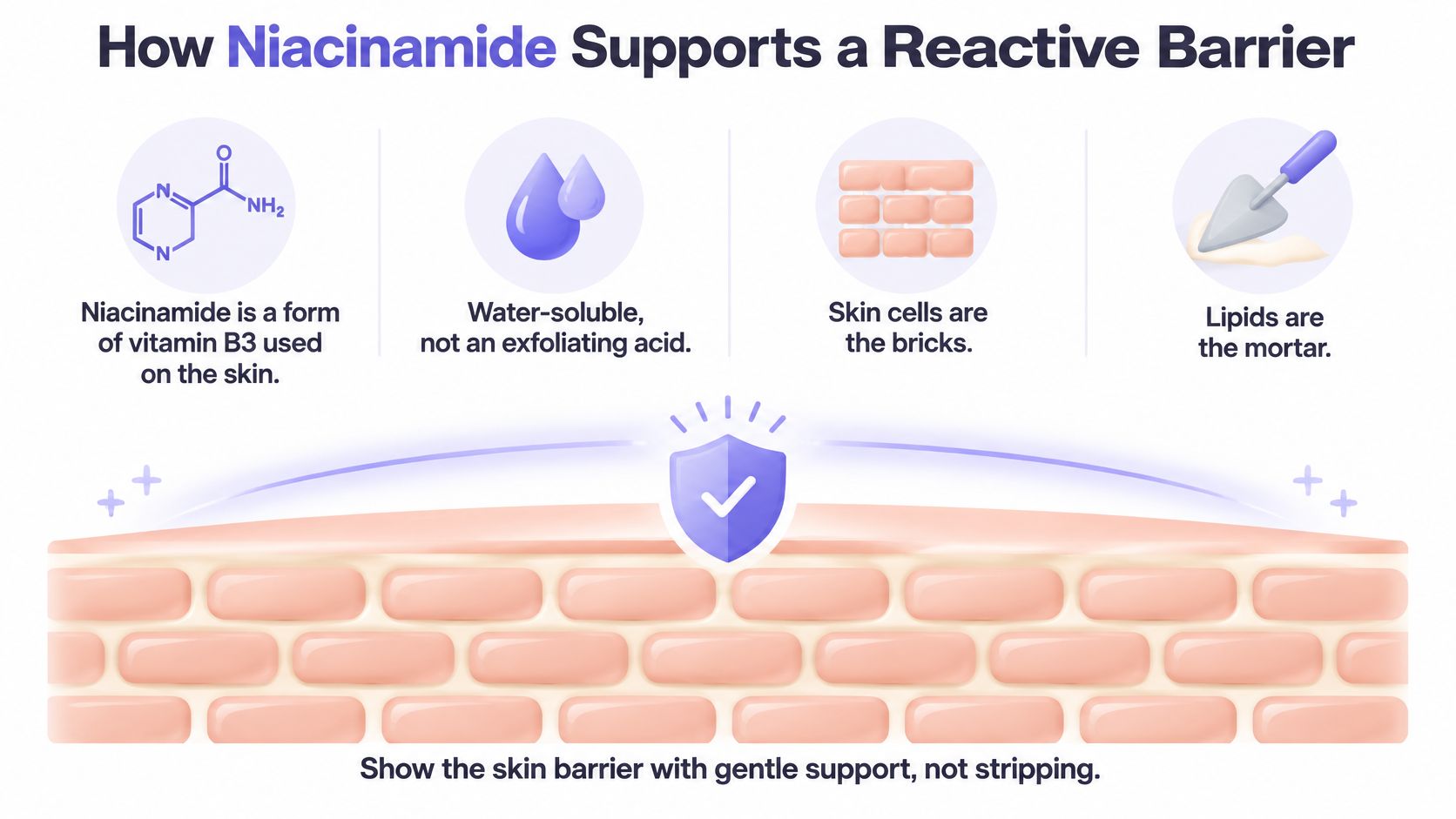
Niacinamide is a form of vitamin B3 used on the skin. It's water-soluble and isn't an exfoliating acid. The useful comparison is a brick wall, not a scrub: skin cells are the bricks, and the lipids between them are the mortar.
When that outer barrier isn't functioning comfortably, water escapes more readily and ordinary skincare can sting. Transepidermal water loss, usually shortened to TEWL, describes water moving out through the skin. It's a measurement, not something you can accurately diagnose from how shiny or dry your face looks.
The illustration below shows the barrier-support approach without suggesting that stripping or peeling is necessary.
What the clinical measurements mean
In a randomized, split-face trial involving people with rosacea-associated redness and sensitive skin, a multi-ingredient dermocosmetic containing niacinamide improved hydration by 31.3% and reduced TEWL by 11.6% from baseline after 15 days; after 30 days, hydration had increased by 35.0% and TEWL had decreased by 11.1%. The formulation performed significantly better than usual skincare on these barrier-related outcomes.
Those results belong to the complete formulation, not niacinamide alone. They don't establish that an unrelated serum will produce the same changes, or that you can calculate your own barrier improvement from how your face feels.
The practical interpretation is still useful. A niacinamide-containing moisturising formula can be a reasonable choice when the goal is better hydration and less reactivity, rather than a stronger peeling effect. For someone whose cheeks tighten during cold-weather walks, comfort under a familiar moisturiser is a more useful early observation than a dramatic glow.
What barrier support doesn't mean
A cosmetic ingredient doesn't diagnose the cause of facial redness. Rosacea, eczema, contact reactions and an overly aggressive routine can overlap in appearance, but they don't all require the same care.
Nor does barrier support make cleansing habits irrelevant. Adding a serum while continuing a cleanser that leaves your face burning is an expensive way to avoid fixing the obvious problem. Our guide to repairing a damaged skin barrier explains how to simplify that foundation.
Comfortable skin is a useful goal in its own right. You don't need tingling, peeling or a freshly polished feeling to justify keeping a product.
The video below provides another format for exploring niacinamide in skincare.
I believe expectations matter most in this case. Keep the ingredient if it makes a sensible, comfortable contribution to your routine. Don't expect it to replace prescribed care or compensate for daily irritation.
How to Patch Test Niacinamide Before Full-Face Use
Start with one new product, while keeping your familiar cleanser, moisturiser and sunscreen unchanged. A small-area home test can reveal an obvious tolerance problem, but it can't rule out every delayed reaction or replace diagnostic patch testing by a clinician.
A practical niacinamide ingredient guide supports small-area testing and gradual introduction of lower-strength formulas. The staged schedule below is a cautious routine recommendation, not a clinically validated test that guarantees safety.
A gradual introduction you can follow
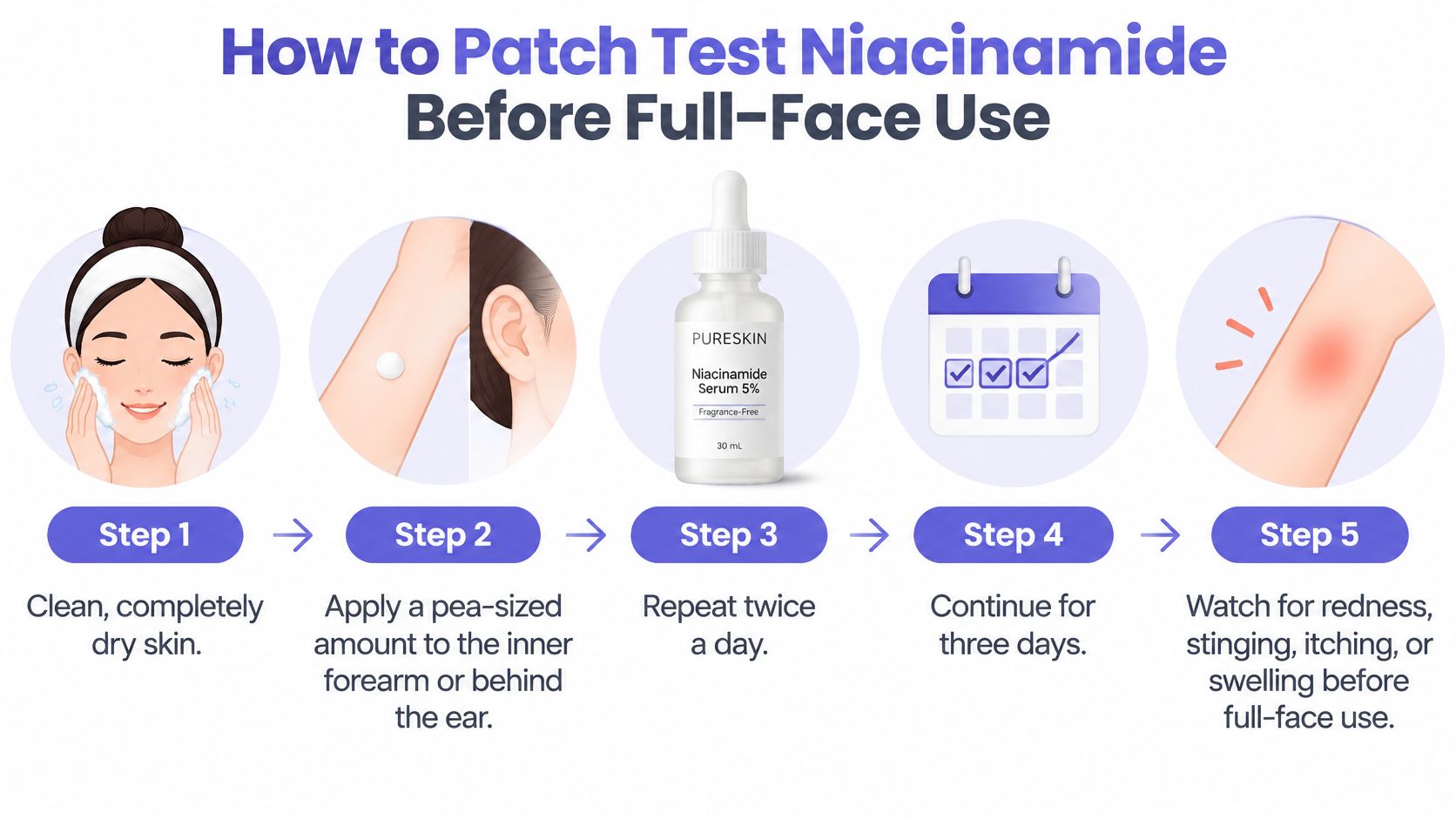
- Test a small area first. On clean, completely dry skin, apply a small amount to the inner forearm or behind the ear. For a cautious home trial, repeat morning and evening over several days, staying within the product's directions rather than increasing the dose.
- Check before every repeat application. Look for lasting redness, itching, swelling or a rash, including changes still present the next morning. Stop testing if these appear. Don't keep applying to see whether the skin gets used to them.
- Move to the jawline if the first area stays calm. Try a thin application on a limited facial area over several evenings. Facial skin may respond differently from the forearm, so passing the first stage isn't permission to apply generously.
- Expand to alternate-evening use. Apply a thin layer over intact facial skin, followed by your usual moisturiser. Leave recovery evenings between applications rather than testing your maximum tolerance immediately.
- Increase only when mornings remain comfortable. Nightly use is an option, not a target you must reach. New tightness, itching or tenderness means you shouldn't increase frequency.
- Consider morning use only if it serves a purpose. You may not need another daily application. Keep sunscreen as the final daytime skincare step.
- Leave other new actives out. Give the formula a quiet introduction before adding an acid, retinoid or another unfamiliar serum. Otherwise, a reaction leaves you guessing which change caused it.
The visual below condenses the small-area stage. Treat it as an initial check, not a substitute for gradual facial use.
Choose an ordinary evening
Don't make the first application immediately after shaving, a peel or a hot shower. Wait until your skin is fully dry and comfortable, and avoid any broken areas. That makes the test easier to interpret and avoids adding another challenge to already stressed skin.
A practical week might include an application on Monday and another on Wednesday, with attention to how your face feels at breakfast. That's an example schedule, not a deadline for progressing.
Success looks ordinary: no new morning tightness, no lingering itch and no need to change your makeup routine to hide irritation.
I'm certain a staged introduction makes an uncomfortable result easier to interpret. It won't prevent every reaction, but it removes the confusion of starting several products together. For texture and formulation choices, use our guide to the best serum for sensitive skin.
Ingredients That Sit Well With Niacinamide and Those to Pause
Niacinamide generally fits beneath a moisturiser and sunscreen without requiring an elaborate layering routine. The important distinction is between ingredient compatibility and your skin's capacity to tolerate the entire routine.
Two ingredients can be compatible in a finished formula while separate products containing them still feel uncomfortable on your face. A dry cheek doesn't care that an online chart labels the combination safe.
Comfortable partners
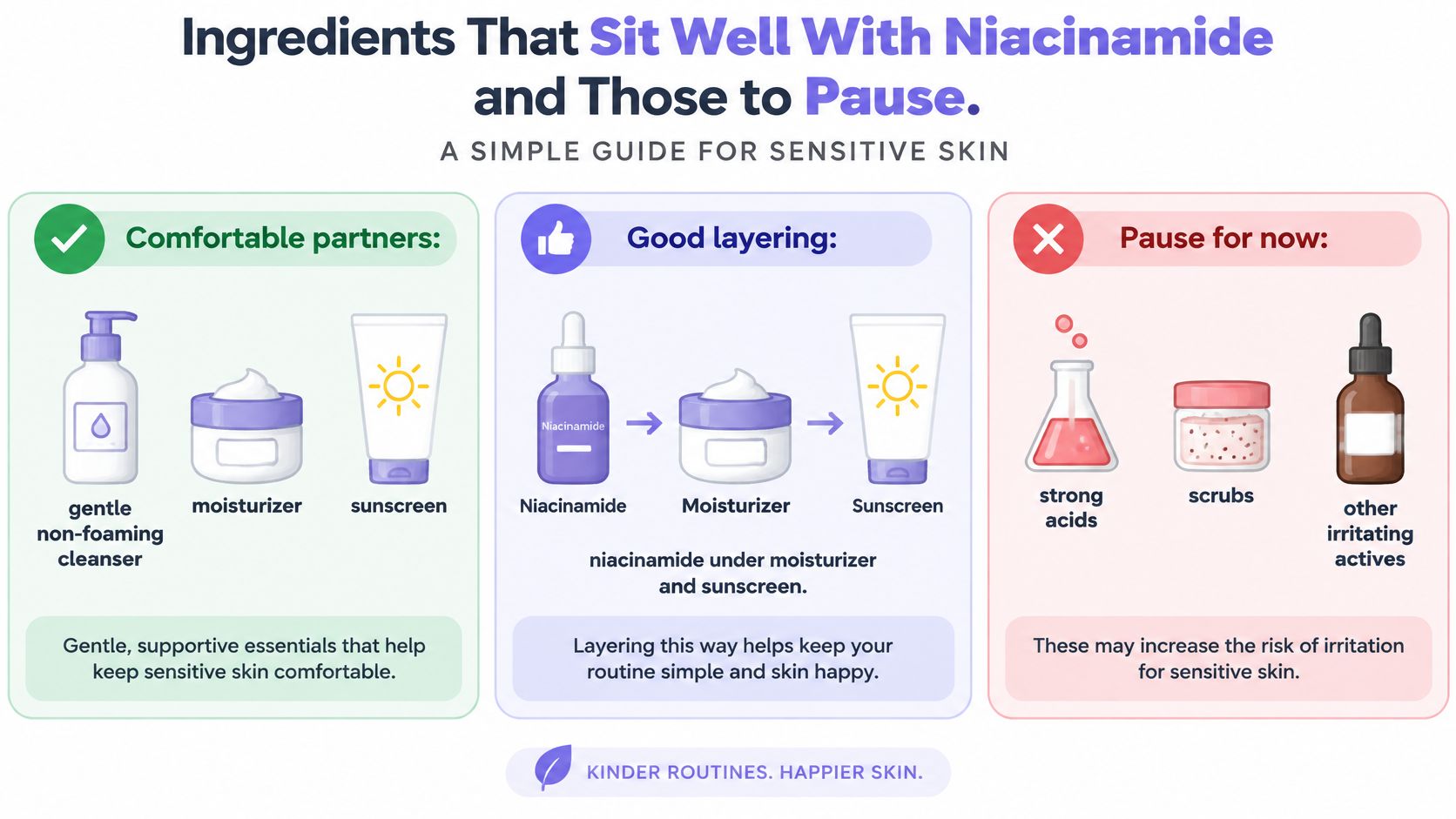
- Gentle non-foaming cleanser: Choose one that leaves your skin comfortable rather than tight. You don't need a squeaky-clean finish before applying niacinamide.
- Bland moisturiser: A familiar cream gives you a stable foundation. Ceramides, glycerin and hyaluronic acid can fit this role when you already tolerate the formula containing them.
- Sunscreen: Keep a tolerated broad-spectrum sunscreen in the morning routine. A mineral formula is an option, but the mineral label alone doesn't guarantee comfort.
A 2025 randomized, investigator-blinded sunscreen study reported reductions of up to 87% in erythema and related colorimetric indices compared with unprotected skin after controlled barrier disruption and ultraviolet/visible-light exposure. The tested sunscreen also contained niacinamide and sclareolide, so the result cannot be assigned to niacinamide alone.
That supports keeping the daytime focus on a complete protective formula. It doesn't justify expecting a standalone serum to reproduce the sunscreen's result.
Ingredients to pause during introduction
- Strong exfoliants and scrubs: Leave strong glycolic or other alpha-hydroxy acids, intensive leave-on salicylic products and abrasive scrubs out of the initial experiment.
- Retinoids and benzoyl peroxide: Don't add or intensify these at the same sitting as a new niacinamide product. If they're prescribed, ask the prescriber before changing the schedule.
- Alcohol-heavy toners and fragrance: Remove avoidable sources of discomfort, particularly if you already know they bother your skin.
- Stinging vitamin C formulas: There's no need to introduce an acidic vitamin C product while you're still establishing niacinamide tolerance.
The graphic below separates a simple supportive routine from unnecessary early additions.
Someone who adds an acid toner and a concentrated serum to an existing retinoid routine has changed too much to interpret a sore face confidently. I believe a simpler combination is the better experiment, not a permanent ban on useful ingredients.
Once your routine is comfortable, our guide to layering niacinamide, vitamin C and sunscreen can help you decide whether another step is worthwhile.
What to Do When Niacinamide Stings or Itches
Mild itching for a few minutes, on skin that shows no redness, happens even under controlled study conditions. Treat it as information about how your skin responded that day, and give the area time to settle before the next application.
In a double-blind controlled trial of a gel cream containing 10% nicotinamide alongside other actives, seven participants, 29% of that group, reported mild itching on day 14, lasting a few minutes without redness. Because the cream contained other active ingredients, the finding does not identify niacinamide as the sole cause.
Niacinamide reactions and what to do
| What you feel | What it often means | What to do |
|---|---|---|
| Warmth or itch for a few minutes, no redness | A transient sensation is possible; the trial above documented brief itching without redness | Let the skin settle; if retrying, use less, less often, with moisturiser after |
| Burning, itch or redness that eases when contact is shorter | Contact time, frequency or a stressed barrier may contribute | Pause other irritating actives; keep the product off broken skin |
| Burning that lasts, swelling, rash or redness that is worse the next day | A stop signal, not a purge | Stop the product and strip the routine back to cleanser and moisturiser |
A randomized study of 60 adults with mild-to-moderate psoriasis tested 4% nicotinamide cream twice daily for 12 weeks and reported burning, itching or redness in some participants; the irritation resolved when they were instructed to wash the area after one hour. That study describes contact time in a medical setting. At home, treat it as context for reading your own sensations, because a cosmetic stays on the skin it was formulated for.
Decide whether to retry or stop
For a mild, fully resolved sensation on intact skin, a smaller amount used less often is a reasonable retry. Applying your familiar moisturiser first gives the product a buffer, and fully dry skin lowers the chance of a sting. Skip the retry entirely while the skin remains sore.
If the same product causes discomfort a second time, stop treating the introduction as a challenge to complete. A different base formula may suit you better, and a routine that leaves niacinamide out remains a perfectly good outcome.
Reducing frequency prevents some premature rejections. Repeated reactions deserve respect: a product that still stings on a simplified, spaced schedule has already given you a clear answer. The aim is skincare your face accepts comfortably.
Calm Routines for Rosacea Eczema and Reactive Skin
These are cosmetic comfort routines, not treatment plans. They assume that your skin is intact, the small-area trial was comfortable and you're not replacing prescribed care.
The sequence matters as much as the product choice. Use lukewarm water, avoid rubbing with a towel and let your face become fully dry before applying an unfamiliar active.
Starter routines by sensitive-skin concern
Use the strength bands set out earlier in this guide: the lower end for reactive skin, the higher band only once the skin stays calm between applications. What changes by concern is the order of the evening and what you deliberately leave out while you introduce the serum.
| Concern | Evening order | Leave out at first |
|---|---|---|
| Rosacea-prone redness | Familiar cleanser, fully dry skin, niacinamide every other evening, bland moisturiser; mineral sunscreen by day | Scrubs, strong acids, alcohol toners |
| Eczema-prone or cracked barrier | Moisturiser buffer first if sting-prone, then niacinamide on intact skin only | Application to open cracks, fragrance, retinoids |
| Skin that stings after washing | Apply only once the post-wash sting has fully settled, every other evening | Vitamin C and retinoid additions during the introduction |
A 2024 pilot study of a combination serum containing 5% niacinamide in 25 healthy participants measured water loss, hydration, redness, melanin and sebum, and its authors noted that this concentration may be appropriate for sensitive skin. The participants were healthy, so the study doesn't prove comfort during rosacea or eczema flares, and the combination formula doesn't isolate niacinamide's contribution.
Match the routine to the face in front of you
For rosacea-prone skin, begin on a quiet evening, not after prolonged heat exposure or during an unsettled flare. Keep the cleanser and moisturiser familiar so a change in warmth or tenderness is easier to notice. Sunscreen belongs in the morning even if you skip niacinamide.
For eczema-prone skin, distinguish dryness from an active, cracked or weeping patch. Don't apply the serum into damaged areas. Our guide to skincare for eczema can help you keep the cosmetic routine focused on comfort while leaving treatment decisions to your clinician.
For skin that burns after washing, treat the sting itself as the scheduling cue. Apply niacinamide only on evenings when your face feels calm after cleansing, onto fully dry skin. Layering a new active onto a predictable irritation cycle makes the result harder to interpret, because you can't tell whether the serum or the wash step caused the reaction.
The buffer order deserves a practical note. When moisturiser goes first, give it a few minutes to settle before the serum so the layers sit comfortably rather than pilling on the surface.
A short routine beats a crowded one when every new step becomes a tolerance test. Keep the evening to cleanser, one active and one moisturiser until the pattern is clear. If you already use a prescribed cream, bring that routine to your prescriber before adding another active.
When a Dermatologist Should Weigh In
Generally well tolerated doesn't mean suitable for every person. A 2024 dermatology overview describes topical niacinamide below 5% as typically well tolerated while acknowledging mild irritation, redness and itching.
Ask a dermatologist before experimenting on open eczema, cracked or weeping patches, or a rosacea flare that won't settle with gentle care. For a child with eczema, ask the child's clinician rather than adapting an adult serum routine.
Bring the details that help
- The packaging: Include the ingredient list and stated concentration.
- Your whole routine: List cleansers, cosmetics, exfoliants and prescribed creams.
- A reaction timeline: Note when symptoms began, how long they lasted and whether application followed shaving, peeling or a hot shower.
- Clear photographs: Record visible changes without applying more product to recreate them.
Seek urgent medical assessment for significant facial or eye swelling, a spreading rash or worsening burning after stopping. Trouble breathing or rapidly developing swelling requires emergency care.
I believe that conversation is worth having before you purchase another bottle. A clinician can help distinguish irritation from a condition that needs a different approach, rather than leaving you to compare percentages indefinitely.
At Healtsy, we offer European pharmacy and parapharmacy skincare, with product information reviewed by a pharmacist and original products sourced through authorised distribution. Visit Healtsy to check ingredient lists, concentrations and suitability information, and choose a simple routine that puts sensitive-skin comfort before stronger percentages.