


If you've been told to pick a mineral sunscreen because it sits on your skin and bounces the sun away, and that makes it automatically gentler and better, I believe you've been given half a story. After 16 years behind a pharmacy counter, I've heard that sentence more times than I can count, usually from someone holding two bottles and feeling more confused than when they walked in.
This is the complete guide to protetor solar mineral I'd give you at that counter. I'm certain this will solve the problem, which isn't choosing a category. It's learning to judge the specific bottle in your hand by what's printed on it.
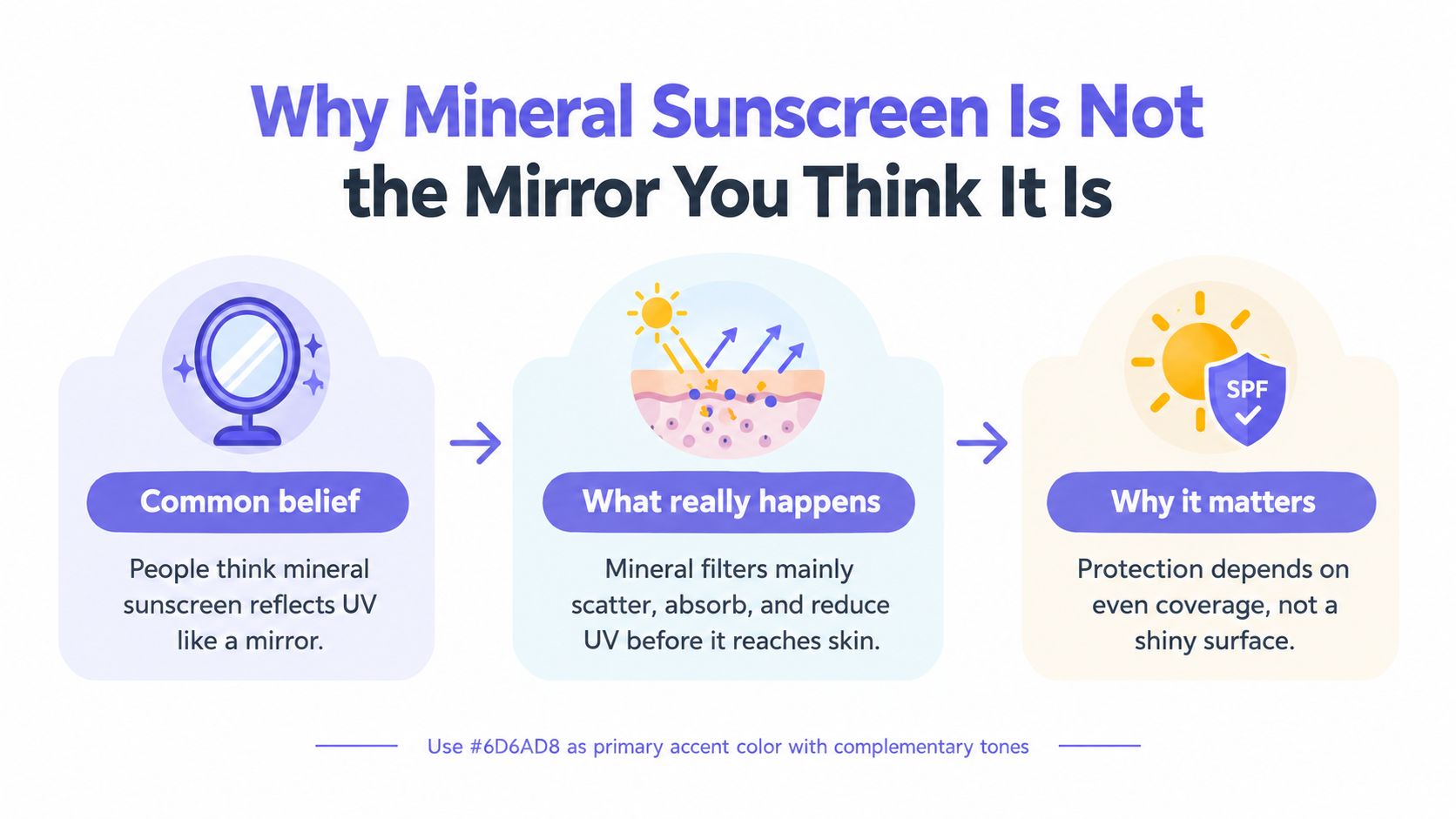
Why Mineral Sunscreen Is Not the Mirror You Think It Is
Many arrive with a tidy picture in mind. Mineral sunscreen is a physical shield, chemical sunscreen soaks in, and the shield must be the safer, more natural choice. I understand why that story sticks. It's simple, and it sounds reassuring.
It isn't quite true. A peer-reviewed review of inorganic sunscreen filters explains that zinc oxide and titanium dioxide interact with UV through absorption, reflection and refraction, with absorption providing most of their photoprotective effect. They don't behave like a bathroom mirror.
What changes once you know that
You stop asking whether "mineral" is better in the abstract. You start asking better questions about one product. Which filters are declared, does it claim broad spectrum or UVA protection, how does the label tell you to reapply, and will the finish let you use enough of it?
Mineral describes the type of filter. It doesn't guarantee gentleness, strength, or a finish you'll like.
That last point matters in real life. The same two minerals can feel elegant in one formula and chalky in another because particle size, dispersion and texture change how a product spreads. Older, larger-particle formulas often left a conspicuous white cast, especially on darker skin. Newer formulas may look very different.
I see this at the counter when someone says, "I tried mineral and hated it," as if they'd tried them all. They tried one bottle. Once we look at the label together, the conversation becomes practical. It's about your exposure, your skin tone, and your routine, not a slogan about bouncing rays away.
How Zinc Oxide and Titanium Dioxide Actually Protect Your Skin
Think of the two mineral filters as colleagues covering overlapping shifts. They work together, but they aren't identical. That simple picture explains a lot of what you see on ingredient lists.
Titanium dioxide is particularly effective against UVB and shorter UVA wavelengths, while zinc oxide provides broader UVA coverage, which is why a review of how particle size and dispersion affect mineral filters describes their protection profiles as complementary. A formula using both can therefore offer more balanced coverage than titanium dioxide alone.

That doesn't mean you can judge protection from an ingredient name. The finished product is what's tested. How the particles are dispersed in the cream, how evenly they form a film, and how much you apply all shape the result.
Why two zinc bottles feel different
Particle engineering is the main reason. Micronized and nano-sized materials improve spreadability and reduce visible whitening, and "nanoparticle" conventionally refers to particles below 100 nm. That size choice is mainly about texture and appearance, not an automatic promise of stronger protection.
- Larger particles: Often more visible and more likely to look chalky.
- Smaller particles: Usually easier to spread and less whitening on skin.
- Dispersion: Even the right filter performs poorly if it's unevenly distributed.
A customer once showed me two tubes and asked why one disappeared and the other sat like paint. Both listed zinc oxide. The difference wasn't the mineral. It was everything the formulator did with it.
So read protetor solar mineral labels for the declared filters, then look for the tested SPF and broad-spectrum claim. That's the evidence you can use.
Mineral Versus Chemical Sunscreen in Real Life
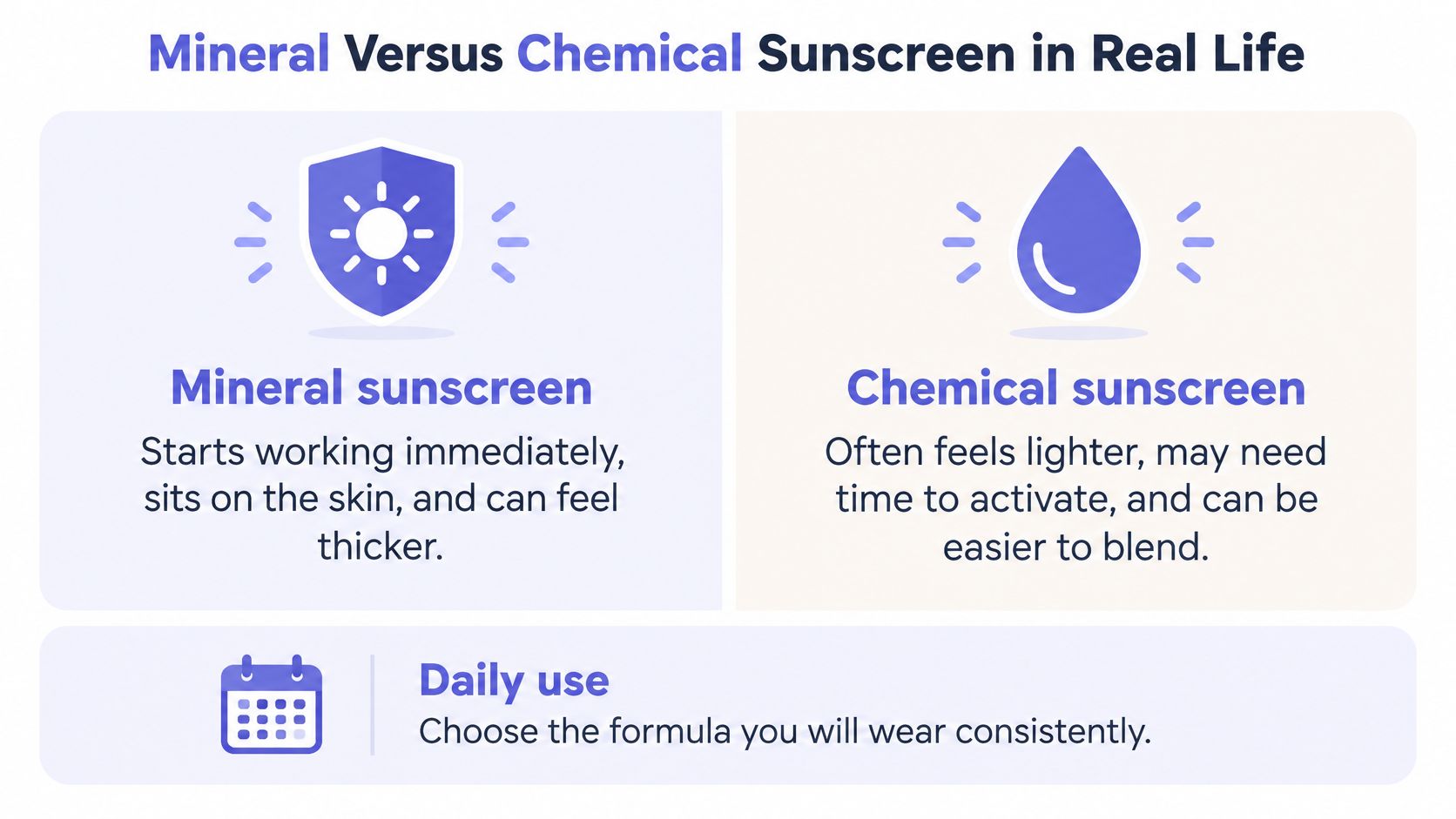
I don't settle this with ideology at the counter, because daily life settles it for many. The best product on paper loses quickly if it stings your eyes, pills under makeup, or makes you dread reapplying it.
A useful starting point is honesty about language. Both mineral and organic filters are chemical substances in the scientific sense, and a comparison of zinc oxide and commercial sunscreens challenges the neat mineral-versus-chemical story many shoppers learn first. The practical differences are declared filters, UVA coverage, film formation, water resistance, finish, and how the product wears.
Where the difference shows up
Mineral formulas can feel thicker and more present. Some people like that visible reassurance. Others find they use too little because a generous layer looks pale, which defeats the purpose.
Organic filter formulas often feel lighter and blend more easily. That helps some people apply a proper amount, especially over larger areas. It doesn't make them universally better tolerated, just as mineral doesn't guarantee no eye sting.
I regularly meet both cases. One customer switched to mineral expecting her eyes to stop watering and was surprised when a fragranced formula still bothered her. Another, a keen open-water swimmer, kept a mineral cream for her face but chose a lighter fluid for her shoulders because she'd reapply it.
The video below gives a visual sense of those texture differences before you test products yourself.
Regulatory status also differs by market, so the same SPF number on a European and a US bottle doesn't describe identical UVA testing. Judge each label on its own terms, and judge it against your week, not someone else's routine.
Reading SPF, Broad Spectrum and PA Labels Correctly
SPF mainly communicates protection against UVB-induced sunburn. UVA exposure is associated with tanning and photoageing, so a high SPF with weak UVA coverage gives you an incomplete picture. If you want the background first, our guide to the difference between UVA and UVB rays covers the basics plainly.
Europe and the US express that UVA side differently. Under the European Commission sunscreen recommendation, the UVA protection factor should be at least one-third of the labelled SPF, so an SPF 30 product should provide a UVA protection factor of at least 10. In the US, broad-spectrum status requires a mean critical wavelength of at least 370 nm, as set out in the FDA sunscreen monograph.
| Label element | What it tells you | European framework | US framework |
|---|---|---|---|
| SPF number | Mainly UVB sunburn protection | Tested on finished product | Tested on finished product |
| UVA marking | Protection extending into UVA range | UVA factor at least one-third of SPF | Broad-spectrum critical wavelength test |
| Filter percentage | Amount of declared filter, not SPF itself | Check full label wording | Zinc oxide and titanium dioxide up to 25% |
Don't treat a higher mineral percentage as a higher SPF. Performance depends on the complete formula and standardized testing. If you're also weighing options during pregnancy, choosing sunscreen for pregnancy is a helpful companion read.
On any bottle, check three things: the declared filters, the SPF, and a clear UVA or broad-spectrum mark.
One practical aside, because sun and dry eyes often come up together at the counter. Hylo Eye Lubricant Eye Gel - 10ml is described in factual terms as a high-viscosity gel-like eye drop intended to remain longer on the ocular surface for intense, long-lasting moisturisation. It's a separate eye-care decision, not a substitute for sunscreen around the eyes.
Applying and Reapplying Mineral Sunscreen the Right Way
Most disappointing sunscreens I've heard about weren't bad products. They were under-applied. That's especially common with mineral formulas, because a proper amount can look more visible than people expect.
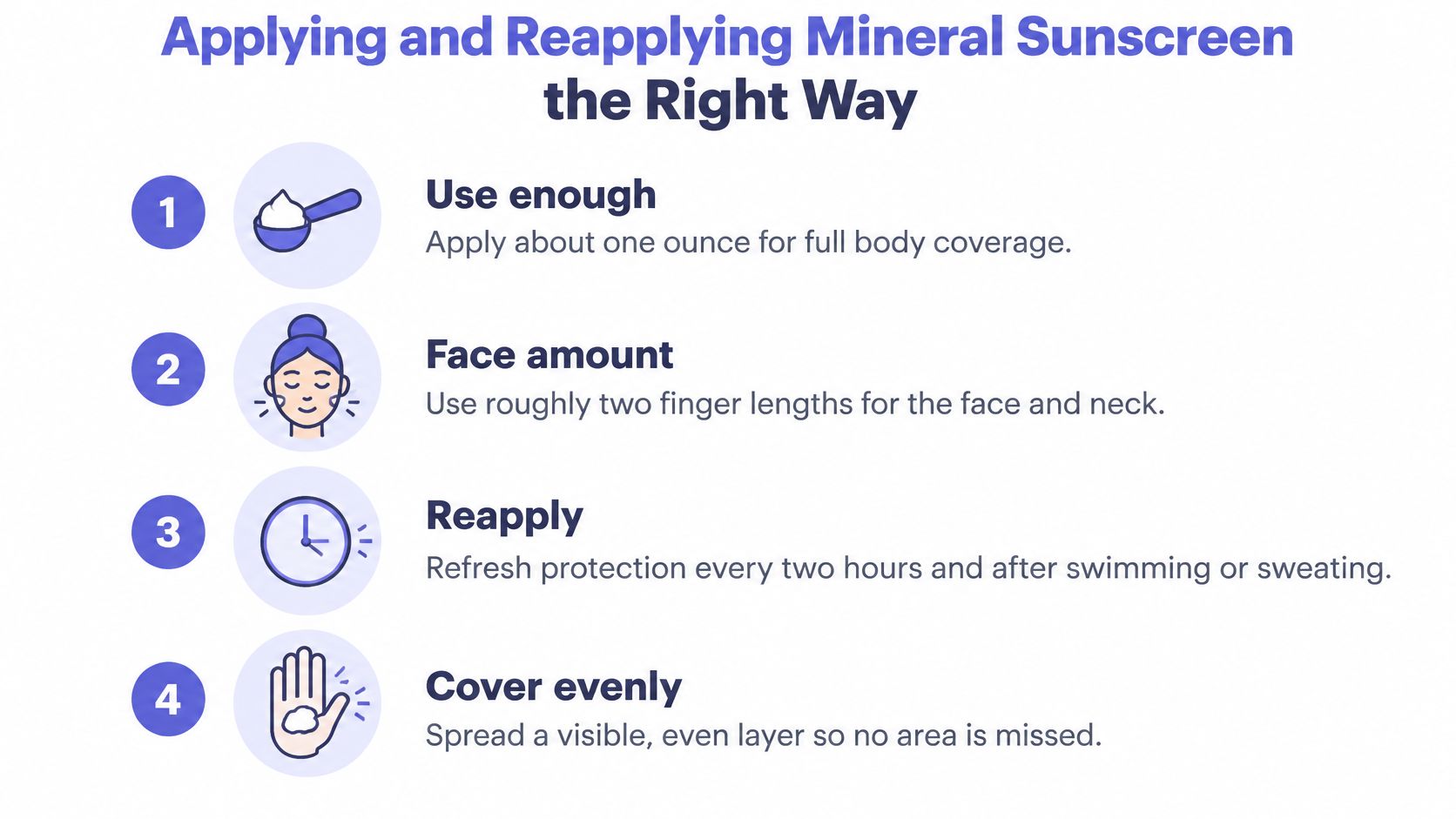
The American Academy of Dermatology sunscreen guidance recommends about 1 ounce, approximately a shot-glass amount, for an average adult's exposed skin, and at least 1 teaspoon for the face, described as enough to cover the length of the index and middle fingers. Apply to dry skin around 15 minutes before going outdoors, then reapply approximately every two hours, or sooner after swimming or sweating.
Making reapplication realistic
SPF testing uses a standardized amount. A thin smear at breakfast won't match that by lunchtime, especially after water, towel drying, or perspiration. Our refresher on how often to reapply sunscreen is worth saving before a holiday.
- Beach day: Reapply after swimming even if the bottle says water resistant.
- Workday: A tinted layer you can top up beats a perfect layer you won't touch.
- Over makeup: Pat rather than rub, and accept some visible build-up.
Think about your whole outfit for the day, too. The same planning that goes into choosing shoes for your first sailing lesson applies to sun care on the water. Decide where the tube lives, in a pocket or dry bag, before you're already out and reluctant to go back for it.
Choosing Mineral Sunscreen for Babies, Pregnancy, Rosacea and Melasma
These are the conversations I have most often, and they never start with a filter name. They start with a situation. A parent with a baby in a pram, someone pregnant who wants the shortest ingredient list, a customer whose cheeks flare at anything fragranced.
For babies and children, texture and cooperation matter as much as the label. A cream a child accepts calmly, twice, protects better in real life than a technically appealing one that turns every application into a wrestling match. Our dedicated guide to mineral sunscreen for kids goes deeper on formats for younger skin.
Matching the bottle to the person
In pregnancy, many readers prefer a short, declared filter list they can read in one pass. That's a reasonable preference. It still helps to check fragrance, finish, and reapplication directions rather than assuming "mineral" answers everything.
With rosacea-prone skin, I usually steer the conversation toward fragrance-free formulas and gentle textures. A mineral filter may suit you, but it isn't a guarantee of tolerance. Patch test on a small area first and watch how your skin behaves over a few uses, not a few minutes.
Melasma changes the priority again. Consistency matters more than occasional heroic beach use, so daily UVA coverage in a finish you'll wear under makeup is the practical goal. A tinted product often helps here because it doubles as your base.
I believe the sensible order is always the same. Define the situation, shortlist by filter and fragrance, then test wear. Your skin's response to a specific protetor solar mineral formula tells you more than any category claim can.
Tinted, Fluid or Cream and How to Test Before You Commit
White cast isn't a matter of taste, and I wish more buying guides said so. It's a measurable formulation effect, and it lands hardest on darker skin tones, where a product can look grey, shift undertones, or transfer onto collars.
A 2025 study developing standardized methods for evaluating white cast found a strong in-vivo correlation of at least r = 0.822 between increasing zinc oxide percentages and greater measured whiteness, with statistically significant differences between formulations. Two products with the same SPF can look completely different on the same face.
What each format tends to do
Untinted creams are the most likely to show. They're often fine for the body or fair skin, but discouraging if you need a generous facial layer daily.
Tinted creams mask whiteness with pigment, which can look natural or slightly off depending on your undertone. Tint is primarily a cosmetic solution. It doesn't prove stronger protection, though comparing shades is easier alongside our roundup of tinted moisturizers with SPF.
Fluids spread thinner and settle faster, which many people prefer under makeup. Watch whether that easy spread tempts you to use too little.
A test that actually tells you something
Apply the amount you'd really use to your jawline, not the back of your hand. Check it in daylight, then look again after it settles, because immediate cast and later appearance aren't the same. Reapply once during the test if you can.
A transparent finish can't be guaranteed across every skin tone, light, or application amount. Anyone promising that hasn't watched enough people try products on.
If a finish makes you skimp, it has failed you, whatever the label says. Choose the protetor solar mineral you'll apply generously and without mirror-checking anxiety.
Your Mineral Sunscreen Shopping Checklist and Where to Buy in Europe
After 16 years of these conversations, I trust a short checklist more than any shelf talk. Keep it on your phone and run any bottle through it before you buy.
- Declared filters: Zinc oxide, titanium dioxide, or both, clearly stated.
- UVA evidence: A UVA mark or broad-spectrum wording, not SPF alone.
- Finish and format: Cream, fluid, or tinted, tested on your jawline.
- Fragrance status: Especially important if your skin reacts easily.
- Reapplication plan: Instructions you can realistically follow on your actual day.
Our wider notes on best practices for choosing sunscreen for your skin pair well with that list if you're comparing several options at once.
Buying European sun care from outside Europe
We come in here. We're a Portugal-based online store for European pharmacy and parapharmacy products, and we ship from Europe to customers worldwide. Our sun care range includes after sun, baby and kids sunscreen, body sunscreen, face sunscreen, lip sunscreen, self-tanners, hair sunscreen, and sun supplements.
We carry brands including Avène, Bioderma, Isdin, La Roche Posay, SVR, Uriage, and Eucerin, alongside many others across skincare and haircare. Every product is 100% original and sourced through authorised distribution, never grey-market channels, and a pharmacist reviews our product information.
Orders ship by DHL from Europe, with import duties already included in the price for the main non-EU markets. Our site is available in English, German and Spanish, which helps when you're comparing a European label against one from home.
Start small. Pick one product, check it against the list above, patch test it on your jawline, and wear it for a normal day. I'm certain that tells you more than another week of reading claims.
Browse our European sun care range, use the checklist above to compare declared filters, UVA marking, and finish, and order the protetor solar mineral that fits your routine with confidence. Visit Healtsy to shop original European pharmacy brands shipped from Europe to your door.