


Sun Protection
Mineral Sunscreen for Kids: A Pharmacist's Practical Guide
You're standing in a pharmacy aisle with a toddler pulling at your leg, a baby waiting in the car, and an entire shelf of brightly coloured sunscreen bottles competing for attention. One says “baby,” another says “natural,” and a third promises invisible protection. The label that matters most may be smaller: the active ingredient panel.
After 16 years counselling parents at the pharmacy counter, I've learned that choosing mineral sunscreen for kids becomes much easier when you separate three questions: How old is the child? What is their skin condition? Can you trust the label? I believe this is the complete practical guide to making that decision without getting trapped by packaging, texture promises, or confusing advice.
Why Parents Keep Hearing About Mineral Sunscreen for Kids
A mineral sunscreen uses zinc oxide and/or titanium dioxide as its active UV filters. These ingredients sit on the skin's surface instead of being absorbed into it in the same way many chemical filters are. That surface-level action is the main reason pediatric and dermatology guidance commonly places mineral formulas first for babies and young children.
For children older than 6 months, broad-spectrum sunscreen with SPF 30 or higher is widely recommended for routine outdoor exposure, while guidance for younger infants puts shade and protective clothing ahead of sunscreen. The Children's Hospital Los Angeles guidance on sunscreen for children reflects that age-based approach and explains why mineral ingredients are often preferred for sensitive skin.
Why the mineral category feels safer to parents
A child's skin may react to sunscreen in several ways. The formula can sting around the eyes, aggravate an existing rash, or cause irritation from fragrance and other inactive ingredients. Mineral filters are less likely to produce the stinging sensation many parents notice with some chemical formulas, so they're often a sensible starting point for sensitive or eczema-prone skin.
Chemical sunscreens use filters such as oxybenzone, avobenzone, and octinoxate. Those ingredients have prompted questions from parents about absorption, irritation, and environmental impact. That doesn't make every chemical sunscreen unsuitable, and I wouldn't describe mineral as a universal verdict against the entire category. It does explain why a mineral-first approach is so common for young children.
My counter-side rule: Start with age and skin condition, then assess the formula. Don't let a colourful “kids” label make the decision for you.
The trade-off is practical. Mineral lotions can leave a white cast, feel thicker, and require more rubbing than clear chemical formulas. Modern products are often easier to spread than older zinc pastes, but the visible film hasn't disappeared completely. Parents who understand that compromise are more likely to choose a product their child will tolerate and apply it consistently.
For a broader foundation on daily UV protection, this sun protection guide is useful. The key point remains simple: mineral sunscreen for kids is a default starting point, not a reason to stop thinking critically about age, skin, and application.
How Zinc Oxide and Titanium Dioxide Actually Protect the Skin
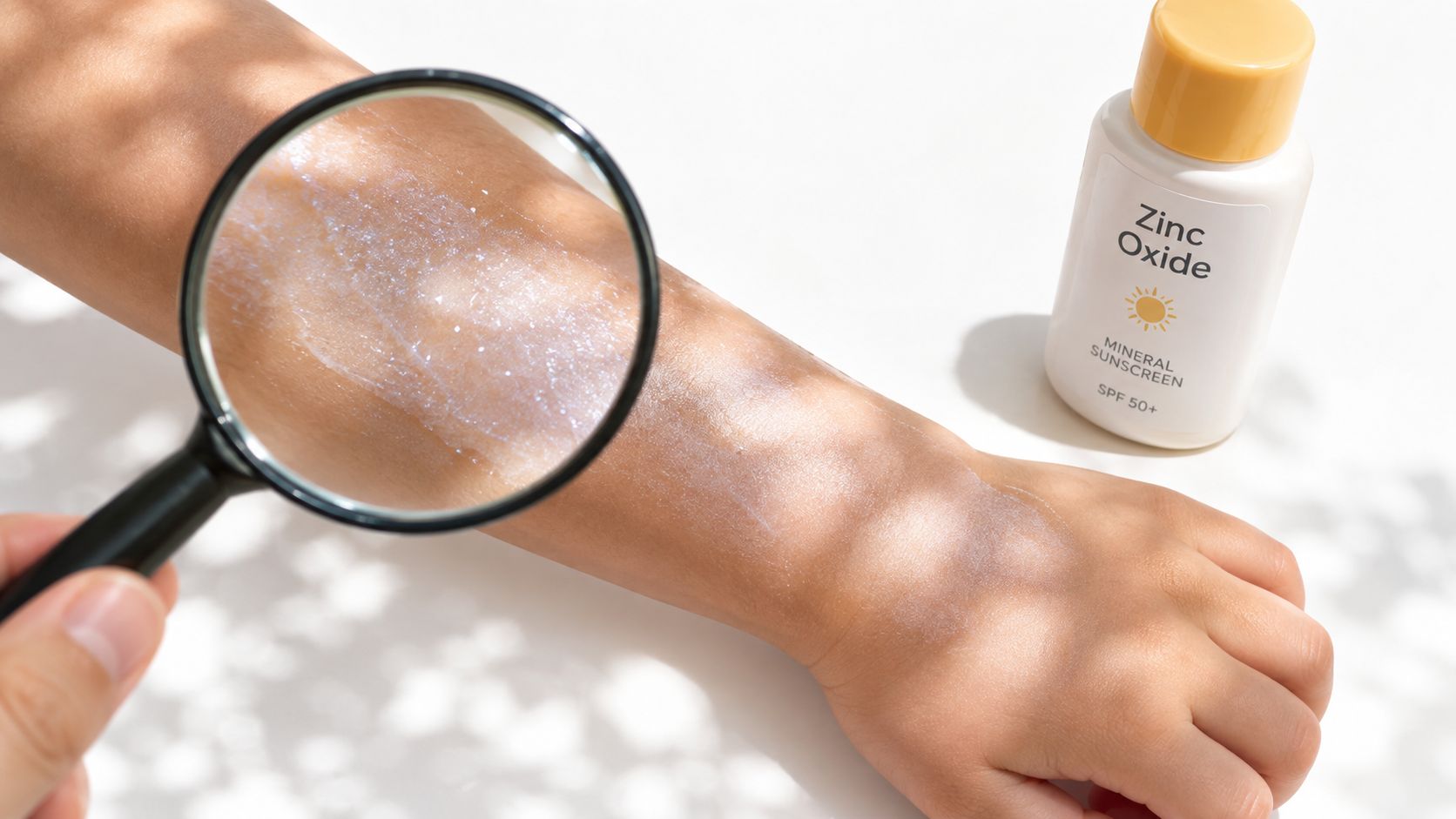
When a child's sunscreen leaves a visible film, that film is part of the protection. The two mineral filters used in children's sunscreens are zinc oxide and titanium dioxide. They form a layer over the outermost skin and scatter or absorb incoming ultraviolet radiation before it reaches living skin cells.
Zinc oxide
Especially useful because it provides broad-spectrum coverage across UVA and UVB wavelengths.
Titanium dioxide
Contributes strong UVB and shorter-UVA protection, so manufacturers often combine the filters for broader mineral coverage.
One DailyMed children's formula lists zinc oxide at 16% and titanium dioxide at 3.4% as active ingredients (DailyMed kids' mineral sunscreen label).
Why the format matters
A lotion or cream makes it easier to apply a continuous layer than a spray. Mineral sprays can release fine particles into the air, raising an inhalation concern, particularly when titanium dioxide becomes aerosolised. Lotions, creams, and sticks are therefore more practical formats for children, especially around the face and on eczema-prone areas. A DailyMed sunscreen monograph outlines formulation considerations and spray-exposure concerns.
Older mineral products were known for a heavy white paste. Micronised and nano-sized particles can improve spreadability and reduce visible residue, but parents should still read the complete label and consider the product format. “Mineral” describes the UV filters, not every ingredient in the bottle.
What children's formulas usually contain
U.S. labels and product examples identify zinc oxide and titanium dioxide as the mineral active ingredients used in children's products. Some formulas use zinc oxide alone; others combine it with titanium dioxide. DailyMed examples include titanium dioxide at 6.4% with zinc oxide at 6.0%, and another formula with titanium dioxide at 8% and zinc oxide at 10% (DailyMed product examples).
The long-standing U.S. recognition of zinc oxide and titanium dioxide as safe and effective over-the-counter sunscreen actives helps explain their strong presence in children's products. For a plain-language explanation of what mineral sunscreen is and how it works, focus on the practical point: the filter type matters, but age, skin condition, ingredients, and reliable application matter too.
Related GuideWhat Is Mineral Sunscreen and How It Works→Mineral Filters Versus Chemical Filters in Real Life
Parents rarely compare sunscreen filters in a laboratory. They compare them while a child is squirming, crying because a product stings, or trying to get dressed before swimming lessons. The useful question is not “Which category wins every time?” It's “Which trade-offs fit this child and this day?”
Mineral filters tend to suit children with sensitive, eczema-prone, or reactive skin because zinc oxide and titanium dioxide remain on the skin's surface and are less likely to sting. Chemical formulas may feel lighter and disappear more completely, which can matter for darker skin tones or children who refuse a visible cream. Both types can still contain fragrance, preservatives, or other inactive ingredients that trigger a reaction.
| Dimension | Mineral Filters, ZnO and TiO₂ | Chemical Filters, oxybenzone, avobenzone, and others |
|---|---|---|
| Skin feel | Can feel thicker and may leave a white cast | Often lighter and more transparent |
| Irritation | Commonly preferred for sensitive and eczema-prone skin | Some formulas may sting, especially near the eyes |
| UV action | Sits on the skin and forms a protective barrier | Absorbs UV radiation through chemical filters |
| Label simplicity | Mineral-only products should list zinc oxide and/or titanium dioxide as actives | May list several organic chemical filters |
| Environmental questions | Non-nano mineral formulas are often chosen by reef-conscious families | Oxybenzone and octinoxate receive particular environmental scrutiny |
| Best practical fit | Sensitive skin, children, face sticks, controlled lotion application | Children or adults prioritising invisible wear and lighter texture |
Where chemical formulas still have a place
A child with a deeper skin tone may find a white cast frustrating, particularly on the face. An active older child may also tolerate a lighter formula better than a thick lotion, and consistent use matters. Those are real considerations, not failures of mineral sunscreen.
My professional preference for younger children remains mineral first, especially when the child has a history of irritation. However, I don't think parents benefit from treating every chemical filter as identical or from abandoning sun protection because a mineral formula is cosmetically imperfect. This mineral versus chemical sunscreen comparison provides additional context for weighing those differences.
CompareMineral vs Chemical Sunscreen→Age, Skin Type, and the Pediatric Rules That Matter
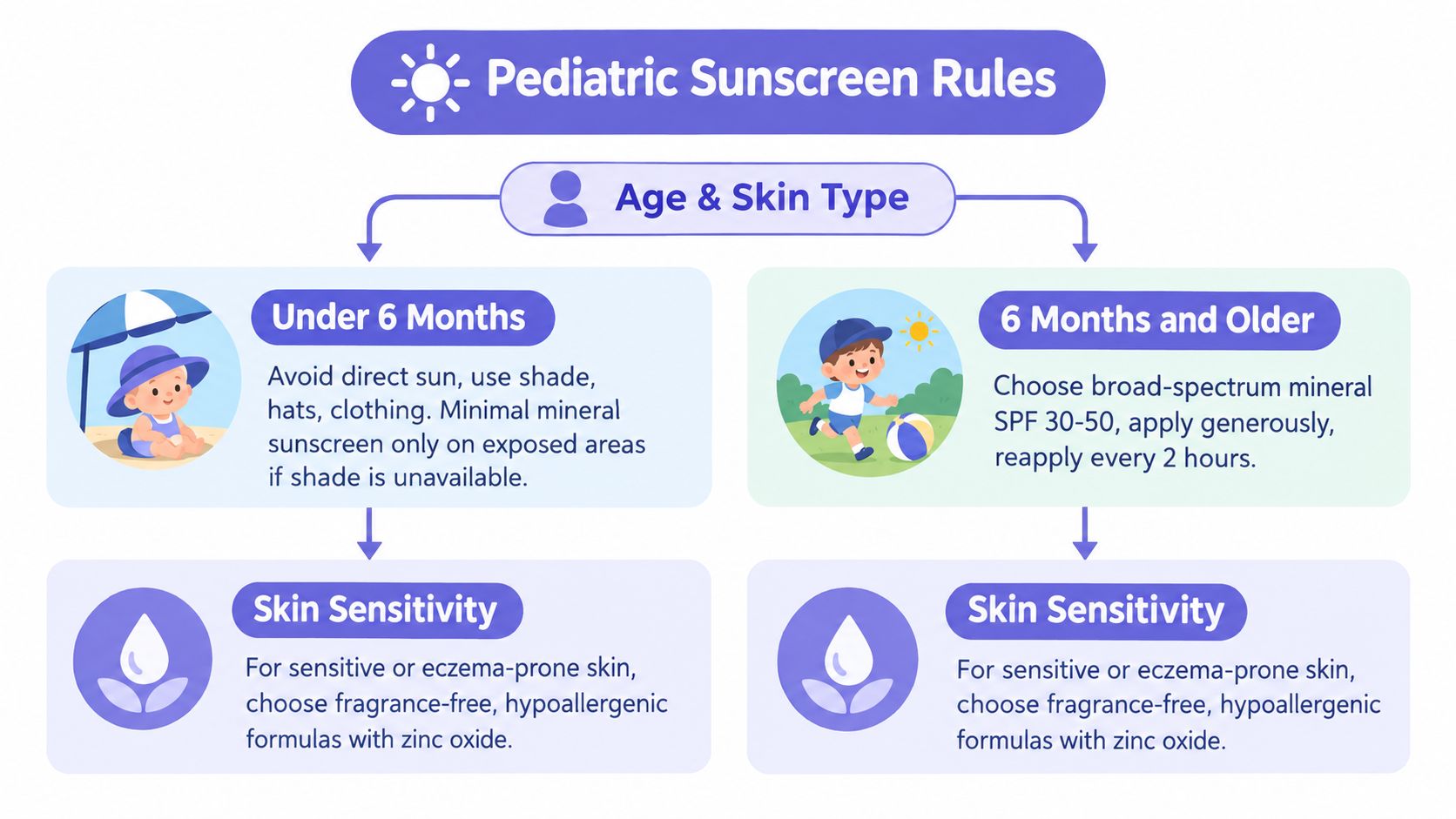
The first decision is age, not SPF. Infants under 6 months generally shouldn't use sunscreen as routine sun protection. Their best protection comes from shade, a hat, protective clothing, and avoiding direct sun. If exposure can't be avoided, pediatric guidance allows mineral sunscreen on small exposed areas rather than treating it as the main protective strategy, as described by NewYork-Presbyterian's pediatric sunscreen guidance.
For babies 6 months and older, the baseline becomes broad-spectrum protection with SPF 30 or higher. That recommendation applies across skin tones because darker skin still needs protection from UV exposure, even though the visible signs of sun damage and the likelihood of burning may differ.
The second decision is skin condition
Age tells you whether sunscreen should be part of the routine. Skin condition helps determine which formula is most comfortable.
- Eczema-prone skin: Choose a fragrance-free mineral formula and avoid applying it over a significant active flare unless a clinician has advised you to do so.
- Sensitive skin: Look for a short ingredient list, no added fragrance, and a lotion or cream that doesn't sting.
- History of contact reactions: Patch test on a small area before covering the child in sunscreen.
- Darker skin tones: Mineral remains a valid option, but a tinted formula may reduce the cosmetic objection to visible residue.
- Healthy, non-reactive skin: Zinc oxide alone or zinc oxide combined with titanium dioxide gives you a straightforward mineral starting point.
The Children's Hospital of Philadelphia advice on sunscreen safety highlights an important nuance that generic product lists often skip: for babies younger than 6 months, sun avoidance comes first, while mineral sunscreen may be reserved for unavoidable exposure.
A fragrance-free baby moisturiser can also support the surrounding routine. This fragrance-free baby lotion guide may help parents distinguish a gentle base routine from a sunscreen decision.
Routine SupportFragrance-Free Baby Lotion Guide→Applying and Reapplying Mineral Sunscreen the Right Way
A child can have a well-chosen mineral sunscreen and still receive inadequate protection if the layer is thin or patchy. Cream often looks excessive at first, then seems to disappear during rubbing. Cover every exposed area evenly, including places that are easy to overlook.
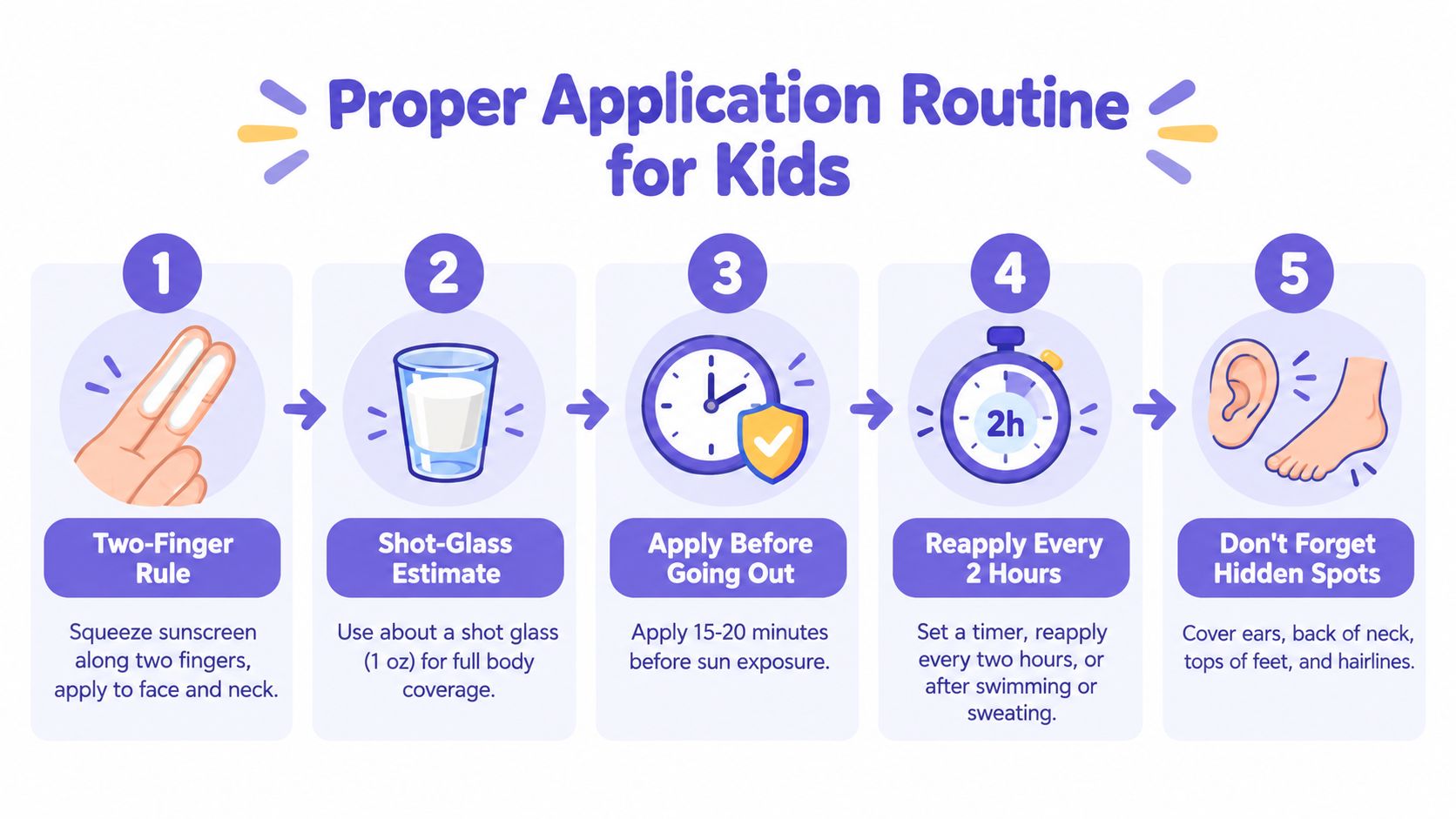
For the face and neck, the two-finger rule offers a practical starting point. Squeeze sunscreen along two adult finger lengths, then spread it across the child's face and neck. For the whole body, use approximately a shot-glass amount, or 1 ounce, as a working estimate. The labelled SPF assumes enough product is applied, so a light smear will not provide the protection shown on the bottle.
A routine that survives real family life
Apply sunscreen before the child runs outside, giving the film time to settle before clothing, hands, or playground equipment rub against the skin. Put moisturiser on first, sunscreen second, and insect repellent after sunscreen when both are needed.
Check the areas parents commonly miss:
- Ears and the tops of feet
- Back of the neck
- Hairline and scalp part
- Bridge of the nose
- Shoulders and exposed forearms
Water resistance lasts for a limited time. Children's products commonly state 40 or 80 minutes during swimming or sweating, so read the bottle rather than treating the sunscreen as waterproof. Towel-drying removes product from the skin. This sunscreen reapplication guide can help families build reapplication into outdoor routines.
Reapply every two hours, and sooner after swimming, heavy sweating, or towel-drying. A phone timer at the pool is useful because active play makes elapsed time easy to lose track of.
White Cast, Reef Safety, and Whether Mineral Really Means Mineral
The white cast is not a manufacturing mistake. It comes from the mineral particles that create the protective film on the skin. If a formula looks completely invisible, it may use a tint, smaller particles, or additional ingredients to improve appearance.
You can reduce the cast without pretending it will vanish on every skin tone. Warm the lotion between your palms, apply it in small sections, and massage it in gradually rather than spreading a large white layer across the entire face. Tinted mineral formulas can improve appearance, but check that the active ingredients still match your preference.
Reef language needs a careful reading
Oxybenzone and octinoxate are the chemical filters most often associated with restrictions in coral-protected waters. Families who want a mineral option may choose non-nano zinc oxide or titanium dioxide, but “reef-safe” isn't a universally regulated guarantee. Local rules can differ, and sunscreen is only one part of reducing environmental exposure.
The more complicated issue is label trust. A bottle can use “mineral” prominently while combining mineral filters with chemical UV filters. An Australian analysis reported that more than a third of products marketed as mineral-only contained unregulated chemical UV filters (analysis of Australian sunscreen labels). That finding doesn't mean every mineral-labelled product is misleading, but it does make the active panel more important than the front label.
| Front-of-Bottle Claim | What Active Ingredients Should Appear |
|---|---|
| Mineral sunscreen | Zinc oxide and/or titanium dioxide |
| Mineral-only | Zinc oxide and/or titanium dioxide, with no additional chemical UV filters |
| Natural or clean | Treat as marketing language, then inspect the full label |
| Reef-friendly | Check local water restrictions and the complete formula |
| Baby or kids | Confirm age guidance, active filters, SPF, and water-resistance details |
Read the back before trusting the front. The Drug Facts or active ingredient panel tells you what provides UV protection. Terms such as “natural” and “clean” don't replace that information.
Third-party testing can add confidence, especially when a brand provides transparent batch information and a clear ingredient list. It's a trust signal, not permission to skip the label.
A Parent's Checklist for Choosing and Trusting a Label
At the shelf, you don't need to memorise every sunscreen ingredient. You need a fast screening process that separates a mineral formula from one that uses mineral language.
Start with the active panel. For a mineral-only product, look for zinc oxide alone or zinc oxide combined with titanium dioxide. U.S. children's labels consistently use those two mineral actives, and a DailyMed example lists zinc oxide and titanium dioxide together in clearly stated concentrations.
Next, look for broad-spectrum coverage and SPF 30 or higher. Broad-spectrum means the product is intended to protect against both UVA and UVB, while SPF primarily communicates the product's tested protection against sunburn-producing UVB. A high SPF doesn't compensate for missed ears, thin application, or failure to reapply.
The ten-second label scan
- Active ingredients: Choose zinc oxide, with or without titanium dioxide, if you want mineral-only protection.
- SPF: Select SPF 30 or higher for children 6 months and older.
- Broad-spectrum wording: Confirm that the label explicitly states broad-spectrum protection.
- Water resistance: Look for 40 or 80 minutes if the child will swim or sweat.
- Fragrance: Prefer fragrance-free formulas for sensitive or eczema-prone skin.
- Expiration date: Don't buy a product with an unreadable or missing date.
- Batch or lot code: Keep this information if you need to contact the manufacturer.
- Quality signals: Consider credible third-party testing or review programmes, such as USP, ConsumerLab, or an independent dermatologist review programme, where applicable.
- Texture: Choose a lotion, cream, or stick if inhalation from sprays is a concern.
- Child cooperation: A formula that gets applied thoroughly is more useful than an ideal formula left unopened.
Price deserves a practical test. A higher price can be justified by a comfortable texture, reliable packaging, transparent testing, or a formula that a child will wear. It isn't automatically justified by pastel packaging, vague “clean” language, or an impressive front-of-bottle story.
For infants under 6 months, the label scan shouldn't replace shade, hats, and clothing. For older children, it should support a routine that families can repeat on ordinary days, not only at the beach.
A Short Recap and a Take-With-You Checklist
The most reliable framework is age first, skin condition second. Infants under 6 months should stay out of direct sun as much as possible, using shade, hats, and protective clothing rather than sunscreen as routine protection. If avoidance isn't possible, mineral sunscreen may be used sparingly on small exposed areas, following pediatric guidance.
For children 6 months and older, choose broad-spectrum mineral sunscreen with SPF 30 or higher. Zinc oxide alone offers a simple mineral option, while zinc oxide combined with titanium dioxide is also common. Children with sensitive or eczema-prone skin usually do best with fragrance-free formulas, but patch testing remains sensible when allergies or previous contact reactions are part of the history.
Application matters as much as the bottle. Use the two-finger amount for the child's face and neck, apply generously to exposed skin, and reapply every two hours, or immediately after swimming, sweating, or towel-drying. Water-resistant labels describe a testing window, not permanent protection.
The product you can apply properly and repeat is the product that belongs in your beach bag.
Printable shelf and beach-bag checklist
- Age: Under 6 months means shade, clothing, and hats first.
- Active ingredients: Zinc oxide alone, or zinc oxide with titanium dioxide.
- SPF: SPF 30 or higher for children 6 months and older.
- Coverage: Broad-spectrum wording for UVA and UVB protection.
- Water resistance: Confirm whether the label states 40 or 80 minutes.
- Skin needs: Fragrance-free and simple for sensitive or eczema-prone skin.
- Label trust: Verify that the mineral claim appears in the active ingredient panel.
- Product condition: Check the expiration date and batch or lot code.
- Application: Cover ears, neck, hairlines, nose, feet, and every exposed area.
- Timing: Reapply every two hours and after water play or towel-drying.
I'm confident this approach will solve the confusion that sends parents back and forth between sunscreen shelves. Mineral sunscreen for kids isn't about finding a perfect bottle. It's about matching the child's age and skin, checking what provides the protection, and choosing a texture your family can use consistently.
Sun protection and gentle care for your family
Healtsy offers pharmacy and skincare products for family routines, including sun protection and gentle care for sensitive skin. Explore curated options, use the skincare quiz for personalised recommendations, and choose products that fit your child's everyday needs.
Explore Healtsy