


Vitamin C Serum Benefits: A Pharmacist's Complete Guide
You've bought a vitamin C serum, placed it beside your cleanser, and applied it faithfully every morning. Weeks later, your skin looks much the same, while the product has changed from clear to yellow or brown. It's easy to conclude that vitamin C doesn't work.
After 16 years in the pharmacy sector, I believe the more useful conclusion is usually different. Vitamin C can support brighter-looking, smoother skin, but the result depends on whether the formula keeps the active ingredient stable, whether it can reach the skin, and whether you use it long enough to judge it fairly. This is the complete guide to vitamin C serum benefits, without reducing the decision to one impressive percentage on the bottle.
Why Your Vitamin C Serum Isn't Working
A shopper once described the familiar routine to me: an expensive serum, a few drops every morning, and no visible change. The bottle had a prominent concentration claim, attractive packaging, and a convincing promise of radiance. What it didn't communicate clearly was how vulnerable L-ascorbic acid, the active form of vitamin C, can be once it meets oxygen, heat, and light.
That matters because a high percentage doesn't guarantee that the same amount remains chemically available when you apply the product. A clear dropper bottle left on a bright bathroom shelf can expose the formula repeatedly to conditions that encourage oxidation. A serum that has visibly darkened, developed an unusual smell, or changed texture deserves caution, even if the label still looks impressive.
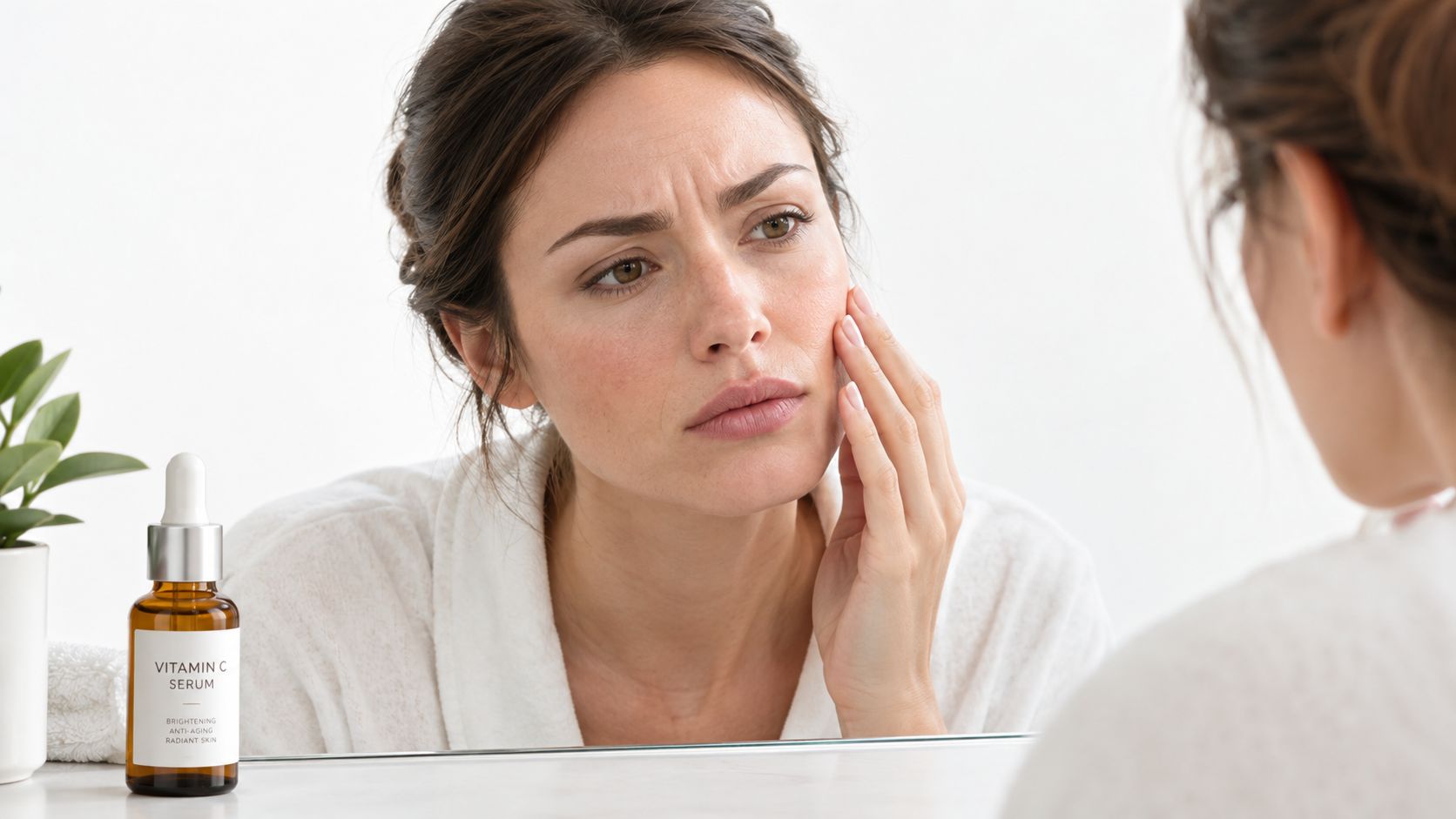
The bottle is part of the formula
Think of L-ascorbic acid like fresh fruit juice. The ingredient may be valuable, but the way you store it affects how much of that value remains. Opaque packaging, limited air exposure, sensible storage, and a clearly stated expiry date are practical quality signals, not decorative details.
You also need to separate two different problems:
Heat, light, and oxygen can reduce the chemical availability of L-ascorbic acid.
An acidic product can sting or cause dryness, particularly when the skin barrier is already irritated.
Clinical studies have assessed visible changes over several weeks or months, not after a handful of applications.
A serum can support the appearance of uneven tone, but persistent or complex pigmentation may require professional assessment.
If your skin is tight, burning, or visibly flaky, pause the serum rather than increasing the amount. A practical guide to vitamin C serum brightening firming can help you compare the cosmetic aims of these products, while Healtsy's advice on repairing a damaged skin barrier is more relevant when irritation is the immediate problem.
Practical rule: A well-preserved, tolerable serum used consistently is more useful than a stronger product that oxidizes or forces you to stop using it.
Price doesn't solve this problem. A premium serum can still be a poor choice if the package allows frequent air and light exposure, while a simpler product may be more sensible if it protects the active and suits your routine. I'm certain that many disappointing experiences come from this mismatch, not from vitamin C being incapable of supporting visible skin improvements.
How Vitamin C Actually Works in Your Skin
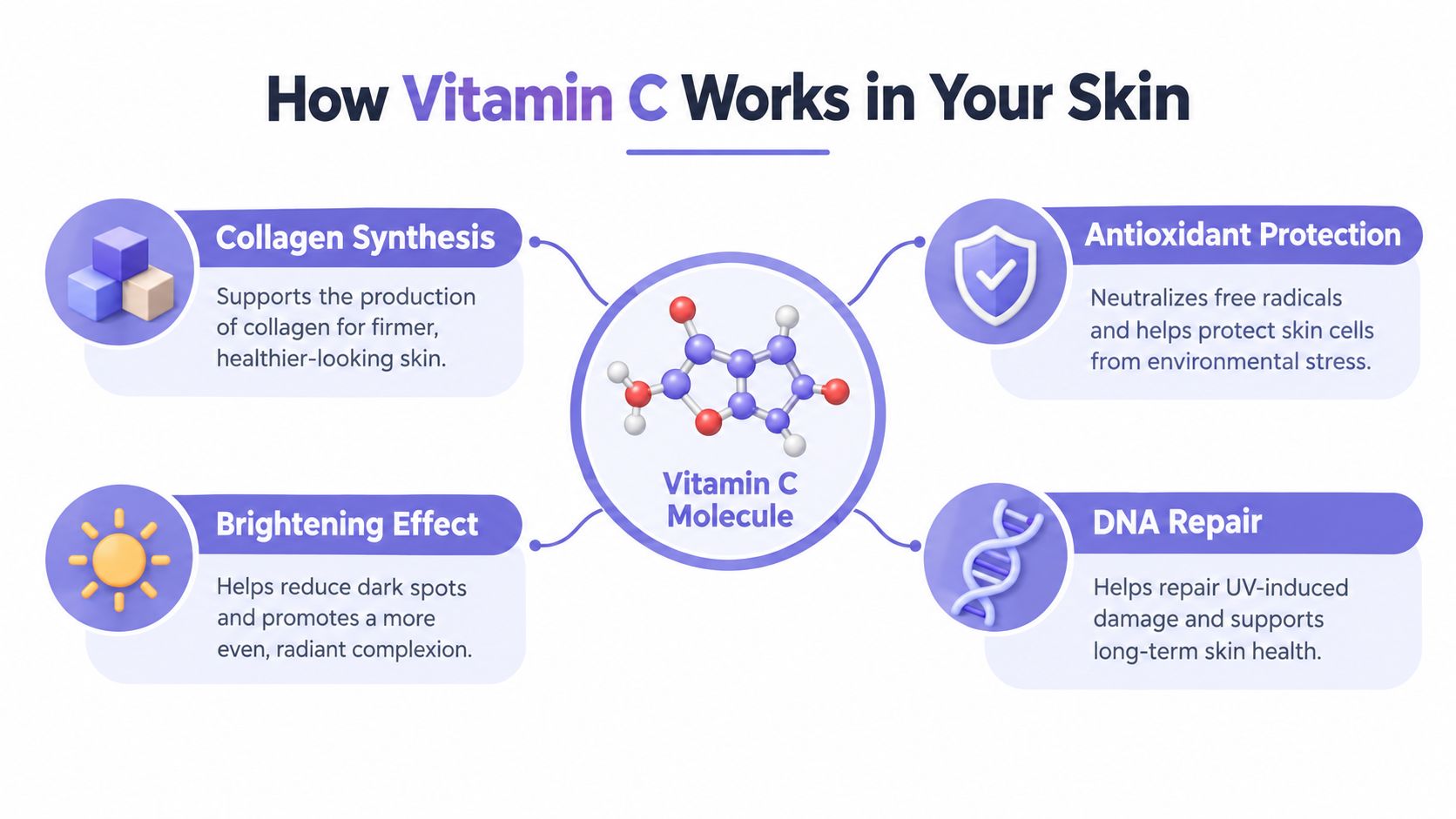
Vitamin C has three especially relevant cosmetic roles: antioxidant support, collagen biology, and melanin modulation. These mechanisms explain why people use it for dullness, fine lines, uneven texture, and the appearance of dark spots, but they don't mean every serum will produce the same result.
Antioxidant support
Ultraviolet exposure generates reactive oxygen species, unstable molecules that can contribute to oxidative stress in skin. Vitamin C can help neutralize some of these molecules. A simple analogy is a fire extinguisher in a kitchen. It doesn't prevent every possible fire, and it doesn't replace safe cooking habits, but it can help limit oxidative damage when used as part of a broader routine.
That's why I describe morning vitamin C as a supporting step, not a sunscreen replacement. Broad-spectrum sunscreen remains the product responsible for regulated UV protection. Vitamin C may complement that protection by helping the skin manage oxidative stress, but it doesn't provide an independent sunscreen effect.
Collagen support
The skin uses vitamin C in collagen-related processes. Collagen gives skin much of its structural support, and vitamin C helps support collagen synthesis, stabilize collagen fibers, and reduce collagen breakdown in the biological pathways discussed in dermatological reviews. In practical terms, this is why a realistic goal is gradual improvement in the appearance of fine lines and texture, rather than an instant tightening effect.
The ingredient works more like a construction assistant than a cosmetic filler. It supports the conditions involved in maintaining skin structure, but it won't physically lift loose skin or erase deep lines after one application.
Melanin and uneven tone
Vitamin C also influences melanogenesis, the process involved in melanin formation. By inhibiting parts of that pathway, topical vitamin C can help improve the appearance of uneven pigmentation over time. That makes it relevant for dullness and some dark marks, although it shouldn't be presented as a guaranteed treatment for melasma or other skin diseases.
The important qualifier is delivery. L-ascorbic acid must reach the appropriate skin layers in a chemically available form. A product that sits on the surface, has degraded in the bottle, or irritates the user so much that it's applied sporadically won't offer the same practical value as a stable, tolerable formula. For a useful product-specific comparison, review the formulation details in this guide to SkinCeuticals C E Ferulic.
This video provides another visual explanation of how vitamin C is used in skincare routines.
A 2023 systematic review identified 7 relevant publications involving 139 volunteers, and the studies generally reported smoother, less wrinkled-looking skin and significant lightening in objective pigmentation assessments. The review also described the evidence base as limited and heterogeneous, so I believe the responsible promise is cosmetic improvement with consistent use, not a guaranteed transformation. (Systematic review of topical vitamin C)
L-Ascorbic Acid Versus Stable Derivatives
The central choice is not “weak vitamin C versus strong vitamin C.” It's a choice between a directly active but fragile form and derivatives designed to improve stability or tolerability.
L-ascorbic acid has the strongest clinical support among topical vitamin C forms. To penetrate effectively, it generally needs an acidic aqueous formula below pH 3.5, which creates a delivery advantage but can also create a comfort problem. Skin that's dry, recently over-exfoliated, or already inflamed may react with stinging, redness, or increased tightness.
Stable derivatives take a different route. Examples include magnesium ascorbyl phosphate and tetrahexyldecyl ascorbate. They're designed with different solubility and stability characteristics, and many users find them more comfortable. The trade-off is that their conversion into active vitamin C, skin penetration, and human clinical evidence can vary. You can't assume that a derivative with the same headline percentage will perform like L-ascorbic acid.
A practical comparison
| Feature | L-ascorbic acid | Stable derivatives |
|---|---|---|
| Evidence | The most extensively studied topical form | Evidence varies by derivative and product |
| Formulation | Usually requires a low-pH system | Often designed for different stability and tolerability conditions |
| Skin feel | May sting, especially on compromised skin | Often more comfortable, though not irritation-proof |
| Main weakness | Chemical instability | Conversion and penetration may be less predictable |
| Sensible user | Someone who tolerates acidic formulas | Someone prioritizing comfort or stability |
I wouldn't choose a derivative just because the packaging says “stable,” and I wouldn't choose L-ascorbic acid just because it sounds more powerful. If low-pH products repeatedly sting, a protected derivative that you can use consistently may be the more rational choice. The strongest theoretical formula is not useful if it stays in the drawer.
For readers comparing buffered approaches and oral products with topical routines, buffered vitamin C dosing advice offers useful context, although oral dosing and topical application are not interchangeable. For a product-focused look at a direct topical option, see this guide to Sesderma Vit-C.
A split-face study involving 10 participants tested a formulation containing 10% water-soluble ascorbic acid plus 7% tetrahexyldecyl ascorbate for 12 weeks. The vitamin C side showed statistically significant improvement in photoaging scores on the cheeks, around the mouth, and overall. (Clinical review and formulation evidence) That result is interesting, but it doesn't establish that every combination formula or derivative will produce the same outcome.
Reading Your Serum Label Like a Pharmacist
A serum label gives you clues, but you need to read those clues together. The percentage is only one part of the decision.
Start with the active form
Look for L-ascorbic acid if you want the form with the strongest topical evidence. If the ingredient list names a derivative, identify which one. Magnesium ascorbyl phosphate and tetrahexyldecyl ascorbate aren't interchangeable, and their percentages shouldn't be compared directly with a percentage of L-ascorbic acid.
Next, consider the concentration in context. Evidence commonly supports L-ascorbic-acid formulas within the 10% to 20% range, but that range doesn't make every product equally effective. A lower concentration can be a sensible starting point for reactive skin, while a stronger formula may be unnecessary if it causes persistent discomfort. (Dermatology review of topical vitamin C formulation)
Check the delivery conditions
L-ascorbic acid generally needs a low-pH aqueous vehicle, and absorption depends on pH, concentration, and the delivery system. The label may not disclose pH, but a transparent brand should provide enough formulation information for you to understand whether the product is intended to deliver direct L-ascorbic acid.
Packaging is equally important. Prefer an opaque or light-protective container that minimizes air entry. An airless pump or narrow, air-restricting tube usually gives the formula more protection than an open jar. A dropper isn't automatically poor, but it demands careful storage and exposes the product to more air during repeated use.
Inspect storage and condition
Store the serum according to the manufacturer's instructions, away from direct sunlight and unnecessary heat. Don't leave it on a windowsill, beside a radiator, or in a hot car. If the product has passed its expiry date or its scent and texture have changed, replacing it is more sensible than trying to rescue it.
Ask four questions before purchase:
- What form is used?
- What concentration is stated?
- How is the formula protected?
- Can I store and use it consistently?
Product reviews can clarify packaging and ingredient choices, but they shouldn't replace your own label check. For example, an Andalou Turmeric C serum review may help you understand a particular formula, while the same decision framework still applies to any brand.
The absorption research behind L-ascorbic acid found that delivery increased as pH decreased, with an apparent concentration optimum around 20% under the tested conditions. Higher concentrations didn't necessarily improve delivery, and skin tissue became saturated after approximately three daily applications, with a tissue disappearance half-life of about four days. (Percutaneous absorption study) Those findings help explain why a bigger number isn't automatically a better shopping decision.
Layering Vitamin C Safely With Other Actives
Vitamin C usually fits most naturally into a morning routine: cleanse gently, apply the serum, moisturize if needed, and finish with broad-spectrum sunscreen. The morning timing is practical because antioxidant support and UV protection serve complementary roles. Vitamin C still doesn't replace the sunscreen step.
The main routine mistake is not necessarily using vitamin C itself. It's introducing several potentially irritating products at once. A low-pH L-ascorbic-acid serum combined with direct exfoliating acids or a retinoid can make the skin feel raw, particularly if the barrier is already fragile.
A calmer scheduling approach
Use the routine that allows each product to earn its place without creating cumulative irritation:
- Vitamin C in the morning: Apply it after cleansing, then follow with moisturizer and sunscreen.
- Retinoids at night: Separating a retinoid from vitamin C can make it easier to identify which product causes discomfort.
- Exfoliating acids cautiously: Use AHAs or BHAs on a different occasion if combining them with vitamin C produces stinging or dryness.
- Niacinamide and peptides: These can generally sit alongside vitamin C, provided the complete formula is tolerated.
- Irritated skin: Don't apply an acidic serum to visibly cracked, burning, or inflamed areas.
There's no universal need to wait a fixed number of minutes between every skincare product. If you're using a strong exfoliating acid, moving it to the evening and keeping vitamin C in the morning is usually clearer and easier than trying to layer multiple acidic steps.
For a routine-specific explanation of combining these products, see this guide to layering niacinamide, vitamin C, and sunscreen. Introduce one change at a time, patch-test new products, and reduce frequency if your skin becomes persistently red or uncomfortable.
Common Myths About Vitamin C Concentration
The most persistent marketing shortcut is higher percentage equals better results. It sounds logical, but skincare formulas don't behave like a volume knob that produces more benefit every time you turn it upward.
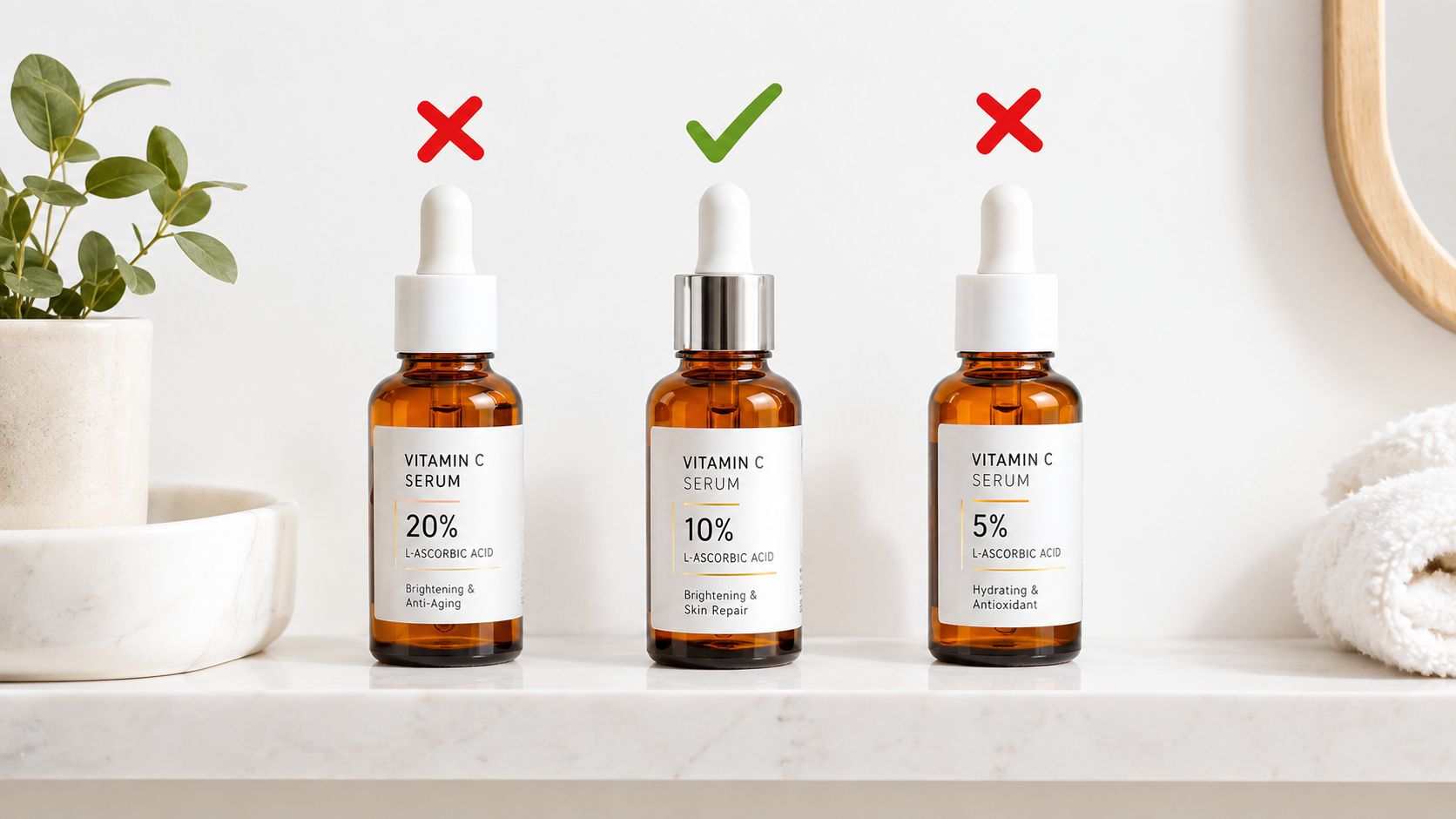
A 20% L-ascorbic-acid serum that has oxidized or irritates your skin may be less useful than a well-preserved 10% formula you can apply consistently. The percentage tells you how much of an ingredient was included, not how much remains active, how well it penetrates, or whether you'll tolerate the product.
What the evidence actually supports
The absorption work discussed earlier found an apparent optimum around 20%, with no clear delivery advantage from pushing the concentration higher under those test conditions. A dermatology review also cautions that concentrations above 20% may increase irritation without improving biological effect. (Topical vitamin C evidence review)
That doesn't mean every 20% product is unsuitable. It means you should judge the complete product. The vehicle, pH, packaging, supporting ingredients, storage instructions, and your skin's tolerance all influence the practical result.
Derivative percentages need translation
A derivative percentage is not a direct measurement of active L-ascorbic acid reaching your skin. Derivatives must undergo conversion, and different forms have different penetration and evidence profiles. A product marketed with a high derivative percentage may therefore be gentler or more stable, but you can't assume it is stronger than a lower-percentage L-ascorbic-acid serum.
Hydration is another area where marketing can overreach. In the systematic review of topical vitamin C, hydration improved similarly in vitamin-C-treated and placebo areas, which suggests hydration wasn't a vitamin-C-specific benefit. Choose a moisturizing serum for hydration, rather than expecting vitamin C alone to transform dry skin.
The better comparison is not 10% versus 20%. It's stable versus oxidized, tolerable versus irritating, and consistently used versus abandoned.
Concentration matters, but it belongs near the end of your evaluation, not at the beginning. I believe this single change in shopping behavior prevents many expensive mistakes.
Realistic Expectations and When to See Results
Vitamin C isn't an overnight solution. In a controlled trial, daily 5% topical vitamin C used on sun-exposed skin for 6 months was associated with significant reductions in deep wrinkles and improved texture compared with the vehicle control. Another double-blind trial using 10% topical ascorbic acid for 12 weeks reported significant reductions in photoaging signs and wrinkles compared with placebo. (Controlled clinical trial summary)
Those timelines are more useful than promises of an instant glow. During the early weeks, you may notice little beyond the way the serum feels. A mild transient tingle can occur with an acidic formula, but ongoing burning, swelling, or worsening redness isn't a sign that the product is “working harder.” It's a reason to stop and reassess.
A fair way to assess progress
At around 4 weeks, focus on use and tolerance rather than dramatic transformation. Is the product still fresh? Are you applying it consistently? Has your skin remained comfortable? If your skin is irritated, the routine needs adjusting before you can fairly assess cosmetic benefit.
At 12 weeks, compare photographs taken in similar lighting. Look for gradual changes in brightness, texture, and the appearance of uneven pigmentation. The evidence supports judging many vitamin C formulas after at least this length of consistent use, not after a few applications.
By 6 months, fine-line and texture changes may be easier to evaluate, particularly when you've used sunscreen consistently. Vitamin C supports a sun-conscious routine, but it can't compensate for repeated unprotected UV exposure.
If pigmentation remains persistent or returns repeatedly, consult a qualified dermatologist rather than adding stronger products indefinitely. The guidance on dark spots and hyperpigmentation can help you think through routine options, but a serum shouldn't be treated as a cure for a diagnosed skin condition.
Compare European pharmacy skincare at Healtsy
Healtsy offers European pharmacy and parapharmacy skincare, with product information that identifies active ingredients, concentrations, suitability, and directions for use. Compare vitamin C formulas and other European dermocosmetics, including international delivery options for shoppers buying from outside Europe.
Visit Healtsy