


Beta Glucan Benefits for Skin: What the Evidence Shows
Why does a label that says beta glucan tell you almost nothing?
The word is a family name, not an ingredient specification. Oat, yeast, mushroom and chemically modified beta glucans can differ in structure, molecular weight and behaviour on skin. Most product pages never say which one is in the bottle, what form it takes, or how much is there. Without source, molecular form and concentration, the name on the front cannot support a specific cosmetic claim.
Small human trials do support a moisturising, soothing effect: better water retention and lower water loss over a short course of use, in modest groups, at low leave-on strengths. That evidence fits comfort and barrier support in a daily routine. It does not turn a face serum into wound care, and it does not stand in for prescribed treatment.
I would match every claim to the study that can carry it. Source, form and concentration come first. Then the result that study measured. That reading shows what to buy, how to use it, and when to stop expecting a cosmetic to do a medicine's job.
What Beta Glucan Does for Skin
Beta glucan is a polysaccharide, a chain of glucose units, that formulators extract from oats, yeast and mushrooms. On the surface of the skin it acts like a light, water-holding film: it slows the rate at which water escapes and leaves the skin feeling less tight. Underneath that film it also interacts with receptors on skin cells, which is where the barrier half of the story comes from.
The three roles worth separating are moisturisation, barrier repair and immune signalling in the skin. Marketing leans hardest on the first. The strongest human evidence sits with the first two, and the third is real but studied mostly in laboratory and animal work.
Three sources, in one line each. Oat (Avena sativa) is the best studied for skin and carries the barrier, hydration and laser-model trials discussed here. Yeast (Saccharomyces cerevisiae) appears in serums and essences with far fewer skin-specific studies behind it. Mushroom-derived beta glucan turns up in smaller soothing and antioxidant blends, with the thinnest skin evidence of the three.
The verdict, plainly: beta glucan earns a place in a leave-on routine for skin that feels dry, tight or easily stressed, used twice daily for several weeks. It does not replace prescribed care for eczema, psoriasis, infected or deep wounds, or active acne lesions.
Expect gradual comfort rather than a visible overnight change, because the trials behind it asked people to use a product consistently, not once. If your main complaint is flatness rather than tightness, the guidance on a hyaluronic acid serum covers the plumping side of hydration, and the two ingredients layer well.
Where the concern shifts from dehydration to fixed lines and laxity, that's a separate conversation, and clinics approach it with options such as non-surgical facial rejuvenation in Peoria rather than a moisturiser. Knowing which problem you have is half the decision.
Oat, Yeast and Mushroom Sources Compared
A pack can print "beta glucan" and still tell you almost nothing. Until it names the source, the molecular form and the concentration, a claim about penetration, soothing or barrier support cannot be lined up against the next bottle. A 2025 review in Food Science & Nutrition makes the same point: the family differs in glycosidic structure, molecular weight, solubility and biological behaviour (the 2025 Food Science & Nutrition review).
Molecular weight explains more than the percentage on the front. A long chain stays on the surface and forms a film. A shorter chain can mix further into the upper epidermis. There is no agreed clinical threshold for how far either form travels in living skin. I would not treat a "penetrates deeper" line on the carton as evidence.
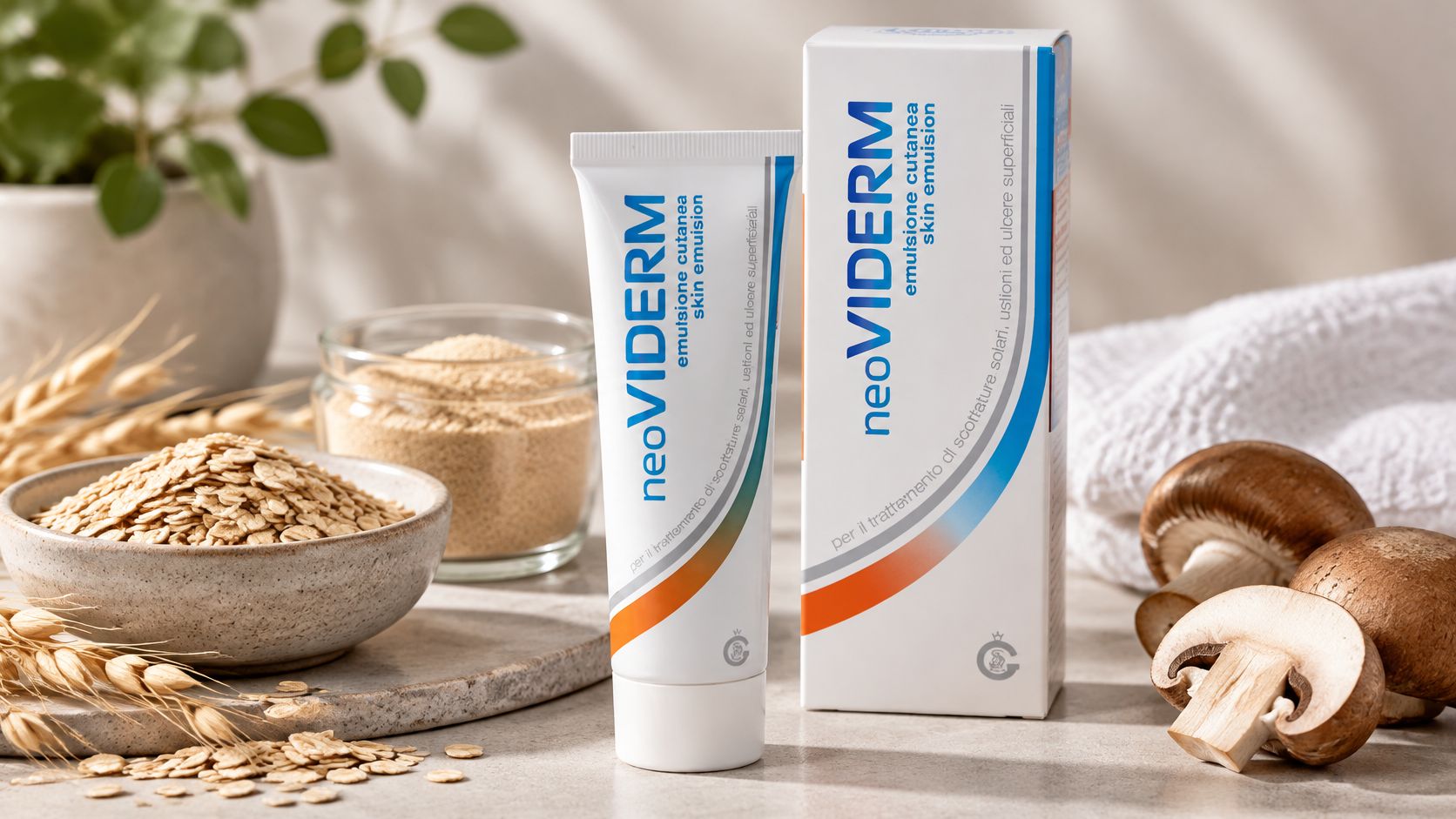
A pharmacy-style emulsion that names its actives is easier to judge than a serum that only says beta glucan.
Why the source changes the product
| Source or form | Where it usually appears | Skin evidence in this guide | What to check on the label |
|---|---|---|---|
| Oat (Avena sativa) | Leave-on moisturisers, emulsions and soothing creams | Most studies: barrier, hydration and laser-model trials | Oat-derived beta glucan named, with concentration where given |
| Yeast (Saccharomyces cerevisiae) | Serums, masks and some hydrating lotions | Limited, mostly cell-level and formulation data | Yeast source named and molecular weight stated if available |
| Mushroom-derived | Niche serums and soothing or antioxidant blends | Very limited for skin; mostly general research | Mushroom source named; treat skin claims with caution |
| Chemically modified (e.g. magnesium carboxymethyl) | Specialist emulsions | One short trial of that named form | Full INCI name, not just beta glucan |
The label routine I'd follow, in order:
- Find the source. If the front says beta glucan and the back does not say oat, yeast or mushroom, you cannot match it to the rows above.
- Check the full INCI name. "Beta glucan" and "sodium carboxymethyl beta glucan" are different entries. A modified form stands or falls on its own trial, not on oat data.
- Skip the percentage race. A higher number is not automatically better. A stated concentration inside a named formula beats a large figure with no source.
The molecular weight. Without it, two serums that both list beta glucan cannot be ranked on penetration.
How Beta Glucan Supports the Skin Barrier
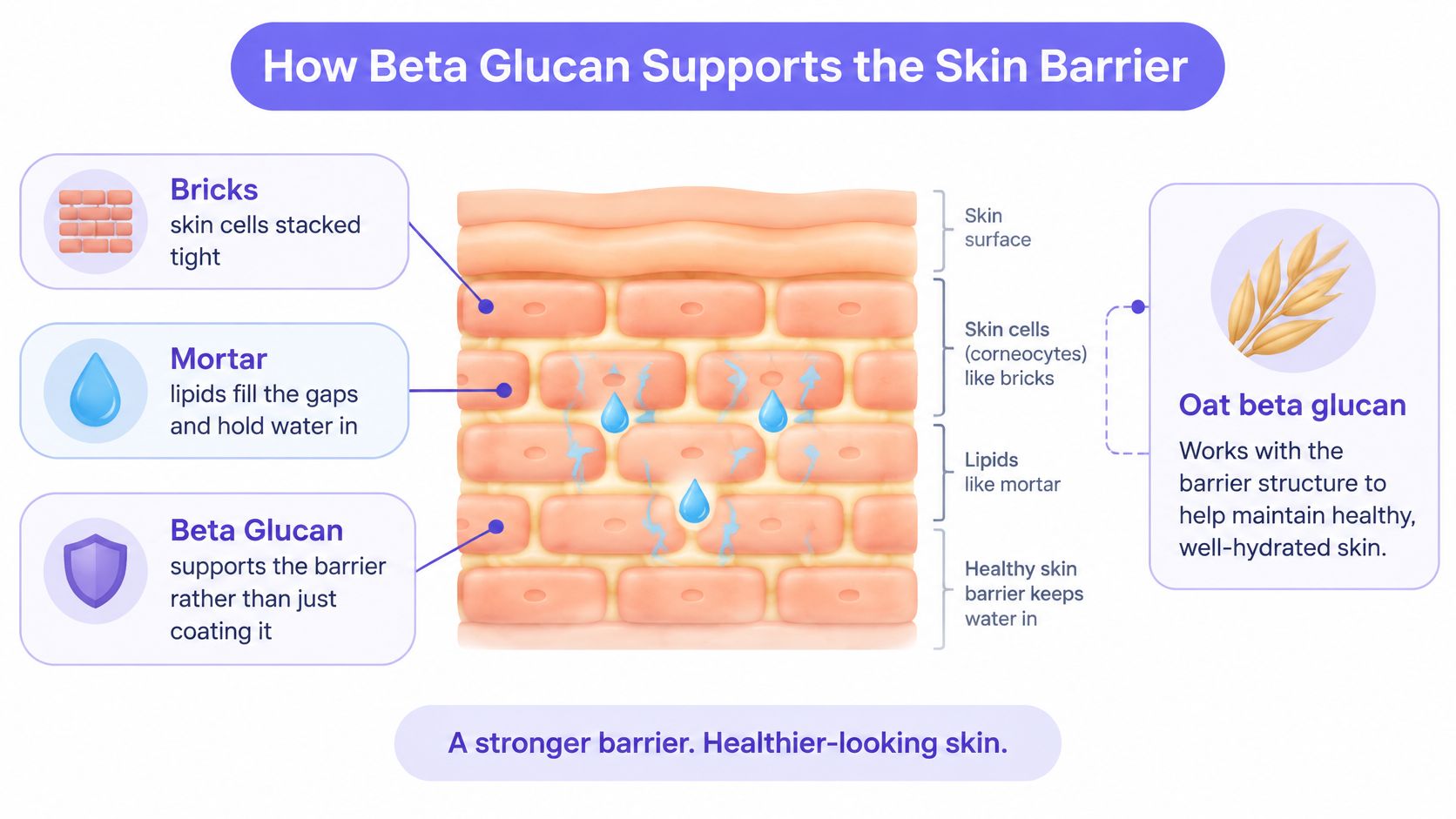
Beta glucan binds Dectin-1 on epidermal cells. From that receptor, the pathway runs through keratinocyte maturation, cell junctions and lipid synthesis, which is how a topical beta glucan can support the barrier instead of only coating the surface.
What happens at the cell level
Experimental work shows oat beta glucan interacting with Dectin-1, a receptor on epidermal cells. Binding switches on downstream ERK and p38 signalling and raises calcium-sensing-receptor expression. In plain terms, that nudges keratinocytes to mature properly (the receptor study). Mature keratinocytes form a tighter outer layer. Gaps left by immature cells let water escape.
The same work reports more cell-to-cell junction proteins and more epidermal lipid synthesis. Junctions hold neighbouring cells together. Lipids occupy the spaces between them. Together those changes lower transepidermal water loss, the lab measure behind skin that stops feeling tight by lunchtime.
A 2024 study in the British Journal of Pharmacology (volume 181, issue 11, pages 1596–1613) reported faster recovery of damaged epidermal barriers through this route, again via epidermal differentiation, junction expression and lipid synthesis (the 2024 study). The 2024 study measured mechanism, not a moisturiser outcome.
The immune side, and its limits
Beta glucan is an immune-active molecule. Soothing formulas draw on that activity, and I keep any calming claim inside the limits of the experiment that produced it. A dish of immune cells can show a response. Disease treatment needs a different kind of evidence.
Exploratory microbiome work points the same way without proving a cosmetic benefit. A 2025 study in Dermatologic Therapy analysed 13,258 operational taxonomic units from 600 facial-skin microbiome samples collected from 10 participants across four points in time and reported more unique OTUs after beta glucan use (the microbiome study). With only ten people, that rise in unique OTUs is a signal worth watching.
Because most of the barrier evidence is cellular or animal-based, change tends to be supportive and slow, and it depends on consistent use. For a fuller picture of how clinicians think about the outer layer, this resource on dermatology and skin health care is worth reading alongside it. If the barrier is already compromised, the practical steps in this guide to repairing a damaged skin barrier matter more than any single active.
A barrier ingredient works when the routine is dull. Same product, twice a day, with your moisturiser, for a month.
Clinical Studies Behind the Skin Claims
A beta glucan line on a label tells you very little until the source, the molecular form and the concentration match a study. Each row below is one study. The useful question is which cosmetic claim that row can support.
Double-blind trials come first. Studies that exist here only as citations inside a review come next. Wound data sits last, because a dressing result is a different category of product from a moisturiser.
| Study | Population | Product and concentration | Duration | Reported result |
|---|---|---|---|---|
| Fractional CO2 laser model (double-blind) | Healthy volunteers with controlled barrier damage | 0.02% and 0.1% oat beta glucan vs no treatment | Up to day 11 | Scabs shed earlier in both groups; 0.1% performed better than 0.02% |
| Atopic-history forearm trial (double-blind, placebo-controlled) | 20 symptom-free volunteers with a history of atopic dermatitis | 0.1% magnesium carboxymethyl beta glucan emulsion vs placebo | 28 days | Higher hydration and smoothness; lower transepidermal water loss |
| Sensitive-skin study (cited in 2025 review) | 13 people with sensitive skin | Formula with 0.5% to 2% beta glucan, twice daily | 6 weeks | Better water retention in the stratum corneum; no erythema observed |
| Skin-ageing study (cited in 2025 review) | 20 men with visible skin ageing | 1.5% beta glucan formula, twice daily | 16 weeks | Significant improvement in firmness and hydration |
| Chronic wound meta-analysis (wound care, not cosmetic) | 354 participants in two chronic-wound studies; 290 in acute-wound studies | Topical beta glucan vs non-beta glucan treatment | 12 weeks | About twice as many chronic wounds healed; acute-wound results inconclusive |
The laser model earns the top row because it was double-blind, controlled, and measured an objective change rather than asking people how the skin felt. I would let it support a soothing and barrier-support claim after the skin has been deliberately stressed. It says nothing about ordinary dryness or a stinging cheek in winter, and an oat fraction does not stand in for yeast or mushroom beta glucan in another base.
The forearm trial is the cleaner hydration test: test emulsion on one arm, placebo on the other. It supports hydration and lower water loss in people whose skin is comfortable at the time of testing. A past history of atopic dermatitis is not an active flare, so I would not stretch it to promise relief during one.
The 2025 review does not add a new trial. It summarises two older, formula-specific studies (the 2025 review). One supports better water retention in sensitive skin without observed redness. The other supports firmness and hydration in men with visible ageing. Both samples are small, both products were their own blends, and the sensitive-skin formula was not pinned to a single strength.
Wound care is where the reputation started, and it is a poor place to borrow confidence for a face cream. A 2018 review summarised four human studies involving fewer than 90 participants in total, including a 3% water-insoluble beta-(1,3)-glucan cream applied to ulcers in 12 patients (the 2018 review). A later meta-analysis found more chronic wounds healed with topical beta glucan than with non-beta glucan care, while acute wounds stayed inconclusive (the meta-analysis). Healing an ulcer is a medical endpoint. It does not licence "repair," "firmness," or "calm redness" on a cosmetic jar.
Small samples and different formulas mean each result belongs to the product that was tested. Match source, form and strength before you treat a study as evidence for the bottle in your hand.
Concentrations and What to Check on the Label
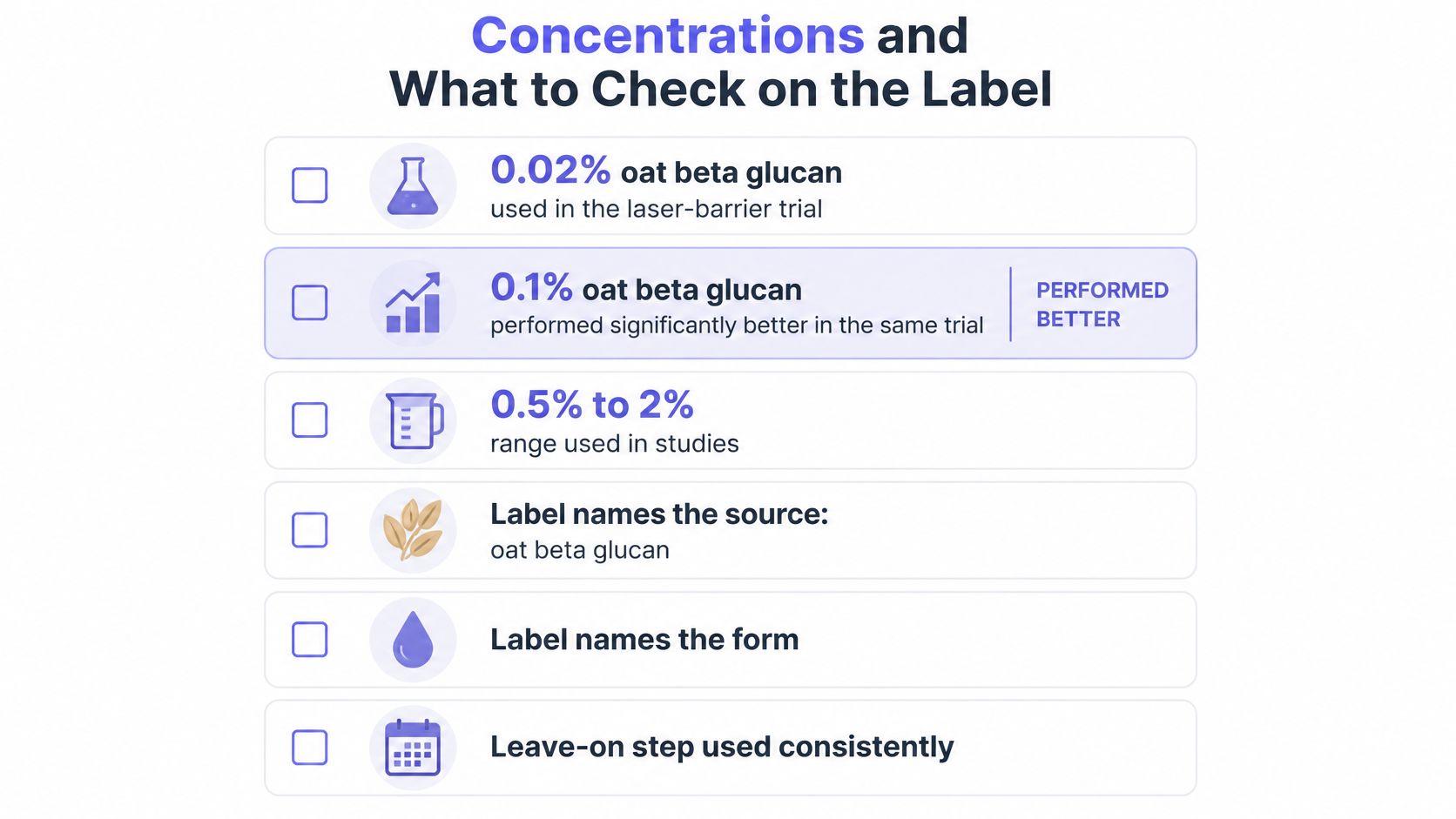
Beta glucan on a label tells you little until you can name the source, the molecular form, and the concentration. Those three details are what let you line a bottle up with a study, and with the cosmetic claim that study can actually support.
The percentages already sit in the table above. I use that table for one job: which amount was tied to which outcome, in which formula. A figure from one product does not travel to another. No proven ceiling exists. A higher percentage may give you more of the material a trial used, or more of a form that trial never tested. The vehicle and the source carry as much weight as the number.
The short video below walks through that limit in plain terms: what a printed percentage can tell you, and what it cannot transfer from one formula to the next. The checklist under it is the same check, in the order I use at the shelf.
Reading the INCI list like a pharmacist
In routine pharmacy label reading, ingredients used in larger amounts tend to sit earlier on the INCI list. That order is only a rough guide. A stated percentage is clearer. Once the amount is small, position on the list tells you little about dose.
My checklist, in the order I work through it:
- Source named. Oat, yeast, or mushroom, not the bare words "beta glucan".
- Molecular form or full INCI name. A modified form should appear as itself, not under a generic term.
- A printed percentage, when the brand gives one. Compare it with the table. Do not treat it as proof the same result will follow.
- Leave-on format. Serum, emulsion, or cream, not a rinse-off cleanser.
- A moisturising base. Other hydrating ingredients alongside it, which is how the tested formulas were built.
- Twice-daily directions. That matches the routine in the studies.
- Fragrance-free if your skin reacts easily, then a patch test on the inner forearm before the face.
Match the claim to the evidence you can see. Hydration and barrier comfort belong with leave-on formulas that resemble the ones studied. A percentage alone does not turn a cleanser, or an unnamed extract, into that evidence.
Who Benefits by Skin Type and Concern
Which skin gains from beta glucan, and which concern is asking it to do a job no trial here measured?
Comfort, hydration and a steadier barrier are the claims the studies can carry. I match the person to that claim, then check the jar names a source and a form close to what was tested, usually a leave-on emulsion, not a rinse-off wash. A clinical-sounding label does not change the job.
Dry, tight skin is the straightforward match. Hydration and comfort showed up in trials run for about a week to four weeks, always twice a day. That schedule is how the products were tested. It is not a promise that tightness will be gone by a set day.
Sensitive skin has the friendliest cosmetic reading: better water retention over six weeks, with no redness recorded in that one formula. Choose fragrance-free, and patch test first. One studied product is not the whole category.
Mature skin with dryness gets a supporting role. The 16-week study, already set out in the clinical studies table, found firmness and hydration gains in a small group of men. Welcome, and modest. Keep the anti-ageing plan. Beta glucan sits beside it.
Oily and acne-prone skin is the honest gap. No trial in this guide looked at those faces, so a light emulsion is reasonable only if it does not feel heavy. Active lesions still need treatment. A moisturiser is a comfort step.
Atopic or eczema-prone skin is supportive only, and only between flares. The forearm comparison, summarised with the clinical studies, is the reference: symptom-free volunteers with a history of atopic dermatitis used a modified beta glucan emulsion twice daily and had higher hydration and lower water loss than on the placebo arm (the forearm trial). That is comfort, not flare care. During a flare, follow the dermatologist's plan. Day-to-day product choices sit in this guide to skincare for eczema.
Damaged or post-procedure skin needs a clinician before a cosmetic goes on. Barrier recovery in the evidence comes from a controlled laser model, not from home use on broken skin. Where skin is very dry, cracked or irritated and an occlusive layer helps, a plain ointment-style moisturiser with glycerin and panthenol, fragrance-free, can sit over a beta glucan cream. Healtsy carries body moisturisers for dry skin and eczema-prone skin for that supporting role.
| Skin type or concern | Realistic expectation | Fit for beta glucan | Key limit |
|---|---|---|---|
| Dry or tight skin | Hydration and comfort with regular leave-on use | Good fit | Twice daily, as the trials were run |
| Sensitive skin | Better water retention without redness in the sensitive-skin study | Good fit in fragrance-free formulas | Patch test first |
| Mature skin with dryness | Modest firmness and hydration support | Supportive | Keep a separate anti-ageing plan |
| Oily or acne-prone skin | No skin trial in this guide | Untested; only if the formula feels light | Active acne needs treatment, not cosmetics alone |
| Atopic or eczema-prone skin | Higher hydration and lower water loss between flares | Supportive only | Follow the dermatologist's plan during flares |
| Damaged or post-procedure skin | Barrier recovery only in a controlled laser model | Ask a clinician first | Not a wound treatment |
If the need is comfort, beta glucan is a sensible choice. If the condition is medical, treat that first and let the moisturiser support it.
Safety, Tolerability and When to Stop
Beta glucan is generally well tolerated in the studies reviewed, and the sensitive-skin study recorded no erythema. Small trials can't promise the same for every face, so a patch test on the inner forearm for three days before facial use is a reasonable precaution, not paranoia.
Check the INCI list for anything you already react to, and note the source if you have a known oat or yeast sensitivity. If your skin runs reactive, start once a day and build to the twice-daily pattern the trials used. That approach is covered in more depth in this guide to the best serum for sensitive skin.
Stop the product and seek advice if you notice itching, burning, spreading redness, a rash or swelling. Don't apply it to broken, weeping, infected or inflamed skin without a clinician's view, because wound-care findings don't carry over to a cosmetic emulsion. If irritation lasts more than a few days, or a skin condition worsens, speak to a pharmacist or dermatologist.
Pairing Beta Glucan With Other Actives
Compatibility is less complicated than the internet suggests. Beta glucan is a moisturising, barrier-supporting ingredient, and it sits comfortably with most actives. Timing is what keeps a routine calm.
| Active | How to pair | Why it works | Watch for |
|---|---|---|---|
| Hyaluronic acid | Layer under moisturiser | Both support hydration; beta glucan adds barrier support | Patch test if skin is reactive |
| Niacinamide | Use together in the same routine | Complementary support for comfort and barrier | Introduce one new active at a time |
| Ceramides | Apply as the moisturising step | Supply the lipids that beta glucan helps the skin build | Choose fragrance-free formulas if skin is sensitive |
| Vitamin C serum | Morning, on clean skin, then beta glucan | Antioxidant first, moisturiser after | Let the serum absorb before applying the moisturiser |
| Retinol | Night, wait until dry, then beta glucan | Beta glucan buffers the dryness retinol can cause | Start with a few nights per week |
| Glycolic or salicylic acid | Exfoliate first, wait 10 to 15 minutes, then beta glucan | Calms the skin after exfoliation | Do not layer directly onto freshly exfoliated skin |
Hyaluronic acid and niacinamide are the easy pairings. Layer them under a moisturiser and you get hydration plus barrier support in one step, which is where Healtsy's catalogue leans, since our products include formulas built around niacinamide, hyaluronic acid, retinol, glycolic acid and vitamin C.
Ceramides deserve their own mention. They supply the lipids that beta glucan encourages the skin to build, so a ceramide moisturiser on top is a logical finish rather than a duplicate purchase.
Vitamin C belongs in the morning, on clean skin, given a minute to absorb before the beta glucan layer goes on. Retinol belongs at night, applied to dry skin, with beta glucan afterwards to buffer the dryness that retinol often brings. Start with a few nights a week.
Acids need the most patience. Exfoliate, wait 10 to 15 minutes, then apply beta glucan, and never layer it straight onto freshly exfoliated skin. If your skin feels tight or stings, reduce the strong actives rather than adding products. The mechanics of ordering a routine are set out in this guide to layering skin care.
One new thing at a time. If two products arrive in the same week and your skin reacts, you won't know which one did it.
Check the Label and Choose Your Next Step
A beta glucan percentage on the front of a pack tells you very little. The label that matters names the source and the molecular form, and the useful next step is a steady leave-on, judged over a month rather than a weekend.
One emulsion that fits that pattern is a Rilastil repair emulsion that combines beta glucans with alginates and hyaluronic acid for a moisturising, protective and smoothing action. The same formula is sold in a larger size once you already know the texture suits you.
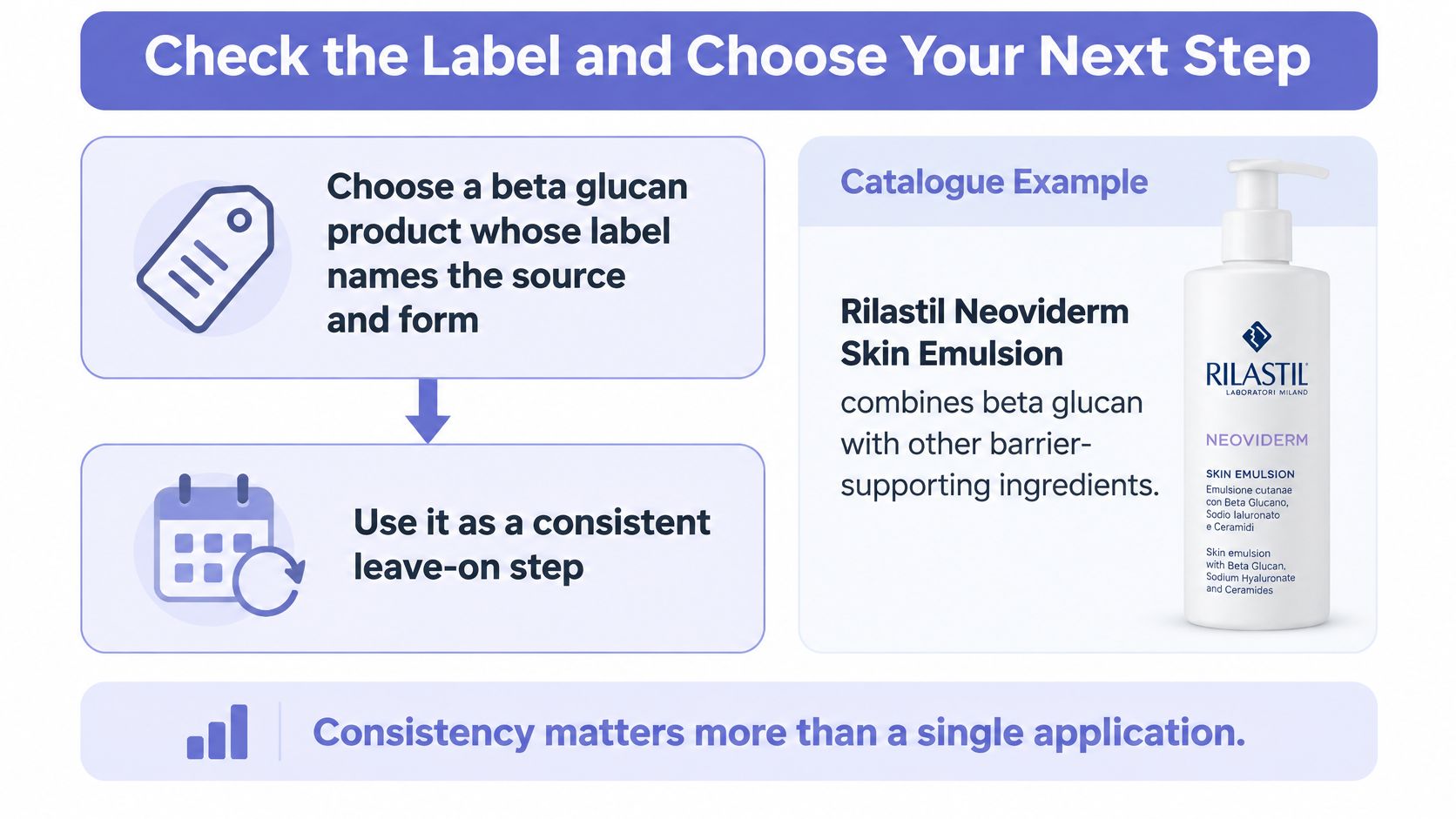
I would give any new beta glucan leave-on four weeks before deciding on a larger size. Keep the cleanser and moisturiser you already use so the emulsion is the only change.
- Week 1. Note tightness, flaking, or calm after cleansing, and treat that note as your baseline.
- Weeks 2 and 3. Stay on the same schedule. Do not swap the moisturiser or add another barrier cream while you are still learning the texture.
- Week 4. If comfort is steady and the finish feels right, the 100ml is the practical refill. If the texture is wrong, stop at the 30ml.
Results depend on consistent use within your existing routine. A label that names source and form is a better buying filter than a bold claim.
European pharmacy skincare, labels you can actually read
Healtsy ships European pharmacy and parapharmacy products from Portugal to the US, UK, Germany, Canada, Australia and the Gulf, with import duties already included in the price for the main non-EU markets. The catalogue covers more than 200 European brands, and a pharmacist reviews the product information, so the beta glucan formulas listed there state their ingredients and concentrations plainly.
Shop Healtsy