


You've added the serum, then the essence, then the facial oil, and by Thursday your cheeks sting when you splash water on them. Nothing on that shelf is bad. The routine built around it is doing too much at once.
I've spent 16 years on the pharmacy side of skin care, answering questions at the counter and in writing, and I'm certain of one thing: most irritation doesn't come from a wrong product. It comes from a crowded sequence and three new things introduced in the same fortnight. Layering skin care isn't a test of how many steps you can survive. It's a budget, and every strong active spends from it.
The habit itself is older than the internet. Korean routines traditionally ran from cleansing and exfoliation through toner, essence, serum, moisturizer and sun protection, and some stretched to as many as 17 steps, as Allure's guide to skin care layering sets out. In the United States, Clinique's three-step system of cleansing, toning and moisturizing arrived back in 1968. Both traditions are useful. What got lost between them is the principle underneath: order does the work, not volume.
Treat this as the complete guide to layering skin care I'd hand a friend at the counter, one who wants fewer bottles and calmer skin, not a seventeen-step hobby.
The Layering Order at a Glance
I believe this order works for most skin, and it matters far more than how many products you own. Read it as six slots rather than six purchases. Two are optional, and each sits where it does because of texture and the job it has to do.
| Step | Morning | Evening | Reason |
|---|---|---|---|
| 1. Cleanser | Yes | Yes | Clears the skin so later layers absorb evenly |
| 2. Toner or mist | Optional | Optional | Light, water-based hydration before heavier layers |
| 3. Serum (vitamin C or niacinamide) | Yes | Optional | Thin, water-based actives go before creams |
| 4. Treatment active (retinoid or acid) | No | Alternate nights | Strong actives get their own controlled slot |
| 5. Moisturizer | Yes | Yes | Seals the layers and supports the barrier |
| 6. Sunscreen | Yes, last | No | Must sit on the surface to protect |
The logic is physical. Water-based formulas spread and sink into clean, slightly damp skin. A rich cream applied first leaves a film, and the serum you put on top of it mostly stays where you put it. That's why thin comes before thick, and why sunscreen outranks everything: it's the one layer that has to remain on the outside.
What the table doesn't settle is the part people write to me about. How long to wait between layers. Which actives can share a night without a reaction. What to change first when the skin stings. Those are decisions, not steps, and they get their own sections below.
Where to start tonight: if the routine is new or your skin is reactive, use cleanser, moisturizer and sunscreen only for two weeks. Then add one layer at a time, and only keep it if your skin stays quiet.
If you'd rather sort the cleansing and sealing layers in one go than buy singles, shop the set on Loyaltie, a three-piece oil cleanser, face balm and face oil bundle that fits neatly into slots one and five.
How to Layer a Morning Routine Step by Step
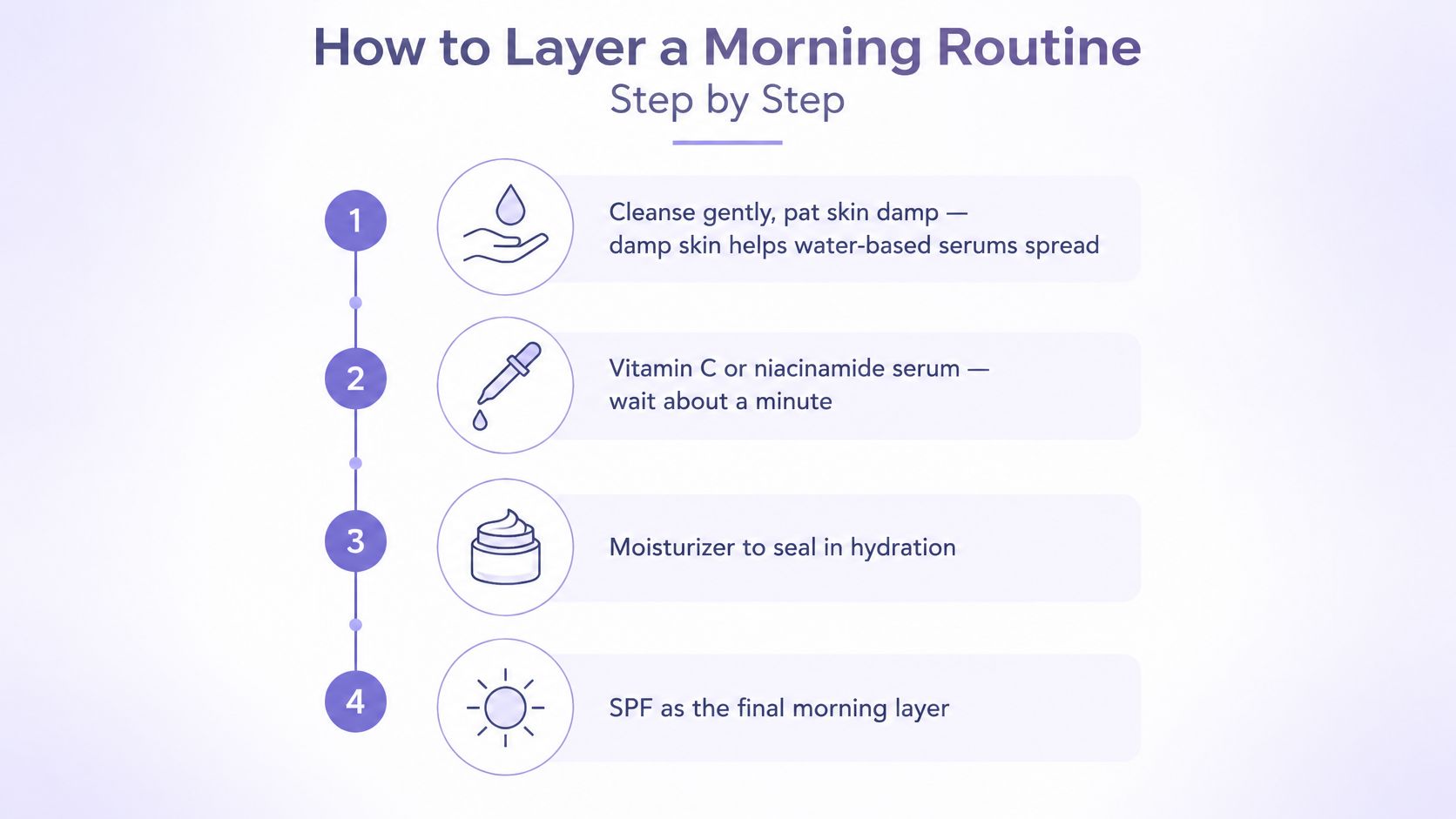
You have about eight minutes before you leave. Four products, in order, with short pauses, will do more than eight products slapped on. The morning irritation budget is one treatment serum. Everything else either supports that serum or sits on top as protection.
- Cleanse, then pat until damp rather than dry. Damp skin lets a water-based serum spread evenly instead of dragging. If the cleanser leaves the skin tight, it has already stripped the barrier, so change the cleanser before you add an active.
- Press in two or three drops of vitamin C or niacinamide serum, then wait about a minute. Work it in with the fingertips for roughly 30 seconds. The pause lets the water phase settle so the cream on top does not dilute it. On a reactive morning, pick one of those serums, not both.
- Apply moisturizer, a pea-sized amount across face and neck. Give a rich cream two to three minutes before sunscreen. A heavy cream followed immediately by SPF often leaves a filmy, rolling finish, and the serum underneath never gets a clean set.
- Finish with broad-spectrum SPF 30 or higher, about two finger-lengths for face and neck, pressed rather than rubbed. The FDA sunscreen guidance sets a floor of SPF 15 for regular use; dermatology guidance commonly asks for 30 or higher, and the label also sets the timing, applying 15 minutes before sun exposure and reapplying at least every 2 hours, plus after towel drying.
- Reapply through the day, not just at 8 a.m. A morning application is not a full day of protection. A commute plus a desk beside a window counts as exposure.
Pilling is common once films start stacking. In a 2024 three-step layering test, researchers from Guangzhou, China, found that 217 of 528 female volunteers, or 41%, experienced skincare-product pilling, reported in the Skin Research and Technology study. In this routine the practical control is the pause and the press: let the cream set, then lay sunscreen on with flat fingertips.
I would rather skip a second serum than rush the SPF. If you want the detail on amount, timing and reapplication, our guide to how to apply sunscreen on the face covers it step by step.
A finished morning looks like this: moisturizer absorbed within a few minutes, sunscreen with no greasy film before makeup. If you're still shiny ten minutes later, the cream underneath is too rich for the season.
How to Introduce One Strong Active at a Time
Dry, tight cheeks can make a retinoid feel like a risky next step. Keep the routine simple while your skin adjusts: cleanse gently, let the skin dry completely, apply a thin, pea-sized amount of retinoid in the evening, then moisturize. In the morning, cleanse, moisturize and finish with broad-spectrum sunscreen.
For retinoids, begin with every-other-night use for the first 2 to 4 weeks. Peeling, redness, dryness and irritation are most likely during this adjustment period, as explained in this clinical review of retinoid tolerability. If irritation becomes significant, pause until the skin settles, then resume less often. Applying moisturizer before the retinoid can reduce early tingling, especially if your skin is dry or sensitive.
A gradual start is the safer route to results. The irritation budget is simple: introduce one strong active at a time. When adding a retinoid, leave exfoliating acids out of that evening's routine, even if both products seem suitable on their own.
On evenings without a retinoid, keep the same basic order: cleanse, let the skin dry, apply one serum or treatment, then moisturize. A familiar structure makes it easier to identify which product is causing a reaction if irritation appears.
If you are considering tazarotene, Boderm Tazarene cream 0.1% - 40ml contains 0.1% tazarotene alongside azeloglycine, panthenol and sodium hyaluronate. It is described for oily areas such as the face, chest and back, and for evening use. Treat it as your one strong active, rather than layering it with another treatment. For a more gradual introduction to retinoids, this guide to introducing retinol for dark skin without irritation offers a step-by-step approach that also considers pigmentation.
Watch for stinging, persistent redness or scaling. If these appear, reduce the routine to gentle cleansing and moisturizer until the skin settles, then reconsider the active and how often you use it.
Which Actives Can Share a Night
Two leave-on treatments can each look reasonable alone and still overload the barrier once they share a night. Read the pairing first. Strength, formula and timing decide whether that night stays inside a tolerable irritation budget.
| Combination | Same Night | Practical Rule |
|---|---|---|
| Retinoid + AHA or BHA acid | No | Use on separate nights; stacking raises peeling and stinging |
| Retinoid + benzoyl peroxide | No | Use at different times of day or alternate nights; benzoyl peroxide can reduce retinoid effect |
| Vitamin C serum + retinoid | Split | Vitamin C in the morning, retinoid at night |
| Niacinamide + retinoid | Yes | Usually tolerated together; introduce niacinamide first if skin stings |
| Azelaic acid + retinoid | Yes, with care | Add one at a time; both can sting during the first weeks |
| Two exfoliating acids | No | Choose one per routine; stacking drives over-exfoliation |
| Moisturizer + retinoid | Yes | Apply after the retinoid, or before it if tingling starts |
Dermatology guidance recommends cleansing first, then a treatment, then moisturizer and sunscreen, as the American Academy of Dermatology's order-of-application guidance states. That sequence fixes where each layer sits. It does not decide which treatments may occupy the treatment slot together, which is why the table is the evening decision.
A workable split already exists in published routines. One clinical pilot used exfoliating pads three times weekly for 8 weeks and twice weekly for 4 weeks, followed by a nightly retinoid serum and SPF 56 each morning; reported effects were transient dryness, stinging or burning, itching and breakouts, per the Journal of Cosmetic Dermatology report. The acid nights and the retinoid nights were not the same nights. Morning sunscreen stayed in place throughout. Sunscreen tolerability alongside tretinoin is often better than people expect, so the SPF step does not need to come off just because a retinoid is in the week.
If benzoyl peroxide is already part of that week, our comparison of salicylic acid vs benzoyl peroxide shows where each one belongs so both are not asked to do the same job on one evening. Patch test a new pairing on the inner arm or jaw before it reaches the whole face.
Adjusting Layers for Your Skin Type
Skin type changes the layers you keep, not the order you apply them in. The sequence stays; the texture, the frequency and the number of actives move.
| Skin type | Layer change | What to avoid |
|---|---|---|
| Sensitive | Cleanser, barrier moisturizer and SPF; one new active after four weeks | Stacking acids and patch-untested formulas |
| Acne-prone | Non-comedogenic moisturizer; treatment active on evenings; oil-free SPF | Heavy or comedogenic textures |
| Dry | Hydrating essence or extra moisturizer after serum; creams at night | Stripping cleansers before actives |
| Mature | Slow peptide or retinol introduction; richer night moisturizer | Starting retinoid and vitamin C in the same week |
| Darker skin | Slow start with consistent moisturizer | Rapid retinoid escalation, which raises dark-mark risk |
Sensitive skin is the group that benefits most from doing less. Cleanser, a barrier moisturizer and SPF, with a single new active allowed in after four weeks. Patch test every new formula, and don't run two acids in the same week.
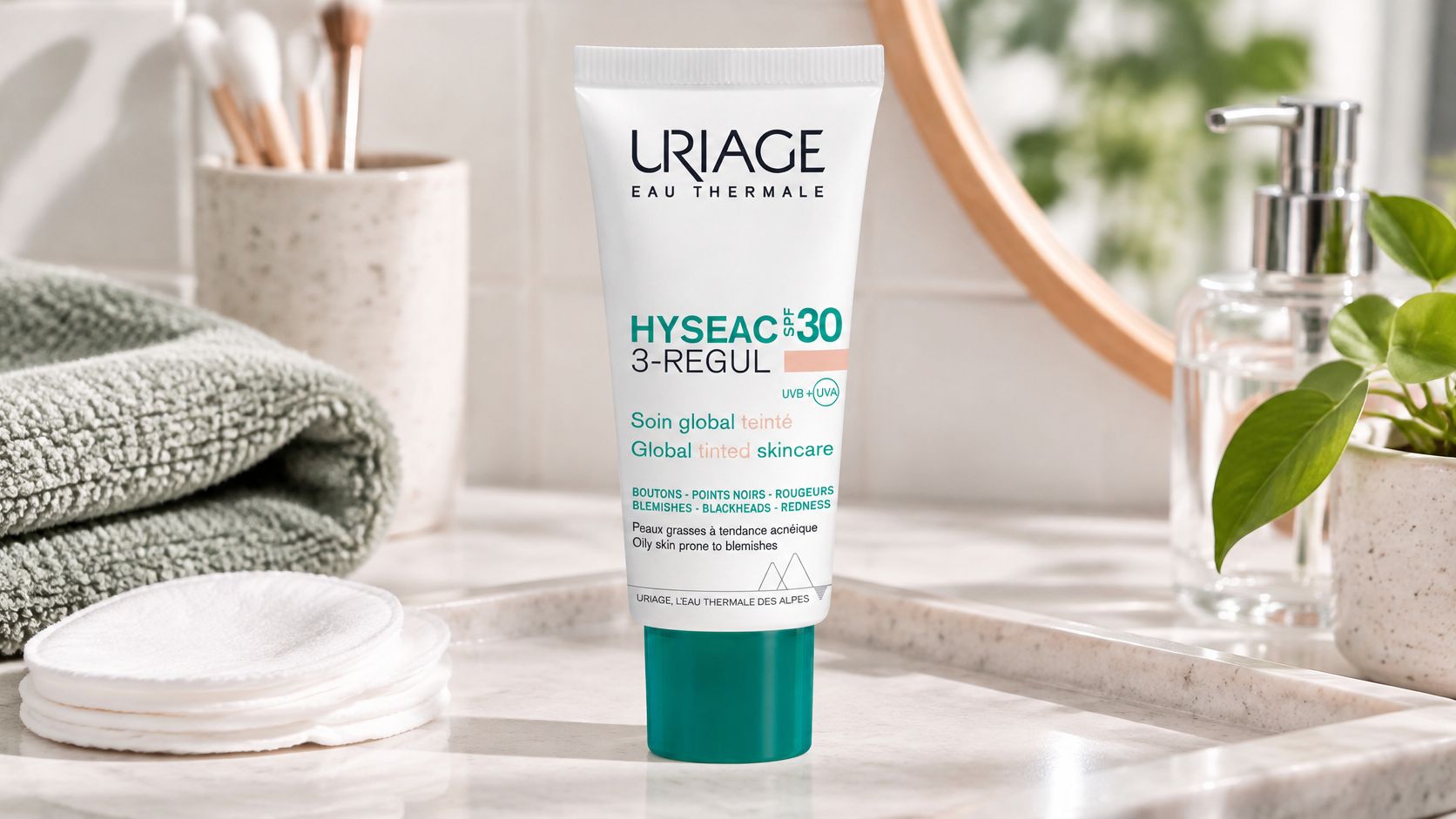
Acne-prone skin can let the morning finish do two jobs. Uriage Hyséac 3-Regul Global Tinted Skin-care SPF30+ - 40ml is an oil-free, non-comedogenic tinted care with a UVA-UVB filter complex, a powder-effect finish and licorice extract for a mattifying effect. It still counts as the final sunscreen layer, so you don't add a separate SPF on top, and it keeps a heavy cream out of the morning.
Dry and mature skin follow the same sequence with richer textures. Add a hydrating essence or a second moisturizer layer after the serum, favour creams at night, and don't launch a retinoid and vitamin C in the same week. On darker skin, slow escalation matters more, because irritation is what drives post-inflammatory dark marks, so moisturize generously and move up in frequency before you move up in strength.
The rule that covers all five: adjust the frequency before you add a new product.
For a fuller routine built around reactive skin, our guide to a dermatologist-recommended skin care routine for dry, sensitive skin takes this further.
Layering Mistakes That Cause Pilling and Irritation
You apply sunscreen, head out, and at lunch a fingertip lifts little rolls of product off your cheek. Careful routines do this too. The film never set, so it lifts instead of staying put.
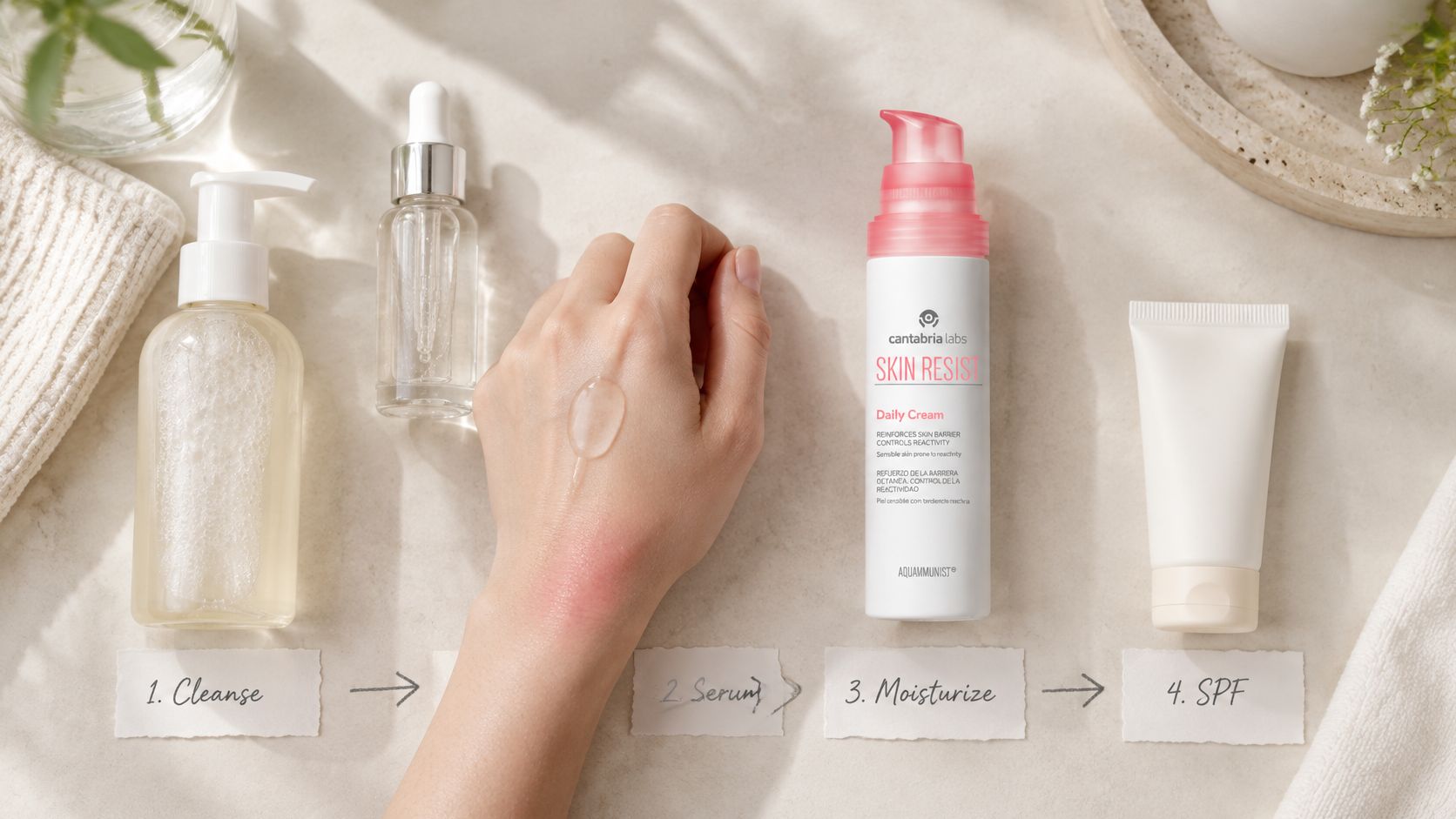
Match the symptom to one change, not a full reset.
| Symptom | Likely Cause | Fix |
|---|---|---|
| Pilling under sunscreen | Too many layers or rubbing each product in | Press each layer, wait one to two minutes, drop one serum |
| Stinging after a retinoid | Too much product, damp skin, or an acid the same night | Use a pea-sized amount, moisturize first, move the acid to another night |
| Peeling and redness in the first weeks | Starting nightly instead of every other night | Step back to the every-other-night pace in How to Introduce One Strong Active at a Time until redness settles |
| Breakouts after a new cream | Heavy or comedogenic texture | Patch test; switch to an oil-free, non-comedogenic moisturizer |
| Tight, flaky skin by afternoon | Missing moisturizer or skipped SPF reapplication | Add moisturizer after serum; reapply SPF outdoors every two hours |
The clip shows that press-and-wait sequence under sunscreen: each layer is patted on, left alone for a minute or two, and only then covered, so the film does not roll when you touch it.
If several products changed in the same week, pull one out for seven days and watch what stops. That single removal is how you find the layer your skin objected to. Adding a replacement in the same week hides the answer.
Season changes the texture, not the order. The American Academy of Dermatology notes that people may need richer, more moisturizing sunscreen textures in winter while keeping protection year-round, in its guidance on choosing the right sunscreen. Humid heat, cold wind, and dry indoor heating make the same stack behave differently. A routine that pilled in July may sit cleanly in January once the cream under SPF is lighter, or the reverse.
If the barrier already feels raw, stop the actives and rebuild with our guide to how to repair a damaged skin barrier before you bring anything strong back.
Choose a Routine You Can Repeat This Week
You get home late, skin a little tight, and the shelf looks like more work than you have left. Choose the shortest routine you will still finish on a night like that.
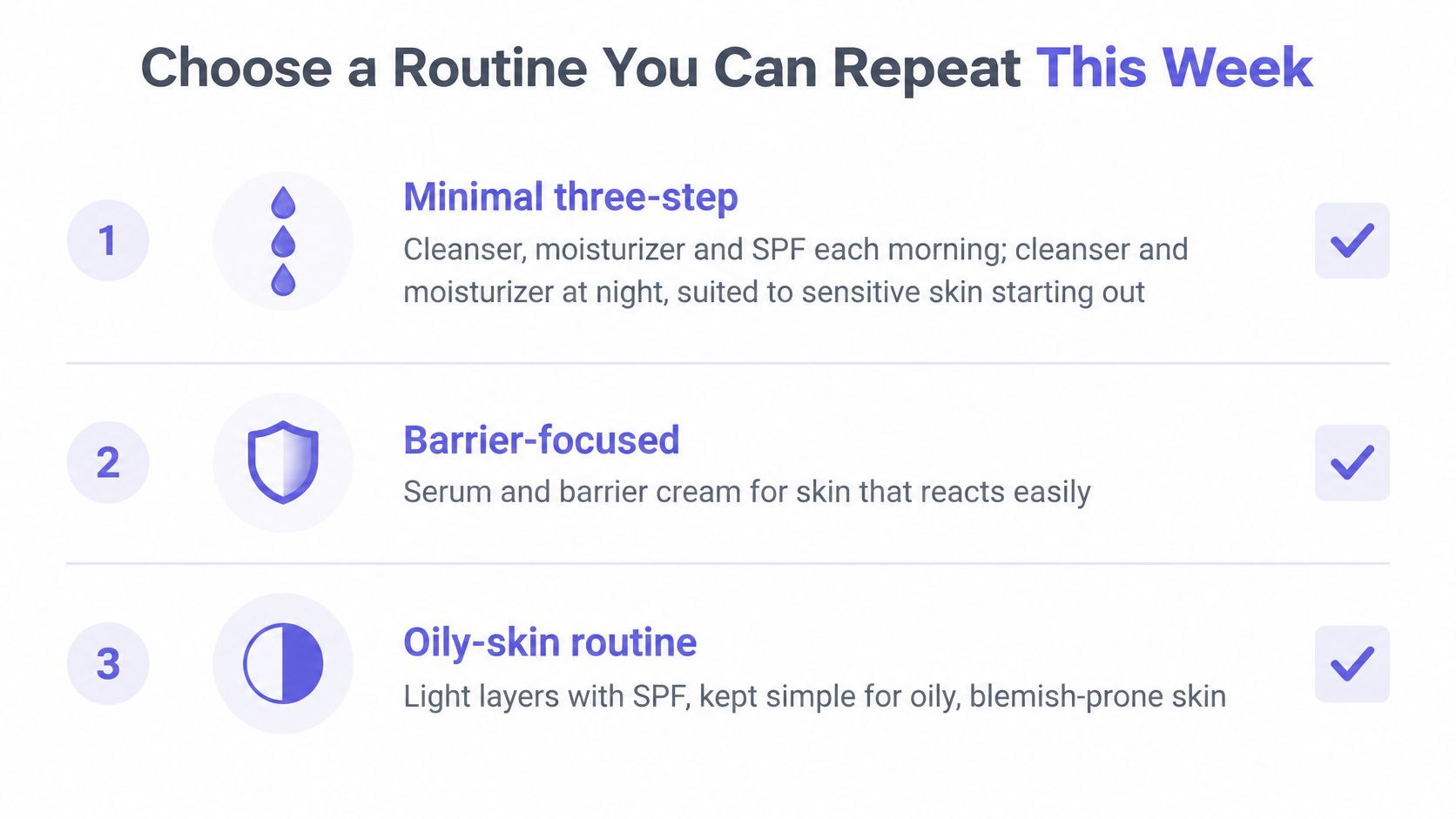
- Minimal three-step. Cleanser, moisturizer and SPF each morning; cleanser and moisturizer at night. Suited to sensitive skin starting out, or anyone recovering from irritation.
- Standard five-step. Morning cleanser, vitamin C or niacinamide serum, moisturizer and SPF; evening cleanser, treatment active on alternate nights, moisturizer. Suited to most adults with one main concern.
- Full seven-step. Adds a toner or mist and an eye cream, and rotates an acid and a retinoid across different nights. Suited to experienced users whose skin has been stable for months.
Hold that choice for four weeks before you judge it, and change one variable at a time. That is the irritation budget in practice: one new active, one routine, long enough to see what the skin does. The controlled evidence points the same way. In a randomized, investigator-blinded study at Johns Hopkins dermatology clinics in Baltimore between May and July 2018, 39 adults with moderate-to-severe dry skin used a mild cleanser followed by a glycerin-rich moisturizer twice daily for two weeks, while 13 controls used the cleanser alone, as reported in the Journal of Cosmetic Dermatology. A two-product sequence, used consistently twice a day, was the regimen under test.
Habit is thinner on the ground than the marketing suggests. A 2024 YouGov survey found that 50% of Americans had a very or somewhat consistent skincare routine, including 20% who described theirs as very consistent, according to YouGov's report on skin concerns and spending. How much cream people apply also differs by country and habit, so a short routine you repeat beats a long one you drop.
I would lock one of the three routines above and run it for four weeks, whether the concern is acne, dehydration or early ageing. If your skin is oily and you want a tinted, oil-free morning finish, the tinted SPF covered above still counts as your final sunscreen layer, so don't add a second one.
Healtsy is a Portugal-based online pharmacy store for European dermocosmetics, and we ship from Europe to the US, UK, Canada, Australia and the Gulf, with import duties already included in the price for the main non-EU markets. Our range covers the concerns this guide touches, including acne, oily skin, sensitivity, rosacea, dark spots and melasma, dehydrated and dry skin, and anti-ageing, so you can build a short routine from products that match your skin rather than guessing. Visit Healtsy to compare the layers, read the concentrations on each product page, and order the ones that fit the routine you've chosen.