


You've shampooed, your hair is still damp, and the comb catches halfway down. A rich cream might help the tangle, but on fine hair it can leave the roots flat and the lengths limp. A spray leave-in conditioner offers a more controlled option: it can help strands glide past each other without requiring a rinse.
I'm a pharmacist with 16 years in health and beauty, including experience with European pharmacy haircare. I believe the most useful advice comes from matching the formula to the hair in front of you, not assuming that every product labelled “leave-in” does the same job. This is the best guidance I can give from that experience, paired with what's known about how conditioning ingredients behave.
Why a Spray Leave In Belongs in Daily Hair Care
A spray leave-in is a post-wash conditioner intended to stay on the hair, rather than be rinsed away. It's sold as a spray alongside creams and serums. The format makes a familiar moment easier: after washing, you can mist the mid-lengths and ends, comb through, and get on with the day.
That convenience matters if you're detangling in a hurry, working with fine hair that doesn't tolerate much cream, or trying to distribute conditioner evenly through curls. A spray isn't automatically lighter in performance, though. The ingredients determine whether it mainly improves slip, adds softness, or leaves a more noticeable film.
This is an established hair-care format, not a niche gadget. One industry report estimated the global leave-in conditioner market at approximately US$2.91 billion in 2025 and projected US$3.12 billion in 2026, a 7.1% year-on-year increase. It identified North America as the largest regional market in 2025 and Asia-Pacific as the fastest-growing region. Those figures cover leave-in conditioners in different forms, including creams, sprays, and serums, rather than spray products alone (global leave-in conditioner market report).
This is the complete guide to using a spray leave-in without guessing: understand what the mist does, match the formula to your hair, and stop before conditioning turns into buildup.
The everyday case for a mist
The format is especially useful when you want to target the hair that tangles without coating every strand from root to tip. Fine, straight hair may need only a little help with combing. Dense, curly lengths may need the spray as a first layer before a richer styler. In either case, the point is controlled application, not using the most product possible.
The market report attributes category expansion partly to increased salon activity and demand for more personalized hair-care products. For shoppers, the practical relevance is simple: lightweight, convenient formats suit people who want post-wash conditioning without adding a rinse step. That doesn't mean a spray can replace every conditioner. If your hair still feels rough after a light mist, a richer product may be the better fit.
How a Spray Leave In Conditions Hair
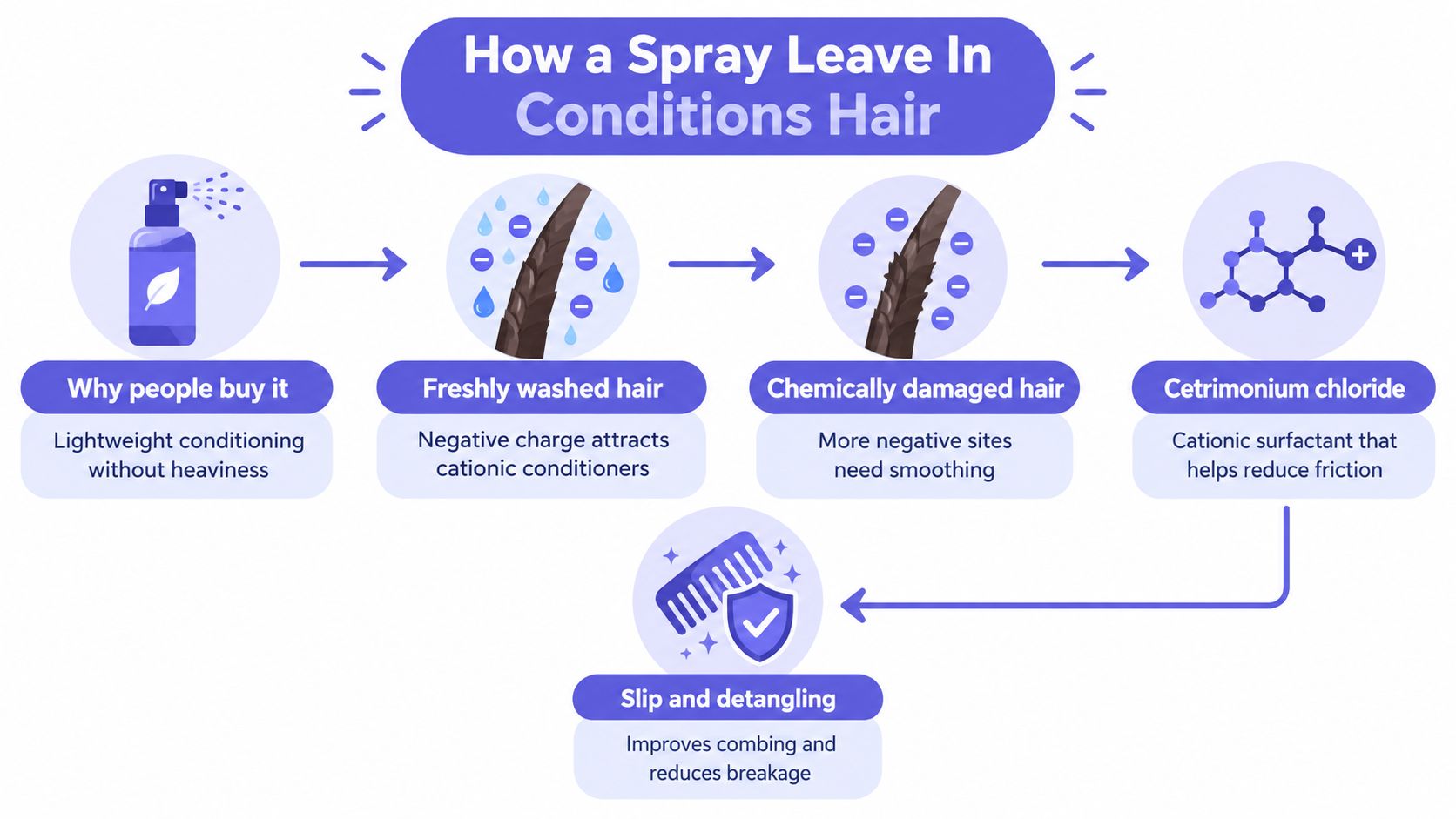
Freshly washed hair can be more difficult to comb, especially when it's porous, bleached, or chemically treated. Conditioning ingredients help by depositing on the hair surface and reducing friction between strands. A key group is cationic conditioners, which carry a positive charge and are attracted to the negatively charged hair surface.
Ingredients such as cetrimonium chloride, behentrimonium compounds, and polyquaterniums can help hair feel less static and easier to detangle. They aren't the only contributors. Humectants help retain water, emollients soften, and silicones can create a lubricating film. A good mental picture is a light raincoat on the fibre, not a plaster cast. Some parts of a conditioning polymer anchor to hair while other parts extend outward, helping strands move past each other.
What the coating can and can't do
A spray can improve slip, gloss, and combability without repairing the hair fibre. Those surface effects are useful, particularly when a comb snags on freshly washed ends, but they aren't the same as reversing chemical or mechanical damage. I'm certain this distinction will solve the worry that every spray is only fake shine: a temporary surface effect can still be real conditioning in the everyday sense of helping hair feel smoother and behave more easily.
Porous or bleached sections may attract more conditioning material than less damaged hair. Apply mainly to mid-lengths and ends, where tangles and roughness tend to show up, rather than soaking the scalp. Too much deposit can leave hair limp, tacky, or coated. Fine hair usually needs a lighter spray and fewer passes than dense or very textured hair.
Research on cationic guar adsorption links its charge behaviour with reduced wet-combing forces, offering a technical rationale for formulas that use cationic guar or related polyquaterniums (research on cationic guar and hair). The practical test is straightforward: notice how wet hair combs after one application, then check the dry feel and how the product washes out over repeated shampoos. If slip improves but the hair feels coated later, reduce the amount or frequency.
For a related look at how surface treatments affect shine and feel, Boost Beauty Lounge's hair gloss guide offers another perspective on cosmetic finish. If you're comparing cleansing steps as well, this overview of intense repair shampoo can help you think about the wash stage alongside leave-in use.
A short visual demonstration can also help make the application process easier to picture.
Spray Leave In Types and What Each One Does
Product names can sound more specific than the formulas really are. “Detangling” usually points to ingredients that improve slip. “Conditioning” may signal added emollients or silicones for softness. “Anti-frizz” often means a light film that helps strands catch less on each other, not a promise to change your curl pattern or control every climate.
Heat-protectant wording deserves care. Treat it as meaningful only when the manufacturer explicitly states that the product is intended for heat styling and gives directions for that use. Don't assume every spray offers heat protection, and don't infer a temperature limit that the label doesn't provide. Likewise, a “protein” or “moisture balance” label doesn't tell you the formula's performance by itself. Check for hydrolyzed proteins, humectants, and other conditioning ingredients instead.
Choose by the job, then compare the format
| Format | What it tends to deposit | Best moment to use it | Watch-out |
|---|---|---|---|
| Spray leave-in | A controllable layer of conditioning agents, sometimes with humectants, emollients, or silicones | Quick detangling and even distribution through damp lengths | Repeated use can leave fine hair limp or coated |
| Cream leave-in | Often a richer combination of conditioning and softening ingredients | When a light mist doesn't soften or smooth enough | Can weigh down fine hair if applied heavily |
| Deep conditioner | A richer rinse-off deposit, often with more conditioning ingredients and emollients | When hair needs a fuller conditioning step during washing | It's not a leave-in, so follow its rinse directions |
Formulation data support a directional distinction, not a rule for every product. In an analysis of conditioners marketed for textured hair, leave-ins contained silicones in 66.7% of cases, compared with 53.8% for deep conditioners. Deep conditioners averaged 2.6 quaternary ammonium conditioning ingredients versus 2.3 in leave-ins, and 5.3 emollients versus 3.3. These figures describe products in that analysis, not every spray or mask on the market (analysis of conditioners for textured hair).
Read the label, not just the product name
A spray is often the better starting point when quick application and dose control matter. If hair still feels rough after a small amount, a cream or rinse-off deep conditioner may provide the richer feel you're looking for. For people interested in how conditioner bases are assembled, these starter recipes for DIY hair conditioner provide useful background, although a homemade formula isn't automatically more suitable for sensitive skin or better suited to your hair.
A product's purpose also matters more than its packaging. Boderm Hairgen Spray - 125ml is described as an antihairloss product, not a detangling leave-in. Its listed ingredients include melatonin, saw palmetto, diamino pyrimidine oxide, ginkgo biloba, milk proteins, and lactose. That distinction is a reminder to check the product's stated use before treating every hair spray as a conditioner. For curl styling, Moroccanoil curl-defining cream is a different format to compare when a mist alone doesn't provide enough softness or definition.
Ingredients to Look For and Question
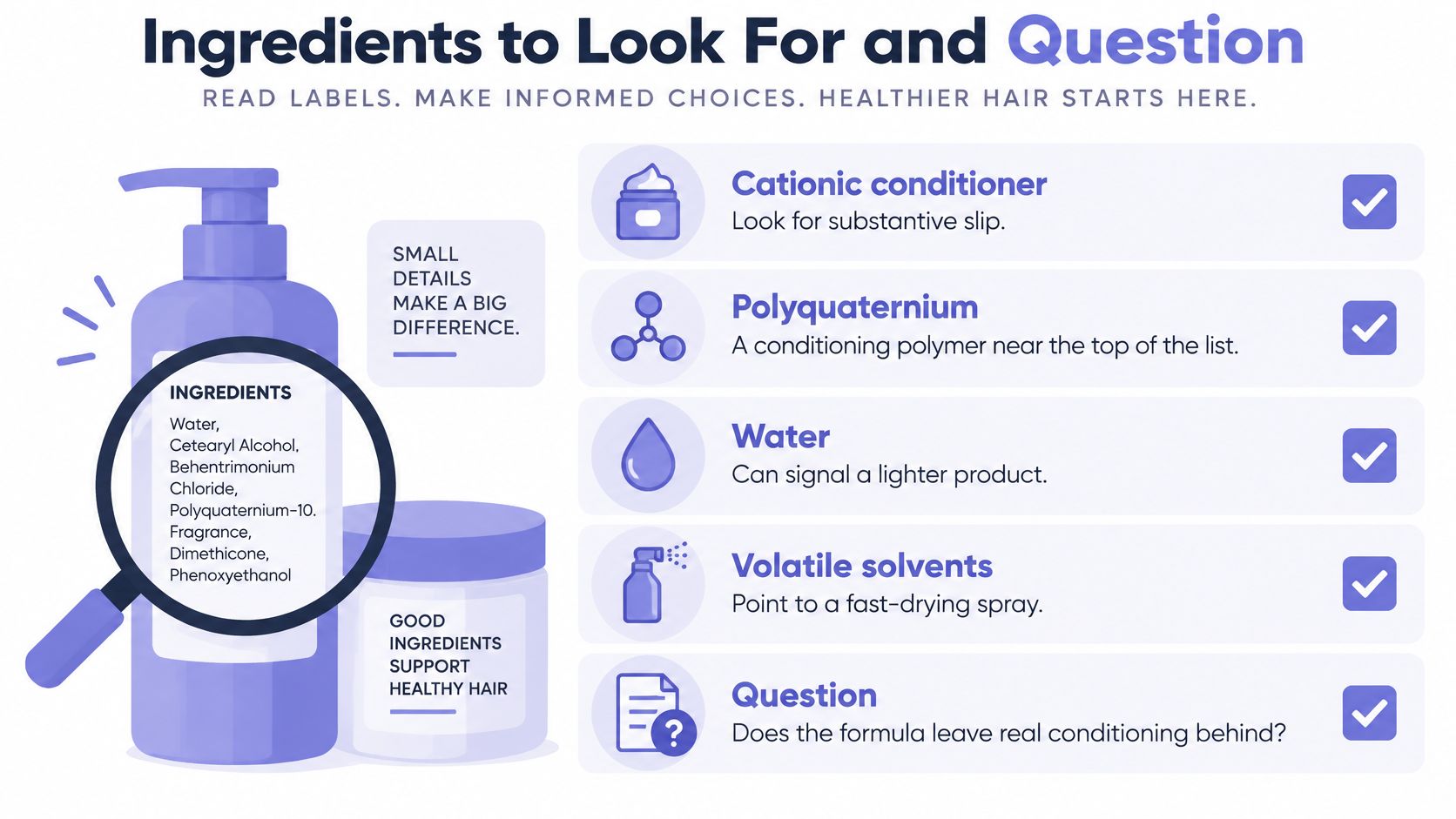
An ingredient list helps you understand why a spray feels the way it does. A cationic conditioner or polyquaternium near the beginning of the list suggests a formula designed to leave substantive conditioning and slip. Water and volatile solvents can point to a lighter, faster-drying feel. Silicones can provide lubrication; their presence isn't proof that a formula is bad or that buildup is inevitable.
Glycerin is a humectant, but its presence doesn't guarantee that every head of hair will feel moisturised in every condition. The formula around it, how much you apply, and how your hair responds all matter. Similarly, “alcohol-free,” “silicone-free,” and “natural” don't automatically mean gentler or more effective. Look for the job you need the product to do, then judge the result on your own hair.
Fragrance and preservatives without alarm
Sensitive users often want to know whether a fragrance or preservative makes a spray unsafe. Ingredient presence alone can't answer that. A cross-sectional analysis of 31 conditioners marketed for textured hair reported fragrance components in 93.5%, cetearyl alcohol in 87.1%, phenoxyethanol in 58.1%, and benzyl alcohol in 41.9%. Every product in the analysis listed at least two chemicals of concern or allergens. The researchers noted that these label findings identify potential hazards, not a person's individual risk, because ingredient concentrations weren't available (conditioner ingredient analysis).
I believe the useful approach is neither to dismiss the list nor to treat one ingredient as proof of danger. Read the full INCI list, note fragrance allergens or preservatives you already know you react to, and avoid spraying toward your eyes or breathing zone. If your skin is reactive, patch-test as appropriate and stop using the product if irritation or a rash develops. Stinging or dryness isn't enough to diagnose allergic contact dermatitis; a clinician can assess a persistent or concerning reaction.
Why leave-on use changes the question
European cosmetic rules define a leave-on product by its intended prolonged contact with skin, hair, or mucous membranes. The rules also distinguish ordinary hair leave-ons from products that may expose the lungs through inhalation, with different concentration limits for the relevant substance (EU cosmetic annexes). That's one reason to follow the product's stated spray method instead of pouring a concentrated product into a homemade applicator.
If you're also reviewing your wash products, this guide to key ingredients in a good shampoo can help you compare cleansing formulas without confusing shampoo ingredients with leave-in conditioning agents.
Using a Spray Leave In on Different Hair
The same spray behaves differently on fine hair than on coily hair, and weight is only part of the story. Cationic polymers give slip for detangling, humectants draw in moisture, silicones coat the surface, and fragrance scents the hair. A lighter mist can still condition well. The label and your hair type decide whether it detangles, coats, or weighs the hair down.
Start with towel-damp hair. Mist a small amount through the mid-lengths and ends, comb through gently, and add more only if the hair still snags. That first pass tells you a lot about the formula before you layer on styling products.
For fine hair, keep the application light. A little slip eases combing; repeated passes can leave the hair flat or limp. If the lengths detangle after one pass, stop there.
Adjust the dose to the hair in front of you
Curly or coily hair often needs more deliberate distribution. Divide the lengths into sections so the mist reaches the areas that tangle. If the spray eases combing but the hair still feels rough, a cream can add the softness the mist didn't provide. A guide to different hair textures and product-specific care can help you think through the difference between needing more slip and needing a richer finish.
Bleached or colour-treated ends may feel rough and porous, and they can pick up conditioning material quickly. Start with a small dose and watch what happens over repeated use. If the hair turns dull or coated, scale back rather than adding another layer.
With thinning hair, keep the product off the scalp unless the label describes it as a scalp product. An airy application through the remaining lengths helps avoid clumping. Postpartum or menopause-related texture changes can leave hair feeling drier and the scalp more reactive. I believe a leave-in can make daily styling kinder, but it doesn't treat hair loss, hormone shifts, or scalp disease.
Stop signal: If hair turns waxy, dull, or unusually limp, reduce the dose or frequency and follow the shampoo directions for removing residue.
When layering creates residue
A cloudy or coated feel after combining products isn't necessarily an allergy or damage to the hair. Cationic conditioners can clash with anionic ingredients in some styling products, which may contribute to cloudiness, precipitation, or residue. Remove one layer and see whether the problem clears before adding anything else.
Because a mist can drift, apply it close to the lengths with the bathroom window open rather than spraying a dense cloud around your face. If you care for extensions, Conde Professional's guide to extension detanglers offers practical advice on detangling without pulling at the attachment area.
Fitting a Spray Leave In into Your Routine
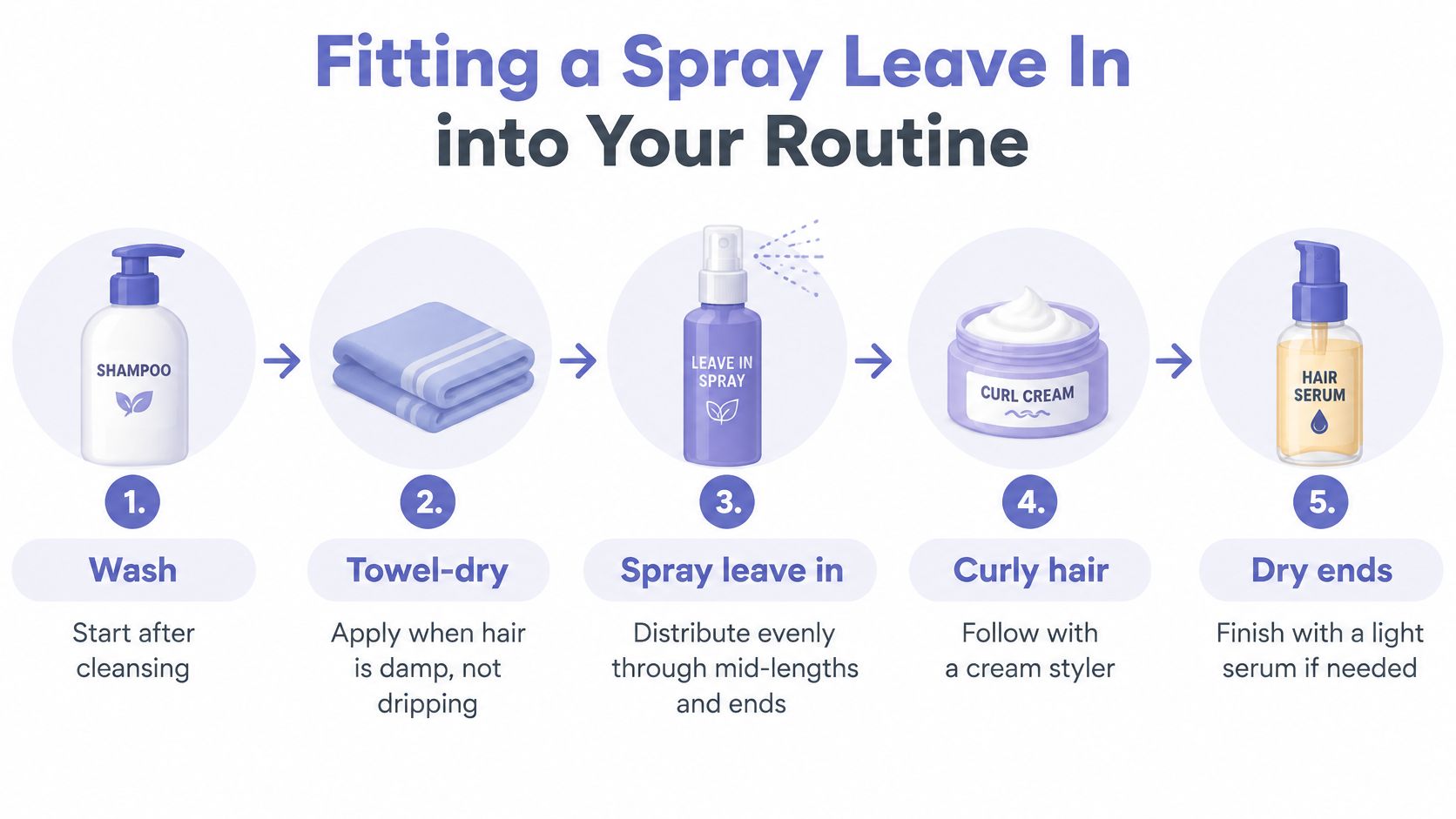
Apply a spray leave-in after washing and towel-drying, while hair is damp but not dripping. Then give it room to work before adding another product. That pause helps you judge whether the spray has already reduced tangling and whether you need a styling product at all.
On curly hair, the spray can come before a cream styler if you need both detangling and definition. On dry-feeling ends, a light serum can follow if the hair still needs a smoother finish. Use oil sparingly and last; layering oil over a heavy silicone film can turn a useful detangler into residue. A serum is a targeted finish, not a second full-head conditioner.
Keep each layer's job clear
Hair sunscreen is a separate product. If you'll be in the sun, use a product specifically intended for hair sun care and follow its label. Don't assume a regular leave-in provides sun protection unless the manufacturer says so.
European cosmetic rules treat a leave-on as prolonged contact and distinguish products that can expose the lungs through inhalation from ordinary hair leave-ons. That makes application method part of sensible use. I believe the complete guide to safe misting is simple: spray the lengths rather than the face, eyes, or breathing zone; ventilate if the formula is strongly fragranced or volatile; and don't decant a concentrate into a random bottle or use it like an aerosol.
Check the result in two ways. Notice how wet hair combs on wash day, then assess the dry feel the next morning. If two products pill or turn cloudy, remove a layer rather than adding a third. Compatibility matters as much as the order in which you apply products. If you're building a routine around hair with lower porosity, this guide to low-porosity hair care can help you consider how a lighter product fits alongside the rest of your routine.
Choosing a Spray Leave In and What to Do Next
Choose by the problem you want to solve. If the comb catches, look for cationic conditioners or polyquaterniums that support slip. If fine hair gets weighed down easily, consider a lighter water-and-solvent base and begin with a small amount. If roughness and softness are the issue, look for a formula that states its conditioning components, such as silicones or emollients, and check whether the directions fit your hair and routine.
Be cautious with claims that suggest a cosmetic spray repairs the fibre. A product can help hair feel smoother, look shinier, or comb more easily without undoing structural damage. I'm certain this will solve the last hesitation: the format isn't a lesser version of a cream. It's another way to control how much conditioner reaches the hair.
Published market estimates differ, but together they suggest sprays account for roughly one-quarter of leave-in conditioner sales. One estimate places sprays at 27.6% of the category in 2025 and forecasts a 7.5% compound annual growth rate through 2034, compared with a 6.8% forecast for the overall category. The same estimate gives the 2025 total market as US$3.2 billion and projects US$5.8 billion by 2034; a separate estimate reports a lower spray share of 22.1%. These figures vary by methodology and category definition, so they're directional rather than a definitive measurement (global leave-in conditioner market estimate).
Make the buying decision practical
Before buying, check who the product is for, what the label says it does, how it should be applied, and whether its ingredients match your hair's needs. For international shoppers comparing European pharmacy haircare, Healtsy is a Portugal-based pharmacy and parapharmacy shop shipping original European haircare from Europe. Our catalogue includes leave-ins and related hair products, and a pharmacist reviews product information. We carry brands including BioScalin, Dercos, Ducray, Klorane, Lazartigue, Phyto, Redken, and Vichy.
You can also compare leave-in products with conditioners, hair masks, hair sun care, scalp care, shampoos, and styling products. Read the INCI against the points in this guide, then start with the smallest amount on your mid-lengths and ends tomorrow. That simple trial tells you more about the right dose than a label promise can.
Healtsy offers European pharmacy and parapharmacy haircare, including leave-ins, conditioners, masks, and styling products, shipped from Europe to customers worldwide. Browse Healtsy, compare the ingredient lists with your hair's needs, and start with a light application on damp lengths.