


You're holding a bottle with an aloe leaf on the front, hoping it'll leave your hair clean without making your scalp feel tight. Beside it sits another shampoo promising comfort, hydration and fewer flakes. Both sound reassuring, but the useful differences are usually on the back of the bottle.
Aloe vera shampoo is best judged by its complete formula, not its botanical headline. The practical, pharmacy-counter approach is to separate what cleanses, what conditions and what might irritate. I believe that's the most useful guidance to give someone choosing between products, without turning a cosmetic ingredient into a treatment promise.
What Aloe Vera Shampoo Is and How It Cleanses
Most aloe vera shampoos are cleansing systems with aloe added, rather than aloe preparations that happen to wash hair. The cleansing ingredients, called surfactants, do the primary work of removing oil and dirt. Aloe supports the finished formula alongside conditioning agents, preservatives and other ingredients.
Aloe gel contains water and polysaccharides, and manufacturers commonly position it as a moisturizing or soothing botanical. That describes its intended cosmetic role, not everything the shampoo does, as discussed in the review of aloe-containing hair-care preparations.
Different ingredients have different jobs
Think of washing a kitchen surface with a sponge, then applying hand cream afterward. The sponge does the cleaning; the cream changes how your skin feels. In shampoo, those roles are combined in the same bottle, but the distinction remains useful: cleansing and conditioning aren't the same task.
The analogy isn't exact, because a shampoo's ingredients interact during washing. Still, it explains why adding aloe doesn't replace the cleansing base, and why a botanical-looking bottle can contain familiar surfactants.
The main roles are illustrated below.
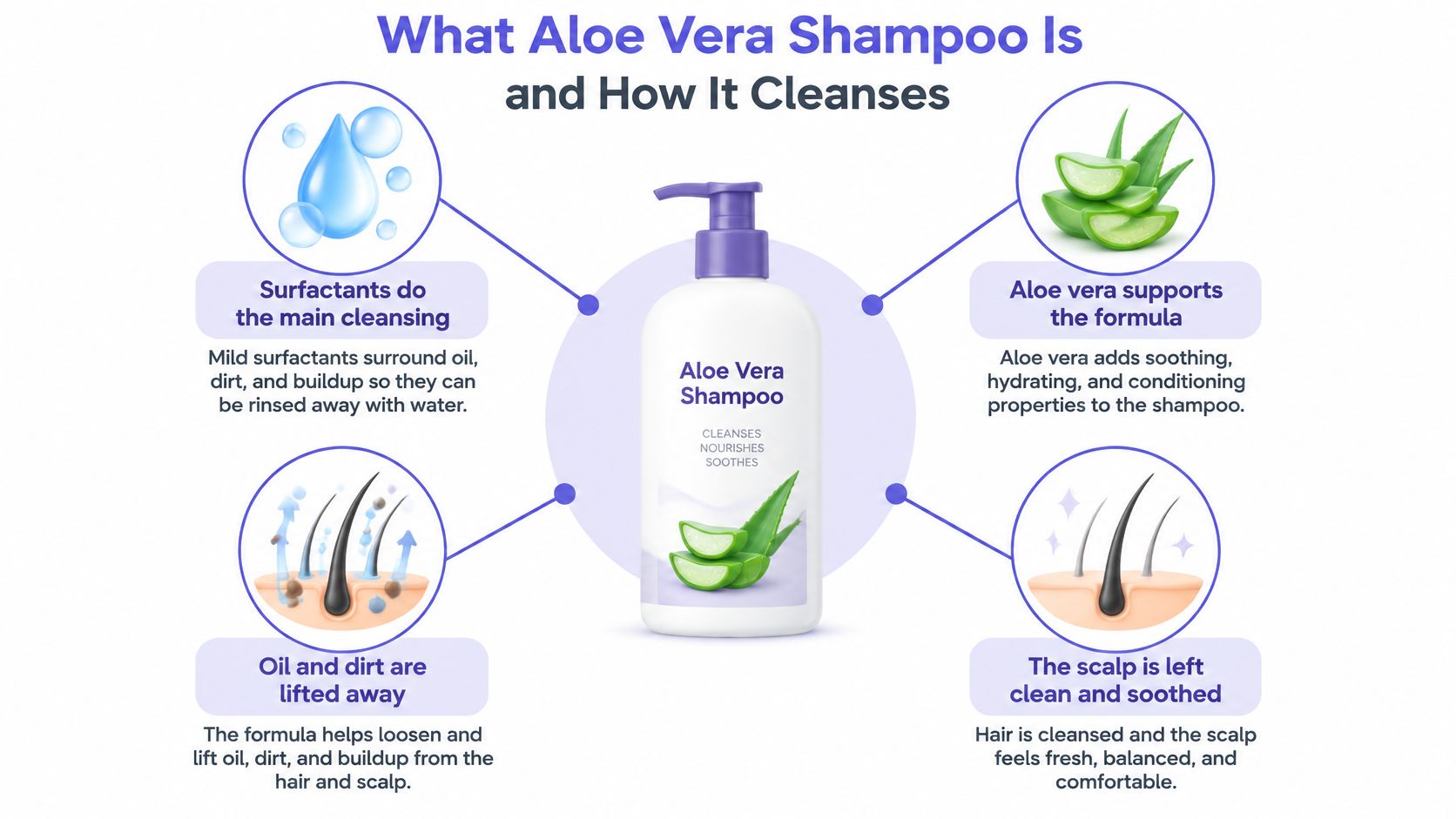
A rinse-off product has a particular purpose
Shampoo is applied, distributed and rinsed away. It therefore has less opportunity for prolonged scalp contact than a leave-in tonic or serum. That difference matters when deciding whether a promise sounds appropriate for a wash product.
A useful way to read a bottle is to separate its functions:
- Cleansing: Which ingredients make up the washing system?
- Conditioning: What supports softness and manageability?
- Scalp comfort: Does the overall formula suit your sensitivities?
- Product instructions: Is it designed to rinse off, rather than remain on the skin?
The broader principles behind good shampoo ingredients and their functions apply just as much to an aloe-labelled bottle as any other. Searching for “shampoo aloe vera” can help you find a category, but it doesn't identify a standard formula. The front label names an ingredient; the complete label describes the product you'll use.
What the Research Says About Dandruff, Hydration and Sensitivity
The evidence is more convincing for formulation feasibility and cosmetic usefulness than for treating scalp disorders. A 2025 literature review covering 30 articles published between 2016 and 2025 examined shampoos, tonics, serums and pomades. It described aloe-containing formulations as generally physically stable and potentially useful for scalp care, but that isn't equivalent to strong clinical proof for an ordinary aloe shampoo.
The inclusion of different product types matters. A result involving a leave-in preparation cannot automatically be transferred to a shampoo, and physical stability doesn't establish a medical benefit.
What the dandruff findings actually show
A quasi-experimental study of hibiscus–aloe scalp gel used applications twice weekly for 4 weeks. Before use, 25% of participants had mild dandruff and 75% had moderate-to-severe dandruff; afterward, those proportions were 90% and 10%, respectively.
That shift is worth examining, but the study didn't isolate aloe's contribution. It tested hibiscus together with aloe, not a standardized aloe-only shampoo, and reported no statistically significant association in its analysis. It therefore cannot justify promising the same result from a bottle on a shop shelf.
Evidence check: Ask whether researchers tested the finished product you're buying, an ingredient mixture or a different type of preparation.
Put benefit claims into separate groups
Hydration and a conditioned feel are reasonable cosmetic aims. Formulation research supports investigating aloe for these purposes, but it doesn't establish how much better a particular bottle will perform than another conditioner-containing shampoo.
Cleansing performance belongs to the complete formula. Studies assessing foam, cleansing, stability or conditioning can describe a formulation's practical characteristics without proving that aloe produced those characteristics independently.
Comfort for a sensitive scalp is an individual tolerability question as well as a formulation question. A product described as soothing may still contain something that doesn't agree with your skin.
For dandruff, compare the actual ingredients and product-specific evidence rather than treating botanical language as a substitute for an appropriate active. A guide to anti-dandruff shampoo ingredients can help distinguish those roles.
Hair-loss prevention and regrowth need stronger, independently controlled clinical trials. A smoother feel, fewer visible flakes or a comfortable wash doesn't demonstrate a change in follicle function. I believe the fairest reading is that aloe can support a cosmetic formula, while stronger treatment claims remain unproven for aloe shampoo itself.
Reading Labels for Aloe Content, pH and Irritants
Turn the bottle around before comparing the size of the aloe leaf printed on the front. The useful specification includes the surfactant base, aloe preparation, conditioning ingredients, fragrance, preservatives and final pH. If information isn't declared, treat it as unknown rather than filling the gap with marketing assumptions.
A declared aloe concentration provides context, but it isn't a quality score. The relevant question is whether the entire formula suits the job you need it to do.
Use pH as context, not a guarantee
In a peer-reviewed study using Aloe elegans gel, formulation pH ranged from 4.6 to 6.4, compared with approximately 6.7 for the commercial benchmark. Formulations containing approximately 96.4–96.6% gel also included oils, glycerin, vitamin E, lemon juice and other ingredients.
Those findings don't prove that a higher aloe percentage is better. They also concern Aloe elegans, so they shouldn't be presented as a direct clinical test of every Aloe vera shampoo. Mildly acidic formulations can support a smoother cuticle feel, but pH alone doesn't describe cleansing strength or tolerability.
Another published aloe-extract shampoo formulation used sodium laureth sulfate as its main surfactant and measured pH 7.23. That contrast shows why aloe on the front label doesn't tell you the finished product's pH or washing system.
Label Elements and What They Tell You
| Label element | What it tells you | What to check |
|---|---|---|
| Aloe ingredient | Which aloe preparation is included | Leaf juice, gel, extract or whole-leaf wording |
| Declared concentration | How much aloe the manufacturer states | Whether a concentration is actually provided |
| Surfactants | The main cleansing system | The complete blend, not aloe alone |
| Final pH | The finished product's acidity | A declared value rather than an assumption |
| Fragrance | Whether scent ingredients are present | Fragrance-free wording when relevant to your allergy |
| Preservatives | How preservation is addressed | Ingredients you already know you react to |
| Conditioning agents | The formula's conditioning component | Whether the intended finish suits your hair |
| Directions | Intended exposure and use | Rinsing instructions and warnings |
Preservatives aren't automatically undesirable, and a familiar surfactant name isn't enough to condemn a product. Your established sensitivities matter more than a blanket ingredient blacklist. If you're unsure whether discomfort is simple dryness or a recurring sensitivity problem, the practical distinctions in recognizing and caring for sensitive skin are useful.
When comparing bottles, mark missing information as missing. Don't assume that an undeclared pH is unsuitable, or that an undeclared aloe percentage means the ingredient is ineffective. Choose on the information available, and keep expectations proportionate.
Matching Aloe Shampoo to Your Hair and Scalp Type
The right question isn't whether aloe shampoo suits everyone. It's whether a particular formula matches your scalp, your hair lengths and the finish you prefer. The following are shopping scenarios, not claims that aloe treats each concern.
When roots and lengths need different things
Your roots feel heavy soon after washing. I'd prioritize a clear cleansing purpose rather than a bottle promoted mainly for rich conditioning. Check what accompanies the aloe, and be cautious about choosing the richest-looking formula because botanical ingredients sound gentle.
Your scalp feels dry or itchy after winter. Look for a cleansing and conditioning balance, but don't assume every itch means you need more moisture. Consider whether discomfort started after a product change, and avoid adding several new scented products while trying to identify a trigger.
Your fine hair falls flat easily. A lightweight finish may matter more to you than an elaborate botanical blend. Judge the result at the roots and lengths separately rather than expecting one ingredient to provide both volume and rich conditioning.
For a broader comparison, matching care to different hair textures can help separate texture preferences from scalp concerns.
The bottle pictured below represents a separate scalp-care option, not evidence of aloe content or suitability for every scalp.
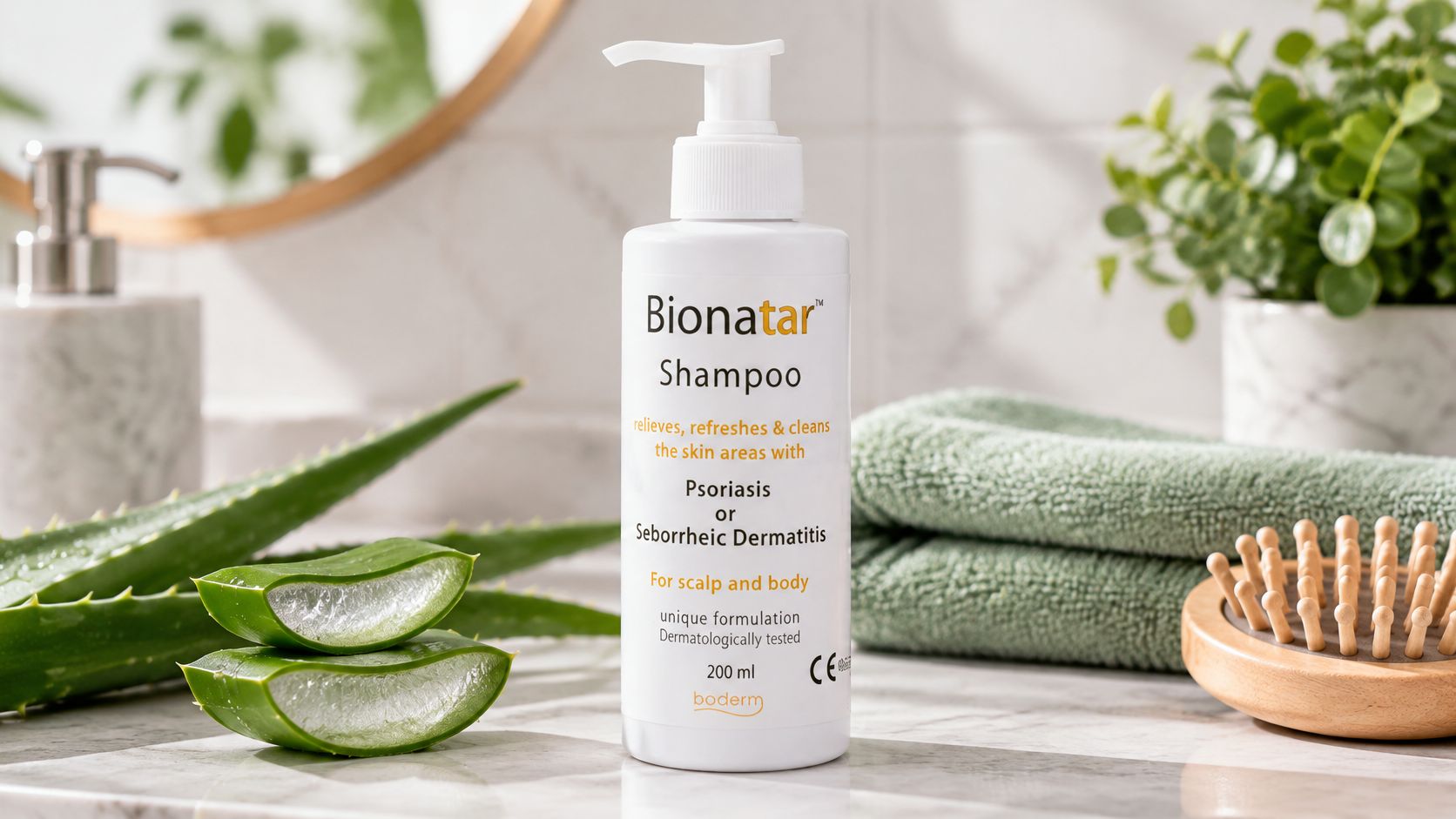
When tolerability comes first
You've coloured your hair and want a gentler-feeling wash. Check the finished product's suitability statement and conditioning profile. Aloe alone doesn't establish colour compatibility, so I wouldn't infer that benefit from the plant name.
Your scalp stings with new products. Start with known triggers and fragrance-free options when fragrance allergy is relevant. Published patch-test data reported aloe reactions in 23 of 1,859 tested patients, while finding no need for fragrance-allergic patients to avoid aloe in fragrance-free products.
That doesn't make every aloe shampoo hypoallergenic, and it doesn't identify the culprit in an individual reaction. Fragrance or preservatives may deserve attention alongside aloe itself.
A sensitive scalp needs a tolerable finished formula, not simply a reassuring ingredient on the label.
For pregnancy, babies or children, check the specific product with the relevant clinician. An adult cosmetic label and a general discussion of aloe can't assess an individual pregnancy, a child's skin or an existing scalp condition.
Using Aloe Shampoo for Best Results and When to Stop
Start with the bottle's directions, not a homemade rule about how long aloe needs to work. Wet the hair thoroughly, measure out the amount recommended on the label and distribute it over the scalp. Massage briefly rather than trying to scrub away every sensation of oiliness or itch.
Rinse thoroughly, then assess the lengths separately. If they feel dry, a suitable conditioner may be more useful than extending shampoo contact or adding another wash. Don't turn a rinse-off cosmetic into an overnight scalp preparation.
Keep the routine predictable
Consistent, correct use gives you a fairer way to judge whether the formula cleans comfortably. Leaving it on longer isn't established as a way to obtain stronger aloe benefits. Where a product has specific contact-time directions, follow those rather than borrowing instructions from another shampoo.
The routine and warning signs are summarized below.
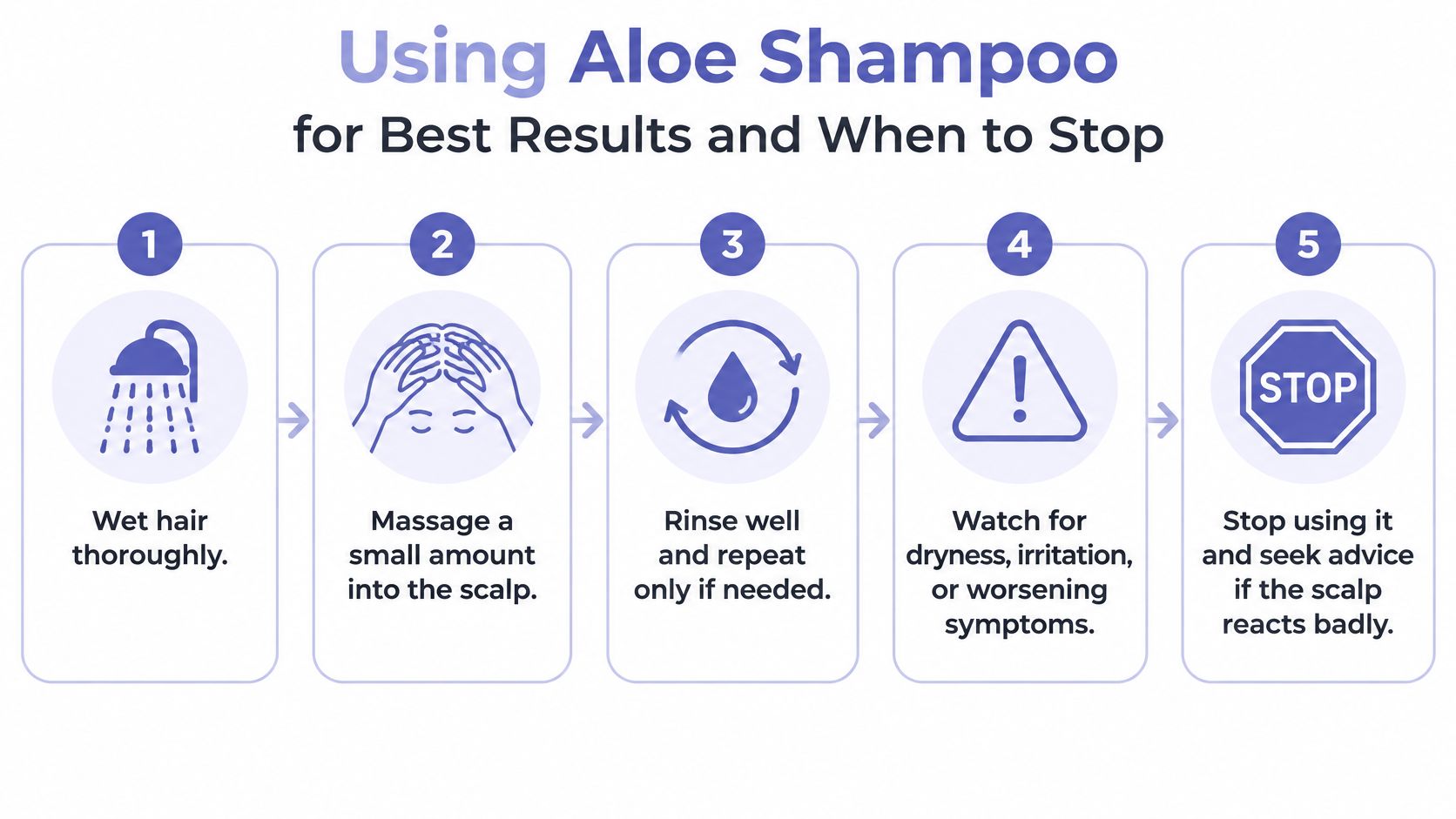
Before full use, consider a small-area trial according to the product's instructions, particularly if your skin is reactive. That isn't a diagnostic allergy test and can't guarantee that later use will be comfortable.
Stop signals matter more than promises
The National Center for Complementary and Integrative Health's aloe safety guidance reports occasional topical reactions including burning, itching, rash and eczema. If stinging, new itching or a rash appears, stop using the shampoo, rinse thoroughly and avoid repeating it while the cause is unclear.
Use this short checklist:
- Before washing: Read the directions and check known allergens.
- During washing: Apply to wet hair and massage without aggressive scrubbing.
- After washing: Rinse fully and assess comfort as well as cleanliness.
- If irritation develops: Stop rather than trying to build tolerance.
- If symptoms persist: Arrange professional assessment instead of repeatedly switching shampoos.
Persistent itching, scaling or inflammation deserves assessment by a healthcare professional. A dermatology review of topical aloe concluded that clinical effectiveness remains insufficiently and rigorously explored, so ongoing symptoms shouldn't be managed through aloe claims alone.
If you're comparing a different scalp-care range, the Vichy Dercos shampoo guide offers another product-reading reference. Use each bottle's own directions rather than transferring a routine between formulas.
DIY Aloe Rinses Compared With Finished Shampoos
A homemade aloe rinse can look appealing when you want fewer unfamiliar ingredients. Blending leaf material or gel with water feels straightforward, but knowing what went into the bowl isn't the same as knowing the preparation's purity, preservation or suitability for your scalp.
The preparation choice is illustrated below.
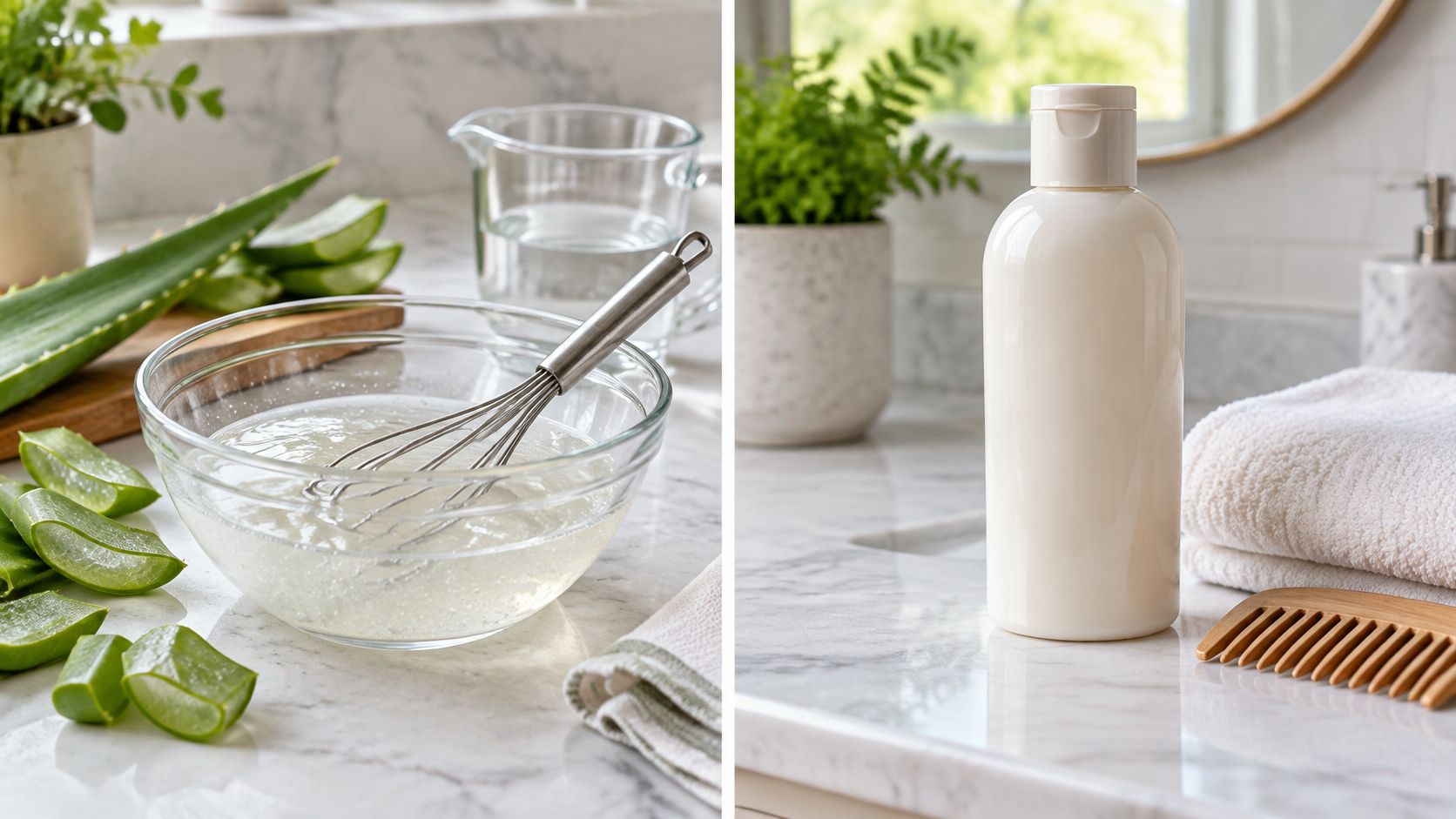
Preparation changes the comparison
A recent toxicological review describes topical inner-leaf gel as generally safe, while advising greater caution with whole-leaf extracts because preparation and anthraquinone content affect the safety profile. Inner-leaf gel and a blended whole leaf therefore shouldn't be treated as interchangeable ingredients.
A homemade mixture also leaves practical questions unanswered. You may not know its impurity levels, whether preservation is adequate or how its final pH compares with a finished cosmetic. Adding kitchen ingredients doesn't resolve those uncertainties.
| Decision point | Homemade aloe rinse | Finished cosmetic shampoo |
|---|---|---|
| Preparation | Depends on your material and method | Has a defined manufactured formula |
| Preservation | May lack controlled preservation | Includes a preservation approach |
| pH | Usually unknown without measurement | May be declared or available from product information |
| Use | No standardized product directions | Has labelled directions and warnings |
| Cleansing | Not equivalent to a formulated shampoo | Designed as a washing product |
Choose predictability for routine care
A finished shampoo isn't automatically irritation-free, and not every manufacturer publishes pH or testing details. Its practical advantage is a defined formula and a label you can evaluate, rather than an assumption that fresh plant material must be safer.
The video below offers additional visual context for aloe preparation; it isn't proof of clinical benefit or a substitute for product safety information.
I believe a properly labelled cosmetic formula is the more predictable choice for routine washing. A raw leaf isn't a finished shampoo, and a homemade rinse shouldn't be treated as an equivalent replacement because both contain aloe.
Where to Buy Aloe Shampoo and Your Next Step
A good listing lets you judge the product before you pay for it. Look for the full ingredient list, the stated cosmetic purpose, the directions and the warnings. For an order from abroad, delivery terms matter as well, though they come after the formula check.
A pharmacy counter lets you discuss symptoms and known sensitivities in person. A local shop lets you read the packaging on the shelf. An online retailer with a wider catalogue can give you access to products your local stores do not stock, provided the listing carries enough label detail to make a real comparison.
Compare the retailer and the formula separately
Healtsy is an online store covering categories that include health, skincare, sunscreen, body, hair, makeup, baby and mom, men and accessories. Its hair range includes shampoos, scalp care, conditioners, hair colour, hair masks, hair sun care, hair supplements, leave-in products and styling products, which means several formulas can sit side by side for comparison. That breadth is useful, although a product filed under scalp care is not automatically an aloe shampoo.
Boderm Bionatar Shampoo - 200ml shows why the ingredient list matters more than the category label. The manufacturer presents it for cleansing, exfoliation and soothing of the scalp and skin, with Ichthyol (sodium shale oil sulphonate) and Salix alba extract among its listed ingredients. I would compare it as a scalp-care formula on its stated purpose, rather than treating it as interchangeable with aloe-based options.
Buying principle: Choose the formula for the job, then choose a retailer that provides clear product and delivery information.
Make the next decision concrete
Before ordering, confirm the exact product version, since the same name can cover different sizes or regional formulations, and check the delivery information shown for your destination at checkout. Assumptions about transit or contents are a poor substitute for what the listing states.
The takeaway from this guide is a working habit: identify the washing system, check tolerability and keep cosmetic comfort separate from treatment claims. The standard I'd expect from a pharmacist-reviewed product guide is candid guidance, not certainty that a botanical will solve every scalp problem.
Put the labels of the products you are weighing side by side. Check where aloe sits in the ingredient list, which surfactants do the washing and whether the directions suit your contact time and washing frequency. If the Bionatar product information matches a scalp-care need you have, review it with the same questions you would put to any aloe shampoo.
Healtsy offers European pharmacy and parapharmacy hair care, including shampoos and scalp-care options with product information to support a label-first comparison. Visit Healtsy to review ingredients and directions, then choose according to your scalp's needs rather than the aloe claim alone.