


Sensitive Skin Care
Sensitive Skin Deodorant: How to Choose Without Irritation
You've just stepped out of the shower, applied a new deodorant, and felt an immediate sting under your arms. By lunchtime, the skin is itchy. By evening, the product you chose because it said “natural” or “gentle” feels like the obvious suspect.
This is a familiar pattern, and it doesn't mean you've done anything wrong. Underarm skin faces sweat, rubbing, shaving, warmth, and repeated exposure to leave-on products. A formula that feels comfortable on the forearm can behave very differently in this enclosed, high-friction area.
Introduction: Why Sensitive Underarms Need a Different Approach
After 16 years in the pharmaceutical sector, I believe the most useful way to choose a sensitive skin deodorant is to move beyond attractive front-label claims. “Clean,” “botanical,” and “natural” don't tell you whether a formula contains a fragrance allergen, an alkaline powder, drying alcohol, or a texture that drags across freshly shaved skin.
The European Commission identifies perfumes and deodorants among the frequent sources of sensitisation to fragrance ingredients. Its review cites fragrance contact allergy affecting about 1 to 3% of the general population, while around 16% of patients patch-tested for suspected allergic contact dermatitis show a positive result for fragrance allergy (European Commission overview of perfume allergies). Those figures help explain why sensitive-skin deodorants have become an important category, particularly for people who repeatedly develop redness or itching after scented products.
The choice also depends on what you need the product to do. An antiperspirant is designed to reduce wetness, while a deodorant primarily addresses odour. A cream may reduce application friction, a roll-on may glide more evenly, and a stick may be convenient but uncomfortable if it pulls over irritated skin.
My practical view: the right product is the one that controls your actual concern without creating a second problem.
This is the complete guide to sensitive skin deodorant selection and use. I'll explain why underarms react so easily, which ingredient families deserve attention, how formats compare, how to patch test, and when persistent symptoms need a dermatologist's assessment. For broader guidance on recognising and caring for reactive skin, you can also review this guide to identifying and relieving sensitive-skin symptoms.
Why Underarm Skin Reacts So Easily
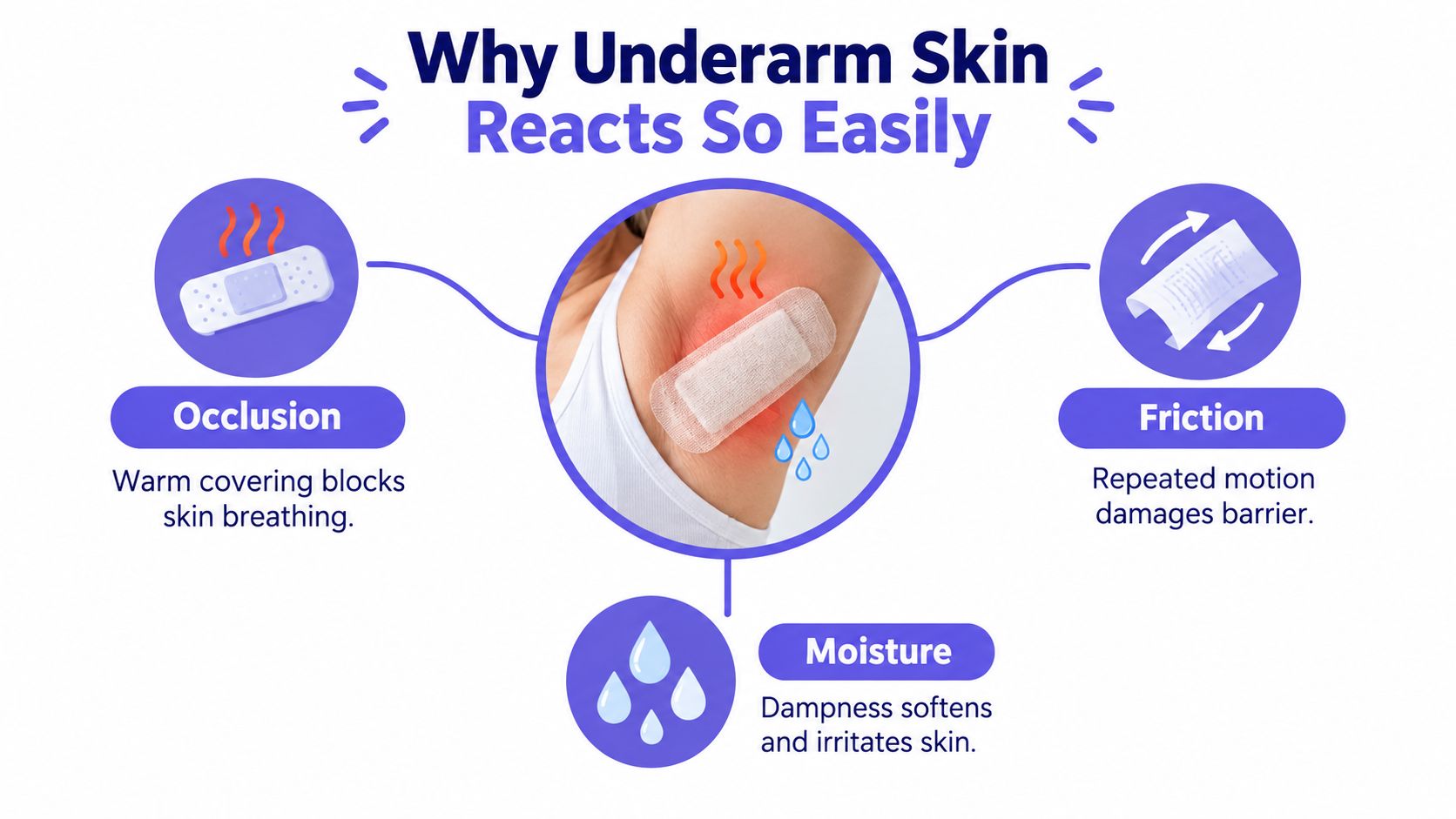
Underarm skin faces a difficult combination of warmth, dampness, limited airflow, and constant movement. Clothing and the arm can rub the same area repeatedly, while perspiration stays against the surface. These conditions make the skin barrier easier to disturb than skin that remains cooler, drier, and more exposed.
The axilla is particularly vulnerable because it is moist, occluded, and exposed to friction, as described in the clinical deodorant provocation study. Occlusion limits normal drying. Friction comes from arm movement, clothing, shaving, and the applicator. Moisture softens the outer layer, allowing rubbing and product ingredients to affect a weakened barrier more readily.
Irritation and allergy are different problems
Burning after deodorant application does not automatically indicate an allergy. Irritant contact dermatitis can follow exposure to a high-pH ingredient, alcohol on recently damaged skin, repeated rubbing, or a formula that leaves the area dry and inflamed. Symptoms may appear quickly and often improve after the trigger is removed.
Allergic contact dermatitis is an immune response to a substance, commonly a fragrance component. Fragrance-mix patch testing is positive in about 10% of tested eczema patients, while reported sensitisation to fragrance-mix ingredients in the general population ranges from 1.7% to 4.1% (PubMed clinical review). Sensitisation can develop after repeated exposure, so a product tolerated for years may eventually cause a reaction.
A separate clinical provocation finding reinforces the need for caution. Among fragrance-sensitive patients, 12 of 20 deodorants, or 60%, triggered axillary eczema during use testing. This result does not make every scented product unsuitable, but choosing fragrance-free products reduces one avoidable contact-allergy risk.
Friction deserves equal attention
Formula choice is only part of prevention. A firm stick can drag over stubble, a waxy layer can accumulate, and vigorous application after shaving can irritate skin even when no recognised allergen is present. Apply with light pressure and avoid repeatedly passing over tender areas.
Fabric can add to the problem. Readers managing sensitivity elsewhere may find this postpartum comfort lingerie advice from Milk&Lace useful, since pressure and rubbing often affect comfort. If the underarm feels raw or tight, review these skin-barrier repair principles before introducing another active product. I believe application mechanics deserve the same attention as a “natural” ingredient list, and fragrance-free texture is often the more practical starting point.
Ingredients to Avoid and Ingredients That Soothe
Underarm reactions usually become easier to investigate when ingredients are grouped by the problem they may create. I don't believe everyone needs to avoid every ingredient listed here. For recurring reactions, changing one allergen family at a time gives clearer information than moving randomly between products.
Start with fragrance-free. Fragrance may be listed as “parfum,” “fragrance,” a fragrance mix, or a blend of essential oils. Botanical wording does not mean a lower sensitisation risk. Essential oils can contain fragrance constituents, and some become more reactive as they oxidise.
Potential allergen families reported in deodorants and antiperspirants include propylene glycol, parabens, vitamin E, and lanolin (review of deodorant and antiperspirant allergens). Propylene glycol may irritate or sensitise some users. Lanolin matters for people with particular allergy patterns, while vitamin E and preservatives can occasionally explain why a product marketed as simple still causes trouble.
Baking soda needs separate consideration. Sodium bicarbonate is alkaline, with a pH around 8, while the skin's natural acid mantle is about pH 5.5. That difference may contribute to burning, redness, or barrier disruption in reactive underarms. Drying alcohols can sting immediately, especially after shaving or when tiny nicks are present.
What gentler formulas can contain
Sensitive skin still needs odour control. Magnesium hydroxide can help neutralise odour without relying on baking soda. Zinc oxide may provide a protective, calming barrier, while tapioca starch and other absorbents can reduce a damp sensation without claiming to stop perspiration.
Ceramides support the skin's protective lipid organisation, and niacinamide may help maintain a more comfortable skin environment in suitable formulations. Neither ingredient makes a deodorant automatically suitable. The full formula, texture, and way it is applied still matter. This ceramide moisturiser guide for sensitive skin offers further context on barrier-supportive products.
| Ingredient Group | Why It Matters for Sensitive Skin | What to Choose Instead |
|---|---|---|
| Fragrance and fragrance mixes | Common sensitisation pathway in leave-on products | Fragrance-free formulas |
| Essential oils | Natural aromatic compounds can still sensitise | Minimal or no botanical fragrance |
| Propylene glycol | May irritate or sensitise some users | A simpler formula with fewer potential allergens |
| Baking soda | Alkaline pH may disturb the acid mantle | Magnesium hydroxide or gentle absorbents |
| Drying alcohols | Can sting shaved or barrier-damaged skin | Alcohol-free or low-irritant formats |
| Lanolin, vitamin E, and selected preservatives | Potential allergens for some individuals | Choose based on your known triggers |
| Ceramides and niacinamide | Can support a more comfortable barrier-focused routine | Include when tolerated, without ignoring the full label |
Label reading also includes checking whether a product is intended for the area.
Boderm Hairgen Spray, 125ml is an antihairloss product containing ingredients such as melatonin, saw palmetto, diamino pyrimidine oxide, ginkgo biloba, milk proteins, and lactose. It is not a deodorant and should not replace underarm care. Recognising intended use helps prevent an unsuitable product from being applied to sensitive skin.
Comparing Deodorant Types for Sensitive Skin
A person whose main problem is dampness needs a different product from someone who mainly notices odour. Shaving, eczema, and repeated rubbing can change the decision again. The useful question is not whether a deodorant is marketed as natural. Assess contact-allergy risk, the formula's fragrance, and how much pressure the format places on the skin.
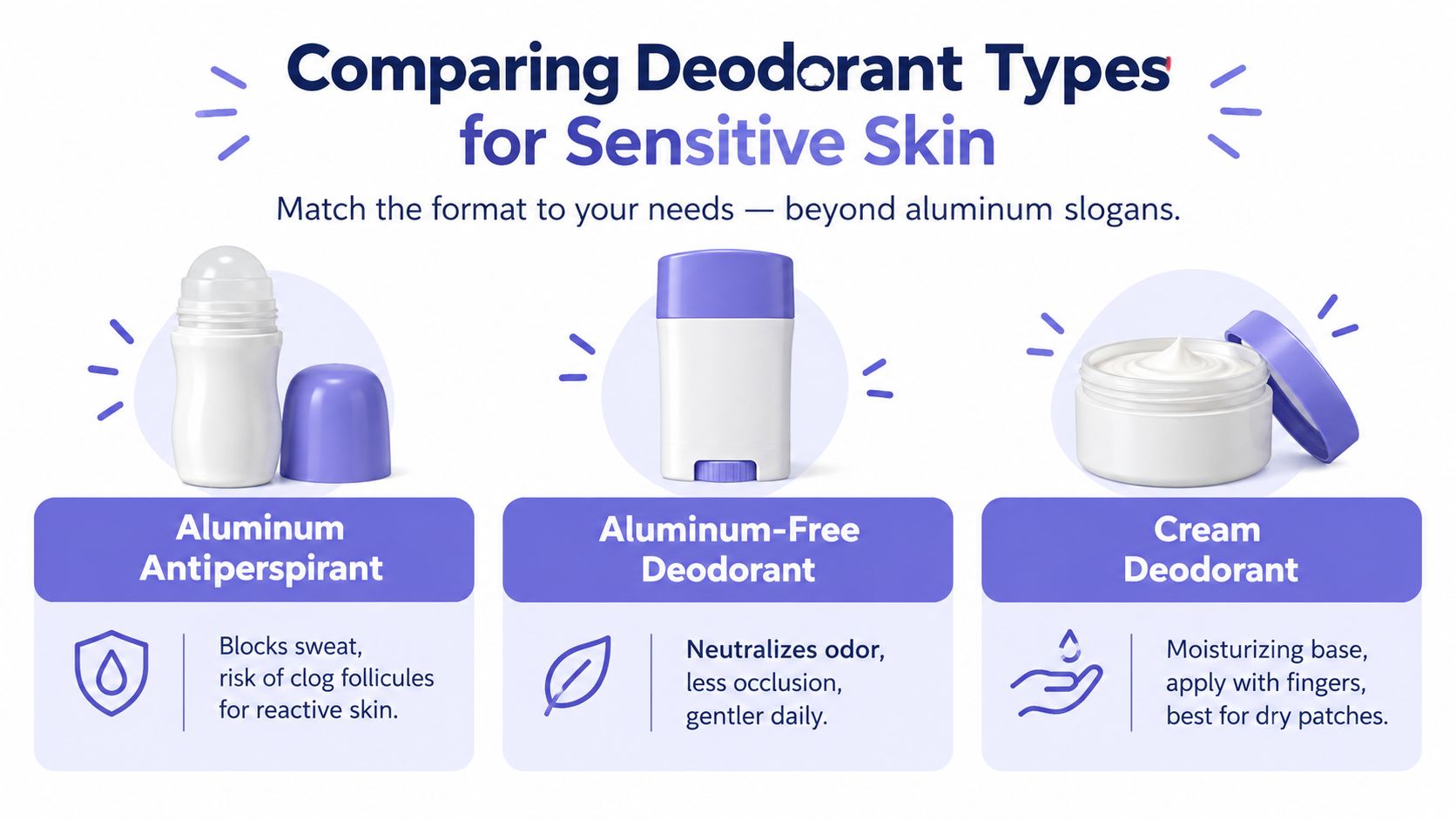
Antiperspirants reduce wetness, while aluminum-free deodorants address odour without stopping perspiration. Aluminum salts may feel irritating on freshly shaved or reactive skin, but that does not make antiperspirants unsuitable for everyone. People with repeated reactions should separate the goal of wetness control from odour control and introduce any new formula cautiously, as noted earlier.
Format can change the irritation profile
A traditional stick is portable and quick, yet a firm product may drag over hair, stubble, or dry patches. Several passes increase friction, and waxy residue can hold moisture against reactive skin. A softer stick may reduce pulling, provided the formula is fragrance-free and avoids known triggers.
Cream deodorants make it easier to spread a thin, controlled layer with less mechanical pressure. Their drawbacks are less convenient fingertip application and a rich base that may feel warm or occlusive for someone who sweats heavily. Roll-ons distribute product evenly, but the skin should be fully dry before clothing is put on.
| Your priority | Format to consider | Main trade-off |
|---|---|---|
| Sweat reduction | Aluminum antiperspirant | May irritate reactive or recently shaved skin |
| Odour control without sweat reduction | Aluminum-free deodorant | Won't prevent perspiration |
| Post-shave comfort | Cream or low-drag roll-on | May feel less convenient than a stick |
| Dry patches or barrier discomfort | Cream with a simple base | Rich texture may feel warm or occlusive |
| Minimal scent exposure | Fragrance-free or unscented option | Odour control comes from neutralisation, not perfume |
Mineral formulas may contain magnesium hydroxide, zinc oxide, or absorbent powders. They can suit someone seeking odour control without aluminum, although “mineral” does not guarantee comfort. Baking soda and essential oils can still appear in natural or mineral-labelled products, so the complete ingredient list matters more than the front label.
A broader self-care routine can support body comfort without making deodorant the focus. The Momotaro Apotheca self-care guide offers low-cost routine ideas. If sweating is unusually disruptive rather than merely inconvenient, review this resource on excessive sweating and hyperhidrosis instead of repeatedly applying more deodorant.
How to Patch Test and Apply Without Irritation
A patch test can't guarantee that a product will never cause an underarm reaction, but it gives you a sensible screening method before full use. It's especially useful when you've recently experienced burning, itching, or a rash and want to avoid repeating the same cycle.
A cautious home routine
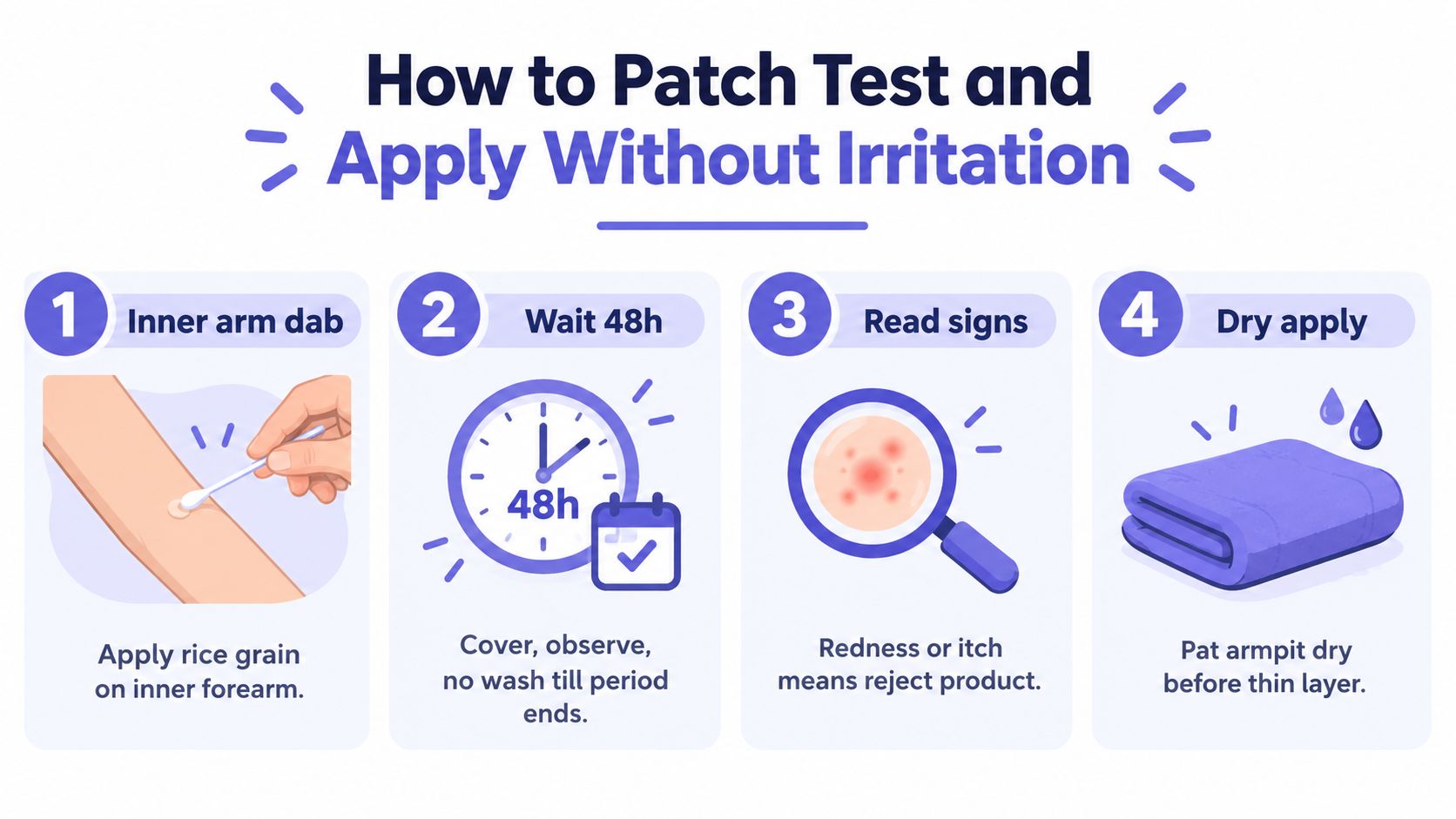
- Choose a small test area. Apply a tiny amount to the inner forearm, where the skin is easy to observe. Don't test over broken, freshly shaved, inflamed, or already irritated skin.
- Leave it undisturbed. Keep the area under observation for 48 hours, following the patch-test approach shown in the accompanying guide. Avoid adding other new products to that spot, because combining changes makes the result difficult to interpret.
- Look for warning signs. Itching, increasing redness, burning, swelling, small bumps, or a spreading rash means you should stop using the product. If the area stays comfortable, that's encouraging, but it isn't permission to apply a thick layer under both arms immediately.
- Introduce the deodorant gradually. Start with a thin layer on clean, completely dry skin. Use fewer passes with a stick, and don't rub cream aggressively. If you've shaved, allow the skin to settle before applying a product, particularly if it contains alcohol, fragrance, or a potentially active antiperspirant ingredient.
The evidence supports assessing tolerability with more than a subjective “it feels fine.” In a controlled 3-week application study involving 30 people with objectively sensitive skin, a roll-on deodorant showed very good tolerability, with no significant changes in hydration, surface lipids, or transepidermal water loss, and no irritative skin changes detected on the forearm despite daily axillary use (controlled sensitive-skin deodorant study). In everyday life, you can't measure these endpoints at home, but you can monitor comfort, dryness, tightness, scaling, and persistent redness.
Here's the video guide for the same simple testing mindset:
Application rule: dry skin and a thin layer usually create less trouble than repeated rubbing over damp or freshly shaved skin.
Special Cases: Eczema, Post-Shave, Pregnancy and Men's Grooming
Eczema-prone underarms
During an eczema flare, even a normally tolerated deodorant may sting because the barrier is already compromised. Pause the product that causes discomfort and avoid experimenting with several replacements at once. Once the area has settled, a fragrance-free formula with a short ingredient list is a more sensible starting point than a strongly scented botanical blend.
I believe the eczema-friendly choice is the simplest tolerated formula, used only when the skin is calm enough to accept it.
After shaving
Shaving removes hair but also creates mechanical stress and may leave tiny nicks that aren't obvious in the mirror. A hard stick, drying alcohol, baking soda, or fragrance can turn mild post-shave sensitivity into a pronounced burning sensation. Choose a low-drag cream or roll-on, apply sparingly, and wait until the skin no longer feels hot or tender.
I'm certain post-shave comfort improves when you treat timing and friction as seriously as the ingredient list.
Pregnancy
Pregnancy can make people more alert to scent and skin discomfort, even when the formula hasn't changed. A fragrance-free product with a modest ingredient list is a reasonable preference, but persistent rash or unusual symptoms should be discussed with a healthcare professional rather than managed through endless product switching.
I believe simple, fragrance-free care is the most reassuring starting point during pregnancy, provided it feels comfortable and fits your clinician's advice.
Men's grooming
Thicker underarm hair, more vigorous washing, frequent shaving, and heavier sweating can change which format feels practical. A cream can reduce drag, while an aluminum antiperspirant may be more relevant when wetness control is the priority. Men looking for a broader routine can also explore this guide to deodorant for men with sensitive skin, while still checking each product's actual ingredient list.
I believe men's grooming works best when the format matches the shaving pattern and sweat level, not when the product is chosen only for its scent.
Choosing with Confidence and When to See a Dermatologist
A confident purchase doesn't require memorising every cosmetic ingredient. Use a short checklist:
- Start with fragrance-free. This removes a major sensitisation pathway.
- Check the active purpose. Choose antiperspirant for wetness reduction, deodorant for odour control.
- Review baking soda and alcohol. These may be especially uncomfortable on reactive or recently shaved skin.
- Assess texture. Avoid products that drag, crumble, or leave heavy buildup.
- Patch test first. Introduce the product on dry, intact skin.
- Track the response. A simple note of product, shaving, exercise, and symptoms can reveal patterns.
I believe this complete guide to sensitive skin deodorant can solve much of the confusion caused by broad “gentle” claims. It won't diagnose an allergy, and no label can promise that every person will tolerate a formula.
See a dermatologist if irritation persists after stopping the suspected product, or if you develop persistent eczema, weeping, marked swelling, blistering, open skin, increasing warmth, or discharge. A clinician can assess whether the problem is allergic contact dermatitis, irritant dermatitis, eczema, infection, or another condition, and may recommend formal patch testing.
The best long-term choice is usually the one you can use consistently without burning, itching, tightness, or repeated redness. Comfort is useful evidence, but recurring symptoms deserve professional attention rather than another cycle of trial and error.
Build a simpler underarm-care routine
Healtsy offers pharmacy and beauty products across skincare, body care, men's grooming, and other everyday health categories, including options suited to sensitive-skin routines. Compare dermatologist-oriented products and build a simpler underarm-care routine around your skin's actual needs.
Shop Healtsy