


Retinal Serum Explained: Strength, Use and Where to Buy
The most repeated advice about retinal serum is to buy the highest percentage you can find and get on with it. I've spent 16 years working with cosmetic actives, and I believe that one sentence causes more abandoned bottles than any other piece of skincare advice. The percentage is a real number. It's just not the number that decides whether a serum works on your face.
Two serums both labelled 0.1% can behave nothing alike by the time they reach you. The active decays in light and air, the base may or may not suit your barrier, and it lands on skin that's already using acids, exfoliants or a prescription. None of that shows up in the headline figure.
This is the complete guide to the variables that decide the outcome: which molecule is printed on the label, what the packaging does to it, the strength that matches your skin this month, and the restart rule for when irritation has built up. Nothing here is a reason to fear retinal. It's a reason to stop reading it as a race.
What Retinal Serum Is and How It Differs From Retinol
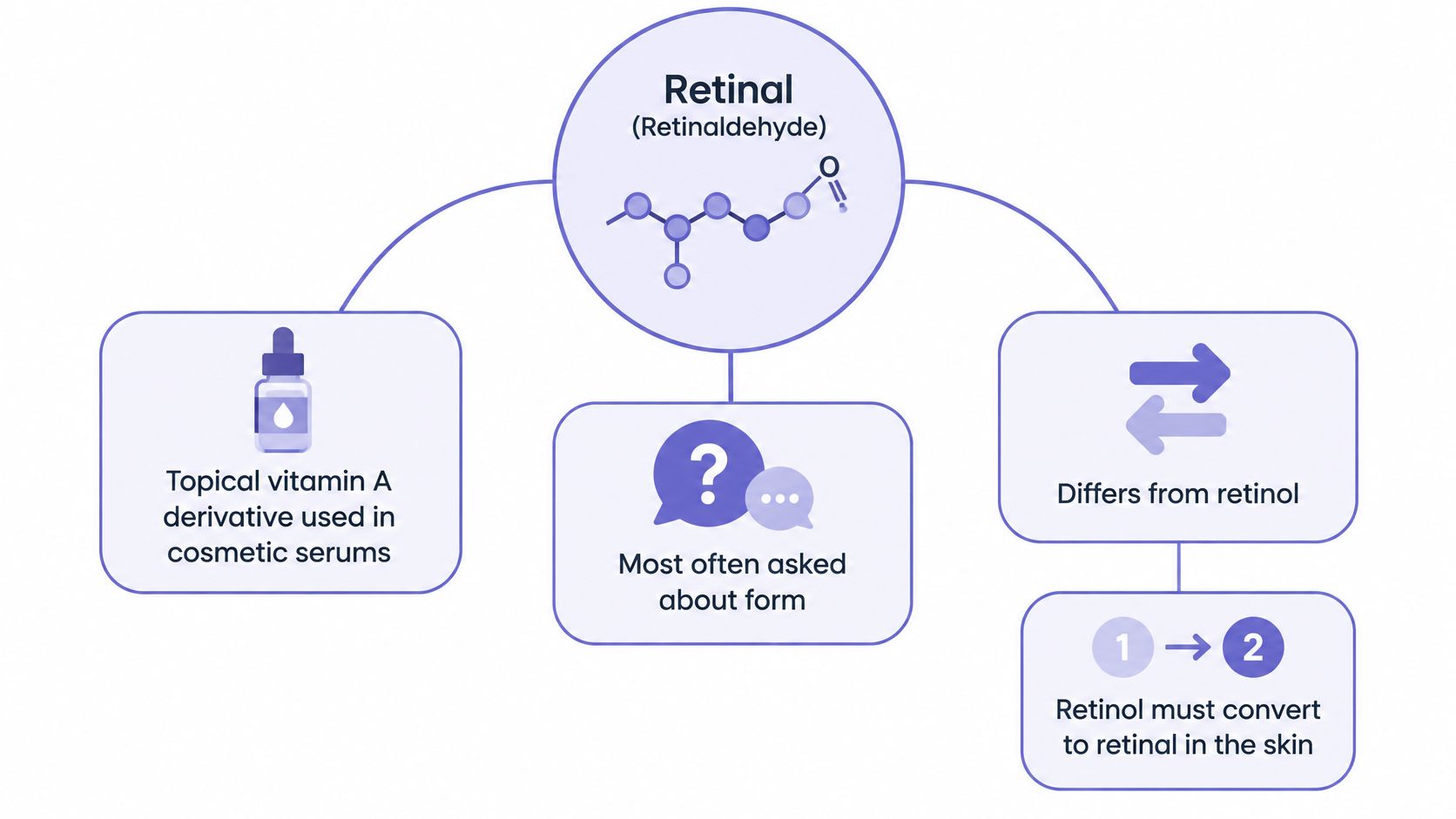
Retinal serum is a cosmetic product built around retinaldehyde, usually written as retinal, a first-generation topical retinoid and one of the vitamin A derivatives used on photoaged skin (review of cosmetic retinoids in dermatology). After 16 years of explaining vitamin A to shoppers, I'm certain this is the form most often confused with retinol, and the confusion is expensive, because it pushes people to compare percentages across molecules that don't convert at the same speed.
One staircase, three starting points
Picture the vitamin A pathway as a staircase with a single door at the top. Retinoic acid is the molecule your skin uses. Retinal sits one enzymatic step below it, retinol sits two steps down, and retinyl esters sit several steps further back.
The review linked above describes retinaldehyde as occupying an intermediate position in that pathway, converted by skin enzymes into retinoic acid, the biologically active form associated with retinoid signalling. That single step explains why retinal products are positioned as stronger than retinol, and why they remain distinct from prescription retinoic-acid products.
Tretinoin isn't a step on the staircase at all. It's already retinoic acid, which is why it's prescription-only and why no cosmetic serum substitutes for it. The research history behind all of this begins in the 1920s, when vitamin A deficiency was connected with abnormal keratinisation, and runs through the mid-century synthesis of tretinoin and isotretinoin to the newer retinoid generations.
Retinal, retinol and tretinoin side by side
| Ingredient | Steps to retinoic acid | Category | Typical labelled strength |
|---|---|---|---|
| Retinal (retinaldehyde) | One enzymatic step | Cosmetic | 0.05% and 0.1% in clinical studies |
| Retinol | Two enzymatic steps | Cosmetic | Set by the brand, not by a standard |
| Retinyl esters | Several steps | Cosmetic | Often unstated on the front panel |
| Tretinoin | None, already retinoic acid | Prescription only | Set by the prescriber, not by the shelf |
The percentage means nothing until you know the molecule
A product containing 0.05% retinaldehyde isn't equivalent to one containing 0.05% retinol or 0.05% tretinoin, and the same review states that clearly. The figure describes how much of a named ingredient sits in the base, not how much retinoic-acid activity reaches your skin.
That's also why formulation carries so much weight across European brands. Retinaldehyde is formulation-sensitive, so packaging, storage instructions and a manufacturer's stated stabilisation system become part of the comparison, not footnotes to it.
The concept map below puts the definition and the conversion difference in one view.
If your skin has reacted badly to every vitamin A product you've tried, a non-retinoid route such as this anti-ageing skincare for sensitive skin is worth understanding before you push a stronger retinal. The wider family tree, including where retinal sits against its better-known cousin, is set out in this comparison of retinol vs retinoid.
I believe the percentage only starts to mean something once you know which molecule carries it. That leads straight to the label.
Reading the Label and Choosing Your Starting Strength
Front panels sell. Back panels inform. I'd turn the box over first, and I'd do it in the same order every time, because the three things that matter most tend to sit in three different places.
Read the label in this order
- The active and its percentage. Look for retinaldehyde or retinal in the ingredient list, then find the stated concentration. A serum that names retinal but prints no percentage can't be compared with anything, so ask the manufacturer before you buy rather than guessing from the ingredient's position in the list.
- The stabilisation claim. Words like stabilised or encapsulated tell you the maker has thought about degradation. They aren't a guarantee, but they should always arrive with a storage instruction attached.
- Batch and expiry. A vitamin A serum with no batch code and no date is a product you can't check on arrival. Cross-border orders sit in transit for days, so this matters more, not less.
- The container. Opaque or light-protective, ideally airless or a pump that limits air exchange. A clear dropper bottle on a bathroom shelf asks for trouble.
A missing percentage is a data gap, not modesty. It should slow your purchase down rather than speed it up.
What the strength comparison actually shows
A comparative clinical report evaluated stabilised retinaldehyde at 0.05% and 0.1% applied twice daily for three months. Both concentrations were associated with a reduction in eye-area wrinkles, and the 0.1% formula produced the slightly larger measured improvement: 1.8% compared with 1.5% for the 0.05% formula (comparative clinical report on retinaldehyde strengths).
Read those two numbers slowly. Doubling the concentration moved the measured result by three-tenths of a percentage point in a specific study population on a specific schedule. It doesn't mean doubling the percentage doubles the visible effect.
The same comparative work sat alongside a three-month randomised, double-blind study of 40 women using 0.05% and 0.1% retinaldehyde creams. Both strengths were associated with reported improvements in hydration, wrinkles, skin roughness and transepidermal water loss, but the study had no vehicle-only control group, so it can't establish how much of the change came from retinaldehyde rather than the base formula (randomised study of 0.05% and 0.1% retinaldehyde creams). That limitation isn't a reason to dismiss the ingredient. It's a reason to read a percentage as one variable among several.
Retinaldehyde strengths and reported results
| Strength | Eye-area wrinkle change (3 months) | Use pattern in studies | Suited to |
|---|---|---|---|
| 0.05% retinaldehyde | 1.5% | Twice daily | New users, dry or reactive skin, anyone also using exfoliating acids |
| 0.1% retinaldehyde | 1.8% | Twice daily | Users whose skin has tolerated a retinoid for several weeks |
| Strength not stated | Not reported | Not reported | Ask the manufacturer before comparing |
Choosing your starting strength
Start at 0.05% if you're new to vitamin A, if your skin runs dry or reactive, or if exfoliating acids are already part of your week. Consider 0.1% only after several weeks of comfortable use at the lower strength, and only if texture and tone are still your main concern.
The more common mistake isn't choosing 0.1% too soon. It's choosing it, reacting within ten days, and concluding that retinal doesn't suit the skin, when 0.05% three nights a week would have been perfectly manageable. Tolerance, consistency and the complete formula matter as much as the number on the carton.
Give any strength at least eight weeks before you judge it, and judge it on comfort, consistency and how the skin feels at the end of a working week rather than on the headline figure. I believe this order, label first and then strength, is the most practical way to choose.
When Pregnancy or Breastfeeding Means Skipping Retinal Serum
Pregnancy is the one situation where the strength on the label stops being the question. Dermatology guidance advises avoiding retinoids when you're pregnant or trying to conceive, and recommends discussing your skincare with a healthcare professional (British Cosmetic Dermatology Group patient leaflet on retinoids).
The part people miss is the trying. Stopping before conception is the guidance, not stopping after a positive test, which means the decision usually arrives while the bottle is still half full and the routine is working well.
Check the ingredient list, not the product name. All of these are vitamin A derivatives and all fall under the same advice:
- Retinal and retinaldehyde
- Retinol and retinyl esters such as retinyl palmitate
- Retinoic acid and tretinoin
Say you find a half-used bottle on the shelf the same week a pregnancy test turns positive. I'd stop that night, store the bottle out of easy reach, and photograph the ingredient list for the next appointment. A clinician can read that list in seconds, and it's far more useful than the marketing name on the front.
Breastfeeding guidance is less uniform, which is exactly why no blanket safe claim belongs in an article like this. Confirm with a pharmacist, GP or dermatologist before restarting, and treat the answer as the one that counts for your situation.
Sun protection doesn't pause with the serum. The same leaflet specifies broad-spectrum SPF 50 every morning with reapplication during the day, so keep that step running while a non-retinoid routine covers hydration and barrier support in the meantime. If you're rebuilding a routine around feeding, this guide to skincare safe for breastfeeding covers the swaps in more detail.
Pause, ask a professional, and restart only when they clear it. I believe that's the right order, and I'd rather you ask a pharmacist than take my word or a product page's word for it.
How to Introduce Retinal Serum Step by Step
The labelled percentage is only one dial. Stability, packaging, your current tolerance and the other products already in the routine decide how the first month feels, so the order below matters as much as the number on the box.
Retinoid products commonly cause temporary dryness or irritation when first introduced, and professional dermatology guidance recommends starting slowly and using moisturiser to reduce the problem (American Academy of Dermatology guidance on retinoids). Expected symptoms include redness, stinging, peeling, itching or excessive dryness.
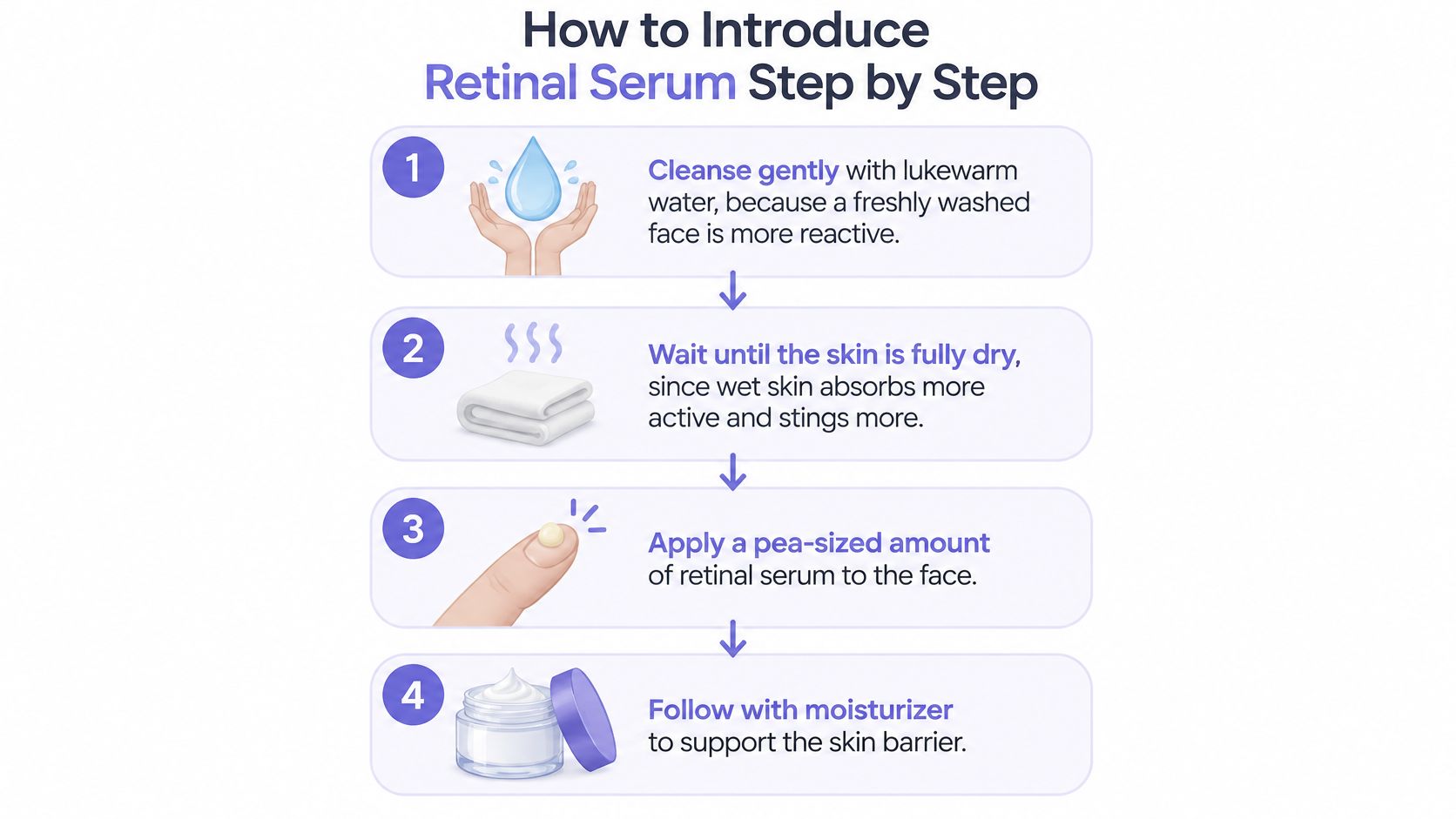
- Cleanse gently with lukewarm water. Hot water plus a foaming cleanser leaves the surface more reactive; save double cleansing for nights when the retinoid stays on the shelf.
- Wait until the skin is completely dry. Wet skin absorbs more active and stings more. Two or three minutes after patting dry is enough, and brushing your teeth first builds the wait into the routine automatically.
- Apply a pea-sized amount to the whole face. Keep it away from the corners of the eyes and the folds beside the nostrils, which sting first. Dotting extra product onto the exact areas you want to change is usually where irritation starts.
- Follow with a fragrance-free moisturiser. The serum can feel like enough on its own; the moisturiser is what keeps the barrier supported while skin adapts.
- Start on nonconsecutive evenings. Beginners should begin on alternate or third nights rather than applying nightly from day one. Very sensitive or eczema-prone skin is more likely to become irritated, so give it the slower ramp.
- Apply it at night and keep mornings protected. Retinoids can increase sensitivity to sunlight, so the daytime routine needs consistent sun protection while the serum is in use.
The pattern behind most rough starts is simple: cleanser too harsh, skin still damp, product layered too thick, moisturiser skipped, frequency climbed too fast.
Introduction schedule for the first eight weeks
| Stage | Frequency | What to watch for |
|---|---|---|
| Weeks 1-2 | Every third evening | Mild tingling is normal; stop if burning persists |
| Weeks 3-4 | Every other evening | Light dryness or peeling; add moisturiser |
| Week 5 onwards | Nightly if skin is comfortable | Redness that lasts past morning means reduce frequency |
| Any stage | Pause until skin settles | Visible irritation or swelling |
The restart rule is the part people skip. If irritation has built up enough to pause, do not resume at the same frequency; go back one step for a week, confirm calm mornings, then climb again. A comfortable week looks like mild dryness at most, no stinging that lasts more than a minute after application, no visible flaking after the first fortnight and no sensitivity that makes your usual moisturiser feel like a sting.
If you prefer to see the order demonstrated rather than read it, this walkthrough covers the same sequence:
Two practical notes for planning ahead. If you're booking an in-clinic treatment, check a four-week microneedling preparation timeline so the serum pause the clinic asks for doesn't collide with a fresh restart. And if you're building tolerance on deeper skin tones, where post-inflammatory pigmentation is a real risk, this walkthrough of how to introduce retinol for dark skin without irritation follows the same logic at a gentler pace.
Fixing Dryness, Stinging and Peeling
A cheek that stings at midnight and a forehead still red at breakfast are different problems with different fixes. Six patterns cover most irritation complaints, and each one resolves without abandoning the serum.
- Stinging concentrated at the nose, mouth and eye creases. The serum is migrating into thinner skin. Buffer those folds with a thin layer of plain moisturiser before the serum goes on.
- Redness that's still there at breakfast. Frequency is too high. Drop to every third night and hold there until mornings are calm again.
- Flaking in the first fortnight. Expected while turnover speeds up. Keep the moisturiser, hold the frequency steady, and don't increase while flakes are visible.
- Tightness and dryness by midweek. Add lipids. Swap in a richer fragrance-free moisturiser on the nights you apply the serum, and let it sit a few minutes after the serum before layering.
- Stinging once acids are in the routine. Layers are conflicting. Put the acid and the retinal on different nights, or pause the acid entirely while the skin settles.
- Flares in eczema-prone or rosacea-prone skin. Stop the serum and speak to a pharmacist or dermatologist before restarting.
Irritation can still build up with a well-made formula. In a 24-week study of 56 women using 0.05% or 0.1% stabilised retinaldehyde, one participant withdrew because of facial erythema and discomfort. One withdrawal in 56 is reassuring, and it is also a reminder that tolerance is individual, never guaranteed by the label.
The restart rule. After a pause, come back at the every-third-evening stage rather than the frequency you left, and wait for two calm weeks before reintroducing exfoliating acids or booking a cosmetic procedure.
I find that irritation which responds to a lower frequency usually settles within ten days to two weeks. Stinging or redness that persists past three weeks at the slower pace is a signal to stop the serum and seek advice, rather than working through it.
Dryness that keeps returning usually means the barrier isn't holding water efficiently, and this explanation of how skin attracts and holds water shows why a moisturiser does more than the serum does in that situation. If the barrier is already damaged, work through how to repair a damaged skin barrier before you restart.
I believe a gradual restart is safer than picking up the old routine exactly where it was left. The skin rarely thanks you for the shortcut.
Where to Buy European Retinal Serums From Abroad
Buying a European retinal serum from outside the EU adds two questions that have nothing to do with the percentage on the label: is the seller authorised, and will the formula survive the journey?
Retinaldehyde is chemically vulnerable to both auto-oxidation and photo-oxidation, so packaging and storage act as performance variables in their own right. Oxygen, light and repeated exposure during use can reduce the amount of intact active reaching the skin across the shelf life (review of retinaldehyde stability and clinical evidence).
A seller checklist before you pay
- Authorised distribution. Confirm the seller uses authorised distribution, and ask how the stock was sourced if the listing does not say.
- Batch and expiry information. Visible on the listing or on the box you receive.
- Storage directions. Look for a manufacturer statement about temperature and light; a generic icon tells you little.
- Stated shipping origin and transit time. Days in transit in summer heat are part of the product's history.
- Import duties in the advertised price. A surprise customs bill can turn a fair price into an expensive order.
Healtsy is a Portugal-based online store for European pharmacy and parapharmacy products, and every product is sourced through authorised distribution. Orders ship by DHL from Europe, and import duties are already included in the price for the main non-EU markets.
The image below shows one of the two formulas compared here.
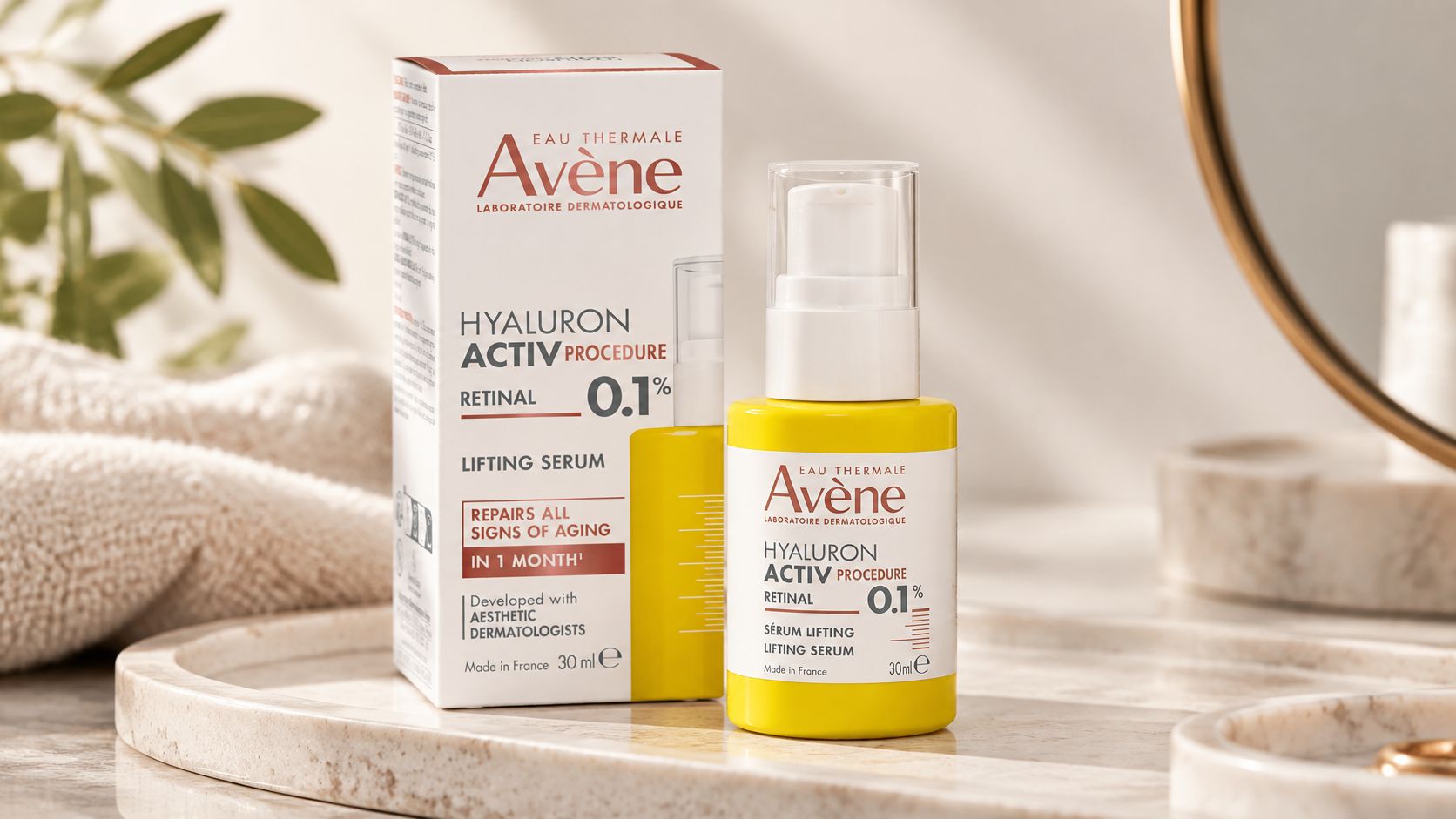
Two catalogue examples show how differently formulas built on the same active can be configured.
Pairs retinal with trehalose and hyaluronic acid in a firming serum aimed at texture, hydration and radiance.
Combines retinal with glycolic acid, which changes the routine completely: the acid and the retinal belong on separate nights while you build tolerance.
Cross-border availability is its own variable, and this explanation of French pharmacy products not available in the US covers why certain formulas never reach local shelves.
Confirm the labelled strength and the container type first. I believe that checklist protects a cross-border purchase better than the headline percentage alone.
Choose the strength that matches your skin this month
Healtsy ships European pharmacy dermocosmetics from Portugal to the US, the UK, Germany, Canada, Australia and the Gulf. The retinal serums, the sunscreens and the barrier moisturisers that make a routine work sit in one catalogue, and each product page names the active ingredients, the concentration where the manufacturer provides it, and how to use the product.
Visit Healtsy