


The popular advice to “buy it in France and bring it home” skips the most important question: what is the product legally classified as in the United States? A missing French pharmacy product isn't automatically unsafe, counterfeit or banned. Its claims, labeling and route to market may differ from those of the American version.
I believe the most useful approach is to read the label before judging the brand. For shoppers researching French pharmacy products not available in the US, the practical questions are what the product contains, what it claims to do, and whether the exact version can lawfully enter the country.
Which French Pharmacy Products Are Missing From US Shelves
French pharmacy product categories and their US status
| Product category | US classification | Why it may be missing | Label check |
|---|---|---|---|
| Face sunscreens, mineral or chemical | Over-the-counter drug | Filters and claims must meet US sunscreen rules | Active filters and SPF testing claim |
| Prescription-strength retinoid and tazarotene creams | Prescription drug | Requires FDA drug approval | Active ingredient and concentration |
| Oral tonics and vitamin ampoules | Dietary supplement when marketed within supplement rules | Formula, dose and claims must meet supplement rules | Ingredient list and dose per unit |
| Dry-eye drops and sprays | Often a medical device, although some eye products are drugs | Requires the applicable US device clearance or drug pathway | Indication and preservative system |
| Baby and child creams with active or sun claims | Cosmetic or drug, according to the claim | The claim sets the category | Exact claim wording on the label |
These are categories where the French version may lack an ordinary US retail equivalent, not a list of products universally absent from American stores. A familiar name on a US website doesn't establish that the formulation matches the French box.
For face sunscreen, the filter list matters more than whether the front says mineral or chemical. For prescription-strength retinoids, the ingredient name needs to be read alongside its concentration and dosage form.
An oral ampoule deserves particular care because its appearance doesn't establish its regulatory status. Read whether it's intended to be swallowed, what each unit contains, and whether the label presents it as a supplement or medicine.
With eye drops and sprays, the intended application matters: a spray for closed eyelids isn't automatically interchangeable with drops placed in the eye. For children's creams, a moisturizing claim and a sun-protection claim raise different questions, even when the packaging looks equally gentle.
What the shelf location doesn't tell you
A French pharmacy sells more than medicines. Its shelves can include cosmetics, supplements and medical devices, so pharmacy placement alone doesn't establish US status.
For an everyday hydration need, start with the texture, ingredients and intended user rather than seeking the most “pharmaceutical” package. Our guide to choosing a French pharmacy moisturizer helps separate that cosmetic decision from a prescription-treatment question.
Practical rule: Absence from US shelves isn't an authenticity test. Assess the product's identity and its legal route to market separately.
Limited availability can reflect regulatory requirements and a manufacturer's decision not to enter the American market. It doesn't, by itself, establish poor quality or counterfeiting.
Why the Same Product Changes Category in the US
A passport remains the same booklet, but the stamp determines where its holder can travel. A product's ingredients are like the booklet; its intended use and claims help determine the regulatory route it must take.
Say a cream promises to smooth the appearance of skin texture. That's a cosmetic purpose. If its marketing instead promises to clear acne, it moves toward drug regulation; wording about fading marks also needs careful reading because an appearance claim isn't the same as a claim to alter pigmentation.
Under FDA's explanation of cosmetics and US law, products intended to treat or prevent disease, or affect the body's structure or function, can be drugs, and products treated as cosmetics in Europe may be drugs in the US, with sunscreen a specific example.
The practical consequences
- Different market, different category. French cosmetic positioning doesn't automatically establish American cosmetic status.
- Combined purposes mean combined obligations. A product can be both a cosmetic and a drug.
- An ingredient isn't a complete classification. Its purpose, presentation and surrounding claims matter too.
FDA's personal-care safety guidance explains that ordinary cosmetics generally don't require premarket approval, while cosmetic-drug products must identify drug active ingredients before cosmetic ingredients.
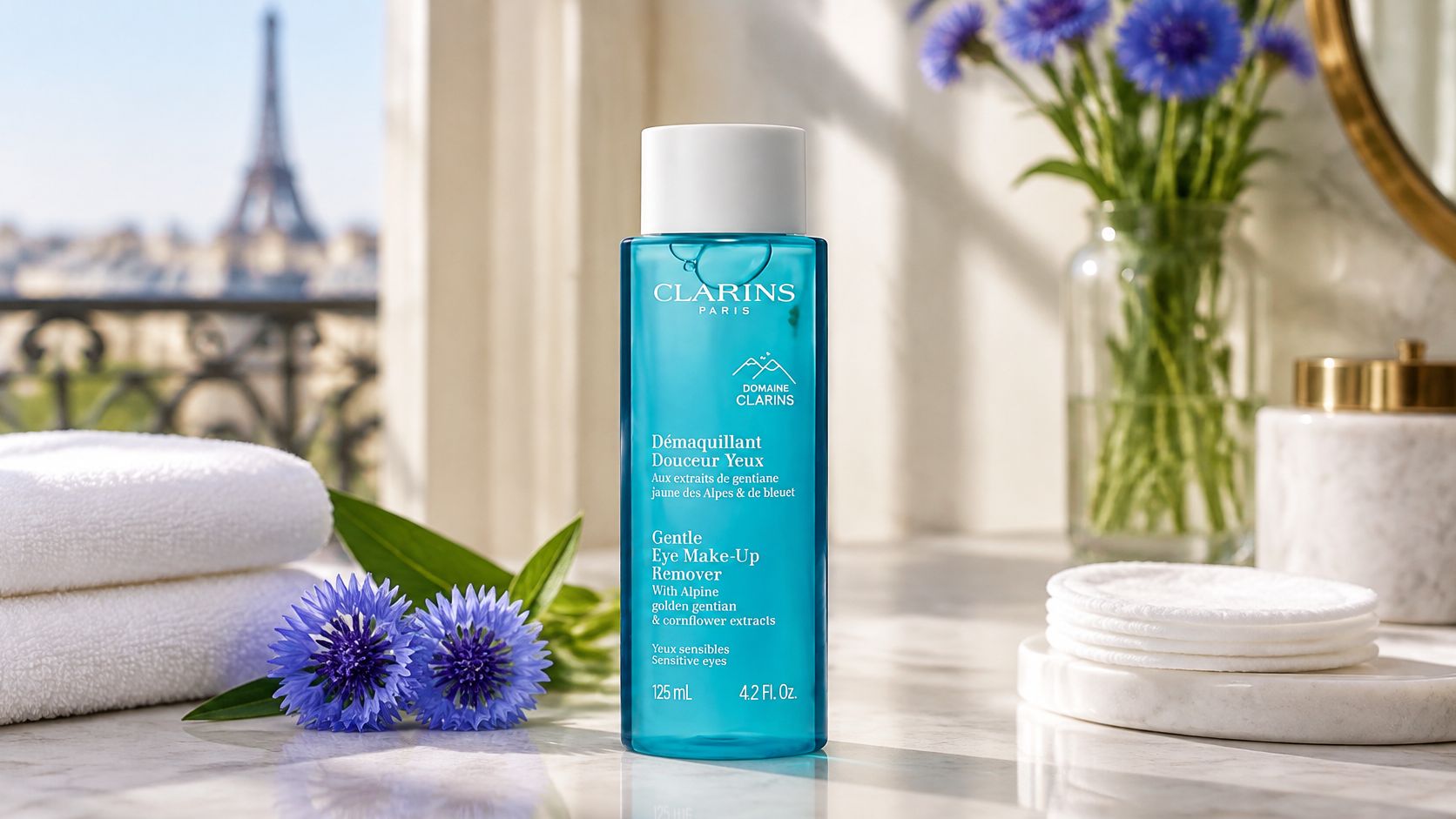
A straightforward cleansing example is Clarins Gentle Eye Makeup Remover - 125ml, described as a fresh, soothing lotion that gently removes makeup and impurities. That description illustrates cosmetic positioning, not a promise to treat an eye condition.
Cosmetics still need safe use and truthful labeling. FDA's importing-cosmetics guidance also describes facility-registration and product-listing obligations under the modernized cosmetics framework, subject to applicable exemptions.
For vitamin-A products, understanding retinol versus retinoid helps prevent another naming mistake. Ask what the French label claims, which actives and concentrations it identifies, and whether the exact product is presented as a cosmetic or medicine.
Why Tazarotene Strength Decides Whether a Product Matches
Tazarotene versions and their US status
| Version | US status | What to compare |
|---|---|---|
| Topical tazarotene cream 0.05% | Prescription, listed in FDA's Orange Book | Concentration and vehicle |
| Topical tazarotene cream 0.1% | Prescription, listed in FDA's Orange Book | Concentration and vehicle |
| Tazarotene lotion 0.045% | FDA-approved bioequivalent to a US reference product | Dosage form and approved status |
The FDA regulatory records described through its cosmetics laws and regulations resources distinguish tazarotene creams at 0.05% and 0.1% with prescription marketing status from an approved 0.045% lotion identified as therapeutically and bioequivalent to a US reference product.
The lower-strength cream row identifies a particular concentration in a cream vehicle. It doesn't establish that every European tube bearing that concentration has the same approval status.
The higher-strength cream row isn't merely an upgraded cosmetic choice. A buyer shouldn't interpret a larger percentage as permission to substitute it for another product or change application instructions.
The lotion row illustrates why form matters alongside percentage. An FDA determination about a particular approved lotion doesn't extend to every cream or lotion containing the same active.
Read beyond the ingredient name
Suppose you find a French tube with tazarotene printed on it and assume it matches a US prescription cream. Before making that comparison, inspect:
- Active identity. Confirm the actual ingredient, rather than relying on a broad term such as retinoid.
- Concentration. Read the percentage printed on the exact tube and carton.
- Vehicle. Establish whether it's a cream, lotion or another dosage form.
- Marketing status. Check the exact product's destination-market status rather than inferring it from European packaging.
The distinction is especially important when reading about a European cosmetic presentation. Our Boderm Tazarene cream guide provides context for reading that product's information, not proof of US prescription equivalence.
This discussion describes labeled cosmetic and prescription uses only. It doesn't recommend treating a skin condition or replacing a prescribed medicine.
Sharing an active ingredient doesn't make products interchangeable. A pharmacist or prescriber needs the complete product details, not just the name on the front.
Foreign Medicines and the Personal Import Limit
Buying a product legally in Europe doesn't automatically mean you can lawfully carry it home or receive it by post. Personal use isn't a blanket exemption from American drug requirements.
FDA's personal-importation guidance explains that foreign approval doesn't establish US approval, and individuals generally may not import foreign drugs or medical devices for personal use. FDA personnel may exercise discretion in limited circumstances, including certain medically necessary situations without an adequate US-approved alternative.
That discretion isn't a shopping entitlement or a seller's guarantee. A foreign medicine may be refused entry even when the purchaser has no intention of reselling it.
A calm decision path
- Establish the French category. Is the exact product a medicine, cosmetic, supplement or medical device? Don't decide from the pharmacy shelf or package design.
- Look for a US-approved option. A prescriber or pharmacist can help distinguish an equivalent medicine from one that merely has a similar name.
- Clarify the medical need. A serious, medically necessary need is different from preferring a European texture, price or brand.
- Discuss the option before ordering. If the need is medical, speak with a prescriber about an appropriate US-approved product and any relevant import questions.
Consider a prescription cream purchased for a flare-up and a fragrance-free cleanser purchased for daily washing. The cream raises a medicine and prescribing question; the cleanser raises a cosmetic-labeling and suitability question.
The practical trade-off isn't convenience versus cost. An imported medicine can leave you without a reliable supply if the shipment isn't admitted, which matters when you depend on continuing treatment.
Cosmetics and supplements follow different product-specific import requirements. Neither should be assumed exempt from review merely because it isn't a prescription medicine.
Import Rules, Labels and Duties at the US Border
An international checkout confirms that a seller can accept an order. It doesn't replace customs entry or regulatory review.
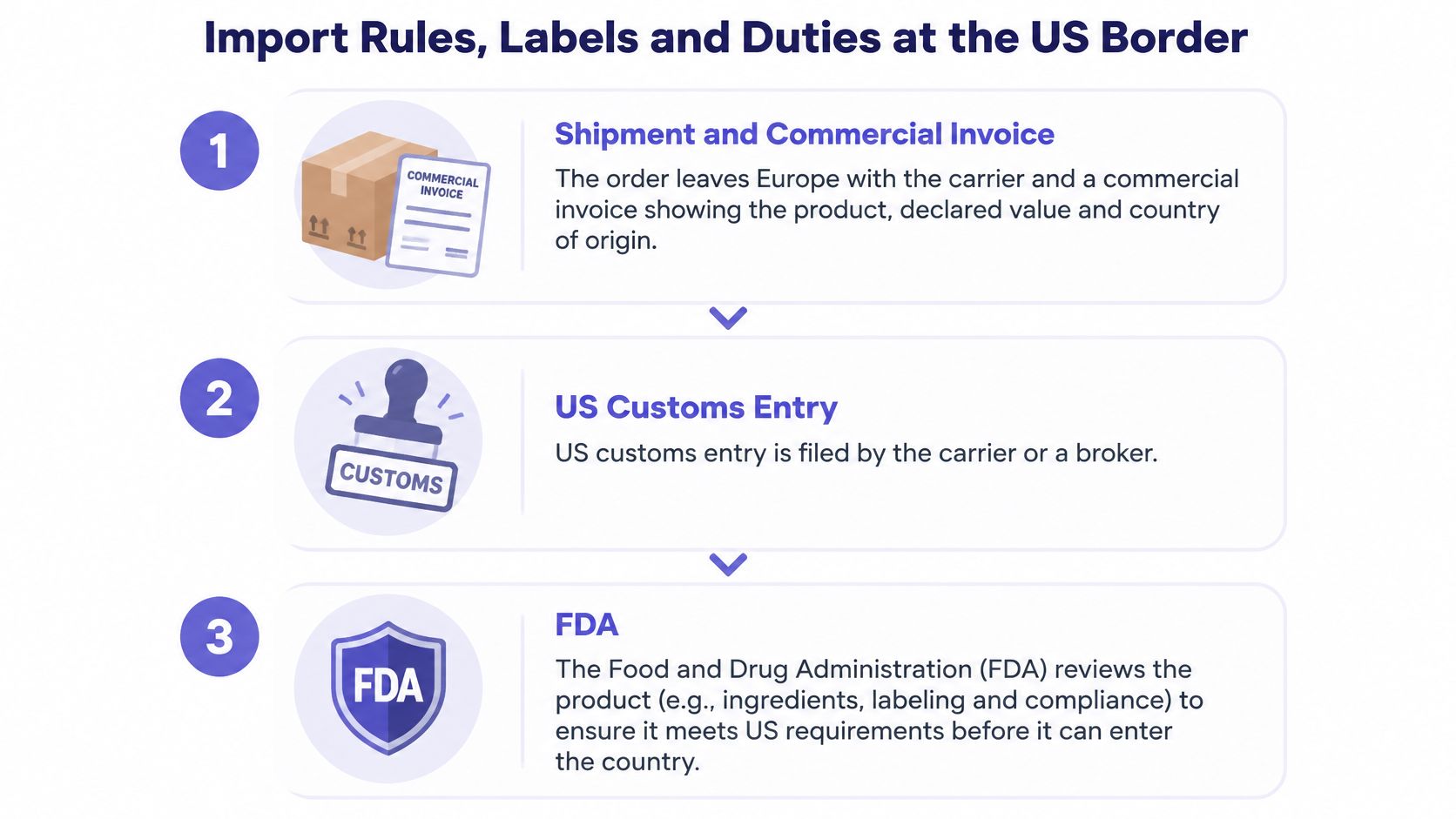
The shipping process includes documents as well as the physical parcel.
What happens during entry
- Departure from Europe. The carrier takes the order with a commercial invoice identifying the product, declared value and country of origin.
- Customs filing. The carrier or a broker files the US customs entry; an accurate product description helps avoid preventable questions.
- Regulatory review. FDA may examine the product and its labeling, so a French-only carton can raise a compliance issue.
- Release or further action. The parcel may be released, held for questions or refused rather than automatically delivered.
FDA's guidance for cosmetics importers states that imported cosmetics must meet US requirements, including truthful, informative English labeling, and that products appearing adulterated or misbranded may be refused, brought into compliance, destroyed or re-exported.
Keep the order confirmation, invoice and label photographs together. If someone requests clarification, those records help identify exactly what was ordered without relying on a shortened listing title.
For further context on the shipping topic, the video below is a supplementary resource, not a substitute for official entry requirements.
Cost and timing checks
Duties can turn on customs classification, declared value and origin. Check current US Customs and Border Protection guidance and the carrier's fees rather than assuming cosmetics are duty-free.
We ship to the United States from Europe. For our main non-EU markets, import duties are included in the price; review the destination-specific checkout details rather than assuming another retailer uses the same arrangement.
Seasonal workload also deserves room in your planning: FDA reported that import-line volume rose 29% during November and December 2024 compared with earlier months, with cosmetics accounting for approximately 550,000 additional import lines per month during that holiday period. That supports allowing a delivery buffer, not promising a particular delay.
US Alternatives With the Same Active Ingredients
Match the active, concentration and form before comparing brand names. That gives you a useful shortlist of candidates; a pharmacist or prescriber confirms whether pharmaceutical equivalence holds.
Form changes the comparison as much as strength. A salicylic acid cleanser that touches skin for a minute before rinsing delivers a different exposure from an alcohol-based pad worn for hours. A serum that lists the same ingredient for a cosmetic claim serves a different purpose from an acne product where that ingredient appears in a Drug Facts panel.
Common actives and their typical US over-the-counter forms
| Active ingredient | Common US form | What to compare |
|---|---|---|
| Salicylic acid | Cleanser, pad or lotion | Percentage, vehicle and labeled purpose |
| Glycolic acid | Toner or peel pad | Percentage and pH, if disclosed |
| Zinc oxide | Mineral sunscreen | SPF claim and broad-spectrum wording |
| Benzoyl peroxide | Acne gel or wash | Percentage, form and directions |
| Niacinamide | Serum or moisturizer | Labeled percentage and complete formula |
Where a comparison can go wrong
For salicylic acid, separate the rinse-off cleanser from the leave-on pad before treating a matching percentage as a matching routine; contact time is the difference that matters. Our guide to salicylic acid versus benzoyl peroxide covers the next step: two actives aimed at similar breakouts work through different mechanisms, so swapping one for the other changes what the product does.
For glycolic acid, check three label fields rather than the headline figure: the disclosed percentage, the pH if the manufacturer publishes it, and the directions, which state whether use is occasional or routine.
With zinc oxide, the meaningful comparison sits in the finished sunscreen's SPF claim, broad-spectrum wording and reapplication directions. The oxide percentage on an ingredient list describes one input to that claim.
Benzoyl peroxide comparisons need the application method alongside the strength. A wash and a leave-on gel carry different directions, so the handling that suits one can overexpose skin with the other.
For niacinamide, look past the advertised percentage to the ingredient list itself: where niacinamide sits in the order, which other actives share the formula, and how fragrance and texture fit skin that already reacts. A lower percentage applied consistently beats a stronger label you reach for twice and abandon.
A better buying question: What matches my intended use and fits my routine, rather than what has the biggest percentage?
Precise strength ranges come from the applicable official monograph or the exact US label; a category-wide assumption can mislead. A pharmacist can help verify that information, and a prescription-level need belongs with a prescriber.
Using a French Product Safely From Its Label
Start with directions you can understand, not a routine copied from social media. If an instruction is unclear, obtain a reliable translation and confirm the meaning before applying or swallowing the product.
For medicines, follow the prescriber's instructions and the dispensing label. For cosmetics, a small-area trial may help reveal intolerance, but it doesn't guarantee that wider use won't cause a reaction.
Make the label usable
- Read the amount and frequency. Don't increase either because the texture feels mild or because another product was used more often.
- Check previous reactions. Look through the complete ingredient list for substances you've reacted to, including ingredients outside the advertised active.
- Follow storage instructions. Keep the packaging away from conditions the label warns against, and distinguish a printed expiry date from an after-opening use period.
- Record when you open it. A note on the carton or in your phone makes an after-opening instruction easier to follow.
- Keep the original label. A pharmacist needs the product identity, active information and directions, not merely a photograph of the front.
For a facial vitamin-A routine, our retinoid cream best-practices guide can help organize cosmetic use. It doesn't replace product-specific warnings or prescribing advice.
Know when to stop
Stop using the product and seek advice if you develop irritation, swelling or a worsening condition. Severe swelling, breathing difficulty or a significant eye reaction needs urgent medical assessment rather than another product trial.
Don't assume discomfort proves an active is working. Adding another exfoliant or increasing frequency can make it harder to identify the cause.
This is general, label-based guidance. A persistent or serious condition needs clinical assessment, not a more ambitious shopping basket.
Verify Authenticity, Legality and Cost Before You Order
Authenticity, lawful import and value are separate decisions. A genuine product can still be unsuitable for your intended use or subject to import restrictions, and an attractive price can become less attractive once shipping and other charges are included.
I would verify the exact item before comparing retailers. A listing with a familiar name but no legible label is a poor basis for deciding what you're buying.
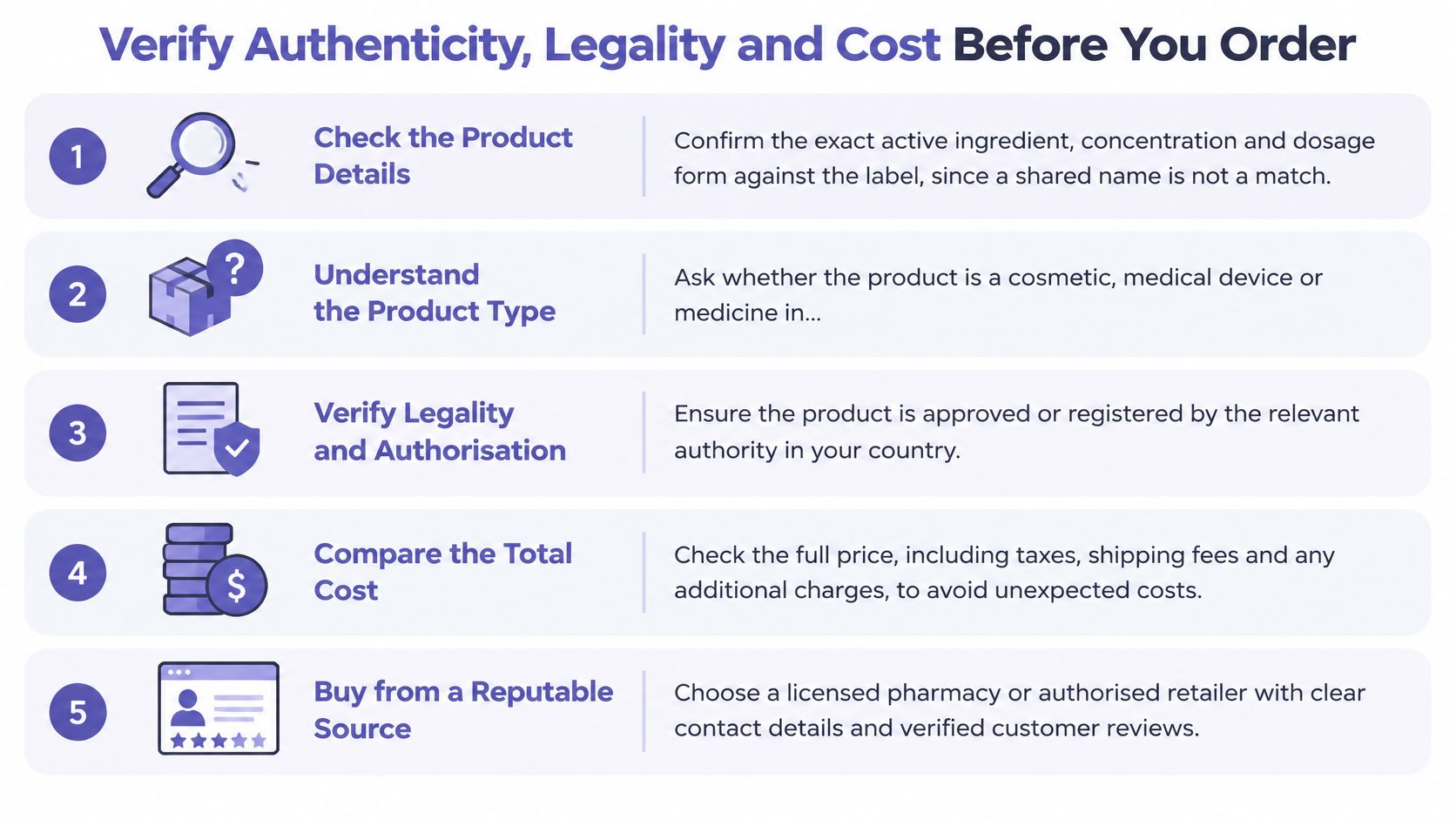
Three questions organize the purchase: is it the same item, can it be imported lawfully, and what does it cost delivered?
Establish identity and traceability
- Confirm the exact version. Match the active ingredient, concentration and dosage form to the item you intend to buy. Check size too, so you aren't comparing different packs.
- Establish the French category. For a medicine or medical device, resolve destination-market requirements before payment rather than treating international shipping as authorization.
- Examine sourcing claims. Authorized distribution is a meaningful distinction from an unexplained resale route, but a claim still deserves scrutiny. Our products come through authorized distribution, never grey-market channels.
- Keep batch and expiry evidence. Photograph the identifiers on the carton and container where present. If they appear inconsistent, ask for an explanation before use.
All products we sell are 100% original and stocked on our shelves, ready to be shipped. We sell no medicines, which is an important boundary when comparing an online parapharmacy purchase with a prescription purchase.
Check the package without overinterpreting it
Compare the packaging, spelling, font, language and printed details with reliable current product information. Unexpected differences justify a question to the seller. Legitimate market versions and packaging updates can look different without anything being wrong.
A batch code supports authenticity only when it matches the sourcing invoice. Read the sourcing information, invoice, packaging and seller's contact details together rather than relying on a single reassuring feature.
Calculate what you'll actually pay
Be cautious when a price is far below other offers for the same version and size. Before payment, review contact details, the returns policy, shipping charges and any destination-specific duties or carrier fees.
We offer free shipping to the rest of the world on orders over 220€. That threshold is useful for calculating a basket, not a reason to add products you don't need.
The border section above covered which records to keep from the listing and checkout. The same file serves here if the delivered item differs from what you ordered, because it gives you a clear basis for contacting the seller.
A missing US listing shouldn't push you into a rushed purchase. Verify the product's identity, establish whether it can lawfully be imported, and compare the full cost before adding it to your basket.
Healtsy offers original European pharmacy and parapharmacy products sourced through authorized distribution, with shipping to the United States. Visit Healtsy to review the exact product information and destination-specific checkout terms, then compare the label with the version you're looking for before ordering.