


You stand at the sink with a blade that drags, a jaw that already feels tight, and a can you grabbed because the foam looked thick. That scene is common. The product on the counter is only one part of the shave, and the label rarely tells you whether it will slip, sting, or sit on the skin.
This is the complete guide to cremes de barbear, written the way I talk in the pharmacy after 16 years in the sector. I believe this is the best account I can give from that work. I'm certain this will solve the habit of picking a cream by scent or lather volume alone. A cream is a lubricant in a small system that also includes water, the razor, the direction of the stroke, and what you put on afterwards.
What Shaving Creams Are and How They Evolved
A dry, scratchy shave usually starts before the razor touches the skin. The hair is stiff, the surface is tight, and the blade has nothing to ride on. Cremes de barbear exist to change that moment. They help water soften the hair, they add slip between blade and skin, and they let you finish with fewer passes. I like to compare a good cream to the lubricant in a well-running hinge. It is not decoration. It is the film that keeps two hard surfaces from grinding.
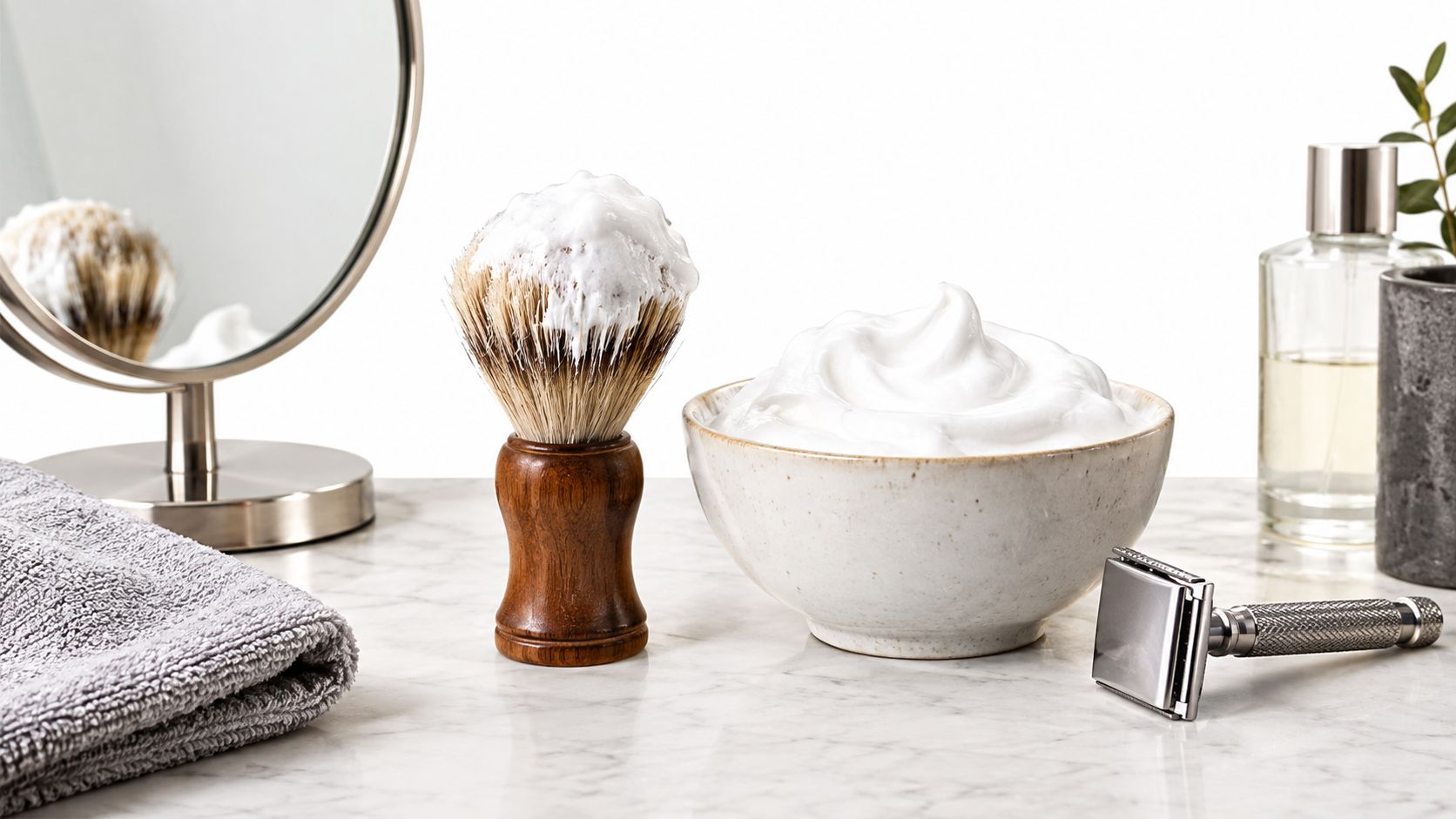
From the soap mug to the ready foam
For a long time the routine was a soap puck, a brush, and a few minutes of work. Brush-lathered creams came next and still asked for a bowl or the palm. The modern mass-market story is tied to aerosol packaging. Those containers were first developed during World War II to dispense insecticides against disease-carrying mosquitoes. After the war, the same idea moved into personal care. The first aerosol shaving cream appeared in 1950 and reportedly captured almost one-fifth of the market for shaving preparations within a short period, according to the manufacturing history of shaving cream.
That shift was practical, not cosmetic. A press of a button gave a ready foam. People who wanted a fast morning shave no longer had to build lather by hand. By the late 1960s, aerosol cans accounted for approximately 65% of shaving-preparation products, the same manufacturing account notes. Packaging changed the category faster than most formula trends do.
Why the names overlap
Shoppers still say shaving cream, shaving foam, and shaving gel as if they were one thing. I believe that habit comes straight from the aerosol era. The jobs overlap, so the words blurred. The products do not. Texture, propellant, and the way the product leaves the pack all differ. A dense cream in a tube, a light foam, and a clear gel can all soften hair and add slip, yet they do not behave the same once they meet water and a blade.
Practical rule: Judge the film on the skin, not the cloud in the sink. Volume is easy to see. Slip is what the razor actually uses.
Key Ingredients in Shaving Creams and What They Do
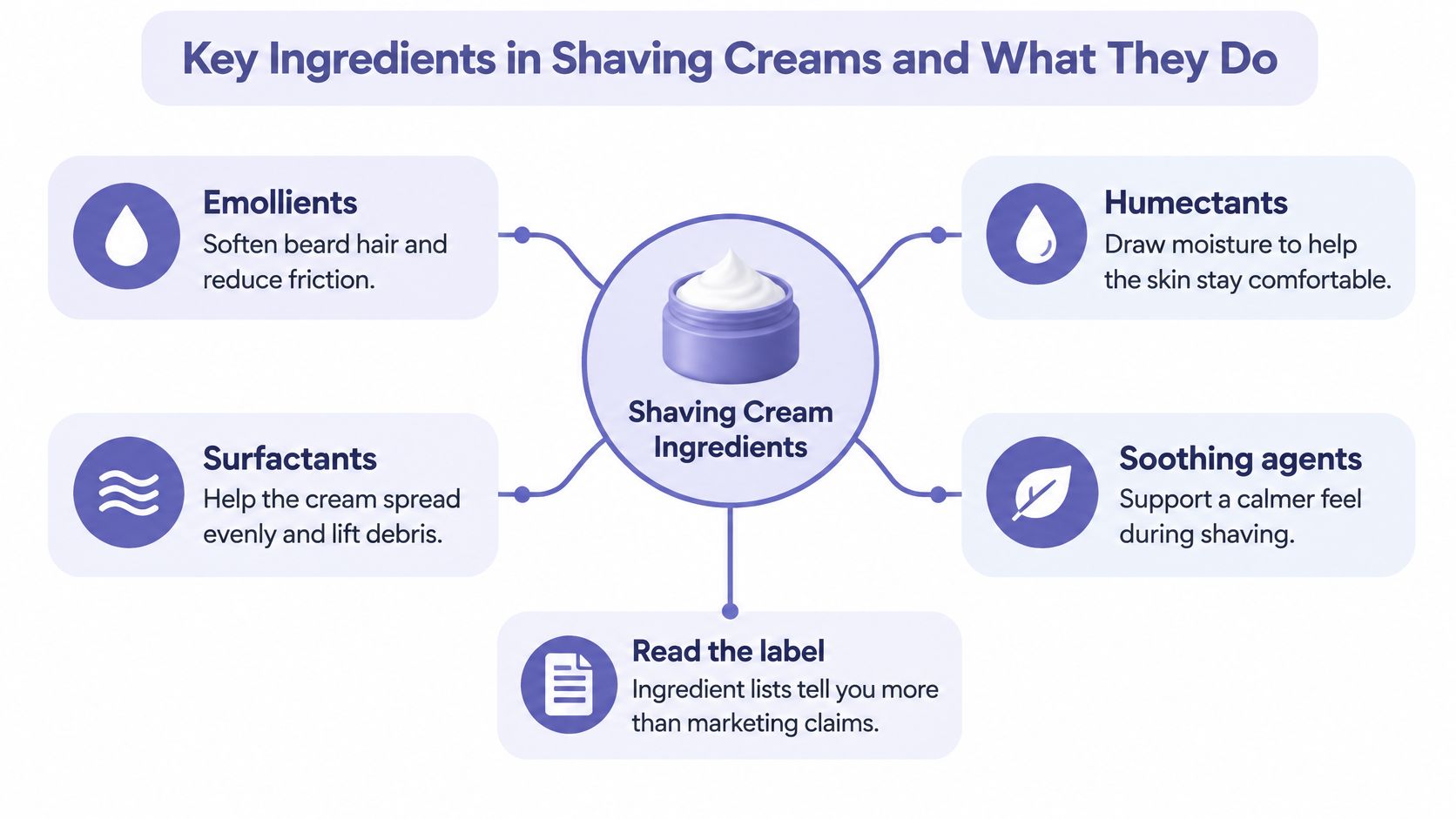
A label is closer to a recipe card than to a slogan. Under U.S. cosmetic labelling rules, cosmetic ingredients are declared in descending order of predominance, and shaving products, including aerosols, sit inside that framework, as set out in the cosmetic product category regulation. The first names usually describe the base. A botanical shouted on the front and listed near the end is a small part of the dish.
Read the base before the extras
Think of the list the way you read a soup recipe. Water or a water-rich base is often the stock. Conditioning agents and emollients are the oil that softens the hair and cuts friction. Thickeners decide whether the product stays put or runs. Lather-forming surfactants help it spread and lift debris, the way a little soap helps a sponge. Humectants such as glycerin draw water in and keep the film comfortable while you shave.
Aloe, oatmeal, and oils can be pleasant. I believe they earn their place when they sit high enough on the list to matter, and when the rest of the formula is simple. A soothing name at the bottom does not make a harsh base gentle. If the early ingredients are mostly water, propellant, and a strong surfactant system, the cream will feel light even if the carton mentions a plant.
Fragrance and preservatives belong on the same reading pass. Fragrance is there for smell. Preservatives keep a water-rich product from spoiling in a warm bathroom. Neither group is automatically a problem for every person. Both are worth noticing if your skin reacts after shaving and not after a plain wash.
If a shave leaves the surface rough for hours, it helps to know how to repair a damaged skin barrier before you stack more products on top.
Fragrance-free is not the same as unscented
Fragrance-free means the formula is made without fragrance materials added for scent. Unscented often means the product has little smell, sometimes because a masking fragrance covers the base odour. That mix-up sends a lot of people back to the same sting. On a reactive face I look for the word fragrance, parfum, and the named fragrance allergens, then I look at where they sit. High on the list, they are a larger share. Near the end, they are smaller, but a sensitive person can still notice them.
Labels cannot promise a calm shave. They can show you the base, the slip ingredients, and whether scent is doing quiet work. For a wider view of how everyday formulas are built, a guide to skincare essentials from ProMD Health Bel Air is a useful companion when you are learning to read any bathroom product, not only a shave cream.
A short film on lather and glide makes the texture difference easier to picture before you compare packs in the next part.
Comparing Cream, Gel, Foam, Soap and Brushless Formats
Format is the body of the product, not the ingredient story. Cream, gel, foam, traditional soap, and brushless cream can share similar soothing claims and still feel nothing alike under a blade. I believe a lighter, taller lather is not automatically the better performer. Expert roundups note that foams may be light and hydrating but can provide less lubrication than other formats, while thicker creams or gels may better protect sensitive skin from friction, as discussed in CNN Underscored's look at shaving creams for sensitive skin.
What changes when the pack changes
A tube or tub of cream asks you to spread a measured amount. A gel often starts clear or dense and breaks into a slick film with water. An aerosol foam is fast and airy, which suits a short routine and a small area. Traditional soap needs a brush and time. Brushless cream skips the brush and still aims for a cushion.
The area matters. A jaw and neck need less product than a scalp or a pair of legs. A brush can make a small dab of concentrated cream cover more skin, and it can also make you use more if you keep loading it. Hard water can flatten lather and slow rinsing. If the film collapses or leaves a chalky feel, the water may be part of the problem, not only the brand.
If you are weighing a blade against other hair-removal options, hair removal advice from Spa Black sets the wider choice in plain terms. Inside a razor routine, the format still has to match the skin in front of you.
| Format | Lubrication Behaviour | Dispensing and Brush Need | Best Suited For |
|---|---|---|---|
| Cream in a tube or tub | Dense slip, stays where you put it | Hand or brush, no propellant | Dry or friction-prone skin, slower shaves |
| Gel | High cushion once worked in, often clearer | Pump or aerosol, usually no brush | Coarse hair, edges you want to see |
| Foam | Light, can feel hydrating, often less slip | Aerosol, no brush | Quick face shaves when skin tolerates it |
| Traditional soap | Slip depends on the lather you build | Brush required | People who like a ritual and can spare time |
| Brushless cream | Moderate to rich film without a bowl | Tube, no brush | Travel and shared bathrooms |
A tall foam can look generous and still let the blade chatter. If you feel drag by the second stroke, switch format before you press harder.
A small amount of a concentrated cream can outperform a large aerosol dose on a dry neck. That is a use test, not a universal ranking. No format wins for every face, every water supply, and every morning.
Choosing a Shaving Cream for Your Skin and Concerns
Matching a cream to a person is a different job from picking a format. A formula that feels fine on an oily cheek can sting a dry neck, and the skin on your face today is not the skin you had five years ago. The cream is one part of a system that includes the blade, the water and the aftercare, so read the label as a sorting tool rather than a promise.
Irritation is not the same as allergy
Irritation is the burn, redness or tightness that shows up when friction, a drying film or a strong ingredient meets your skin that day. It often fades when you change technique or use less product. Allergy is a specific reaction to a substance, and it tends to return every time that substance is present, even inside a cream marketed as gentle.
In the patch-testing literature on cosmetic products, shaving cream appears as the cosmetic category tied to 10% of reported product identifications, with gallate mixtures and cetrimide among the allergens found. A newer prospective study reported in that literature puts preservatives behind 29.8% of patch or photopatch reactions and fragrance behind 14.4%. I believe those numbers cut against simple natural-versus-chemical advice. A plant extract can irritate one face and a preservative can be uneventful for the next, and dermatology guidance is clear that a potentially irritating ingredient may affect some users rather than everyone.
Dermatologically tested means the product went through some form of skin testing. It does not mean allergy-proof. Ingredient lists also shift by country and by reformulation, so a tube that suited you abroad may differ from the one on a local shelf.
For day-to-day sorting of sting, redness and tightness, our notes on identifying and caring for sensitive skin sit well beside a shave decision.
A small-area habit, not a guarantee
Put a pea of the new cream on the inner forearm or along the jaw for two or three mornings. Leave it for a minute, rinse, and wait. Stop if you see swelling, a spreading rash or itch that lingers. A home check will not catch every allergy. If reactions repeat across several simple formulas, ask for professional patch testing instead of buying a sixth tube.
Dry skin usually does better with a richer cream and fewer fragrant extras. Acne-prone skin often prefers a light film that rinses clean, with a non-heavy moisturiser afterwards. Eczema-prone skin wants the shortest ingredient list you can tolerate and no scrubbing. Where ingrown hairs keep returning, slip and fewer passes matter more than a new scent.
One honest caveat: head-to-head trials comparing creams across these skin types are thin, so a two-week log of your own sting and redness tells you more than any claim on the box.
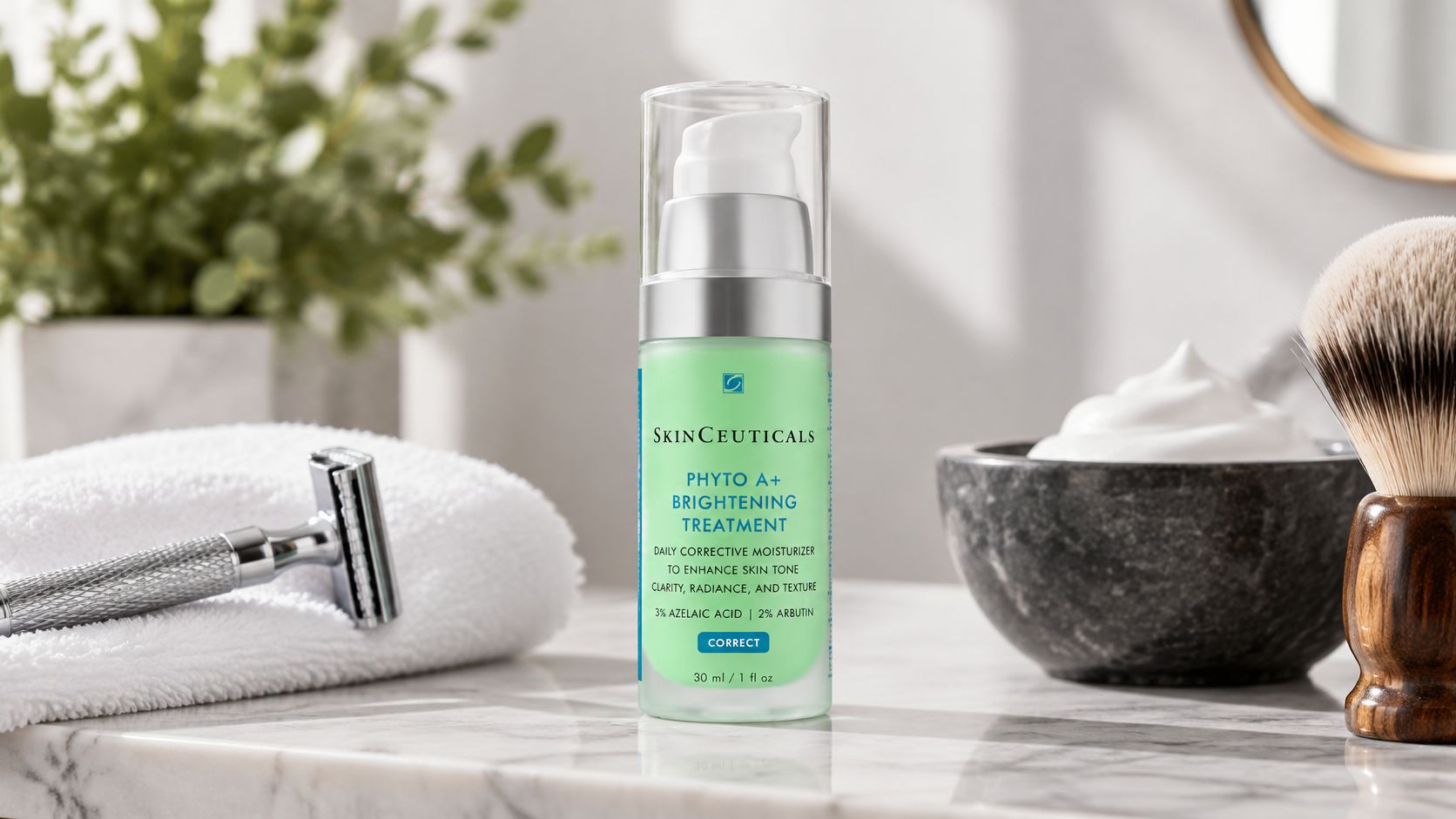
If redness lingers between shaves, a separate daily product such as Skinceuticals Correct Phyto A+ Brightening Treatment - 30ml is a light gel-cream with azelaic acid and arbutin aimed at daily texture and radiance. It is not a shaving cream, and it does not replace one.
Application and Shaving Technique That Make the Cream Work
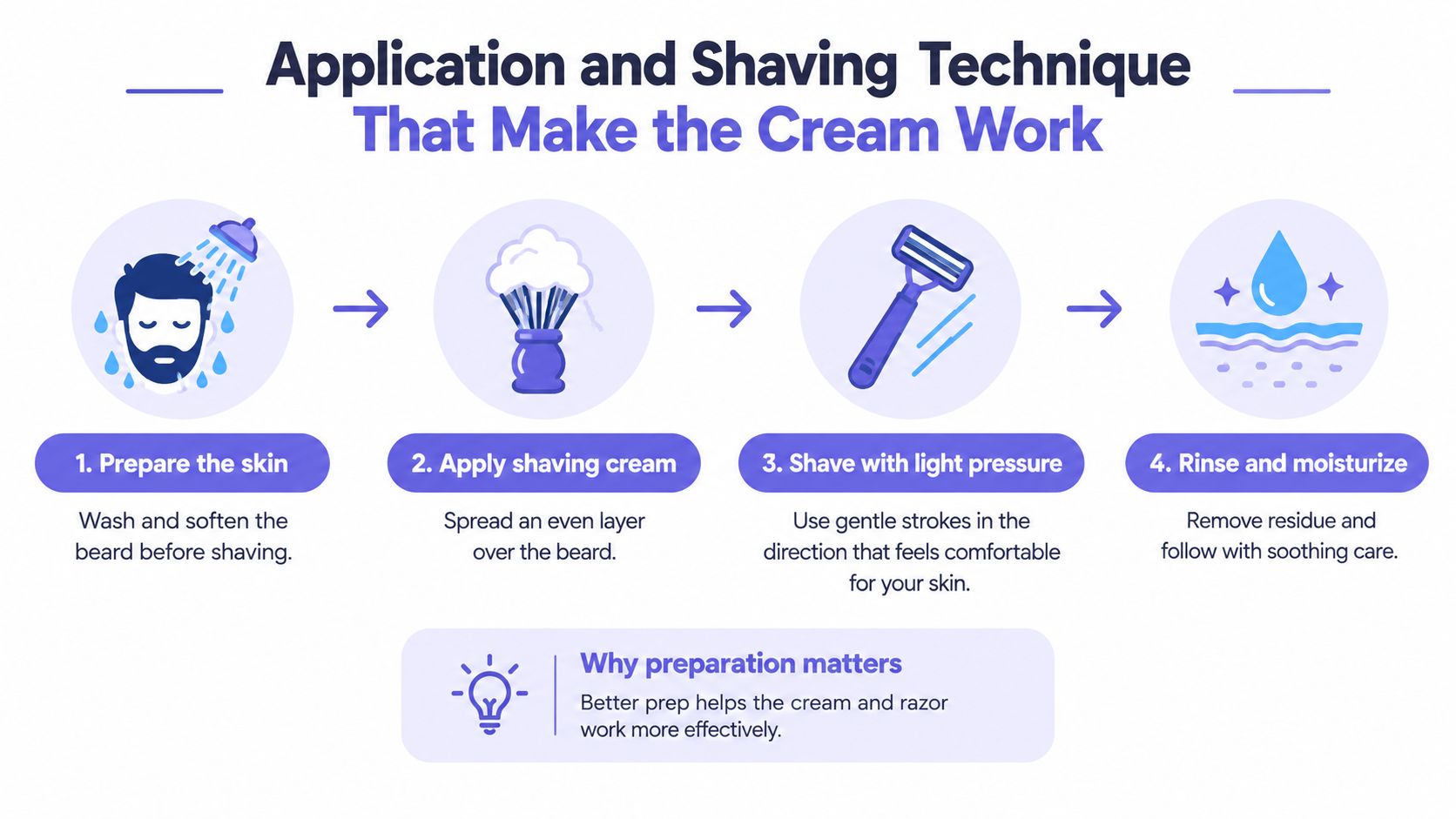
The best tube still fails on dry hair. The American Academy of Dermatology recommends wetting the skin and hair before shaving because moisture softens the hair and lets the razor pass more easily, and it points to shaving right after a shower as a practical option, in its guide on how to shave. Warm water does the softening. The cream keeps that softness from disappearing while you work.
A short sequence you can picture
- Wet first. Shower, or hold a warm, damp cloth on the area. People with very dry or sensitive skin should pick a product labelled for sensitive skin, as that same Academy guidance notes.
- Let a moisturising cream sit. For skin prone to visible bumps, the Academy says leave it on for one or two minutes, and keep it wet. If it dries, rinse and apply more. Do not shave through a dry film. Those details are in the Academy's notes on razor bump remedies.
- Use short strokes with the growth. Shaving with the direction of hair growth helps reduce razor bumps and razor burn. Rinse the blade after every stroke so hair and cream do not clog the next pass.
- Limit the repeats. Short strokes, and do not pass over one area more than twice. A thick layer plus hard pressure is not a better shave. It is extra friction.
A clean face before the cream matters as much as the cream itself. Our piece on why cleansing is your skin's ally is the step I would not skip on a congested or oily beard area.
If the razor tugs, stop and rewet. Pressing harder only asks the blade to scratch what the cream was meant to cushion.
This part of the routine ends when the last stroke is done. Rinsing, aftershave, and razor care come next, on purpose, so the shave itself stays simple.
Aftercare, Razor Pairing and Storage Habits
The last stroke is not the end of the shave. Leftover cream, a dull edge, and a razor left in the steam all undo a careful pass. Rinse the cream away with warm water, gently and fully. Residue left on the skin may irritate. Follow with a cool, damp washcloth, then an aftershave made for irritated or bump-prone skin. If it burns or stings, stop it and choose another. The American Academy of Dermatology lays out that finish, the five-to-seven-shave replacement interval for disposable razors, and cleaning an electric razor on the same interval, in its guidance on razor bump prevention.
Pair the cream with fewer products
A moisturising cream cannot fix dry hair, repeated strokes, a dull blade, or shaving against the grain. I believe the mechanical steps matter as much as the label claim. Pair the cream with a non-comedogenic cleanser before you shave and one moisturiser after. On reactive skin, skip the extra toner, scrub, and heavily fragranced splash in the same hour.
Store the razor in a dry place rather than in a wet shower or on a damp sink. Complete drying helps limit bacterial growth. That is ordinary tool care, the same idea as drying a kitchen knife instead of leaving it in the sink.
For the balm or fluid you put on once the skin is clean, our notes on after shave cream keep the finish practical. If the surface stays cracked or reactive for days, professional care for compromised skin barriers from ProMD Health Ashburn Med Spa is a sensible next conversation, not another new foam.
Travel without a mess
Seal pump bottles and pressurised cans before they go in a bag. Check the carrier's rules for aerosols before you fly. A small brushless tube is often easier than a large can when you are moving between bathrooms. Decant only into a container you can close tightly, and do not leave a cream in a hot car if the texture splits.
Sustainability and Formulation Trade-Offs to Weigh
A leaf on the carton does not make a shave lighter on resources. I believe "natural" ingredients do not, by themselves, establish a lower environmental impact. A plant oil shipped in a heavy jar can outweigh a plain formula in a lighter pack. Scented marketing language is a poor substitute for a few checks you can do in the shop.
Variables you can actually compare
- Packaging and local recycling. Aluminium, plastic, and mixed aerosol cans are not accepted the same way in every city. A recyclable material you cannot recycle at home is only a claim.
- Concentration and dose. A dense cream used in a small amount can last longer than a fluffy foam you spray until the sink is full.
- Rinse-off time. A film that needs long scrubbing uses more water and more friction.
- Aerosol versus pump. Propellant adds convenience and a different pack. A pump or tube avoids that gas and can be easier to empty.
- Brush or no brush. A brush can spread a concentrate further. It also needs cleaning and has its own lifespan.
I have not seen comparative lifecycle data that would let me call one format universally greener. That gap is real. Until a fair comparison exists, the honest move is to label the unknown and test each claim against the list above.
Refill habits from adjacent products are a useful parallel. Our roundup of refillable body washes and lotions shows how concentration and pack design change use, even though those products are not shaving creams.
If a brand cannot say what the pack is made of, how much you need per shave, and whether the empty container is accepted where you live, treat the green claim as unfinished.
Where to Buy Shaving Creams Abroad and Next Steps
Cremes de barbear are a large international category, and published estimates differ because researchers draw the borders differently. One recent industry estimate valued the global shaving-cream market in the tens of billions of dollars, counted unit sales in the billions of small packs, and projected the figure to roughly double by the early 2030s. Another estimate placed the broader shaving-lotions-and-creams market at US$15.8 billion in 2025 and forecast US$24.2 billion by 2032, while projecting the shaving-cream segment alone to grow at 7.5% annually and reach US$6.9 billion, as summarised by GII Research on shaving lotions and creams. The gap between these numbers reflects scope rather than a broken category. Lotions, gels, foams, soaps, and nearby grooming items move the total depending on where the line is drawn.
How a European pharmacy shop reaches you
Healtsy is a Portugal-based online store for European pharmacy and parapharmacy products. We ship from Europe to shoppers in the United States, the United Kingdom, Germany, Canada, Australia, and the Gulf. Orders travel by DHL. Import duties are already included in the price for the main non-EU markets, and the site is available in English, German, and Spanish.
Our range covers aftershave, shaving products, men's skincare, face washes, moisturisers for men, body washes, deodorants, and shampoos for men, alongside wider personal-care lines. I believe this context matters for a practical reason. A shaving cream works as one component of a system, sitting between the cleanser you wash with and the balm you apply after the blade, so it belongs on that shelf rather than in a separate hobby aisle.
Is a cross-border tube authentic
Buy through authorised distribution rather than a grey-market listing with a blurred label. That is how we source, and a pharmacist reviews the product information before it goes on the page. If the ingredient list on the screen does not match the carton in your language, pause and ask. Reformulation and local labelling are normal. A seller who cannot say where the stock came from is not.
What delivery and duties look like
DHL carries the parcel from Europe. For the main non-EU markets we serve, import duties sit inside the price, so the checkout figure is not a surprise customs bill added later. Having the site in English, German, and Spanish also helps when you are comparing two European INCI lists side by side.
How to choose between two European formulas
Put both labels next to each other. Read the first five ingredients for the base. Note fragrance, preservatives, and whether the format is cream, gel, or foam. Match that to dry, reactive, or ingrown-prone skin using the checks earlier in this guide. Then order the simpler one first.
Before you order, hold your current tube up to this guide. Check the order of ingredients, the format, and whether the cream stays wet through a full pass. I believe that five-minute check will solve more bad shaves than another scented aerosol.
Healtsy carries European pharmacy shaving products, aftershaves, and men's skincare shipped from Europe with duties included for the main non-EU markets. If you have narrowed your choice to two formulas, compare their first five ingredients and format using the checks above, then browse the European grooming and shaving range to match a cream to your routine.