


Rosacea Skincare
Best Rosacea Face Moisturizer Guide for Calm Skin
You wake up, look in the mirror, and see the familiar warmth across your cheeks. Your skin feels tight after cleansing, your usual moisturizer stings, and the product that promised a smoother complexion now seems to make the redness more noticeable. That moment can make choosing another cream feel like a gamble.
After 16 years in skincare, I believe the safest way to find the best rosacea face moisturizer is to stop judging products by their luxury, richness, or popularity. The more useful question is: which formulation is least likely to trigger discomfort while supporting the skin barrier? This complete guide to choosing a rosacea-friendly moisturizer focuses on ingredient logic, texture, application, and real-life situations so you can make a calmer choice with less trial and error.
Introduction to Finding Calm for Rosacea Prone Skin
A moisturizer can feel comfortable for weeks, then sting after a weather change, hot shower, new cleanser, or stressful day. Someone else may have similar redness but prefer a light gel-cream because richer textures feel warm or congested. These responses show why rosacea care requires more than choosing the most popular or expensive product.
The best rosacea face moisturizer is usually the formula least likely to trigger discomfort while supporting the skin barrier. I believe a sensible starting point is a simple, fragrance-free, barrier-supportive formula that feels comfortable on application and remains comfortable with repeated use. Texture matters too. A cream may suit tight, flaky skin, while an oily, reactive face may do better with a lighter system.
Rosacea affects a substantial global population. A 2018 systematic review pooled 32 population-based studies covering 26.5 million people and estimated that 5.46% of the global adult population is affected, which extrapolated to about 415 million people worldwide (systematic review of rosacea prevalence). A worldwide study published in 2024 sampled 50,552 people older than 16 across 20 countries and found an overall prevalence of 5.1%, with rosacea reported across Europe, North America, Asia, and Latin America (worldwide rosacea prevalence study summary).
The practical goal is steady comfort through daily use, changing climates, and fluctuating redness. A moisturizer should support that routine rather than promise an overnight transformation.
| Your main concern | Usually the most sensible starting point | Why it may fit |
|---|---|---|
| Tightness, flaking, or roughness | A fragrance-free cream with humectants and barrier lipids | It can provide hydration while reducing moisture loss |
| A compromised-feeling barrier | A simple balm or protective cream | More occlusion may reduce exposure to environmental irritation |
| Oiliness or discomfort under sunscreen | A lightweight gel-cream | It can offer hydration without a heavy finish |
| Frequent reactions to new products | A short, uncomplicated ingredient list | Fewer components make label screening easier |
| Treatment already prescribed | A moisturizer used in the correct sequence | It supports comfort without replacing medical care |
Serums and moisturizers serve different roles, so readers comparing them can review the difference between serum and moisturizer. Use the table as a starting point, then judge a formula by its ingredient logic, texture, and how your skin behaves after repeated applications.
Why Rosacea Skin Needs a Different Moisturizer Approach
A moisturizer that feels comfortable on ordinary skin can sting, burn, or make rosacea-prone skin feel hotter. The difference often lies in barrier tolerance, not just in how much water the product adds. The skin barrier helps limit water loss and reduce exposure to external irritants, so a compromised-feeling barrier needs a calmer formulation system.
I believe the practical goal is to reduce avoidable triggers during everyday use. Choose a formula that combines humectants, which attract water, with occlusives, which help slow water loss, without adding an unnecessarily strong scent, tingle, or active-heavy finish. Moisturizer can support comfort, but it does not replace diagnosis or treatment when symptoms persist.
The best option is therefore the one least likely to provoke a flare for that person. A rich balm may suit overnight dryness, while a lighter gel-cream may work better beneath sunscreen or in humid weather. Texture, climate, skin oiliness, and flare intensity all affect tolerability, so product names alone offer limited guidance.
Comfort has to survive daily life
A formula can feel pleasant in a cool bedroom yet become too occlusive in humid weather. The same product may help dry, tight skin at night but feel heavy under morning sunscreen. These responses are useful information, not evidence that one texture is universally better.
Prioritize a formula with a sensible ingredient system and a finish you can apply consistently. A short, familiar formulation may be easier to tolerate than one built around numerous botanicals, strong sensory effects, or aggressive actives. If a moisturizer repeatedly causes warmth, stinging, or increased redness, stop treating that reaction as a normal adjustment.
For broader guidance on visible redness and rosacea care, ProMD Health rosacea solutions may be useful. Persistent, painful, or changing symptoms deserve professional assessment rather than repeated product switching.
Sun protection also belongs in the daily plan, but it does not need to be forced into the moisturizer. This guide to sunscreen for rosacea skin can help with choosing a compatible final morning step. Keep each product's role clear, then judge the routine by comfort over repeated use.
Ingredients to Seek and Ingredients to Avoid for Rosacea
Label reading becomes much easier when you evaluate ingredient groups rather than chasing a brand name. I generally start with three questions: does the formula hydrate, does it help limit moisture loss, and does it avoid common irritants?
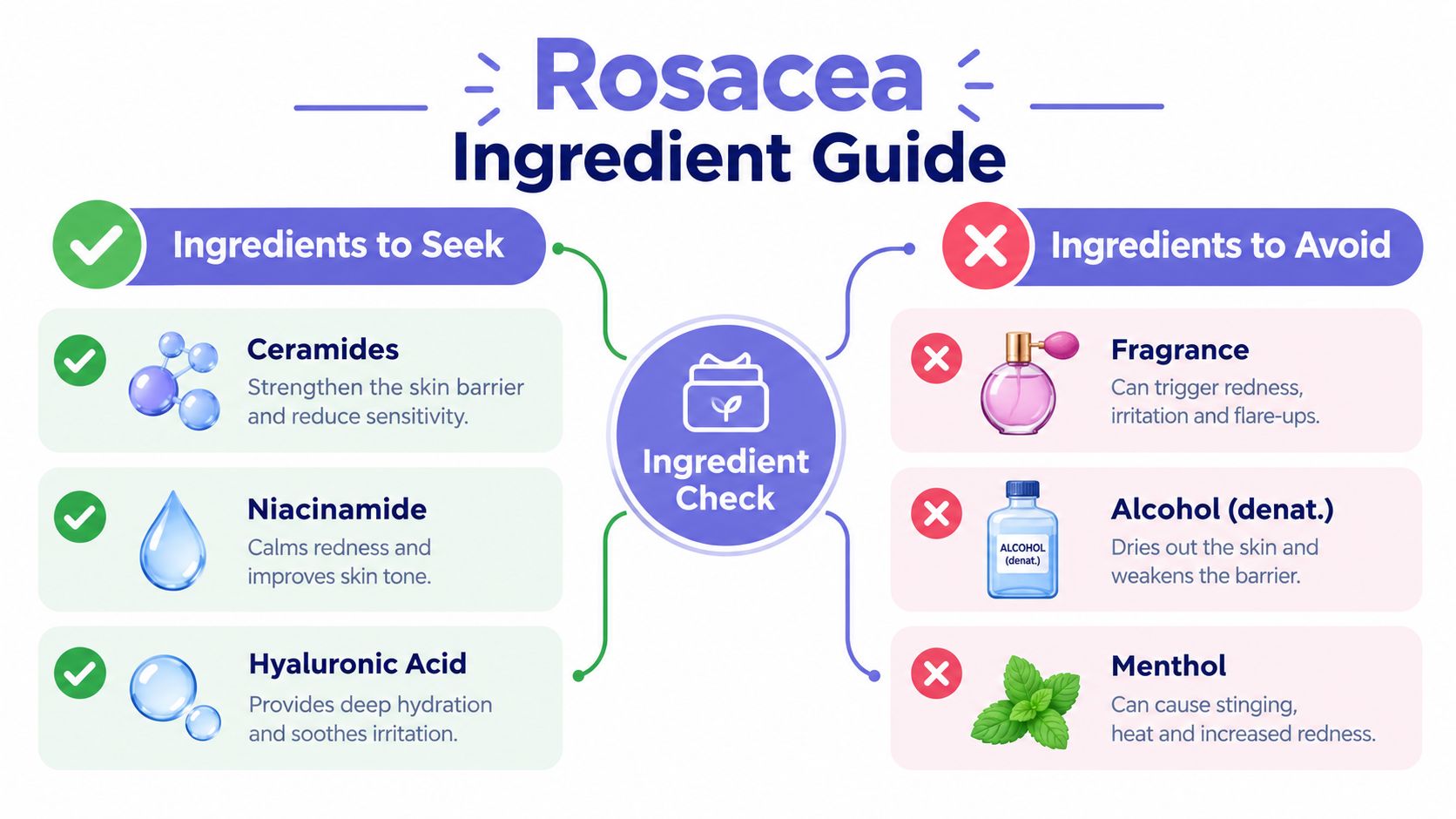
Ceramides are barrier-supporting lipids commonly used in products designed for dry or sensitive skin. Hyaluronic acid can provide humectant hydration, while niacinamide may support barrier function and improve how the skin handles daily moisture loss. A randomized, investigator-blind controlled study in 50 people with rosacea found that a niacinamide-containing facial moisturizer applied twice daily for 4 weeks improved stratum corneum barrier function, using each participant's untreated forearm as an internal control (niacinamide moisturizer study).
A useful label doesn't need every desirable ingredient. A short formula with glycerin, ceramides, hyaluronic acid, niacinamide, or a straightforward silicone system may be more sensible than a long botanical list that introduces multiple possible sensitizers.
Ingredients worth prioritizing
- Ceramides: Useful when dryness and barrier discomfort are prominent.
- Hyaluronic acid and glycerin: Humectants that can increase the skin's water content without relying on exfoliation.
- Niacinamide: A barrier-focused ingredient with clinical support in a rosacea moisturizer context, although individual tolerance still matters.
- Simple occlusives: Petrolatum, dimethicone, and other uncomplicated protective ingredients can reduce moisture loss. A silicone-based formula isn't automatically harsh or suffocating.
- Minimal soothing systems: Colloidal oatmeal, allantoin, or thermal water may suit some reactive users, provided the complete formula remains comfortable.
A common mistake is assuming that “natural” or “clean” automatically means gentle. Essential oils, fragrant plant extracts, and complex botanical blends can still irritate rosacea-prone skin. The packaging story tells you less than the full ingredient list.
Ingredients that deserve caution
Older survey data found that 58% of 1,023 people with rosacea said skincare products aggravated their condition, with alcohol, fragrance, menthol, and witch hazel among the ingredients reported as irritating (review of skincare considerations in rosacea). That doesn't mean every person reacts identically, but it makes a cautious screening process worthwhile.
Be especially careful with:
- Fragrance and parfum: Added scent can create an avoidable irritation risk.
- Alcohol: Denatured alcohol may feel light and fast-drying, but it can be uncomfortable on a fragile barrier.
- Menthol and camphor: Their cooling sensation can feel soothing initially while provoking discomfort in reactive skin.
- Harsh astringents: Witch hazel and similarly tightening formulas may leave skin drier.
- Strong exfoliating or retinoid products: These may have a role under professional guidance, but they aren't automatically appropriate in a daily rosacea moisturizer.
If you're considering a targeted active such as azelaic acid, review azelaic acid for rosacea separately rather than expecting a moisturizer to perform every treatment function.
Comparing Creams Balms and Gel Creams for Rosacea Comfort
Texture determines how a moisturizer behaves after application. It influences heat retention, layering, spreadability, and whether you can use the product consistently. The best rosacea face moisturizer is therefore partly an ingredient decision and partly a situational texture decision.
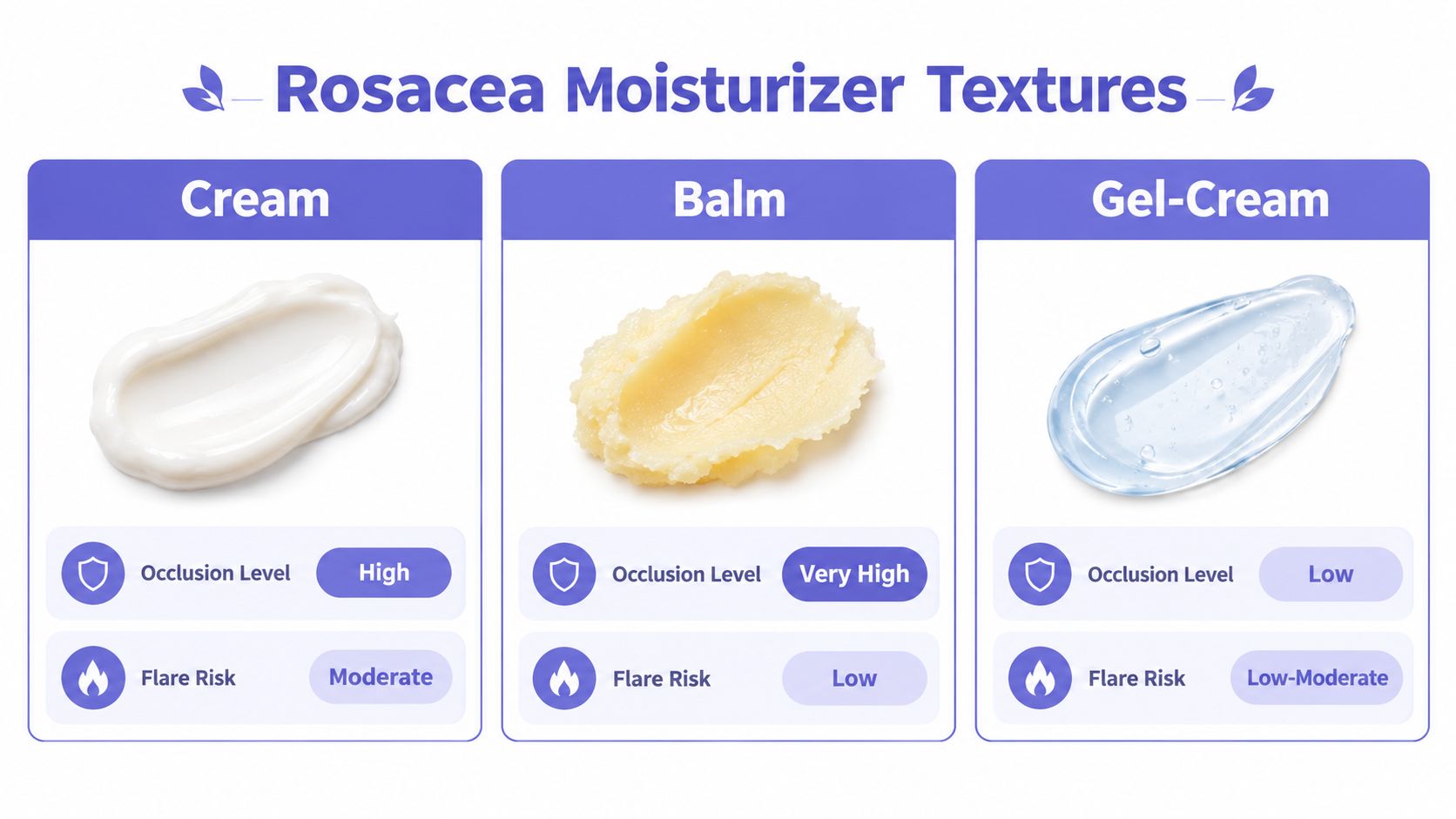
A cream can be the most comfortable choice when the face feels tight, rough, or flaky, especially at night. It usually offers moderate to substantial occlusion without the very sealed finish of a balm. The trade-off is that a rich cream may feel warm or greasy for someone with oilier skin or a tendency to flush.
For nighttime dryness: Choose a cream when your skin needs a protective layer and you won't be applying several products over it.
A balm offers the highest level of protection among these three categories. It can be useful when the barrier feels raw, exposed, or unusually dry, but it may feel too heavy across the entire face in warm or humid conditions. Some people use it only on the cheeks, around the nose, or over particularly dry patches.
Gel-creams sit at the lighter end. They spread quickly, suit daytime use, and often layer more comfortably beneath sunscreen or makeup. The drawback is that a low-occlusion texture may not be enough when the skin is actively peeling or feels tight shortly after cleansing.
| Formulation type | Best for | Texture and finish | Watch outs |
|---|---|---|---|
| Cream | Dryness, roughness, evening use | Cushioned, smooth, moderate to rich finish | May feel warm or heavy on oilier skin |
| Balm | Compromised-feeling barrier, very dry areas | Dense, protective, highly occlusive | Can feel greasy or uncomfortable in heat |
| Gel-cream | Daytime use, combination or oil-prone sensitivity | Lightweight, quick-spreading, lower-shine finish | May not provide enough protection for severe dryness |
Match the format to the moment
A commuter in a cold, windy climate may prefer a cream in the morning and a balm on exposed cheek areas at night. Someone working in a warm office may choose a gel-cream during the day and reserve a richer formula for evening. A person whose face becomes shiny but still feels tight may need better hydration, not necessarily a heavier layer.
The richest moisturizer isn't automatically the gentlest. A plain barrier formula with a comfortable silicone finish may outperform a botanical-heavy cream that creates warmth or stinging.
Application order also affects comfort. Rosacea care guidance recommends a mild cleanser first, prescribed topical medication after the skin is dry, and moisturizer afterward, followed by makeup if desired (rosacea moisturizer guidance). For more detail on barrier-focused formulas, this guide to a ceramide moisturizer for sensitive skin can help you compare suitable product profiles.
How to Build a Rosacea Friendly Daily Routine
A routine should work on an ordinary morning, including days when your skin feels warm or tight. Keep the sequence short, and let each step support the barrier rather than adding unnecessary stimulation.
Morning
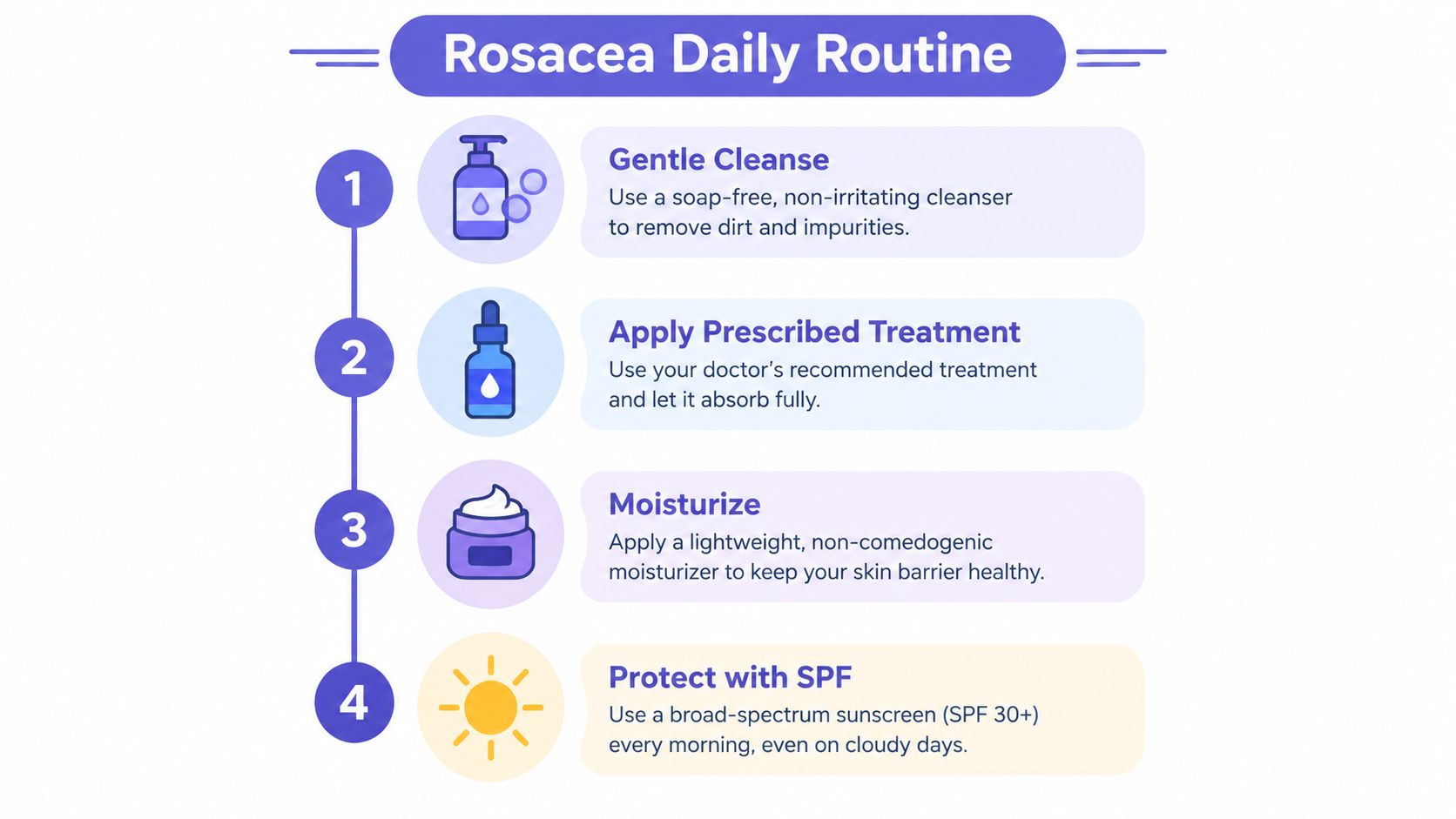
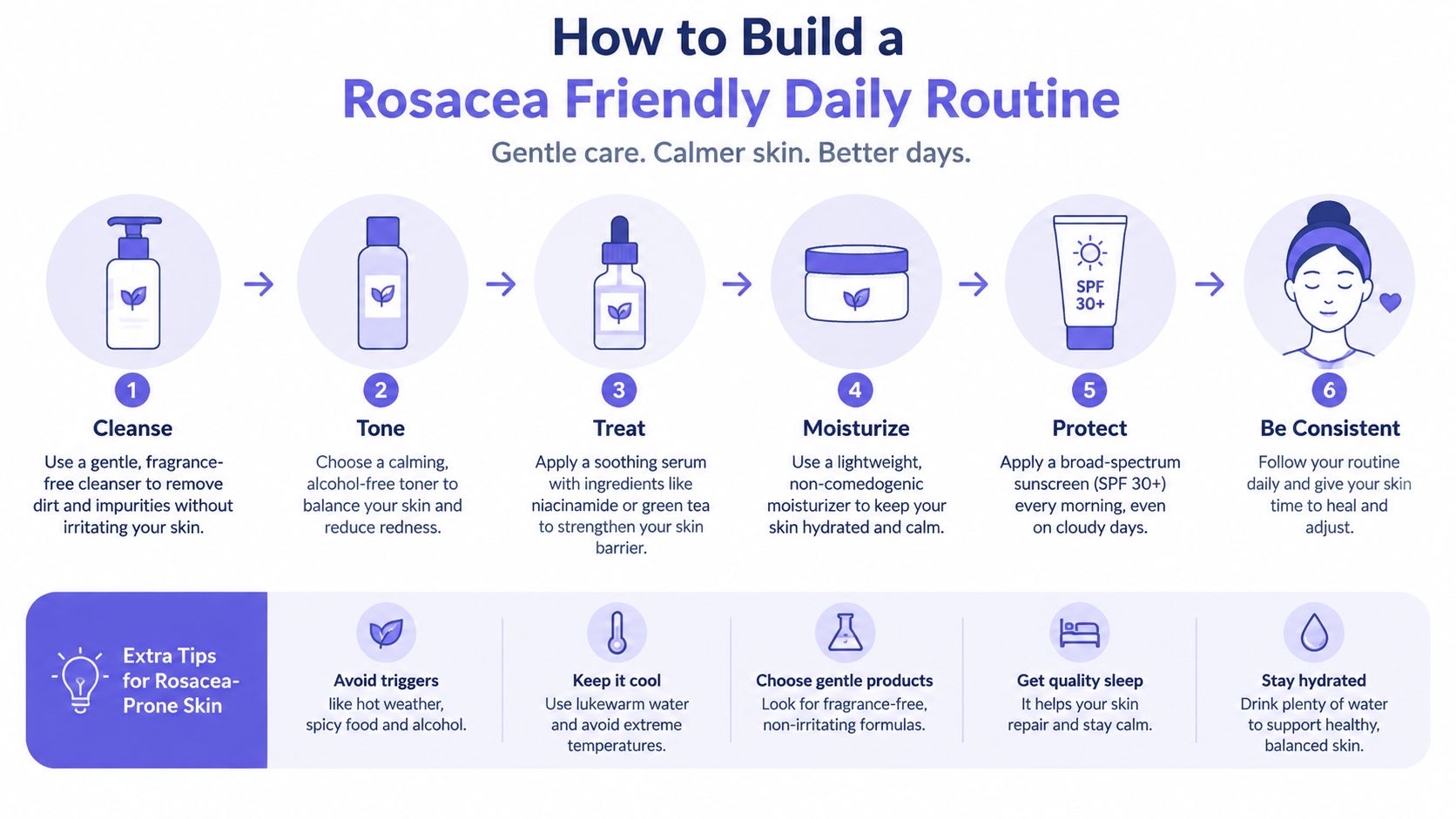
- Cleanse gently: Use a mild, non-abrasive cleanser with comfortably warm water. Skip scrubbing, brushes, and very hot water. If your face is neither oily nor sweaty after waking, a minimal cleanse may be more comfortable than thorough washing.
- Apply prescribed treatment: If a clinician has prescribed a topical medication, apply it to clean, dry skin according to the directions. A moisturizer supports comfort but does not replace treatment.
- Moisturize: Spread a thin, even layer of your selected cream, balm, or gel-cream. Press or smooth it gently instead of repeatedly rubbing areas that already feel hot.
- Protect with sunscreen: Apply a compatible sunscreen before makeup. If the sunscreen pills, use less moisturizer underneath or let the layers settle before applying the next product.
Evening
Remove makeup and sunscreen with a gentle cleanser, then pat the skin dry with a soft towel. Apply prescribed topical treatment to dry skin if directed, and use moisturizer after that step is complete.
Clinical literature reports that daily moisturizer use may improve rosacea-related dryness, roughness, flaking, stinging, burning, itching, and tingling. Studies have also reported improvements in barrier markers (clinical review of moisturizers in rosacea). The practical benefit depends on tolerance. Applying more product does not guarantee better protection, and rubbing a thick layer into flushed skin can add avoidable friction.
Small technique changes make a difference
Apply moisturizer while the skin remains lightly hydrated. Keep prescribed medication on dry skin unless your clinician has advised another method. Warm the product between clean fingertips, then pat or smooth it across the face in sections.
If a formula stings, adding another product usually makes the cause harder to identify. Stop that product, simplify the routine, and return to a moisturizer you have previously tolerated, if available. During a flare, gentle cleansing, a tolerated moisturizer, and daytime sun protection may be easier to manage than several new active products.
For further practical guidance, read this resource on how to treat rosacea at home. Persistent or worsening symptoms may require medical review.
Sensitivity Testing and Early Warning Signs to Watch
Rosacea-prone skin may tolerate a moisturizer one day and object to it during a flare. A careful introduction helps separate a formula problem from a temporary change in the skin.
Apply a small amount beside the jaw or on the side of the neck. Keep the test area free of other new products, then assess the skin immediately and later that day. If it remains comfortable, apply the moisturizer to a limited facial area before using it across the face.
A practical introduction sequence
- Choose one new product: Introduce one formula at a time. Adding a cleanser, serum, moisturizer, and sunscreen together makes the trigger difficult to identify.
- Test a small area first: The jawline gives more relevant information than the hand because facial skin can react differently.
- Increase coverage gradually: Try one side of the face or a small cheek area before full-face application.
- Record what happens: Note burning, itching, warmth, tightness, visible redness, or increased dryness. A simple trigger diary can reveal recurring patterns.
- Pause when symptoms persist: A brief sensation differs from ongoing burning, worsening redness, or discomfort that continues after application.
Choose a moisturizer by repeated comfort, not by a dramatic first sensation.
Burning is not a sign that a moisturizer is working. Persistent stinging, itching, or rising redness means the formula should be stopped and reassessed.
Do not test a new product during the most intense flare if you can avoid it. Inflamed skin makes results harder to interpret, so return to the simplest previously tolerated routine and establish a clearer baseline. If a product repeatedly causes discomfort, review the full formula rather than assuming one highlighted ingredient explains the reaction.
Seek professional advice for severe pain, eye symptoms, marked swelling, or symptoms that do not settle. A pharmacist or clinician can also help distinguish irritation from an allergic response or a rosacea flare, particularly when several products have changed recently.
Our Recommendation for Choosing Your Best Rosacea Moisturizer on Healtsy
I believe the right choice becomes clearer when you use an if-then framework rather than searching for one universal winner.
If tight, flaky, or rough
Start with a fragrance-free cream containing barrier-supportive ingredients such as ceramides, humectants, or niacinamide. A richer evening texture may suit, while a lighter daytime layer reduces warmth beneath sunscreen.
If the barrier feels raw
Consider a simple, more occlusive balm or protective cream. Apply it selectively if a full-face layer feels too heavy. Don't assume a thick botanical formula is safer than a plain silicone-based or lipid-focused option.
If combination or oily
Try a gel-cream with a short ingredient list. It should leave the face comfortable rather than tight, sticky, or hot after application.
If you react to many products
Remove fragrance, alcohol, menthol, camphor, harsh astringents, and unnecessary actives from the first round of candidates. Introduce one formula at a time and judge it by repeated comfort.
If your skin feels tight, flaky, or rough, start with a fragrance-free cream containing barrier-supportive ingredients such as ceramides, humectants, or niacinamide. A richer evening texture may be appropriate, while a lighter daytime layer can reduce warmth beneath sunscreen.
If your barrier feels raw or unusually exposed, consider a simple, more occlusive balm or protective cream. Apply it selectively if a full-face layer feels too heavy. Avoid assuming that a thick botanical formula is safer than a plain silicone-based or lipid-focused option.
If your skin is combination, oily, or uncomfortable under makeup, try a gel-cream with a short ingredient list. It should leave the face comfortable rather than tight, sticky, or hot after application.
If you react to many products, remove fragrance, alcohol, menthol, camphor, harsh astringents, and unnecessary actives from the first round of candidates. Introduce one formula at a time and judge it by repeated comfort, not by how impressive the ingredient list appears.
Healtsy offers pharmacy skincare categories that include gentle barrier creams, dermatologist-approved French pharmacy lines, sensitive-skin moisturizers, and rosacea-focused options such as Boderm Rosaid Cream and Ioox Dioxmin Anti-Redness Moisturizing Serum. Product suitability still depends on your symptoms, treatment plan, and personal tolerance, so read the complete ingredient list and use the sensitivity-testing approach above.
This is the complete guide to choosing a best rosacea face moisturizer based on barrier support, formulation simplicity, and real-life use. I'm certain it can solve the confusion around creams, balms, and gel-creams, but professional guidance remains important when redness is persistent, painful, or affecting the eyes.
Find your calm, rosacea-friendly moisturizer
Compare fragrance-free moisturizers, gentle barrier creams, and rosacea-relevant pharmacy skincare in one place. Use the skincare quiz for a more personalized starting point, then introduce your chosen moisturizer gradually and track how your skin responds.
Explore Healtsy