


What Is the Difference Between Serum and Moisturizer
You're standing at the bathroom shelf with two bottles in hand. One is a light dropper serum, the other a cream moisturizer, and both claim to hydrate, smooth, or improve the look of your skin. The natural question is simple: what is the difference between serum and moisturizer, and do you really need both?
After 16 years in the pharmaceutical and skincare sector, I believe the clearest answer is this: a serum is primarily a delivery system for targeted ingredients, while a moisturizer is primarily a sealing and barrier-support system. They can overlap, but they aren't interchangeable in most routines. This complete guide-to-serum and moisturizer use will help you decide what belongs on your skin, in what order, and when climate or skin type changes the answer.
Why Serum and Moisturizer Confusion Happens
The confusion makes sense because modern skincare products often use the same language. A serum may promise hydration, radiance, softness, or barrier support. A moisturizer may contain hyaluronic acid, niacinamide, peptides, or other ingredients commonly associated with serums. Two products can address similar concerns while performing very different jobs.
Packaging adds to the problem. Both products may arrive in elegant bottles, use short ingredient lists, and describe themselves as lightweight, nourishing, or clinically tested. Texture gives you a clue, but texture alone doesn't explain the science. A watery serum and a gel moisturizer may feel almost identical during application, yet their formulas are designed to behave differently on the skin.
I often see people simplify their routine in the wrong direction. Someone with oily skin may remove moisturizer because their face already feels shiny, then continue applying several active serums. Someone with dry or sensitive skin may buy a highly concentrated treatment when their immediate need is a stronger protective layer. In both cases, the routine becomes less comfortable because the products aren't matched to the actual job.
The practical distinction: serum delivers a focused treatment, moisturizer helps the skin retain water and maintain its protective surface.
The skincare routine steps guide can help place both products within a wider routine, but the central decision is more specific than counting steps. You need to ask whether your priority is targeted correction, hydration retention, barrier comfort, or a combination of these.
Why the distinction affects results
A serum may be the better choice when you're targeting a particular concern, such as uneven tone, fine lines, or dehydration. A moisturizer may be the better choice when your skin feels tight, rough, flaky, or easily irritated. If you need both treatment and protection, using them in sequence usually makes more sense than forcing one product to perform both roles.
The difference also explains why a serum can feel impressive at first but leave skin uncomfortable later. A lightweight formula may spread easily and deliver active ingredients, yet it may not provide enough emollient or occlusive support to slow water loss. Conversely, a rich cream can leave the surface soft without delivering a concentrated treatment for a specific concern.
The useful question isn't “Which product is better?” It's “Which function is missing from my routine?” Once you answer that, the choice becomes far less confusing.
How Serum and Moisturizer Work on Your Skin
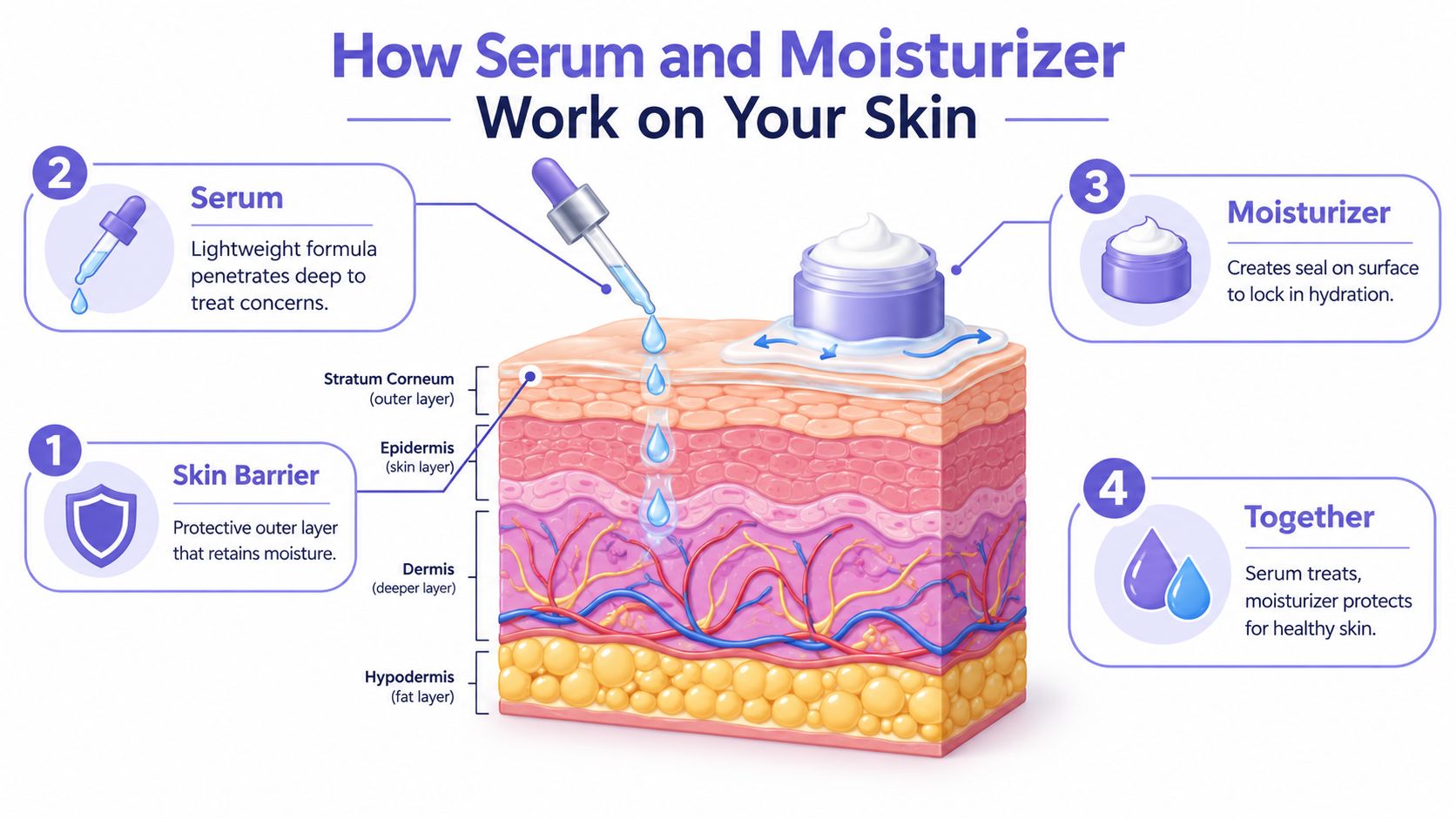
Your skin's outermost layer, the stratum corneum, acts as a protective barrier. It helps limit water loss and shields the underlying skin from everyday environmental exposure. A well-formulated moisturizer supports this surface by adding water-binding ingredients, smoothing rough areas, and creating a more protective film.
A serum approaches the problem from another direction. Its thinner vehicle is designed to spread quickly and carry targeted actives toward the skin. Common examples include vitamin C, hyaluronic acid, retinoids, niacinamide, and peptides. These ingredients may serve different purposes, but the serum format gives them a concentrated, focused place in the routine.
Think of delivery and sealing
I use a simple analogy with patients and customers. A serum is like a delivery vehicle. It carries a selected ingredient to the skin in a light formula that doesn't add much surface weight. A moisturizer is more like a protective blanket. It helps reduce evaporation, smooths the surface, and supports the barrier so the water already present in the skin is less easily lost.
That analogy doesn't mean every serum penetrates or that every moisturizer forms an identical seal. Formulas vary. Still, it accurately captures the intended division of labor: serums are generally more targeted, while moisturizers are generally more focused on hydration, lubrication, and barrier support.
Moisturizers can also act as vehicles for active ingredients. Their role isn't merely cosmetic. Clinical literature describes benefits involving hydration, softness, skin appearance, and barrier function, while a scoping review found that moisturizers can improve stratum corneum hydration and lower transepidermal water loss. The product's richer texture often reflects a higher presence of emollients and occlusives.
Why the order matters biologically
Serum usually goes onto cleansed skin before moisturizer because the lighter product can spread directly over the surface. Moisturizer then adds a more protective layer over the treatment. This doesn't guarantee that every active will work for every person, but it gives each product the environment its formulation was designed for.
A randomized study of a hydrating serum added to a moisturizer regimen found significant improvements in facial dryness and softness within 2 weeks, with reported p-values below 0.02 (PubMed clinical study). The finding supports a practical conclusion: a hydrating serum often works as an adjunct to moisturizer rather than as a complete replacement.
For readers interested in the role of hydration-focused ingredients, this guide to hyaluronic acid serum provides useful context. A serum can add water-binding support, but the moisturizer still determines how effectively the routine limits surface water loss.
Some professional skincare discussions also examine non-topical approaches to moisture and firmness. For broader background, Thermiva for skin moisture and firmness offers a resource from Georgia Plastic & Reconstructive Surgery. It belongs in a different category from daily serum and moisturizer use, but it reinforces an important point: surface hydration and deeper tissue concerns aren't the same problem.
Serum vs Moisturizer Key Differences Explained
The most useful comparison involves more than whether one product feels watery and the other feels creamy. Serums are typically lightweight, water-based leave-on treatments with higher concentrations of targeted actives. Moisturizers usually combine humectants, emollients, and occlusives in a thicker vehicle designed to hydrate the stratum corneum and reduce water loss.
Molecular size is often discussed as part of this difference. Serums are commonly formulated with smaller molecules and less heavy sealing material, while moisturizers contain more emollients and occlusives to create a protective surface layer. These are formulation tendencies, not guarantees that every product behaves identically.
Serum vs Moisturizer At a Glance
| Feature | Serum | Moisturizer |
|---|---|---|
| Main purpose | Targets a specific skin concern | Supports hydration and the skin barrier |
| Typical texture | Lightweight, fluid, or gel-like | Cream, lotion, balm, or richer gel |
| Formula emphasis | Concentrated active ingredients | Humectants, emollients, and occlusives |
| Common ingredients | Vitamin C, hyaluronic acid, retinoids, niacinamide, peptides | Glycerin, emollients, occlusives, barrier-supporting ingredients |
| Best routine position | After cleansing | After serum |
| Main trade-off | May not provide enough surface protection alone | May not deliver a focused active at serum concentration |
The texture difference comes from phase composition and the amount of lipid, emollient, and sealing material in the vehicle.
A serum is often the more efficient format for a defined concern. For example, someone focused on the appearance of dark spots may choose a vitamin C or niacinamide serum, while someone concerned with fine lines may consider a retinoid or peptide formula. The active still matters more than the word “serum” on the label, and sensitive skin may not tolerate every concentrated ingredient.
A moisturizer is better suited to the daily maintenance job. It softens the stratum corneum, improves surface comfort, and helps reduce evaporation. Its formula may also carry active ingredients, but its primary design usually favors barrier support and moisture retention rather than high-intensity targeting.
Why one product can't always replace the other
A hydrating serum may make skin feel more comfortable immediately, especially if it contains a humectant. But without sufficient emollient or occlusive support, that hydration may not remain comfortable in a dry environment. A moisturizer may leave the skin smooth and protected, yet it may not offer the focused ingredient profile someone wants for uneven tone or visible fine lines.
That doesn't mean everyone needs a complicated shelf. A person whose only goal is basic hydration may reasonably use a moisturizer alone. A person with oily skin in a humid climate may sometimes prefer a hydrating serum and a lightweight sunscreen, provided the skin remains comfortable and the sunscreen formula offers enough emollient support for that individual.
For people with reactive or easily dehydrated skin, a guide to choosing a ceramide moisturizer for sensitive skin can help clarify why barrier ingredients may deserve priority over stronger actives. A beginner-friendly skincare product list from ProMD Health Bel Air is also useful when the main challenge is choosing a manageable starting point rather than adding every category at once.
The trade-off is straightforward. Serum alone may simplify a routine, but moisturizer remains essential when the barrier needs support. The right answer depends on what your skin feels like after cleansing, how it responds during the day, and the climate around you.
How to Layer Serum and Moisturizer in the Right Order
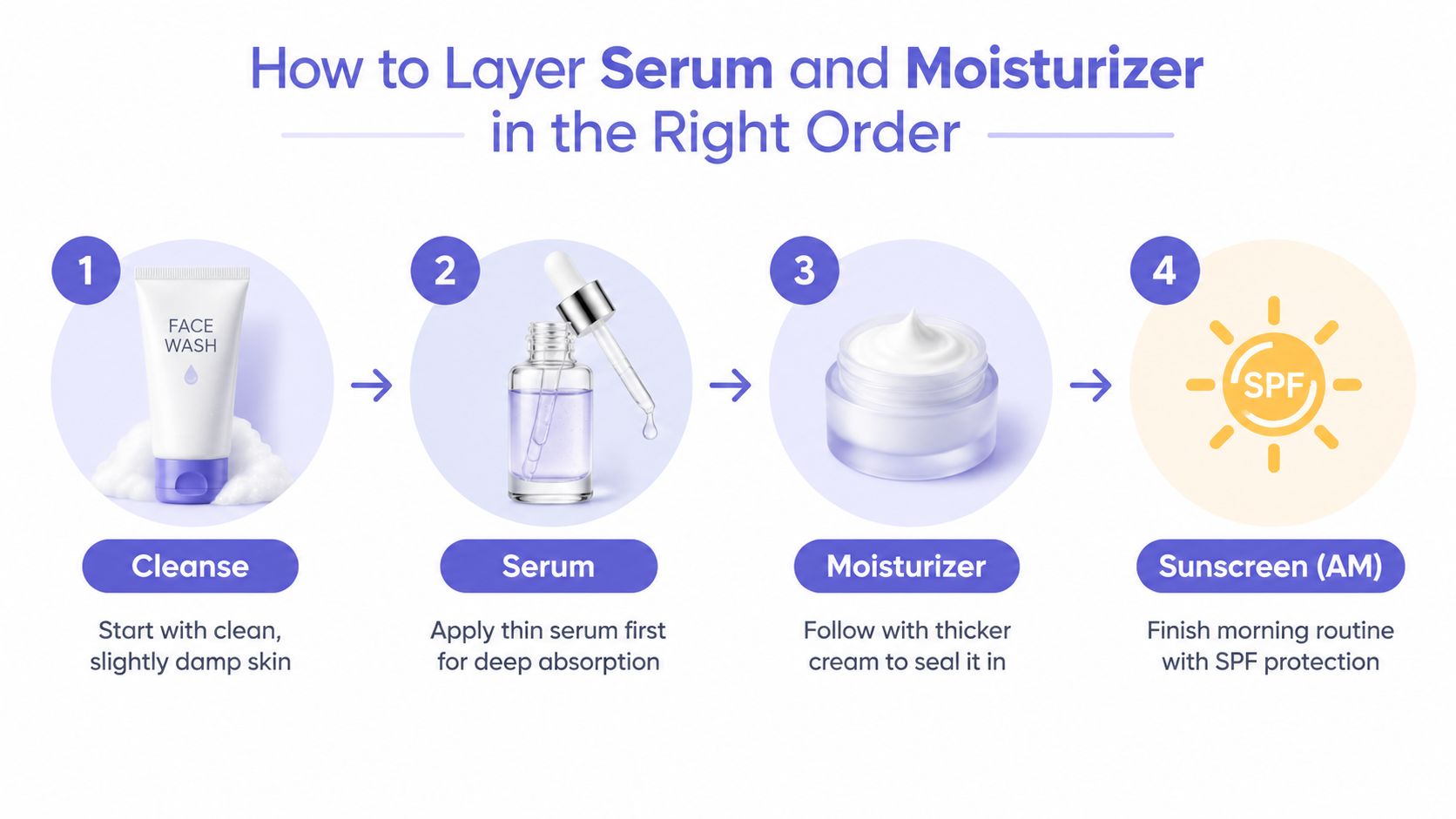
The standard order is cleanser, serum, moisturizer, then sunscreen in the morning. This follows the thinnest-to-thickest principle used in dermatology routine guidance. Cleveland Clinic describes serum as the second step after cleansing and moisturizer as the third, while sunscreen follows in the morning (Cleveland Clinic routine-order guidance).
Start with a gentle cleanse, then pat the skin so it isn't dripping wet. Apply the serum in a thin, even layer. Once it has settled enough to spread without excessive slipping, apply moisturizer over the top. In the morning, finish with sunscreen as the final protective step.
A workable morning routine
- Cleanse: Remove overnight surface residue with a cleanser suited to your skin.
- Apply serum: Use the targeted treatment on clean skin. A hydrating formula may work well on slightly damp skin, while an irritating active may require more cautious application.
- Moisturize: Choose a texture that leaves the skin comfortable, not coated or tight.
- Protect with sunscreen: Complete the morning routine with sunscreen, as recommended in routine-order guidance linked to the American Academy of Dermatology (serum and moisturizer routine guidance).
Evening use and common errors
At night, cleanse, apply serum, and follow with moisturizer. You don't need sunscreen in the evening, and you don't need to add several serums because they fit before cream. Product compatibility and skin tolerance matter more than filling every available step.
One common mistake is putting moisturizer on first because the skin feels dry, then applying a treatment serum afterward. The cream may make it harder for the serum to spread evenly across the surface. Another is applying too much serum. A concentrated product doesn't become more effective because the skin is covered in a thick layer.
If a serum stings, increases redness, or leaves the skin persistently tight, reduce the active routine and give barrier support more attention.
A serum-and-cream routine has also shown sustained hydration benefits over an 8-hour wear period in clinical research, supporting the practical sequence of serum first and moisturizer second (clinical hydration study). For help combining specific ingredients, this guide to layering niacinamide, vitamin C, and sunscreen can make a complex routine easier to assess.
Choosing the Right Combination for Your Skin Type and Climate
The same serum and moisturizer can feel completely different in a humid summer environment and a dry winter room. Skin type matters too, but the way your skin feels after cleansing and several hours of wear gives more useful information than an online label alone.
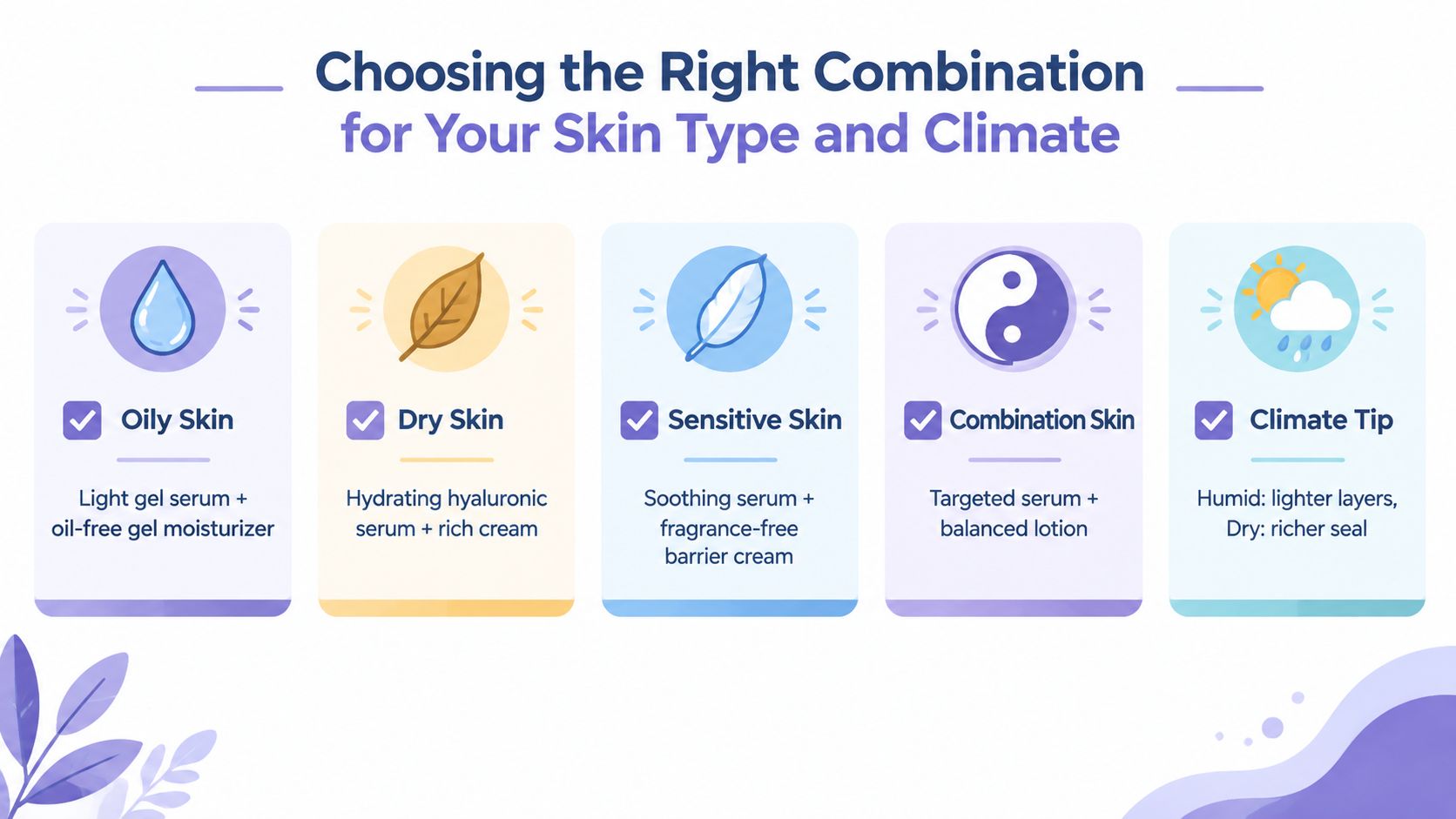
Oily skin may still be dehydrated. If your face becomes shiny but feels tight after washing, removing every moisturizing layer may worsen discomfort. In a humid climate, a hydrating serum followed by sunscreen may be enough for some oily skin types, especially if the sunscreen has a comfortable emollient base. If the skin feels tight by afternoon, add a light oil-free gel moisturizer rather than jumping straight to a heavy cream.
Dry skin usually benefits from the complete delivery-and-sealing combination. A hydrating serum can add water-binding support, while a richer cream provides the emollient and occlusive layer needed for comfort. In cold or dry air, the moisturizer becomes much less optional because the environment makes water retention harder.
Use skin feel as a decision tool
Oily skin
A light gel serum may suit the treatment step, followed by an oil-free gel moisturizer if sunscreen alone doesn't prevent tightness.
Dry skin
Pair a hydrating serum with a richer cream, especially when roughness or flaking appears.
Sensitive skin
Favor a soothing serum and fragrance-free barrier cream. If an active causes burning or redness, simplify rather than layering more products.
Combination skin
Apply a targeted serum where the concern exists, then use a balanced lotion or different textures across facial areas if needed.
Mature skin
Prioritize comfort and barrier support alongside targeted actives. Skin that feels drier with age often needs more sealing than it once did.
The practical serum guide for sensitive skin can help narrow the treatment category without treating sensitivity as a reason to avoid every serum. The better approach is to choose a compatible active, introduce it carefully, and keep the barrier routine dependable.
Seasonal adjustment is normal
In humid weather, lighter layers often feel better and reduce the temptation to skip skincare altogether. In dry weather, a richer moisturizer can protect comfort even when the same serum remains appropriate. Combination skin may need a gel in oilier areas and a lotion or cream where dryness appears.
I'm certain the most useful routine is the one you can adjust without abandoning. If skin feels greasy, reduce the weight of the moisturizer. If it feels tight, rough, or reactive, increase barrier support before adding another treatment product.
Building a Simple Routine That Actually Works
A good routine doesn't need every product category. Start by identifying the concern and the barrier condition separately. If you want to target uneven tone, texture, or visible fine lines, consider one appropriate serum. If your skin feels tight, rough, or easily irritated, choose a moisturizer that supports comfort first.
The basic structure is uncomplicated:
- Morning: Cleanse if needed, apply serum, moisturize according to skin feel, then use sunscreen.
- Evening: Cleanse, apply serum if appropriate, and finish with moisturizer.
- When irritated: Reduce or pause strong actives and focus on gentle cleansing and barrier support.
- When oily in summer: Test whether a hydrating serum and sunscreen are sufficient, then add a light moisturizer if tightness appears.
Give a new routine time to show whether your skin tolerates it. Observe comfort, dryness, oiliness, redness, and how the skin feels later in the day rather than judging the product only during application. A routine that looks elegant on the shelf but causes persistent discomfort isn't working well for you.
A simple Japanese morning cleanse and protect routine offers another practical example of keeping the morning sequence focused. The principle is consistent across routine styles: cleanse appropriately, apply treatment, support hydration, and protect during the day.
After 16 years in this sector, I believe the best knowledge I can give is also the most practical. Serum treats, moisturizer protects, and the right combination depends on your skin, climate, and concern. I'm certain this framework will solve the confusion that comes from treating both bottles as interchangeable.
Build a routine around your actual skin needs
Healtsy offers pharmacy-grade skincare, sunscreen, cleansers, targeted serums, and moisturizers for concerns including sensitivity, dryness, acne, dark spots, and mature skin. Compare suitable formulas rather than adding products without a clear purpose.
Shop Healtsy