


Skincare · Pigmentation
Tranexamic Acid Serum: What It Does and How to Use It
A surprising fact about tranexamic acid serum is that its appeal in skincare comes from a medicine with a very different original purpose. The ingredient was developed to influence bleeding pathways, yet topical research now supports its role in addressing melasma and post-inflammatory hyperpigmentation. That history matters because it helps separate a useful cosmetic active from the exaggerated promise that any product carrying the name will erase every dark spot.
I'm a pharmacist with sixteen years in dermocosmetics, and I've watched tranexamic acid move from specialist medical discussions to bathroom shelves. I believe the best knowledge I can give is practical: look past the percentage on the front of the bottle, assess the complete formula, protect the skin barrier, and give the routine enough time to work. This is the complete guide to what tranexamic acid serum does, how to choose one, and how I would use it.
Why a Surgical Ingredient Ended Up in Your Bathroom
A drug once reserved for trauma theatres and postpartum haemorrhage is now found in topical serums beside familiar hydrators such as hyaluronic acid. That transition happened because dermatologists recognised that tranexamic acid influences biological signals involved in pigmentation, not because it behaves like a conventional exfoliating acid.
A reader might arrive at this ingredient after trying vitamin C, niacinamide and retinol, only to find that cheek patches or post-acne marks remain visible. The frustration is understandable. A serum can be perfectly respectable and still fail if the pigmentation diagnosis is wrong, the formula irritates the skin, or daily ultraviolet exposure keeps stimulating new pigment.
Tranexamic acid has a long-established pharmacology as a medicine, while the topical serum format is comparatively new. In a clinical study involving abdominoplasty patients, topical administration produced mean peak serum concentrations of about 5 µg/ml, compared with 66.1 ± 13.0 µg/ml after intravenous administration. The study used 10 µg/ml as the threshold considered relevant for a systemic antifibrinolytic effect in adults, and only one moistening patient exceeded it, while none of the topical bolus patients did. These findings help explain why cosmetic serums are positioned as low-systemic-exposure skin products, not as substitutes for medical treatment (Pfizer prescribing information).

The bathroom-shelf lesson
The ingredient's medical background shouldn't make a cosmetic serum sound more powerful than it is. A topical product doesn't deliver the same exposure, formulation, or clinical protocol as oral or intravenous tranexamic acid. The evidence for a serum must be judged on the actual product format, its supporting ingredients, and the condition being treated.
A 12-week Brazilian study involving 55 patients evaluated a facial serum containing 3% tranexamic acid, 1% kojic acid and 5% niacinamide for mild-to-moderate post-inflammatory hyperpigmentation. The result supports the category, but it doesn't prove that tranexamic acid alone produced every observed change, because the formula contained several active ingredients (clinical study summary).
That distinction is central to my approach. The genuine differentiator isn't just whether a bottle says TXA. It's whether the formula suits your skin, whether you can use it consistently, and whether your routine prevents the pigmentation from returning.
If you're also managing a damaged area of skin, practical cleansing principles such as those described in this wound-care guide are relevant, but a cosmetic serum shouldn't be applied to an open wound or actively broken skin.
How Tranexamic Acid Actually Lightens Dark Spots
Think of pigment production as a stove. Melanocytes are the cooking station, ultraviolet exposure and inflammation keep turning up the heat, and plasmin-related signalling acts like a hand fanning the flame. Tranexamic acid helps reduce that signal, so the pigment-making process becomes less overactive.
In plain terms, topical TXA interferes with plasminogen activation and plasmin-mediated pathways. This reduces inflammatory messages from skin cells, including pathways involving prostaglandin E2, interleukin-6 and alpha-melanocyte-stimulating hormone. The result isn't bleaching, peeling or destruction of pigment cells. It's a reduction in some of the signals that encourage melanocytes to produce excess melanin.
What that means on the face
This is why tranexamic acid is often selected for melasma and post-inflammatory hyperpigmentation, rather than for general hydration. It works upstream of visible discoloration. A pimple, friction, heat or UV exposure may trigger inflammation first, and the pigment becomes noticeable later. TXA addresses part of that signalling environment, while sunscreen reduces the ongoing external trigger.
A systematic review and meta-analysis reported significant reductions in melasma severity. Its pooled MASI result was a standardized mean difference of -1.783, with a 95% confidence interval from -2.076 to -1.490 and P < 0.0001. The same review included a meta-analysis of 1,563 adults, finding significant decreases in both MASI and Melanin Index, supporting a measurable pigmentation effect rather than relying only on consumer anecdotes (systematic review and meta-analysis).
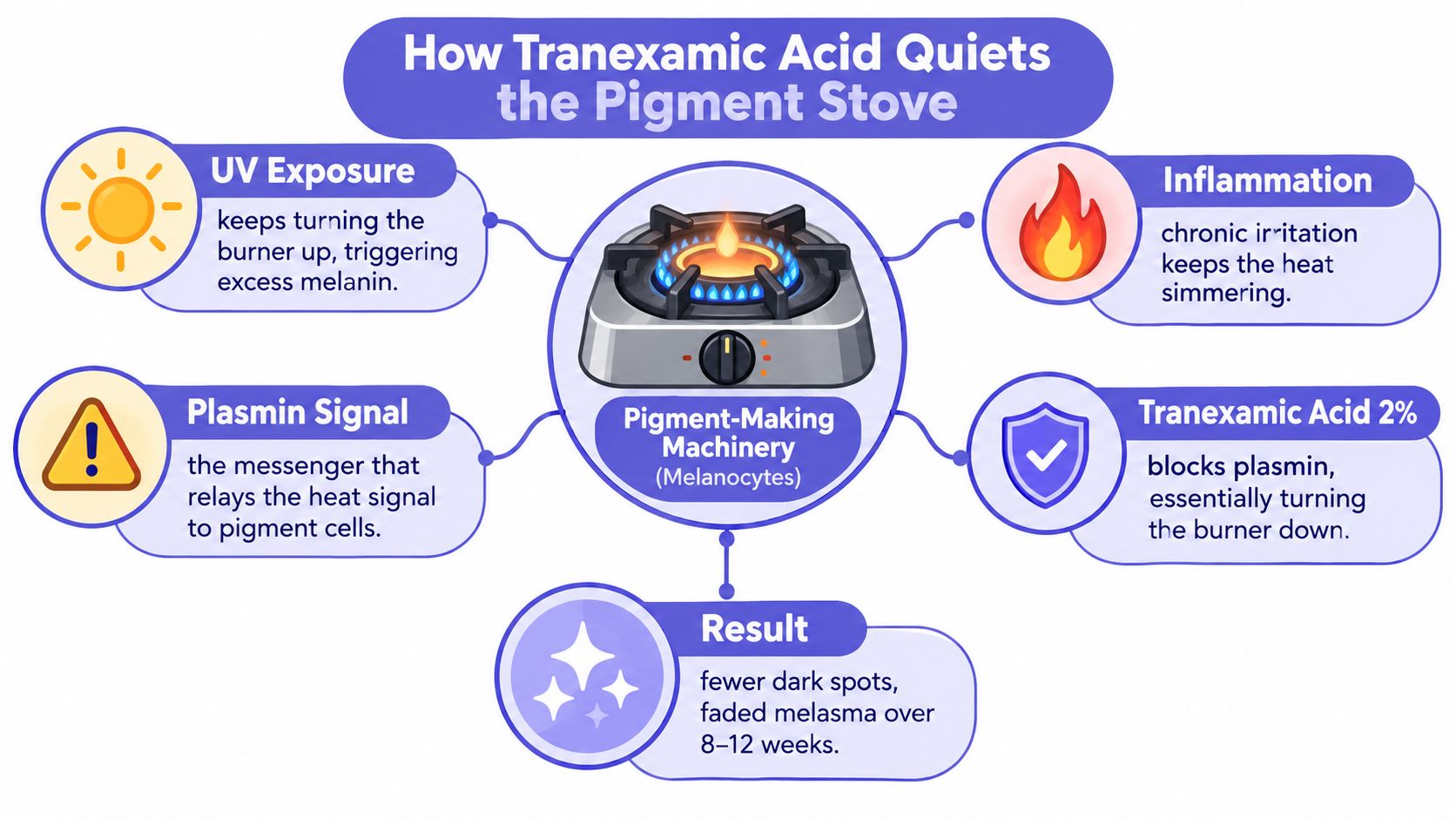
The timeline still requires patience. Reviews of topical TXA commonly describe visible lightening after 4 to 8 weeks, while many clinical studies assess outcomes over 8 to 12 weeks. Those aren't contradictory promises. They reflect the difference between noticing an early change and making a proper decision about whether a routine has delivered enough improvement (Journal of Cosmetic Dermatology review).
If a product promises dramatic fading in a few days, question the marketing before questioning your skin.
Sun exposure can also undermine progress. A serum may reduce pigment signalling, but it can't stop unprotected UV exposure from stimulating new discoloration. For a broader discussion of treatment options and professional assessment, Skinsation Aesthetics Inc.'s advice on melasma and hyperpigmentation is a useful supplementary resource.
For practical background on persistent marks, this guide to dark spots and hyperpigmentation also helps explain why prevention and consistency matter as much as the serum itself.
Choosing the Right Concentration for Your Skin
A higher percentage does not automatically produce better fading. Most topical tranexamic acid serums sit in the 2% to 5% range, but concentration is only one part of the decision. The finished formula, supporting actives and your skin barrier determine whether you can use the product consistently.
| Concentration | Best For | Skin Type | Pairing Notes |
|---|---|---|---|
| 2% | First-time users and mild discoloration | Sensitive, dry or easily irritated skin | A sensible starting point with a simple moisturiser and sunscreen |
| 3% | General post-inflammatory marks and uneven tone | Normal, combination or moderately sensitive skin | A practical middle ground, especially in multi-active formulas |
| 5% | More persistent pigmentation concerns | Experienced users with an intact barrier | Introduce cautiously alongside retinoids, acids or other brightening actives |
Start with the formula, not the headline
A water-based serum usually feels light and layers easily under moisturiser. It may combine TXA with niacinamide, kojic acid or humectants, making it convenient for combination skin. Silicone gels and emulsions tend to feel more cushioning, which can suit dry skin or a barrier that needs support.
The evidence does not make percentage a complete scorecard. The combination-product study cited earlier evaluated TXA alongside other brightening ingredients, so its result should be treated as a benchmark for a multi-active serum rather than proof that isolated TXA at the same concentration performs identically (study report). That distinction matters when marketing presents one number as the whole explanation.
A recent randomized study also assessed a multi-active serum containing 1% TXA, niacinamide, vitamin C and hydroxy acids. Pigmentation improved significantly, while the hydroquinone comparison group had more erythema. The multi-active serum also performed better for hydration and barrier function (randomized study). Those findings support judging the complete formula and its tolerability, not just selecting the strongest label.
My practical choice is straightforward. I'd select 2% for reactive skin or when several routine changes are happening at once, 3% for a balanced everyday option, and 5% only when the barrier is stable and the user already knows how their skin responds.
Two percent used consistently is more useful than five percent used sporadically.
If you are weighing TXA against another pigment active, assess the whole routine rather than chasing strength alone. This azelaic acid guide can help you decide whether azelaic acid better matches your skin's needs and current tolerance.
Tranexamic Acid Compared to Other Brightening Actives
Tranexamic acid occupies a specific place on the brightening map. It isn't a replacement for every established ingredient, and it shouldn't be described as universally gentler because many people tolerate it well. The useful question is, which biological pathway needs attention, and what can your barrier handle?
| Active | Primary Mechanism | Evidence Strength for Melasma | Tolerability | Best Paired With |
|---|---|---|---|---|
| Tranexamic acid | Reduces plasmin-related inflammatory signalling | Supportive topical evidence, with outcomes varying by formula | Often well tolerated, but irritation and dryness can occur | Niacinamide, sunscreen or a carefully selected azelaic acid routine |
| Hydroquinone | Tyrosinase inhibition and reduced melanin production | Longstanding clinical use, with medical supervision appropriate in some settings | More irritation and redness concerns | Dermatologist-directed routines and strict photoprotection |
| Niacinamide | Helps reduce melanosome transfer and supports the barrier | Useful supporting evidence, especially in combination formulas | Generally compatible with many routines | TXA, moisturisers and sunscreen |
| Vitamin C | Antioxidant activity and influence on pigment-related pathways | Formula-dependent evidence for uneven tone | Acidic forms may sting; derivatives may be easier to tolerate | Sunscreen and barrier-supporting products |
| Azelaic acid | Supports pigment regulation while also addressing inflammatory skin processes | Established dermatology use for several discoloration patterns | Can sting or feel drying during introduction | Niacinamide or alternating TXA use |
Where TXA earns its place
Tranexamic acid doesn't remove existing pigment like a scrub, and it doesn't bleach the skin. Its distinctive role is calming part of the signalling that can encourage excess melanin production. That makes it a useful partner rather than a competitor to ingredients working through tyrosinase inhibition, antioxidant activity or melanosome transfer.
The evidence needs careful reading. The 3% TXA, 1% kojic acid and 5% niacinamide serum study showed improvement after 12 weeks, but a combination study can't isolate how much each ingredient contributed (clinical evaluation). Reviews also report that some 5% TXA formulations can outperform vehicle alone and appear comparable with hydroquinone in particular settings, but that doesn't mean every 5% serum will reproduce those results (independent clinical review).
If I could buy only one active, I'd choose based on diagnosis and tolerance. A person with a fragile barrier and inflammatory discoloration may prefer a well-formulated TXA or niacinamide product. Someone with persistent melasma may need a dermatologist's assessment rather than another over-the-counter bottle. For stubborn cases, I prefer one primary active, one supportive active and reliable sun protection over a crowded routine that creates irritation.
More detail on choosing a supporting ingredient is available in this explanation of what niacinamide serum is good for.
Adding a Tranexamic Acid Serum to Your Routine
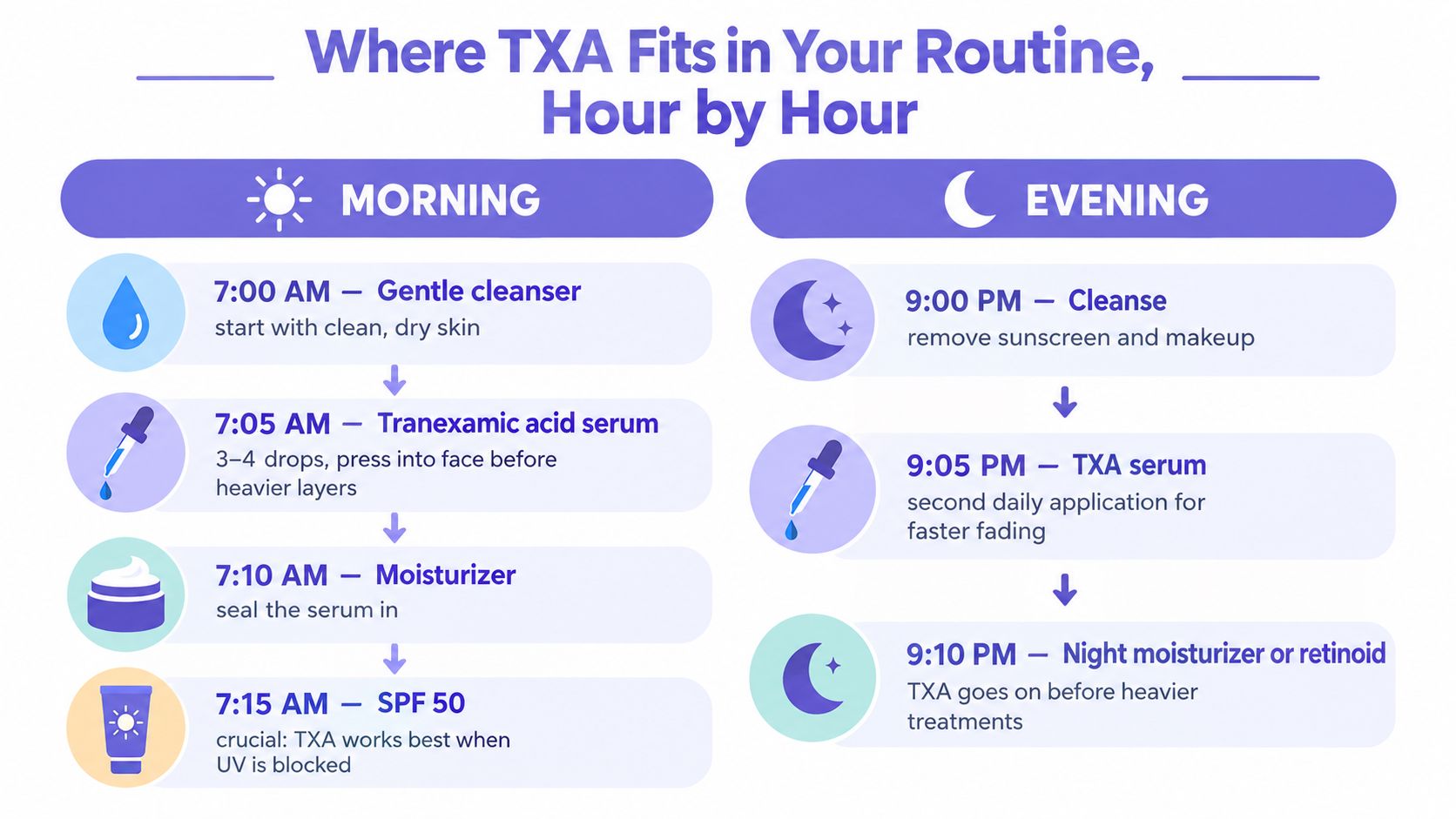
A tranexamic acid serum belongs after cleansing and before heavier moisturisers. In the morning, it goes before sunscreen. At night, it can sit beneath moisturiser, with a retinoid used according to your established tolerance rather than added impulsively on the same night.
A simple daily framework
Morning
- Cleanse gently, or rinse if your skin is dry and comfortable doing so.
- Apply the TXA serum to clean, dry skin.
- Follow with moisturiser if needed.
- Finish with SPF 50. This step protects the progress made by the rest of the routine.
Evening
- Remove sunscreen and makeup thoroughly without scrubbing.
- Apply the serum.
- Use moisturiser to reduce dryness.
- If you already use tretinoin, follow the schedule prescribed or established for your skin. Don't treat TXA as permission to increase tretinoin frequency.
TXA generally fits comfortably with niacinamide, azelaic acid and many vitamin C derivatives. Strong retinoids and high-strength AHAs deserve more caution, particularly when the skin is already dry, stinging or peeling. Introduce one change at a time so you can identify the cause if redness appears.
A four-week patch-test approach is sensible. Apply a small amount to a limited area for several evenings, then expand to one facial application every other evening if the skin remains calm. Move to daily use only when there is no persistent burning, swelling or worsening dryness.
Two schedules I would actually use
For a beginner, I'd use TXA on Monday, Wednesday and Friday evenings for the first two weeks, then add morning use if the skin stays comfortable. I'd keep exfoliating acids and new retinoids out of that introductory period.
For an experienced tretinoin user, I'd use tretinoin on the established nights and TXA on the alternate evenings, with a moisturiser after each. A morning TXA application can be added if the routine remains comfortable, but SPF 50 every day isn't optional.
For context on application technique, this sunscreen guide for the face explains the final step that protects the routine. Readers comparing approaches to uneven tone may also find ProMD Health Columbia's overview of uneven skin tone treatments useful when deciding whether cosmetic care is enough.
Safety, Side Effects and Who Should Skip It
Topical tranexamic acid serum isn't the same as taking oral tranexamic acid. The topical studies and pharmacology data support the idea of much lower systemic exposure, but that doesn't make every formula harmless or suitable for every face. The skin still responds to the complete product, including preservatives, fragrance, solvents and accompanying acids.
The common mistake is calling TXA universally gentle. Irritation can occur when the serum is applied too often, layered onto a compromised barrier, or combined with several strong actives. Dryness, flaking and stinging are possible, and a rare allergic contact reaction can occur with any cosmetic ingredient.
When caution matters most
Skip application on active eczema or a rosacea flare. I'd also avoid it on skin that is cracked, recently over-exfoliated or persistently burning. Anyone with known hypersensitivity to the ingredient or the formula should not retry it without professional guidance.
Pregnant or breastfeeding users should discuss cosmetic active routines with a qualified clinician because topical safety data for TXA in these situations are limited. That isn't the same as saying harm is established. It means the available information doesn't justify casual reassurance.
Some people interpret renewed pigmentation after stopping a product as a withdrawal effect. More often, the underlying trigger remains active, particularly UV exposure or inflammation. If the skin stops receiving pigment support and sun protection becomes inconsistent, discoloration may become visible again.
Stop the product and consult a dermatologist if you develop persistent stinging, unusual swelling, a rash that doesn't settle, or new darkening that continues despite simplifying the routine.
Don't self-treat a changing, asymmetrical or unusual pigmented lesion with a cosmetic serum. A serum is appropriate for a cosmetic pigmentation concern that has been identified as such, not for every mark that happens to look dark.
Shopping and Selection Tips for International Buyers
A good purchase starts with the label, not the influencer's before-and-after photograph. Look for tranexamic acid named clearly in the INCI list, a stated concentration, a formula with limited unnecessary fragrance, and packaging that protects the contents from light and repeated air exposure.
The 2% to 5% range is the most useful starting point for comparing topical products, but the number should be connected to the complete formula. A product that says “brightening complex” without identifying the TXA concentration gives you less information than a straightforward label that names the percentage and supporting ingredients.
What to check before ordering
- Concentration: Confirm the TXA percentage rather than relying on phrases such as “advanced brightening.”
- Ingredient list: Look for supporting ingredients such as niacinamide, and be cautious with fragrance or essential oils if your skin reacts easily.
- Texture: Choose a water-based serum for light layering, or an emulsion and gel format if your skin needs more cushioning.
- Packaging: Opaque, airless or UV-protective packaging can reduce avoidable stability concerns.
- Seller: Use an authorised retailer with clear product information, batch details and a returns policy.
- Regulatory context: European pharmacy products, Korean formulas and American products may use different labelling conventions, so compare the full INCI list rather than the front label alone.
- Suitability: Check whether the product is vegan-certified or carries pregnancy-related suitability information, but don't treat either statement as a substitute for medical advice.
International shoppers should also account for authenticity, delivery territory and import arrangements. A lower product price can stop being attractive if the seller uses grey-market distribution, provides no batch information or leaves duties unclear. Check whether the retailer ships to your country, whether duties are included, and how the product is protected during transit.
A practical shortlist has three tiers. First, remove products with undisclosed concentrations or aggressive fragrance if your barrier is reactive. Second, compare the texture and supporting ingredients with your existing routine. Third, choose the option you can replace reliably through an authorised channel rather than buying a one-off bottle from an uncertain marketplace.
Healtsy is one European online source that lists pharmacy and parapharmacy products, provides active ingredients and usage information, and ships selected products internationally through authorised distribution. If you're comparing a European serum from the United States, United Kingdom, Canada, Australia or the Gulf, verify the current product page, destination availability and delivery terms before ordering.
The most honest conclusion is simple. Tranexamic acid serum can be a useful part of a pigmentation routine, but formulation, tolerance and sunscreen determine whether the ingredient earns a permanent place on your shelf. I'm certain this approach will solve the most common shopping and usage confusion, even though no serum can guarantee a permanent cure for melasma or every form of discoloration.
Compare European Pharmacy Skincare by Active Ingredient
If you want to compare serums by active ingredient, concentration, texture and international availability, visit Healtsy. Use the product information to check how a tranexamic acid serum fits with your existing routine and confirm shipping details before ordering.
Visit Healtsy