


What Is Niacinamide Serum Good for? A Pro's Guide
You've probably seen niacinamide serum described as a solution for almost everything: acne, enlarged pores, redness, dark spots, dryness, and fine lines. That broad promise can make shopping harder, especially when two bottles look similar but contain very different concentrations and supporting ingredients.
After more than 16 years in the pharmaceutical sector, I've learned to judge an ingredient by its mechanism, evidence, tolerability, and practical place in a routine. I believe niacinamide earns its reputation because it supports several skin functions at once, but it isn't a magic cure. The question is not just whether it works. It's what niacinamide serum is good for in your skin, at what strength, and alongside which products.
Your Complete Guide to Niacinamide Serum
A common situation goes like this. Someone notices shine around the nose, a few post-acne marks on the cheeks, and irritation after trying a strong exfoliant. They buy a niacinamide serum because the label promises oil control, brightening, and barrier support. After applying it generously twice a day, they develop stinging and assume the ingredient has failed.
The problem may not be niacinamide itself. It may be the concentration, the rest of the formula, or the decision to introduce several active products at once. In my experience, people get better outcomes when they treat niacinamide as a reliable supporting active, rather than as a product that must solve every concern overnight.
Niacinamide is a form of vitamin B3 used in topical skincare. Its value comes from its multifunctional activity. It can help the skin retain hydration, support the barrier, calm visible redness, influence oil production, and improve the appearance of uneven pigmentation. Those benefits make it relevant to oily, sensitive, blemish-prone, uneven, and mature skin.
My professional view: A good niacinamide serum should make your routine more resilient, not more complicated.
The serum format is popular because it delivers a concentrated leave-on application before moisturizer. It's also important to understand how a serum differs from a moisturizer, since the two products have different formulation purposes. This guide to the difference between serum and moisturizer can help you decide whether you need one product or both.
For shoppers comparing formulas, a curated guide to best drugstore niacinamide serums can be useful for identifying accessible options, but the label still matters more than the marketing. Look for the niacinamide concentration, the texture, and whether the formula also contains ingredients your skin already tolerates.
My aim is practical: help you understand why this ingredient works, where it can disappoint, and how to use it without overwhelming your skin.
The Four Pillars of Niacinamide's Power
A serum can leave skin feeling smoother while the underlying problem continues. Niacinamide is useful because it works on several processes that influence hydration, oil balance, pigmentation, and visible irritation. From a pharmaceutical perspective, its value lies in improving the skin's operating conditions rather than forcing rapid exfoliation or renewal.
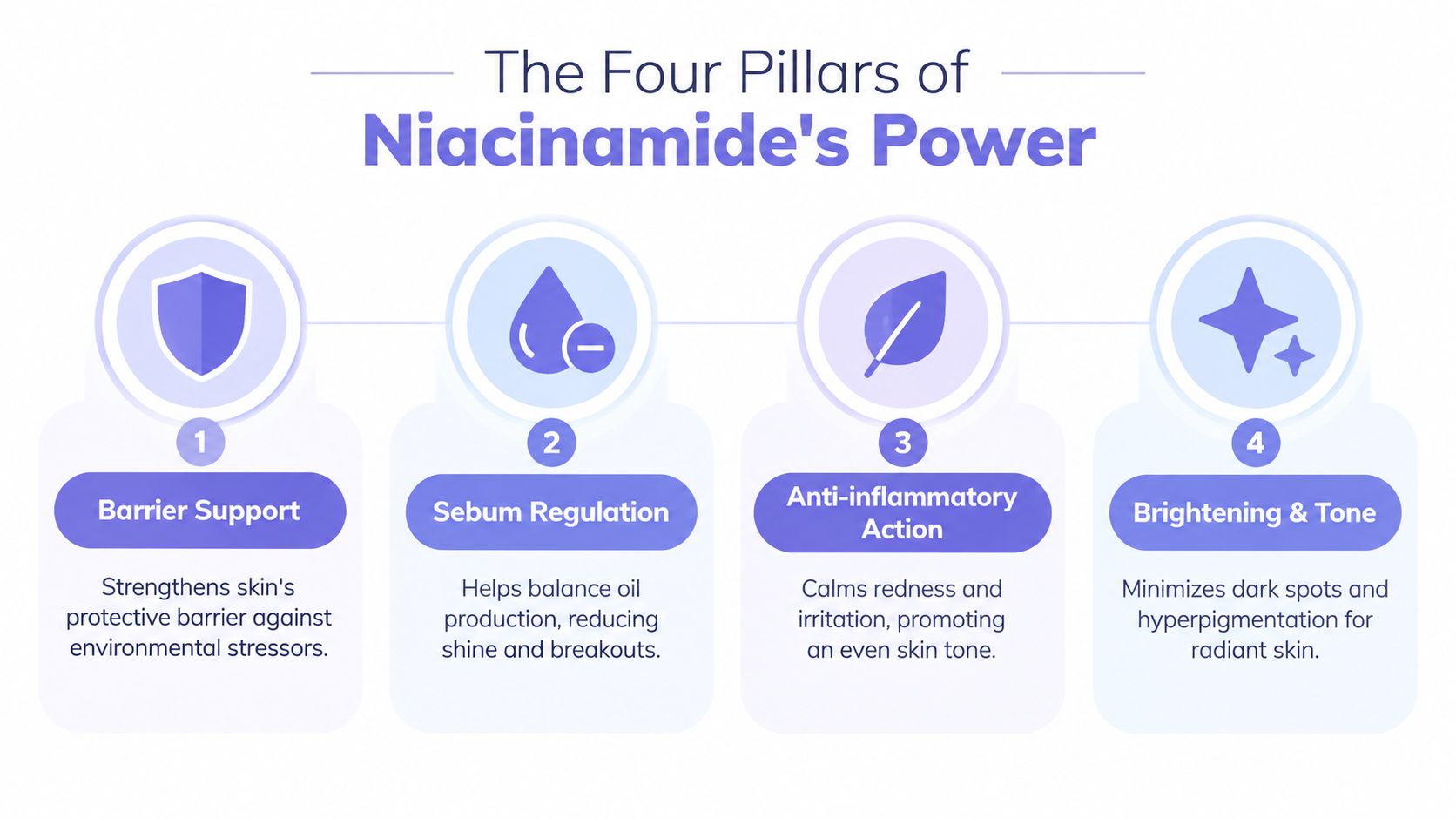
Barrier support
The skin barrier consists of cells supported by organized lipids. If that structure is disrupted, water escapes more readily and irritants can enter more easily. Tightness, flaking, sensitivity, and ongoing redness may follow.
Niacinamide helps the skin maintain this lipid organization, which explains its usefulness after over-cleansing, excessive exfoliation, or treatment-related dryness. It works alongside a bland moisturizer rather than replacing it. People with recurring dryness may need broader critical skin barrier solutions, because a serum cannot address every cause of discomfort.
A practical barrier-focused routine pairs a gentle cleanser with a well-formulated moisturizer and daily sun protection. Niacinamide can then provide supportive care without making the routine unnecessarily complicated.
Sebum regulation
Oil control should not depend on stripping the skin. Harsh cleansers and aggressive degreasing products can create temporary tightness and irritation. Niacinamide takes a gentler route by helping reduce sebaceous lipid production without a detergent-like effect.
Clinical evidence reports that 5% niacinamide reduced sebum excretion by about 19% over a 12-week study, alongside visible reductions in oiliness and pore appearance. Read the clinical evidence on niacinamide and sebum production. This makes the ingredient relevant to oily and blemish-prone skin, although it does not replace acne treatment.
Pore appearance reflects genetics, oil flow, and material inside the pore. Less surface oil can make pores look less prominent, but the result is gradual maintenance rather than permanent pore removal.
Brightening and tone
Uneven pigmentation involves melanin production and the movement of melanosomes from melanocytes to keratinocytes. Niacinamide helps interrupt that transfer, so dark marks may gradually appear less noticeable. It supports a more even-looking tone without functioning as a bleaching agent.
A classic mechanistic study found that 2% niacinamide inhibited melanosome transfer by 35% to 68% in a coculture model. Clinical use also significantly decreased hyperpigmentation and increased skin lightness compared with vehicle after 4 weeks. Review the mechanistic evidence for niacinamide and pigmentation.
For post-acne marks and facial hyperpigmentation, consistent application matters more than aggressive layering. This guide to preventing hyperpigmentation offers further practical context. Daily sunscreen remains necessary because ultraviolet exposure can continue stimulating pigment. Niacinamide supports tone correction, but it cannot offset inconsistent sun protection.
Anti-inflammatory action
Red, uncomfortable skin often reacts to products it previously tolerated. Niacinamide has anti-inflammatory activity, which helps explain its place in routines for visible redness, irritation, and sensitivity after treatment.
A randomized controlled pilot study involving 25 healthy Caucasian participants found that one month of a niacinamide-containing serum significantly increased skin hydration and reduced erythema, meaning facial redness. The study did not find significant changes in melanin or sebum over that short period. See the study on hydration and erythema.
That distinction guides responsible use. Niacinamide may calm the environment around irritated skin while supporting hydration, yet it should not be treated as a stand-alone therapy for a diagnosed inflammatory skin condition. I'm certain its strongest role is as a well-tolerated support ingredient, selected according to the skin's condition and the rest of the routine.
Finding the Right Strength for Your Skin
A bottle marked with a higher percentage can look more persuasive, but higher doesn't automatically mean better. In pharmacy practice, I choose concentration according to the skin's tolerance, the target concern, and the other active ingredients already in the routine. A stronger formula may suit someone accustomed to active products. Sensitive or recently irritated skin often does better with a lower or moderate strength.
Peer-reviewed review literature identifies 4% to 5% as a common cosmetic range for skin-aging and pigmentation concerns. Read the review of topical niacinamide. I believe this range is a sensible starting point for many adults because it has clinical support without making the strongest available formula the default.
Evidence also suggests that concentration can matter for discoloration. A randomized, split-face, double-blind trial found that 5% nicotinamide reduced hyperpigmented spots more than vehicle after 4 and 8 weeks, while 2% wasn't statistically significant for that outcome. The finding supports a practical dose-response relationship when dark spots are the primary concern. Review the trial summary on niacinamide and hyperpigmented spots.
Niacinamide concentration guide
| Concentration | Primary benefit | Best for |
|---|---|---|
| 2% | Gentle barrier and hydration support | Sensitive routines and first-time users |
| 4% | Balanced support for tone and skin aging | Uneven tone, mild redness, and routine maintenance |
| 5% | Stronger evidence for pigmentation and oil balance | Dark spots, oily skin, and blemish-prone skin |
| Higher strengths | More concentrated active exposure | Experienced users who tolerate niacinamide well |
Use the table as a starting point, not a guarantee. Formula design affects comfort: pH, preservatives, fragrance, and accompanying actives can matter as much as the headline percentage. A 5% fragrance-free serum may be easier to tolerate than a lower-strength product containing irritating essential oils.
When to choose less or more
Reactive skin should start with a lower or moderate strength, used less often while comfort is assessed. Stinging, persistent burning, or worsening redness is a reason to pause, not to push through. A serum for sensitive skin should prioritize comfort, because an ingredient that cannot be used consistently offers little practical benefit.
Higher strengths may appeal to people addressing oiliness or pigmentation, yet they can add irritation when paired with retinoids, exfoliating acids, or a weakened barrier. I'm certain that a tolerable concentration produces better real-world results than chasing the largest number on the label.
How to Integrate Niacinamide into Your Routine
If your skin feels tight after cleansing or reacts easily to new products, the order and pace of application matter as much as the serum itself. Niacinamide usually goes after cleansing and before moisturizer, but the right routine depends on your other active ingredients and your skin's current condition.
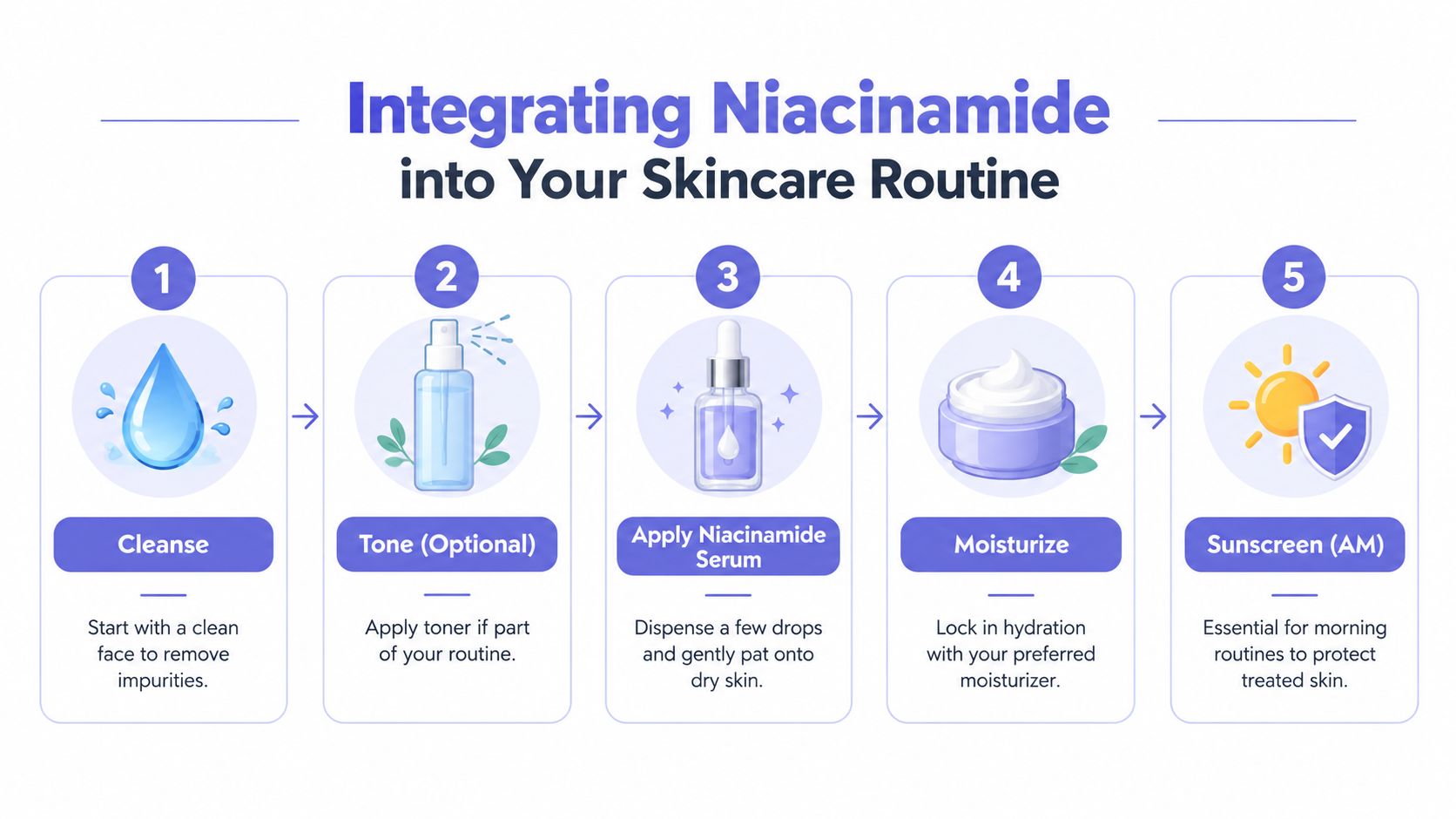
A practical application sequence
- Cleanse gently. Remove sunscreen, makeup, and surface impurities without leaving your face tight or stripped.
- Use toner only if you need it. Toner is optional, not a required step.
- Apply niacinamide serum. Follow the product label and spread the serum over clean skin.
- Moisturize. Choose a formula suited to your skin type that helps reduce water loss.
- Finish with sunscreen in the morning. Daily protection matters particularly when uneven pigmentation is one of your goals.
A gradual introduction is easier to assess than starting several new products together. Use niacinamide alone for an initial observation period. If irritation develops, you can identify the likely cause more accurately than if you begin it alongside a retinoid, exfoliating acid, and new moisturizer.
Add one meaningful change at a time, especially when your skin is already dry, red, or sensitized.
You can apply niacinamide in the morning, evening, or both when your skin remains comfortable. Consistency matters more than forcing a higher frequency. Persistent burning, increased redness, or discomfort means the routine needs adjustment, not that you should continue unchanged.
Pairing it with other actives
Niacinamide generally combines well with hydrating ingredients such as hyaluronic acid and with moisturizers that support the skin barrier. It can also sit alongside retinoids, since its barrier-supporting and soothing role may improve comfort. Retinoids still require gradual introduction, and niacinamide does not remove that need.
Vitamin C needs more judgment. Pure ascorbic acid formulas may favor a different pH environment, and layering several active products can increase sensitivity for reactive skin. If compatibility or comfort is uncertain, apply vitamin C in the morning and niacinamide in the evening. People whose skin already tolerates both may layer them, provided the complete formula remains comfortable. This guide to layering niacinamide, vitamin C, and sunscreen explains how to organize that morning combination.
Exfoliating acids require the same caution. A serum containing salicylic, glycolic, or lactic acid can still irritate, even when niacinamide is included. Start with a simpler routine, then add one active at a time as your skin demonstrates stable tolerance.
This video offers a visual routine demonstration:
Who Benefits Most from Niacinamide Serum
Niacinamide makes the most sense when you match its strengths to a specific skin pattern. I don't recommend it because every person needs the same serum. I recommend it when the formula addresses a problem without creating a new one.

Oily and acne-prone skin
For someone who wakes up with shine across the forehead and notices that makeup breaks down around the nose, sebum regulation is the most relevant pillar. Niacinamide can help reduce oiliness and make pores look less noticeable, while its barrier support helps avoid the dry, stripped feeling caused by aggressive oil-control products.
For active acne, I frame niacinamide as an adjunct, not a complete treatment. It may support calmer skin and help with post-acne discoloration, but it shouldn't replace a clinically appropriate acne regimen when breakouts are persistent, painful, or scarring.
Sensitive or compromised skin
Someone who experiences tightness after cleansing, redness around the cheeks, or stinging from ordinary products may benefit most from niacinamide's barrier and anti-inflammatory functions. In this situation, the formula matters as much as the ingredient. A simple, fragrance-free serum at a tolerable concentration is more practical than a highly active product with multiple potential irritants.
The aim isn't to force rapid transformation. It's to help the skin feel more comfortable and remain stable while you repair the rest of the routine. People with ongoing flushing or diagnosed rosacea can also explore guidance on niacinamide serum for rosacea, while remembering that persistent symptoms deserve professional assessment.
Mature skin and uneven tone
For mature skin, niacinamide can contribute to a broader routine focused on barrier strength, visible tone, and the appearance of fine lines. Earlier dermatology research reported improvements in the appearance of wrinkles, yellowing, and elasticity with topical niacinamide, and later clinical work has continued to support its versatility for pigmentation and skin aging.
A double-blind randomized clinical trial found that 4% niacinamide was effective for melasma. A later study using a 5% niacinamide serum reported a depigmenting benefit similar to a regimen containing 4% hydroquinone over a 5-month treatment course, supporting niacinamide's role in hyperpigmentation and mature-skin routines. Review the clinical evidence for niacinamide in melasma and aging skin.
An achievable expectation is gradual improvement in the appearance of uneven tone, not a change to your natural skin color. Consistent use, moisturizer, and sunscreen will usually matter more than adding several brightening products at once.
My Final Professional Advice on Niacinamide
After 16 years in the pharmaceutical sector, I continue to view niacinamide as one of the most dependable and versatile skincare ingredients available. Its strongest practical advantages are barrier support, hydration, redness control, oil balance, and assistance with uneven pigmentation.
I believe its value comes from being useful without demanding an unnecessarily complicated routine. It isn't a magic bullet, and it won't replace targeted care for significant acne, melasma, rosacea, or persistent irritation. Used at a sensible strength and introduced gradually, however, it can become a dependable foundation for many skin types.
I'm certain the most successful niacinamide routine is the one you can use consistently without discomfort. Choose the concentration according to your concern, introduce one active at a time, moisturize, and protect your skin from the sun.
Build a routine suited to your skin
Healtsy offers pharmacy-grade skincare, sunscreens, targeted products for concerns such as acne, dark spots, eczema, and rosacea, plus dermatologist-approved formulas from European and international brands.
Shop Niacinamide at Healtsy