


Magnesium Supplement for Sleep: A Complete Guide
At 1:47 a.m., the bedside lamp is back on. Tomorrow's meetings are already running through your head, your phone is within reach, and the melatonin gummies you bought are only half-used. You're tired, but your nervous system hasn't received the message.
That's often when magnesium enters the conversation. A friend recommends glycinate, a search result suggests citrate, and a brightly packaged product promises deeper rest. After 16 years working in the pharmaceutical sector and watching what people experience at the dispensary counter, I believe magnesium deserves a calmer, more honest discussion. It may help some people, but it isn't a universal sleep treatment.
This guide will help you decide which form fits your complaint, how to interpret the dose, when to take it, what interactions matter, and when magnesium isn't the right answer. If you're comparing options, this overview of magnesium for better sleep can provide another useful perspective, but your decision should still rest on the product label, your health history, and realistic expectations.
When Sleep Won't Come and Magnesium Enters the Chat
The person reaching for magnesium at night usually isn't looking for a miracle. They want something practical for the familiar pattern: lying awake, waking repeatedly, feeling tense in the legs, or opening their eyes before the alarm with a mind that's already busy.
A magnesium supplement for sleep can make sense as a supporting experiment, especially when muscle tension, dietary gaps, or mild evening restlessness are part of the picture. It makes less sense as a rescue pill for long-standing insomnia caused by untreated anxiety, sleep apnoea, shift work, pain, medication effects, or an irregular schedule.
The evidence sits between marketing and dismissal. A 2021 systematic review and meta-analysis combined three randomized controlled trials involving 151 older adults across three countries. Magnesium shortened sleep-onset latency by 17.36 minutes compared with placebo, but the review rated the evidence low to very low certainty and found that the increase in total sleep time was not statistically significant (systematic review in PMC). That's a real signal, but it's not a guarantee.
Pharmacist's view: A plausible supplement can be worth a careful trial, but it shouldn't delay an evaluation when poor sleep is persistent or disabling.
Consider two people. One has occasional difficulty settling down, mild calf tightness, and a reasonable sleep schedule. Another spends much of the night awake, snores heavily, feels exhausted during the day, and has been struggling for months. Magnesium may be a modest add-on for the first person. The second person needs a broader clinical assessment, not another bottle from the supplement aisle.
By the end of this guide, you'll have a pharmacist-style decision framework instead of another guess in the dark. I can't promise that magnesium will solve your sleep problem, and no responsible professional should. I'm certain, however, that a better-informed choice is safer and more useful than following whichever form is trending online.
How Magnesium Actually Talks to Your Sleep System
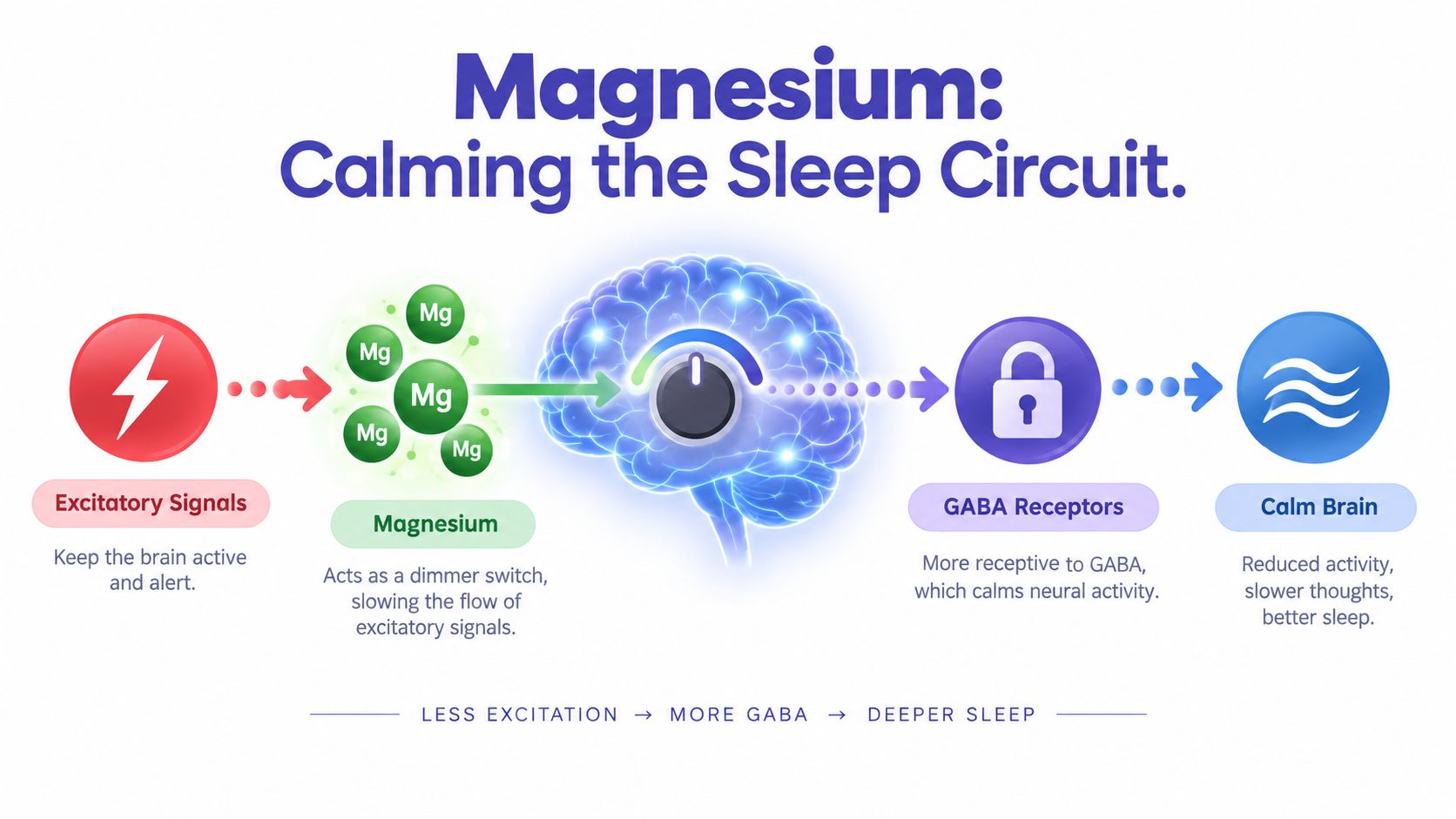
Think of the nervous system as an audio circuit. During the day, excitatory signals help you stay alert, respond quickly, and concentrate. At night, the brain needs to reduce that volume. Magnesium is involved in several processes related to nerve signalling and muscle function, so the popular “calm the circuit” explanation has a biological basis, even though the sleep evidence remains limited.
Magnesium can be pictured as a dimmer switch around inhibitory signalling, including pathways associated with GABA, the brain's main calming neurotransmitter system. This doesn't mean a capsule acts like a sedative or flips the brain instantly into sleep mode. It means magnesium may support the balance between stimulation and relaxation, particularly when intake is inadequate or when physical tension keeps a person alert.
Magnesium also participates in processes connected with melatonin production, stress regulation, and muscle relaxation. These mechanisms help explain why people associate it with winding down, but a plausible mechanism isn't the same as proven clinical effectiveness. If your magnesium status is already adequate, taking more may produce little noticeable change.
What the clinical evidence actually says
The older insomnia research is small. The 2021 review found only three randomized trials and 151 older participants, with all trials judged to have moderate-to-high risk of bias (PubMed summary of the meta-analysis). Its result suggests magnesium may help some people fall asleep faster, but it doesn't establish magnesium as a reliable treatment for insomnia.
A broader 2023 systematic review examined nine studies involving 7,582 adults. Observational studies linked magnesium status with aspects of sleep health, including daytime sleepiness, snoring, and sleep duration, while randomized trials produced uncertain results for sleep disorders (2023 systematic review). The U.S. National Center for Complementary and Integrative Health also describes the research as very limited and conflicting (NCCIH overview of magnesium and sleep disorders).
A newer 2025 randomized, double-blind, placebo-controlled trial included 155 adults with self-reported poor sleep. Participants received magnesium bisglycinate providing 250 mg of elemental magnesium plus 1,523 mg of glycine for 28 days. The improvement in Insomnia Severity Index scores was statistically significant but modest, with an effect size of d=0.2, and the glycine component means the result can't be assigned to magnesium alone (2025 trial). That's why I describe magnesium as reasonable to test, but not settled science.
For readers comparing magnesium with melatonin, this discussion of melatonin and magnesium for sleep may help clarify that the two supplements work through different biological pathways. You can also review broader information about magnesium supplement benefits, while keeping sleep-specific claims in proportion to the evidence.
Glycinate, Citrate, Oxide, and Threonate Compared
There isn't one universal “best” magnesium form. I match the form to the person's main problem, their bowel sensitivity, the elemental magnesium listed on the label, and any medicines they take.
Magnesium glycinate, also called bisglycinate, is usually the first form I consider for someone whose poor sleep comes with tension or an anxious evening routine. It's paired with glycine and is commonly chosen for its generally gentle gastrointestinal profile. The newer trial discussed above studied this form, but the modest result cannot prove that glycinate itself resolves insomnia.
Magnesium citrate suits someone who wants general supplementation and also tends toward constipation. Its laxative effect can be helpful for one person and disruptive for another. A practical review such as this 2026 magnesium citrate guide can help you compare product labels, but don't assume a citrate product is automatically appropriate for nighttime use.
Magnesium oxide is often inexpensive and contains a relatively high proportion of elemental magnesium by weight, but it's less well absorbed and more likely to loosen stools. I'm more likely to associate it with constipation support than with a targeted sleep trial.
Magnesium L-threonate is marketed for brain-related benefits because it's promoted as a form that may reach the central nervous system. The sleep evidence is thinner than the marketing suggests, so I wouldn't choose it solely because the packaging uses terms such as “brain health” or “neuro support.”
| Form | Elemental Mg % | Absorption | Best For | GI Tolerance |
|---|---|---|---|---|
| Glycinate or bisglycinate | Varies by product | Generally well absorbed | Tension-prone or anxiety-linked sleep difficulty | Usually gentle |
| Citrate | Varies by product | Generally well absorbed | General support with constipation tendency | May loosen stools |
| Oxide | Relatively high by weight | Lower absorption | Constipation support | More likely to cause diarrhoea |
| L-threonate | Varies by product | Marketed for brain availability, clinical sleep evidence remains limited | Readers interested in cognitive positioning, with cautious expectations | Product-dependent |
How to read the comparison
The elemental percentage matters because the compound isn't the same thing as the mineral your body uses. A large capsule number doesn't automatically mean a more effective product. Price also varies by form and brand, but a higher price doesn't establish better sleep results.
Choose glycinate when tolerance and physical tension matter most. Choose citrate when bowel regularity is part of the picture. Treat oxide as a functional laxative option rather than a premium sleep formula, and approach L-threonate with particular caution because its sleep claims outrun the certainty of the available evidence.
Right Dose, Right Time, Right Label
The most common label mistake is confusing the weight of the magnesium compound with the amount of elemental magnesium. A capsule may list magnesium glycinate as the compound, while the Supplement Facts panel separately states how much elemental magnesium that serving provides. Those figures aren't interchangeable.
For adult sleep trials, practitioners commonly discuss an evening range of roughly 200 to 400 mg of elemental magnesium, but the appropriate amount depends on diet, kidney function, medicines, bowel tolerance, and the product's formulation. The clinical literature also includes studies using divided doses, and a 2026 review noted that oral magnesium has been studied up to three times daily, with each dose under 1 g (2026 review). That isn't a personal dosing prescription.
A simple label check
- Find the elemental magnesium amount per serving in the Supplement Facts panel.
- Confirm the chemical form, such as glycinate, citrate, oxide, or L-threonate.
- Check whether the serving means one capsule, two capsules, or a larger portion.
- Look for a batch or quality-testing statement, a clear expiry date, and a manufacturer that provides contact details.
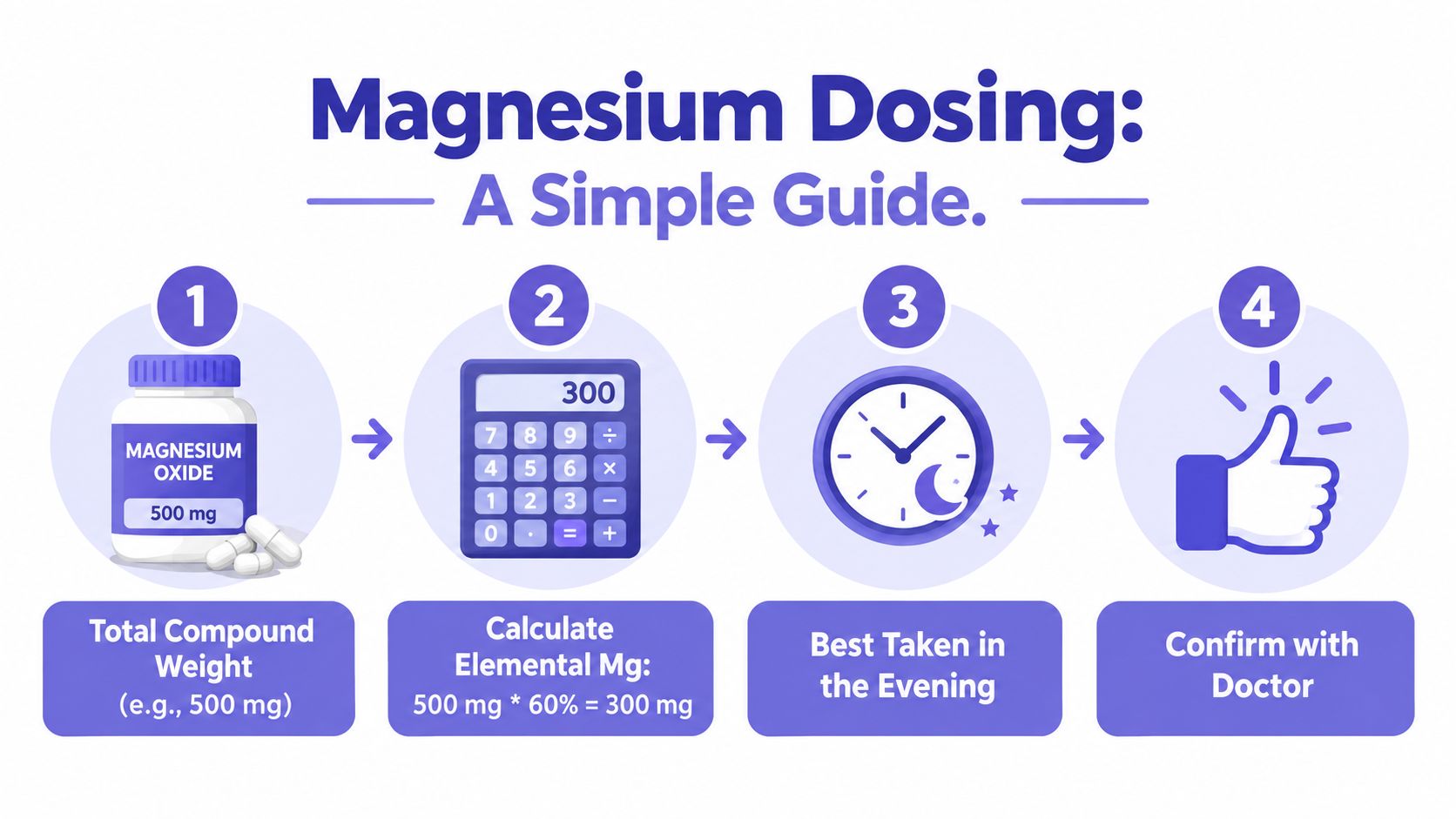
Taking magnesium 30 to 60 minutes before lights-out is a practical starting point because it connects the supplement with an established bedtime cue. Some people tolerate it better with food. If a full evening amount causes loose stools or morning urgency, splitting the intake earlier in the day may be more comfortable, provided the total amount remains appropriate for you.
Label-reading rule: Judge the product by elemental magnesium, form, tolerability, and quality controls, not by the largest number printed on the front.
Avoid products that hide the mineral amount inside a proprietary blend or add unnecessary stimulants, excessive botanicals, or a long excipient list you can't tolerate. If you're comparing a pharmacy-style option, you can examine the specifications of Absorbit Magnesium B6 tablets, then compare its elemental amount and form with alternatives rather than buying by branding alone.
Safety, Interactions, and Who Should Pause
Magnesium is often well tolerated, but “natural” doesn't mean interaction-free. The first practical warning sign is usually diarrhoea, cramping, or repeated loose stools, especially with forms that draw water into the bowel. For adults, the commonly cited tolerable upper intake level for supplemental magnesium is 350 mg of elemental magnesium per day, excluding magnesium naturally present in food. That ceiling comes from the risk of gastrointestinal effects rather than a guarantee that every person should take that amount.
Several medicines deserve a conversation with a pharmacist. Magnesium can interfere with the absorption of tetracycline and fluoroquinolone antibiotics and bisphosphonates, so these products generally need careful separation. Proton pump inhibitors and certain diuretics can also affect magnesium status or change how a person should approach supplementation.
| Medication or Condition | Interaction Concern | Practical Spacing or Caution |
|---|---|---|
| Tetracycline antibiotics | Magnesium can reduce antibiotic absorption | Ask the pharmacist for exact spacing |
| Fluoroquinolone antibiotics | Magnesium can bind the medicine in the gut | Don't take together; follow the prescription guidance |
| Bisphosphonates | Magnesium may interfere with absorption | Use the product-specific separation instructions |
| Proton pump inhibitors | Long-term use can affect magnesium status | Discuss persistent use and symptoms with a clinician |
| Certain diuretics | May alter magnesium balance | Review the medicine and supplement together |
| Chronic kidney disease | Reduced clearance can raise the risk of magnesium accumulation | Seek medical advice before supplementing |
| Myasthenia gravis or severe heart block | Magnesium may be clinically inappropriate in some situations | Pause and obtain individual medical guidance |
| Pregnancy-related questions | Dose and formulation need personal assessment | Ask an obstetric clinician or pharmacist first |
People with chronic kidney disease, myasthenia gravis, severe heart block, or pregnancy-related concerns shouldn't self-dose based on a social media recommendation. Older adults may also need a medication and kidney-function review before starting.
You can read about broader nutrient combinations in this guide to vitamin D, magnesium, and K2, but don't assume that combining several supplements makes a sleep plan safer or more effective. If you're taking regular medicines, bring the actual bottles or a current medication list to the pharmacy.
Magnesium Alongside Real-Life Sleep Habits
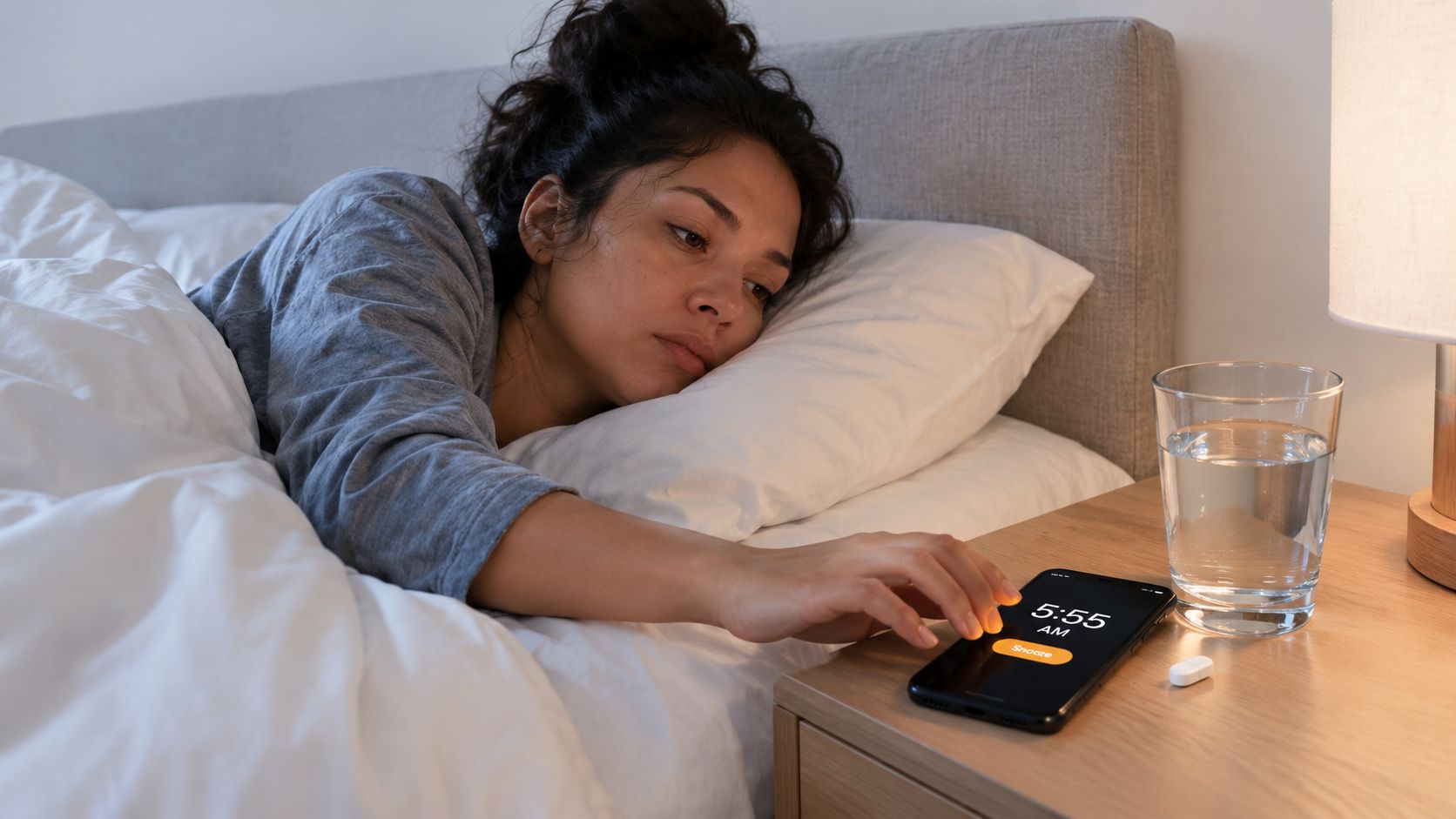
A parent with a 6 a.m. alarm often doesn't need another complicated routine. Their problem is usually a collection of small pressures: late meals, unfinished work, a phone beside the pillow, and a mind that treats bedtime as the only quiet planning period.
On Monday, the parent tries magnesium glycinate with food at 9:30 p.m., then keeps the lights-down routine unchanged. That first night isn't a dramatic success. The useful observation is that the capsule is tolerated and doesn't cause a midnight bathroom trip.
By Wednesday, the parent shifts the screen curfew earlier and leaves the phone charging away from the bed. The magnesium remains attached to the same evening cue, rather than being taken only after a bad night has already started. On Friday, dinner moves earlier, which makes lying down more comfortable and removes one more factor pulling sleep in the opposite direction.
The routine does more than the capsule
A sensible magnesium trial works best beside habits that reduce stimulation:
- Use a consistent cue: Take the supplement at a similar time and pair it with dimmer lighting, washing up, or reading.
- Protect the afternoon boundary: Keep caffeine earlier rather than using it to compensate for a poor night.
- Create a wind-down buffer: Give work, scrolling, and household planning a defined stopping point.
- Don't chase sleep: If you're awake, avoid repeatedly checking the time or treating the supplement as an emergency sedative.
A magnesium product can become one thread in a routine. It can't compensate for an unpredictable wake time, untreated pain, heavy evening stimulation, or a bedroom environment that keeps you alert.
For some people, melatonin enters the same conversation. Information about melatonin capsules may be useful, but combining supplements isn't automatically better. The goal is a repeatable routine that helps your brain recognize the transition to sleep, not a growing collection of rescue products.
Choosing a Quality Supplement and Starting Smart
At the counter, I'd rather see someone buy a straightforward product with a transparent label than an expensive formula with dramatic promises. The important details are easy to state: elemental magnesium per serving, chemical form, serving size, expiry date, and credible quality controls.
Look for third-party testing marks such as USP or NSF when available, while remembering that a seal speaks to manufacturing and product verification, not proof that the supplement will cure insomnia. Check the excipient list if you have allergies, digestive sensitivities, or a reason to avoid particular sweeteners and colourants. A megadose or proprietary blend makes it harder to know what you're testing.
Use a controlled self-trial
- Set a baseline: Before starting, note roughly how long it usually takes to fall asleep, how often you wake, and how alert you feel in the morning.
- Keep one variable stable: Use the same product, form, and bedtime pattern rather than changing several supplements at once.
- Track tolerance: Stop or reduce the trial if loose stools, cramping, or other unwanted effects appear.
- Review the pattern: Look for a modest change in sleep onset or next-day calmness, not dramatic sedation.
The 2025 trial in adults with poor sleep found a modest effect size of d=0.2, and its formula also contained glycine (trial report). That supports realistic expectations. If magnesium helps, the benefit may feel like a slightly easier transition to sleep, fewer tension-related interruptions, or a calmer evening. It shouldn't feel like being forcibly sedated.
If nothing changes after a consistent trial, don't keep increasing the amount indefinitely. Review the diagnosis, medicines, caffeine, alcohol, breathing symptoms, restless legs, mood, and sleep schedule. You can compare a transparent product such as Bioactive Magnesium tablets with other options by specification, not by price or packaging.
Your Magnesium Sleep Questions Answered
Is glycinate better than citrate for sleep?
Not universally. Glycinate or bisglycinate is often the more comfortable choice for someone with muscle tightness, anxious evenings, or a sensitive stomach. Citrate may suit someone who also has constipation, but its bowel effect can disrupt sleep if the dose is too high or taken too late.
What is the safe upper limit?
For adults, the tolerable upper intake level for supplemental elemental magnesium is 350 mg per day. That figure relates mainly to diarrhoea and other gastrointestinal effects. People with kidney disease, significant heart conditions, or complex medication regimens need individual advice rather than relying on a general limit.
Should I take it with food?
If magnesium causes nausea or loose stools, taking it with food may improve comfort. Timing it 30 to 60 minutes before bed gives it a consistent place in the routine, but there's no requirement to take it on an empty stomach.
Can I combine it with melatonin or prescription sleep medicine?
Don't assume that combining products is harmless. Magnesium, melatonin, and prescription sleep medicines can create a more complicated regimen, particularly if you're taking other sedating medicines or have an underlying condition. Ask a pharmacist or prescriber to review the exact products.
Should I take it every night?
A consistent short trial is easier to judge than taking it only on nights when sleep has already gone wrong. If it causes no benefit after several weeks of appropriate use, increasing the amount is unlikely to solve the underlying problem.
What if it doesn't work?
That's useful information, not a personal failure. Persistent insomnia may need assessment for anxiety, depression, pain, reflux, restless legs, medication effects, breathing disorders, or a behavioural sleep pattern. Older adults and people with diabetes should choose based on their full medical profile, not on a form marketed as universally gentle.
Pregnancy and paediatric use should be discussed with a clinician. Children, pregnant people, and anyone with kidney or neuromuscular disease shouldn't self-dose from an adult supplement label.
I believe magnesium can be a reasonable supporting player for selected adults, but it isn't a substitute for treating the cause of ongoing insomnia. My complete guide-to-magnesium supplement for sleep comes down to this: choose the form thoughtfully, calculate elemental magnesium, protect against interactions, and judge the result against a clear baseline.
Build a Safer, More Informed Sleep Routine
Healtsy offers pharmacy and nutritional supplement products that let you compare magnesium options by formulation and label details rather than relying on packaging alone. Review available wellness products and build a safer, more informed routine for sleep and everyday health.
Visit Healtsy