


You're standing in front of the bathroom mirror after dinner, cheeks warmer and redder than they were an hour ago. A new niacinamide serum is half out of its box, but you're hesitating. Will it help your skin feel less reactive, or will tomorrow bring more burning, flushing, and regret?
That uncertainty is familiar. After a rosacea diagnosis, many people cycle through cleansers, moisturisers, oils, and serums, trying to identify the one product that will finally make their skin behave. Niacinamide serum for rosacea can be useful, but the answer isn't merely whether niacinamide is “good” or “bad.” The more useful question is which rosacea pattern, formulation, concentration, and routine context make it supportive rather than irritating.
I've worked in the pharmaceutical sector for 16 years, guiding people through practical skincare decisions where tolerance matters as much as theoretical benefit. I believe the most responsible advice is to treat niacinamide as a potential maintenance ingredient, not an emergency flare treatment. This is the complete guide to making that decision carefully.
Standing in Front of the Mirror With Reactive Skin
The product on the counter usually isn't the only problem. The difficulty is that rosacea can change from one day to the next. You might tolerate a product on a calm morning, then feel it sting after exercise, a hot meal, cold weather, or a late night. That makes a new serum feel like a gamble, especially when marketing language promises calm, stronger skin, and a smoother complexion in one bottle.
Consider someone with persistent cheek flushing who has recently added several products. There's a cleanser marketed for radiance, a botanical mist, a vitamin C serum, and now niacinamide. If the face burns after application, the serum may receive the blame even though the irritation comes from the combined routine. Conversely, someone with papules and an easily dehydrated barrier may find that a simple niacinamide formula helps the skin feel more comfortable between episodes.
Rosacea isn't one uniform presentation. Papulopustular rosacea includes inflammatory bumps, while erythematotelangiectatic rosacea is dominated by flushing and persistent redness. Phymatous rosacea involves thickened skin, and ocular rosacea affects the eyes and surrounding symptoms. A topical serum may have a different place in each situation, and it won't address every feature.
The decision starts with context
Before applying the serum, ask three questions:
- Is the skin currently calm? A new active is harder to assess during burning, marked swelling, or an obvious flare.
- What else is in the routine? Retinoids, exfoliating acids, fragrance, essential oils, and drying cleansers can change tolerance.
- What does the product contain besides niacinamide? The vehicle, preservatives, botanical extracts, and texture may matter as much as the headline ingredient.
A consultation can also help separate rosacea from contact dermatitis, acne, or another condition that resembles it. For readers who want professional guidance on sensitive facial care, the ProMD Health DC facial consultation offers useful context on approaching reactive skin without treating every red face the same way.
The rest of this guide uses that practical frame. Niacinamide may support a stable baseline, but the right concentration and a quiet routine matter more than chasing the strongest formula.
How Niacinamide Actually Helps a Rosacea-Prone Barrier
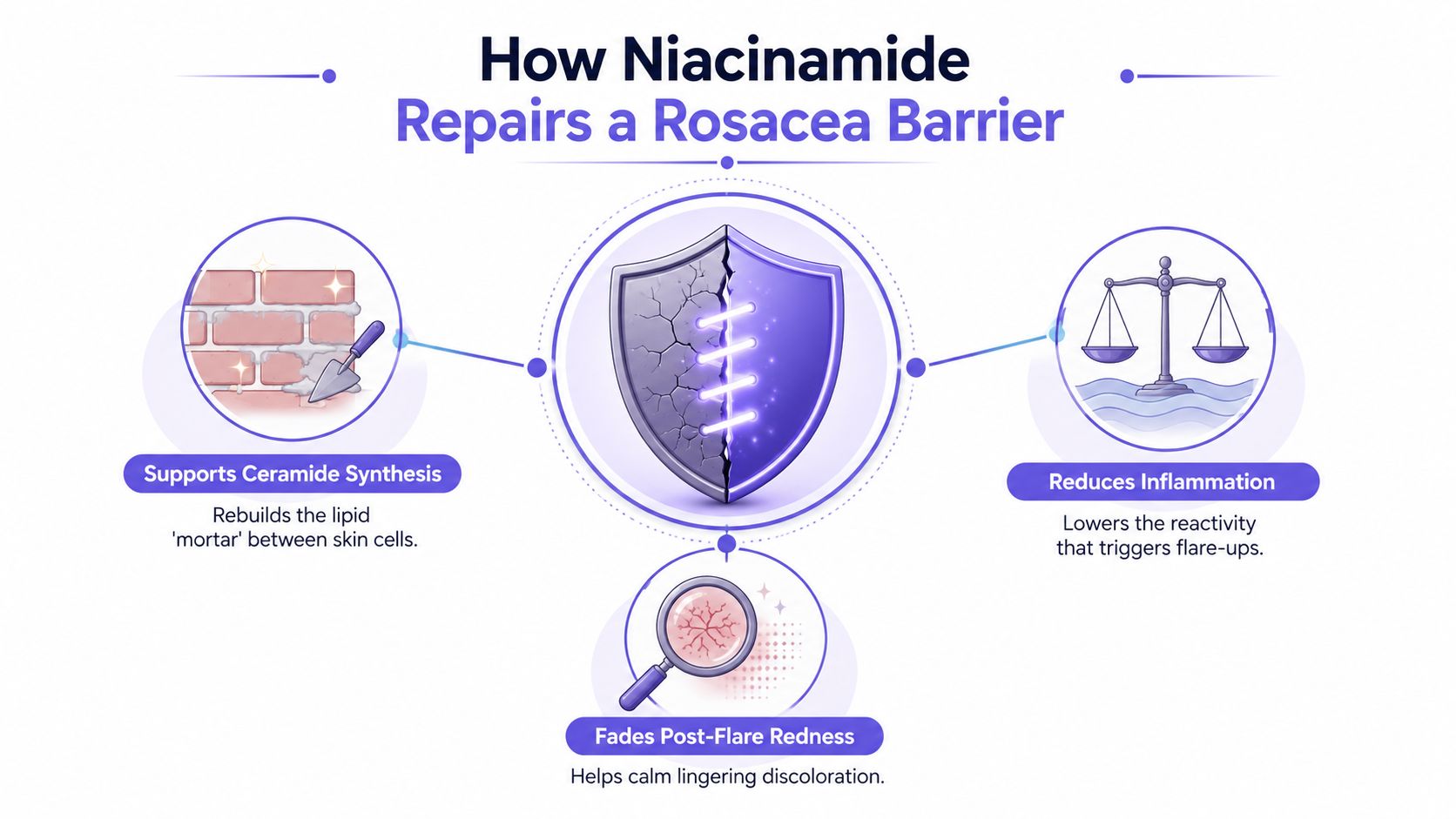
Think of the outer skin barrier as a brick wall. Skin cells are the bricks, and lipids, including ceramides, form part of the mortar holding the structure together. When that mortar is weakened, water escapes more easily and irritants can move inward. Rosacea-prone skin may then feel tight, sting after cleansing, flush quickly, or react to products that were previously comfortable.
Niacinamide, also called nicotinamide, can support this barrier in several ways. A dermatology review reports that topical niacinamide reduces transepidermal water loss and increases moisture content in the stratum corneum, the outer layer of the skin dermatology review. That mechanism matters because better water retention can make the surface less vulnerable to everyday irritation.
Three useful actions
- It supports the lipid structure. Niacinamide is associated with supporting ceramide synthesis, helping reinforce the “mortar” between skin cells. A stronger barrier may feel less prickly after washing and may hold moisturiser more effectively.
- It can moderate inflammatory activity. Rosacea involves visible redness and reactivity, and niacinamide may help quiet some of the signals involved in inflammatory skin responses. The practical aim isn't instant removal of redness. It's a calmer baseline between flares.
- It provides antioxidant support. Skin exposed to environmental stress can become more reactive. Niacinamide's antioxidant role may complement barrier care, particularly when the routine also includes gentle cleansing and daily sun protection.
What the evidence can and can't tell you
An early 2005 randomized, investigator-blind, controlled observational study followed 50 people with rosacea using a niacinamide-containing facial moisturiser twice daily for 4 weeks. The moisturiser improved the stratum corneum barrier and provided clinical benefit the PubMed study. That's relevant to barrier support, but it doesn't prove that every modern serum will suit every person.
For practical background on selecting a gentle formula, ArtNaturals' guide to gentle niacinamide for all skin is a useful general ingredient reference. Healtsy also discusses the ingredient's wider role in niacinamide skincare, though a rosacea-prone routine still needs individual testing.
The most realistic expectation is gradual support: less stinging, improved softness, and a more comfortable surface. Niacinamide isn't a cooling rescue gel for an active flare, and it won't erase visible vessels or replace medical treatment.
Finding the Right Concentration for Your Skin
Concentration is an important choice, but it isn't the only one. A 5% serum in a short, fragrance-free formula may be kinder than a 2% cream containing multiple botanical extracts, essential oils, or a drying solvent. The ingredient list and the condition of your barrier can change the practical meaning of the percentage on the label.
A 2% formula is often the sensible starting point for very reactive skin, frequent flushing, or a recently disturbed barrier. An independent dermatology summary reports that a moisturiser containing 2% niacinamide reduced blotchiness, flakiness, and bumps after 4 weeks in rosacea patients the dermatology summary. That example gives clinicians and consumers a practical concentration and timeline, although a moisturiser isn't identical to a serum.
A 5% formula can suit someone whose skin is calm enough for a more active maintenance product, particularly when the base is simple. A 10% formula may appeal to people concerned about oiliness or inflammatory bumps, but stronger isn't automatically better for flushing-prone skin. It can sting more readily in erythematotelangiectatic rosacea or when the barrier is already compromised.
| Concentration | Best Rosacea Subtype | Primary Benefit | Irritation Risk |
|---|---|---|---|
| 2% | Highly reactive or flushing-prone skin | Gentle barrier and comfort support | Lower, provided the vehicle is simple |
| 5% | Calm, mildly reactive skin or mixed concerns | Balanced maintenance support | Moderate, depending on the formula |
| 10% | Some papulopustular and oil-prone routines | More noticeable oil and texture focus | Higher for reactive or actively flushed skin |
Let the subtype guide the first choice
For papulopustular features, a moderate concentration may be attractive if the skin also tolerates other treatment. For erythematotelangiectatic or highly reactive skin, starting lower is usually more rational than choosing a high-strength serum because the label sounds more powerful. Phymatous changes and ocular symptoms need medical assessment rather than a concentration experiment.
The key trade-off is potency versus gentleness. If your barrier feels raw, start with a minimal 2% to 5% product and use it infrequently. Healtsy's guide to the best serum for sensitive skin can help you assess the wider formula, not just the niacinamide percentage.
Introducing Niacinamide the Safe Way
A careful introduction gives you useful information. Applying a serum across the whole face on the first night doesn't tell you whether the product works, because a reaction may spread before you can identify its source.
A measured introduction protocol
- Test a small area first. Apply a pea-sized amount to the inner arm or behind the ear and monitor it for 48 hours. Don't test over broken or freshly shaved skin.
- Use one facial quadrant. If the first test is quiet, apply a pea-sized amount to one cheek or another small facial area every other evening during the first week. Keep the rest of the routine unchanged.
- Expand slowly. If the test area remains comfortable, increase coverage gradually rather than moving immediately to frequent full-face use.
- Consider morning use later. Build toward nightly application by the second week only if the skin remains settled. Add a morning application after 14 days of tolerance, and keep sunscreen as the final morning step.
Read the skin's timing
Suppose you apply the serum on a Tuesday evening. On Wednesday morning, the cheek feels mildly warm but looks unchanged. That may be a reason to pause and observe rather than immediately add more product. A brief tingle that fades within 60 seconds is different from burning that persists, spreads, or becomes more intense.
True irritation may show as ongoing burning, increasing redness, swelling, hives, or a rough rash. Delayed reactions can appear later in the day, especially when the serum is combined with another new product. If symptoms continue after stopping, seek clinical advice.
A simple barrier-care guide such as Healtsy's damaged skin barrier routine can support the return to basics. During the introduction, don't add exfoliating acids, retinoids, or new masks at the same time. One change makes the result interpretable.
Ingredients That Pair Well and Ones to Avoid
Niacinamide usually works best inside a quiet routine. The companion ingredients should improve hydration or reduce friction, while the ingredients you avoid should be those that increase stinging, dryness, or vascular warmth.
| Pair Well With Niacinamide | Avoid Alongside Niacinamide |
|---|---|
| Hyaluronic acid, adds water-binding hydration without exfoliating the surface | Denatured alcohol, which may feel drying or sting compromised skin |
| Ceramides, help support the lipid barrier | High-strength retinoids during flares, which can increase irritation when the barrier is unsettled |
| Panthenol, offers conditioning and comfort support | Menthol and peppermint derivatives, which can create cooling sensations that are unsuitable for reactive skin |
| Centella asiatica, commonly used in calming formulations | Synthetic fragrance, a common source of unnecessary exposure in sensitive routines |
| Allantoin, helps make a formula feel soothing and protective | Rosemary and eucalyptus essential oils, which can be irritating for some rosacea-prone users |
| Low-percentage azelaic acid, may fit an anti-inflammatory routine when tolerated | Harsh exfoliating acids above 10%, particularly during burning or active flares |
| Mineral sunscreen filters, provide daily protection with a generally well-tolerated option | L-ascorbic acid at low pH, which may produce stinging in reactive skin |
These aren't absolute chemical prohibitions. They're practical risk controls. A person may tolerate an ingredient that another person can't, but a rosacea routine shouldn't contain several potential irritants just because each product appears reasonable alone.
Layer combinations with patience
If you use low-strength azelaic acid, don't apply it immediately after niacinamide during your first trials. Leave roughly 60 seconds between layers, and use azelaic acid only when the skin is calm enough to tolerate it. If tingling persists, separate the products by routine or alternate evenings.
Be cautious with supplements marketed around flushing, too. Products containing inositol hexanicotinate 60 softgels are not interchangeable with topical niacinamide, and supplement decisions deserve pharmacist or clinician review, especially alongside medicines.
For more guidance on combinations, Healtsy's article on layering niacinamide, vitamin C, and sunscreen provides broader routine context. With rosacea, however, the gentlest workable combination is usually the most useful one.
Layering Niacinamide in a Rosacea-Friendly Routine
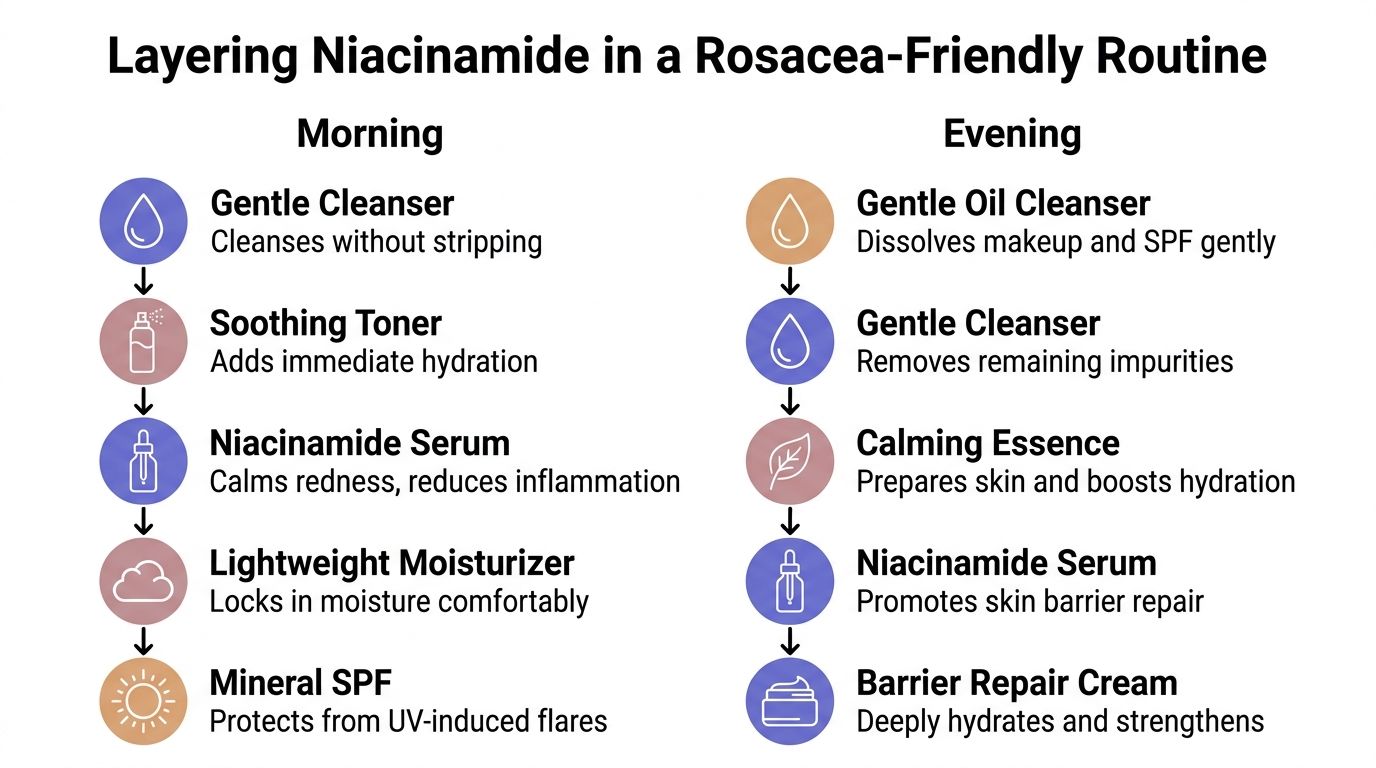
A routine should make the serum easy to evaluate and the barrier easy to protect. Niacinamide generally sits after cleansing and watery hydration, before a richer moisturiser or oil.
Morning arrangement
Start with a gentle low-pH or pH-balanced cleanser, or rinse with lukewarm water if cleansing leaves your skin tight. Follow with a hydrating toner containing humectants if you already know the product suits you. Apply niacinamide to slightly damp skin, then use a barrier moisturiser with ceramides and cholesterol.
Finish with mineral sunscreen, SPF 30 or higher, as the final protective layer. Use enough to cover the face and exposed areas, and don't introduce sunscreen and serum on the same day if your skin is extremely reactive. The aim is a routine that limits friction, dehydration, and avoidable exposure.
Evening arrangement
Use a cream or milk cleanser. If you wear resistant sunscreen or makeup, remove it gently without scrubbing, then cleanse once more only if needed. An optional hydrating essence can follow, but it isn't essential.
Apply niacinamide alone or before azelaic acid if both have already passed separate tolerance tests. Allow about 60 seconds between those layers to reduce transient tingling, then apply an occlusive moisturiser, paying particular attention to the cheeks and nose. Add facial oil only if dryness remains and the oil itself has been tolerated.
Routine safeguard: Don't apply niacinamide over a retinol on the same night during a flare window. Simplify first, then reintroduce one active at a time.
A short video can also make product order easier to visualise:
The common mistake is treating every layer as harmless because the products are individually popular. In practice, the cleanser, serum, acid, retinoid, moisturiser, and sunscreen all contribute to the total irritation load.
When Niacinamide Backfires on Reactive Skin
Niacinamide isn't automatically soothing for every face. A new serum introduced during an active flare can backfire because the skin is already sending strong irritation signals, and even a normally comfortable product may feel intolerable on that surface.
Mixed routines create another problem. Retinoids, benzoyl peroxide, and high-percentage exfoliants can compromise the barrier or increase dryness. If niacinamide arrives at the same time, you may see burning or redness without knowing which product caused it. The vehicle can also be responsible. Fragrance, botanical extracts, solvents, or an overly active formula may create intolerance even when the niacinamide itself isn't the issue.
Separate flushing from irritation
Some people experience transient warmth or flushing after application. Niacin, a different form of vitamin B3, is associated with vasodilation, while niacinamide doesn't behave identically. Still, a reaction that repeatedly produces warmth, redness, hives, or burning deserves attention rather than dismissal.
Use this checklist when the serum seems to worsen your skin:
- Timing: Increased redness or stinging that appears 20 to 30 minutes after application is a reason to stop and assess the full formula.
- Routine changes: If the flare began after adding another product, remove the newest additions before blaming niacinamide.
- Persistence: Ongoing burning, swelling, or hives isn't a routine adjustment signal.
- Lack of progress: If redness or texture doesn't improve after consistent use for 8 to 12 weeks, reassess the product and diagnosis rather than escalating concentration.
The clinical evidence is promising but limited. The rosacea studies available here are small or short-term, and the populations and formulations aren't identical to every serum sold today. The 2006 multicenter NICOS cohort enrolled 198 patients with acne vulgaris and/or rosacea using oral nicotinamide with zinc and copper. In the rosacea subgroup, 75% reported their appearance was moderately or much better by 8 weeks, while 55% reported at least moderate lesion reduction after 4 weeks the NICOS cohort study. Those findings show measurable short-term improvement in an oral combination, not proof that a topical 10% serum will rescue a flare.
For a broader discussion of irritation from active ingredients, Healtsy's guidance on vitamin C and sensitive skin is relevant. My practical conclusion is simple: niacinamide is often better introduced once the skin is calm.
Your Next Step Toward Calmer Skin
Start with the current state of your face, not the product label. If your skin is actively burning, swollen, covered with a new rash, or affected by eye symptoms, pause experimentation and speak with a qualified clinician. A serum can support a routine, but it isn't a substitute for diagnosing the pattern of rosacea.
If your barrier feels reasonably settled, use this decision checklist:
- Choose a restrained formula: Look for 2% to 5% niacinamide with minimal supporting ingredients, no fragrance, and no unnecessary essential oils.
- Patch test carefully: Test behind the ear or on the inner arm for 48 hours, then apply a small amount to one facial area.
- Track the response: Keep a simple journal of warmth, burning, flushing, bumps, dryness, and the other products used that day.
- Increase gradually: Move from occasional use toward nightly application only when the skin remains comfortable.
- Review the outcome: If there's no improvement after 8 consistent weeks, or if symptoms worsen, stop treating the serum as the answer.
A jawline test for 5 nights can be particularly practical because it exposes the skin to repeated use while limiting the area involved. Keep the rest of your routine stable, and don't judge success by one calm morning. Look for a more comfortable baseline, less stinging during cleansing, and fewer product-related setbacks.
I'm certain this method will give you a clearer answer than applying a strong serum to the whole face during a flare. Based on my 16 years in the sector, I believe the best niacinamide decision is rarely the most aggressive one. It's the formula your skin can tolerate consistently, used as maintenance support while medical care addresses persistent, inflammatory, or ocular rosacea.
Healtsy offers skincare, sunscreen, pharmacy items, and targeted products for concerns including sensitive skin and rosacea, with product information and verified customer reviews to help you compare routine options. Visit Healtsy to explore gentle formulas and build your next routine around tolerance rather than trial and error.