


Isdin Fusion Water: The Complete Guide to SPF 50
You've probably encountered ISDIN Fusion Water in a Spanish pharmacy, a dermatologist's office, or a travel skincare routine. The familiar question comes next: is this actually a better daily sunscreen, or is it just another lightweight SPF 50 with attractive packaging?
After 16 years reviewing skincare and pharmacy products, I believe the useful answer starts with the exact variant and the label, not the popularity of the product family. Fusion Water can be a very comfortable choice for daily facial protection, but “ISDIN Fusion Water” doesn't identify just one formula. Climate, skin type, finish, tint, reapplication habits, and water exposure all matter.
What Isdin Fusion Water Actually Is and Where It Came From
ISDIN was founded in Barcelona in 1975, and the company built its reputation around dermatological skincare, including facial photoprotection, pediatric care, and products designed for post-procedure routines. The brand's own history places a major commercial milestone in 2015, when it launched Fusion Water as a daily facial photoprotector intended to make high-SPF wear feel lighter and easier to use. You can read the brand's background on its official ISDIN company page.
That origin explains the product's central idea. Fusion Water isn't a traditional thick sunscreen cream. It's a low-viscosity, water-phased facial fluid designed for people who want SPF 50 without the heavier, more occlusive feel associated with some classic sun creams. ISDIN describes the format as ultralight and suitable for daily use, with a finish intended to sit comfortably on the face.
The line has since expanded beyond the original clear fluid. Regional listings include Fusion Water SPF 50, Fusion Water COLOR, Fusion Water MAGIC, Fusion Water LIGHT, Fusion Water GLOW, and pediatric versions, although names, packaging, and ingredient sets can vary by country. That's why a review that treats every tube as one interchangeable product can mislead international buyers.
What the water-like format means
Think of Fusion Water as a facial sunscreen fluid rather than a moisturizer with SPF. It spreads quickly, leaves relatively little residual film, and generally makes more sense for people who dislike a greasy sensation or visible heaviness during the day.
That texture can work particularly well for:
It isn't automatically the best choice for every face. Very dry or barrier-compromised skin may prefer a more emollient sunscreen vehicle, especially if moisturizer alone doesn't prevent tightness. The “water” name describes the sensory format, not a guarantee that every skin type will find it nourishing.
Choose Fusion Water for the feel you can apply generously and reapply, not simply because “ultralight” sounds more advanced.
The original family is built around SPF 50 and UVA/UVB protection, while later variants add tint, different cosmetic finishes, or different positioning. If you're comparing availability outside Europe, check the exact product name, packaging language, and ingredient list before ordering. A useful starting point for the classic format is the listing below.
Reading the Label on Isdin Fusion Water SPF 50
A pharmacist reads sunscreen labels in layers. First comes the protection system. Then comes the vehicle, the ingredients that create the feel, and finally the details that determine whether someone will enjoy wearing it every morning.
The classic ISDIN Fusion Water SPF 50 uses a multi-filter system that includes octocrylene, avobenzone, ethylhexyl salicylate, phenylbenzimidazole sulfonic acid, polysilicone-15, and bis-ethylhexyloxyphenol methoxyphenyl triazine. The official regional product page provides the Fusion Water SPF 50 ingredient and product information.
Each filter contributes differently to the overall system. Avobenzone is associated with UVA coverage, while ethylhexyl salicylate and phenylbenzimidazole sulfonic acid contribute to UVB protection. Octocrylene and polysilicone-15 support the broader filter blend, and bis-ethylhexyloxyphenol methoxyphenyl triazine is a photostable filter used in modern sunscreen formulation. The practical point is not to memorize every chemical name. It's to understand that the formula uses several filters together rather than relying on one ingredient to do everything.
The vehicle matters as much as the filters
The sunscreen's water-phased character comes from the solvent and texture system around those filters. Water and alcohol denat. contribute to the fast-spreading, quick-drying sensation many users associate with Fusion Water. That can feel refreshing in heat, but people with easily irritated or very dry skin may prefer to test the product carefully rather than assuming a fluid will be soothing.
Silica and polymethyl methacrylate can contribute to a smoother, softer-focus finish and help reduce the impression of surface oil. Tocopheryl acetate provides antioxidant support within the cosmetic formula. The overall result is a product designed to leave a lighter-feeling film than a rich cream sunscreen.
| Ingredient | Function |
|---|---|
| Octocrylene | Part of the UV filter system and supporting photostability strategy |
| Avobenzone | Contributes to UVA protection |
| Ethylhexyl salicylate | Contributes to UVB protection within the filter blend |
| Phenylbenzimidazole sulfonic acid | Water-soluble UVB filter |
| Polysilicone-15 | Supporting UV filter in the multi-filter system |
| Bis-ethylhexyloxyphenol methoxyphenyl triazine | Photostable broad-spectrum filter |
| Water and alcohol denat. | Solvent phase associated with the fluid, fast-drying feel |
| Silica and polymethyl methacrylate | Texture and soft-focus finish support |
| Tocopheryl acetate | Antioxidant support |
For a plain-language refresher on the protection terms, this guide to the difference between UVA and UVB is useful. SPF mainly communicates the product's tested sunburn protection performance, while UVA protection matters for a different part of the exposure picture. A high SPF doesn't turn sunscreen into an all-day shield, so application quantity and reapplication remain important.
The label also deserves attention because regional formulas can differ. Don't assume that a product called Fusion Water COLOR or Fusion Water MAGIC has exactly the same ingredient list as the classic clear version. For fragrance sensitivity, acne-prone skin, pregnancy questions, or a known reaction to a particular filter, read the current carton and tube for the market where you're buying.
Every Fusion Water Variant Explained and Who Each One Is For
The simplest way to choose this range is to stop searching for “the best Fusion Water” and identify the finish and use case you actually need. The products share the Fusion Water concept, but the variants are not interchangeable.
| Variant | Finish | Best For |
|---|---|---|
| Classic Fusion Water SPF 50 | Clear, lightweight facial fluid | Combination skin, oily skin, and everyday humid-weather wear |
| Fusion Water COLOR SPF 50 | Tinted finish with cosmetic coverage | Buyers who want a more even-looking complexion with their daily SPF |
| Fusion Water MAGIC SPF 50 | Color-adapting cosmetic finish | People who prefer a flexible tint for light to medium complexions |
| Fusion Water LIGHT SPF 50 | Lighter, more matte-oriented finish | Very oily skin and routines where shine control matters |
| Fusion Water GLOW SPF 50 | Radiant cosmetic finish | Dull-looking skin and people who prefer luminosity |
| ISDIN Pediatrics Fusion Water SPF 50 | Pediatric facial and exposed-skin format | Families shopping for the pediatric version rather than an adult facial SKU |
Classic for a clear daily layer
The classic Fusion Water SPF 50 is the reference point for the range. It suits someone who wants a clear, thin-feeling sunscreen and doesn't need tint or radiance from the product itself. In a humid climate, this is often the most straightforward place to start, particularly if richer sunscreens make the face feel coated.
It may not be enough on its own for very dry skin. A lightweight sunscreen can still work over a well-absorbed moisturizer, but the moisturizer needs to provide the comfort the sunscreen vehicle doesn't.
COLOR and MAGIC for cosmetic convenience
COLOR is the more direct choice when you want a tinted finish and some visual evening of the complexion. It can be useful for someone who dislikes applying foundation over sunscreen, although tint intensity and undertone suitability are personal and should be checked against the exact regional listing.
MAGIC is positioned as a color-adapting option. That makes it appealing when you want a less obvious shade decision, but “universal” shouldn't be interpreted as a perfect match for every complexion. Color-adapting products can still look different depending on skin tone, application amount, and the light in which you assess the finish.
LIGHT, GLOW, and Pediatrics
LIGHT is the variant to investigate when a matte or more oil-control-oriented finish matters most. GLOW points in the opposite cosmetic direction, with a more radiant appearance for people who find flat matte finishes tiring or aging on the skin.
The pediatric version should be treated as its own product, not as the adult formula in smaller packaging. Pediatric positioning, ingredient selection, and use directions can differ by market. Parents should follow the current label and choose the version intended for the child's age and exposure pattern.
The exact name on the front of the package matters. “Fusion Water” is a family name, not a complete ingredient or performance specification.
For international buyers, the safest comparison method is to record three details before checkout: the full variant name, the SPF marking, and the current ingredient list. That small habit prevents a common mistake, ordering a tinted or pediatric product when the intention was to buy the classic clear fluid.
How to Apply and Layer Isdin Fusion Water in a Real Routine
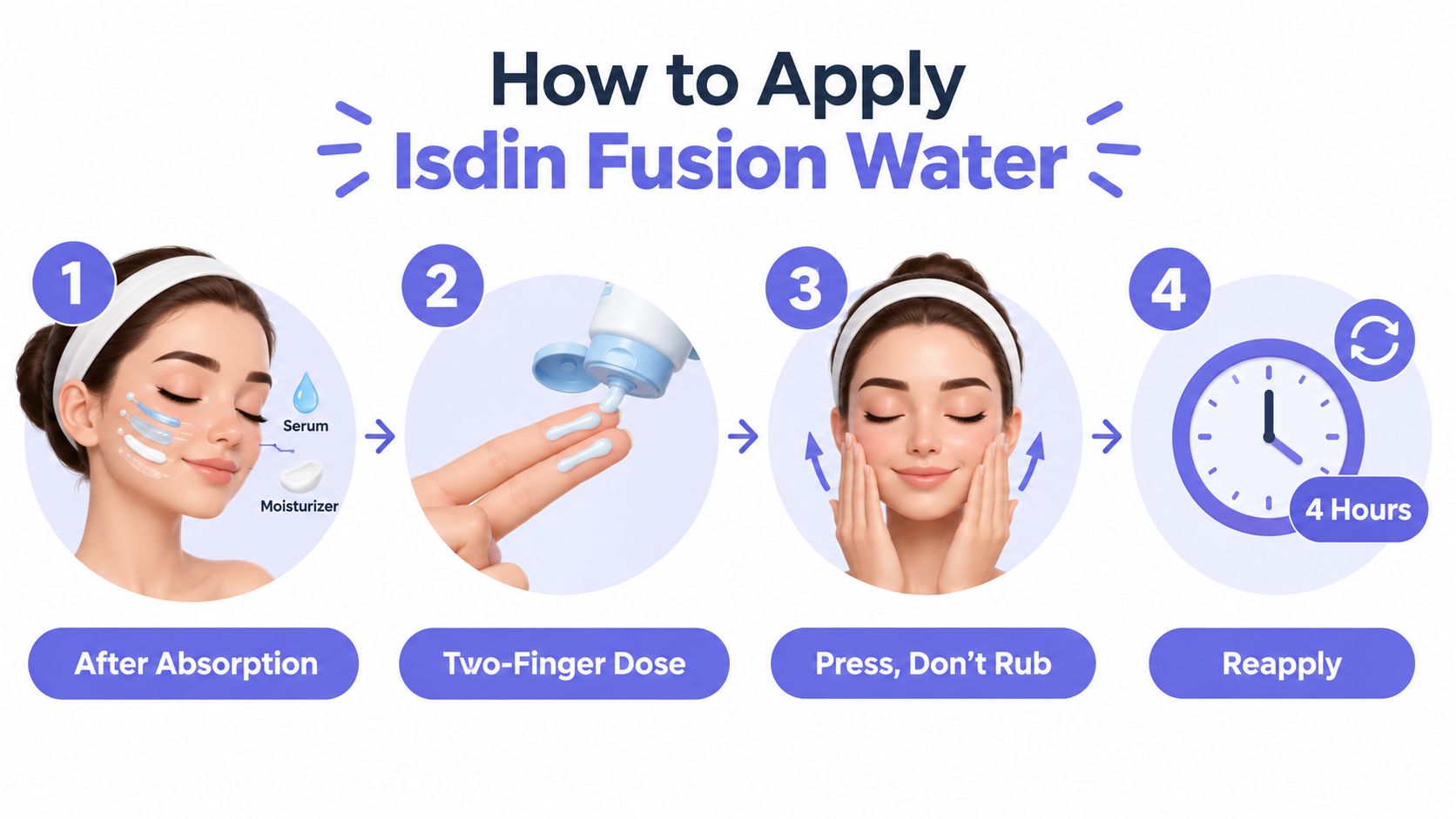
Start with clean skin, then apply serum and moisturizer if you use them. Allow those layers to settle before sunscreen. A fluid formula can pill when it is spread over wet skincare, so waiting for absorption is more useful than adding more rubbing.
Use a two-finger-length dose for the face and neck as a practical measuring method. Apply it in sections, using gentle pressing and spreading motions rather than aggressive rubbing. The aim is to create an even film without disturbing the layers underneath.
Layering without pilling
Vitamin C, niacinamide, and azelaic acid can usually sit beneath sunscreen when the products are compatible with your skin and have absorbed properly. Retinol belongs in an evening routine for many people, so it doesn't need to compete with the morning sunscreen layers.
Silicone-heavy primers can sometimes cause rolling or pilling over a fluid sunscreen. If that happens, reduce the amount of skincare beneath it, give each layer more time to settle, or apply makeup by pressing rather than dragging. A tinted Fusion Water may also reduce the number of complexion products needed.
For a practical face-sunscreen routine, see this guide on how to apply sunscreen on your face.
Reapplication depends on your day. If you're outdoors, sweating, swimming, wiping your face, or experiencing mask friction, the sunscreen film can be disturbed and needs attention. A morning application may be adequate for a mostly indoor day with limited exposure, but it shouldn't be treated as permanent protection.
A simple routine looks like this:
- Morning: Apply skincare, let it absorb, then apply the full sunscreen dose.
- Before extended outdoor time: Check that the first layer is even and hasn't rubbed away.
- After heavy sweating or water exposure: Reapply once the skin can be dried and covered evenly.
- During prolonged daylight exposure: Reapply according to the conditions and the product's current label.
Here's a short visual guide to the application process:
Fusion Water's lightweight feel is helpful here because people are more likely to tolerate another application than they are with a thick, sticky product. It still won't make swimming or intense sweating irrelevant. If water resistance is your main requirement, choose a product whose current label clearly supports that use.
How Fusion Water Compares to Other SPF 50 Facial Sunscreens
Comparison becomes clearer when you separate four questions: how the formula feels, what the label promises, how it behaves around water, and whether your skin can tolerate the vehicle.
Fusion Water is strongest as a texture-first daily facial sunscreen. Its official positioning emphasizes an ultralight, water-phased format with SPF 50 and UVA/UVB protection. That makes it attractive for people who avoid sunscreen because they dislike heaviness, shine, or a strongly visible film.
Eryfotona Actinica occupies a different position within the ISDIN range. ISDIN's own comparison identifies Eryfotona Actinica as SPF 50+ and water resistant, while Fusion Water MAGIC is listed as broad spectrum, SPF 40, and not water resistant on that comparison page. The lesson is important: even products from one company shouldn't be treated as interchangeable. Read the exact product page for the exact market. See the ISDIN comparison of Fusion Water MAGIC and Eryfotona Actinica.
La Roche-Posay Anthelios UVMune 400 Hydrating Cream, Heliocare 360 Gel Oil-Free, and Bioderma Photoderm MAX Aquafluide are reasonable names to place on a shopping shortlist, but their current regional labels should be reviewed before making a direct technical comparison. Packaging, fragrance statements, filter systems, water-resistance claims, and cosmetic finishes can vary between markets and reformulations.
| Product | Filter system | Finish | Water resistance | Best for | Price band |
|---|---|---|---|---|---|
| ISDIN Fusion Water SPF 50 | Multi-filter system, check the regional INCI | Lightweight fluid | Check the exact regional label | Daily facial wear and humid-weather comfort | Varies by market and retailer |
| ISDIN Eryfotona Actinica | Check the current product label | Different ISDIN facial format | Listed by ISDIN as water resistant on its comparison page | Buyers prioritizing a more durable protection profile | Varies by market and retailer |
| La Roche-Posay Anthelios UVMune 400 Hydrating Cream | Check the current regional INCI | Hydrating cream format | Check the exact regional label | People who prefer a more nourishing texture | Varies by market and retailer |
| Heliocare 360 Gel Oil-Free | Check the current regional INCI | Gel-oriented format | Check the exact regional label | Buyers comparing oil-free facial textures | Varies by market and retailer |
| Bioderma Photoderm MAX Aquafluide | Check the current regional INCI | Aquafluid format | Check the exact regional label | People comparing fluid European facial SPFs | Varies by market and retailer |
For another retailer's selection and a useful comparison point, you can browse lo la beauty skincare picks, particularly if you're considering a tinted aquafluid format.
If texture is the reason you skip sunscreen, start with Fusion Water. If water exposure, very dry skin, or a specific dermatologist-led requirement dominates the decision, shortlist other formats first.
The right comparison is personal. A fluid that disappears on combination skin may feel insufficiently comforting on dry skin. A more durable product may be the more sensible choice for a beach day, even if it feels less elegant under makeup. This guide to choosing, applying, and reapplying SPF 50 can help organize that decision.
Buying Original Isdin Fusion Water From Outside Europe
International buyers often worry about three things: whether the tube is genuine, whether the formula matches the European version, and whether the final cost will change after checkout. Those concerns are reasonable because sunscreen packaging and names can vary between countries.
Start with the product identity. Before opening the parcel, compare the full name, SPF marking, packaging language, manufacturer details, lot code, and expiry or period-after-opening information with the product listing. An EAN or barcode can support an authenticity check, but it shouldn't be treated as proof by itself. A copied barcode can still appear on an illegitimate listing.
A sensible parcel check
- Check the seal and carton: Look for damage, leakage, unexpected relabelling, or packaging that differs materially from the listing.
- Match the variant: Confirm whether you received Classic, COLOR, MAGIC, LIGHT, GLOW, or a pediatric product.
- Inspect the lot information: Make sure the lot code is present and legible.
- Review the INCI: Compare the ingredient list with the current product information for the market where it was purchased.
- Keep the documentation: Save the order confirmation, invoice, and shipping record until you're satisfied with the product.
Grey-market marketplace listings can create uncertainty around storage, age, regional formulation, and seller accountability. That doesn't mean every marketplace product is counterfeit, but it does mean the buyer has less control over the supply chain. An established European pharmacy or parapharmacy retailer should be able to identify the product supplied, provide an invoice, and answer basic questions about shipping and returns.
Delivery to the United States, United Kingdom, Canada, Australia, Singapore, and Gulf destinations depends on the carrier, destination, customs processing, and the service selected. Transit can take longer when a parcel is held for inspection, so don't order at the last moment before a trip.
Duties and taxes also depend on the destination and the retailer's shipping arrangement. Check whether the checkout price includes import charges, whether the carrier may collect them on delivery, and what documents accompany the order. Those details matter more than a low headline price.
The product listing should state the item supplied, the quantity, the seller's contact details, and the shipping terms. If those basics are missing, I'd choose a different seller rather than trying to save a small amount on a product applied to the face every day.
My Honest Take on Who Should Buy Isdin Fusion Water
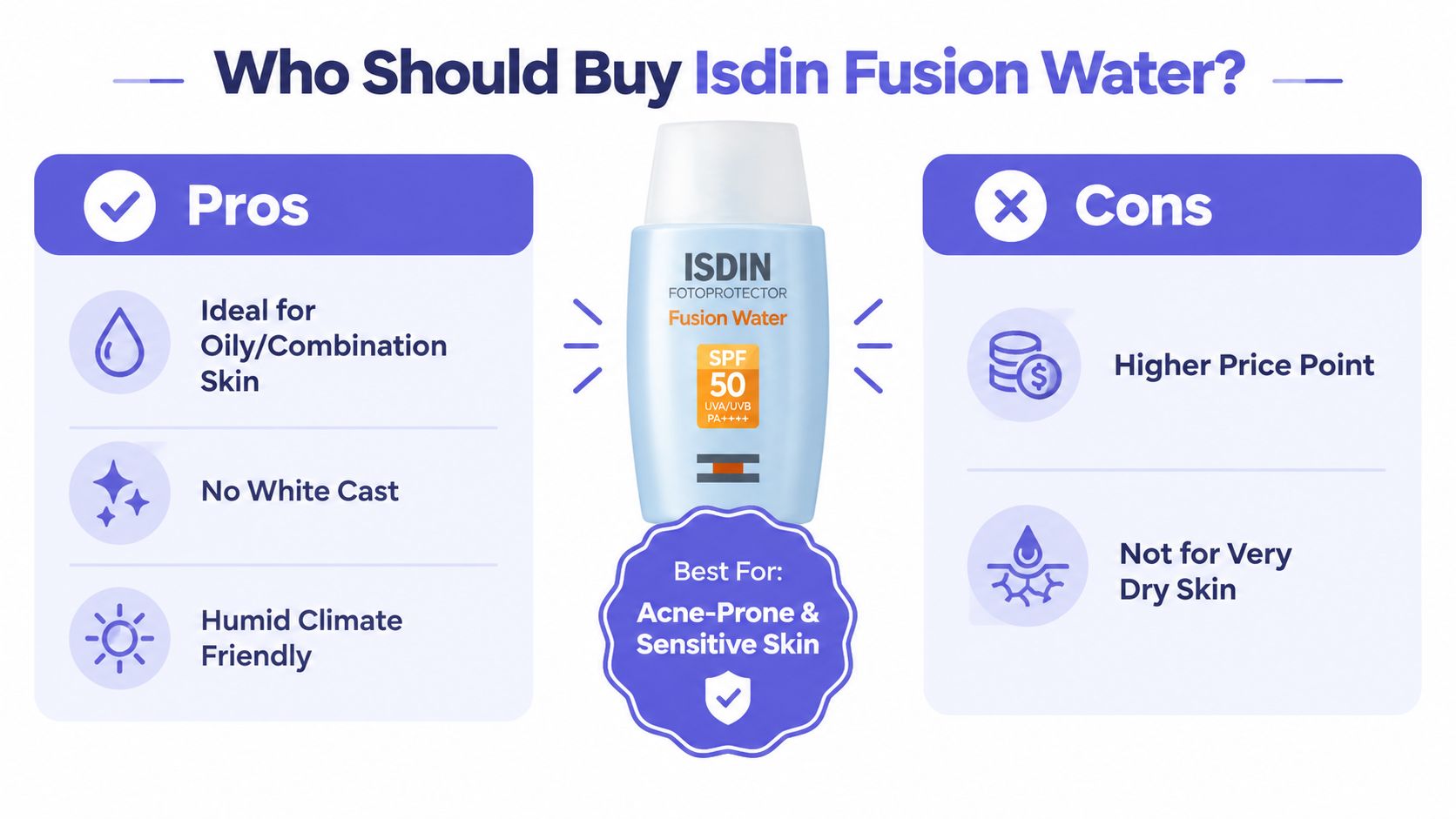
I believe ISDIN Fusion Water makes the most sense for someone with combination or oily skin who wants a lightweight facial SPF 50 for everyday wear, particularly in a humid climate. It's also a sensible format for people who dislike a white-looking finish, prefer fluid textures, or want sunscreen that can sit beneath makeup without feeling like a heavy cream.
The classic version is the clearest starting point. Choose COLOR or MAGIC if tint matters, LIGHT if shine control is your priority, GLOW if you prefer a more radiant finish, and the pediatric version when shopping for a child-specific product. Always confirm the current regional label because the family includes different formulas and use cases.
I'd look elsewhere if your skin needs a rich emollient base, if you're choosing primarily for swimming or intense sweating, or if your dermatologist has recommended a specific medical-grade alternative. I also wouldn't select any Fusion Water variant solely because of broad marketing language around blue light, pollution, infrared, or free-radical defense. The consistently clear foundation is SPF 50, UVA/UVB protection, and a light facial texture. Extra claims should be assessed against the exact product and market label.
For readers managing blemish-prone routines, this guide to sunscreens for acne-prone skin offers useful context. Price differences between European and US or UK listings can reflect regional pharmacy margins, shipping, taxes, and distribution arrangements. They aren't, by themselves, proof that one tube is authentic and another isn't.
Find your Fusion Water at Healtsy
Healtsy offers European pharmacy and parapharmacy products sourced through authorised distribution, with product information reviewed by a pharmacist and shipping from Europe to customers in multiple international markets. Check the current ISDIN Fusion Water variant, ingredient details, availability, and delivery terms before ordering.
Shop Healtsy