


Mineral Sunscreen Ingredients: The Complete Guide
The advice you hear most about sun protection is that mineral is the safe choice because it sits on your skin and bounces UV away like a mirror. I believe that sentence does more harm than good. Reflection is a small part of the story, and the word mineral on a front label tells you almost nothing about how much protection you're getting.
This is the complete guide to mineral sunscreen ingredients that I wish every reader had before picking up a tube: what zinc oxide and titanium dioxide really do, how particle size and coatings change the finish, why sprays and powders carry a different risk, and how to read a label in a shop in under a minute. I'm certain it will solve the confusion that sends many shoppers home with the wrong formula for their skin.
The core idea is simple. A filter name is an identity, not a performance score. Zinc oxide isn't automatically better than titanium dioxide, a 25% formula isn't automatically stronger than a 12% one, and mineral isn't a synonym for broad spectrum.
Zinc Oxide and Titanium Dioxide at a Glance
The word mineral identifies the filter, not the performance of the finished sunscreen. The two mineral filters are zinc oxide and titanium dioxide, both inorganic ingredients. The US Food and Drug Administration proposed both as generally recognized as safe and effective at concentrations up to 25% (FDA proposal on sunscreen active ingredients). Their coverage differs: zinc oxide extends further into UVA, while titanium dioxide is strongest across UVB and shorter UVA wavelengths.
| Filter | UV coverage | Typical formulation role |
|---|---|---|
| Zinc oxide | Broader, extends further into UVA | Film-forming filter, common in tinted and sensitive-skin formulas |
| Titanium dioxide | Especially efficient in UVB and shorter UVA | Often surface-coated to improve feel and stability |
| Both combined | Aims for full UVB and UVA coverage | Common in tinted and high-SPF formulas to balance coverage |
Why the pair covers more than either alone
Read the coverage column as a description of each filter's role. Zinc oxide reaches further into UVA wavelengths associated with aging. Titanium dioxide performs particularly well in UVB and shorter UVA, and is often surface-coated to help it disperse and feel smoother on skin. A formula combining the two uses their different coverage ranges; that choice alone does not establish how well the finished product protects.
Mineral filters are common in sunscreens. In 2025, 43% of 2,217 sunscreen products analyzed in the United States used zinc oxide or titanium dioxide as active ingredients, according to the Environmental Working Group's annual sunscreen report. In Australia, reporting on a 2025 study identified 143 products on the Therapeutic Goods Administration register whose only declared active ingredients were zinc oxide or titanium dioxide, according to reporting on the study.
Neither the filter name nor its concentration alone tells you how a particular sunscreen performs. The 25% figure is a proposed concentration limit, not a measure of superiority or proof that one formula is safer than another. Judge the finished product by its labelled SPF and broad-spectrum claim, not by the mineral label alone.
The counter rule I repeat most: the ingredient list tells you what went into the tube. Only the SPF and broad-spectrum claim tell you what was measured on skin.
How Mineral Filters Block UV on Your Skin
The picture many carry is a layer of tiny mirrors. Mineral sunscreen, the story goes, sits on the surface and reflects sunlight away, while chemical filters absorb it. That contrast feels clean, and it's wrong.
A 2025 explanation from the University of New South Wales puts the correction plainly: both inorganic mineral filters and organic filters primarily absorb UV energy, with reflection only part of the mechanism. Scattering does the rest of the work, deflecting and spreading incoming light in many directions so less of it reaches living skin.
The diagram below shows what that layer looks like on the surface.
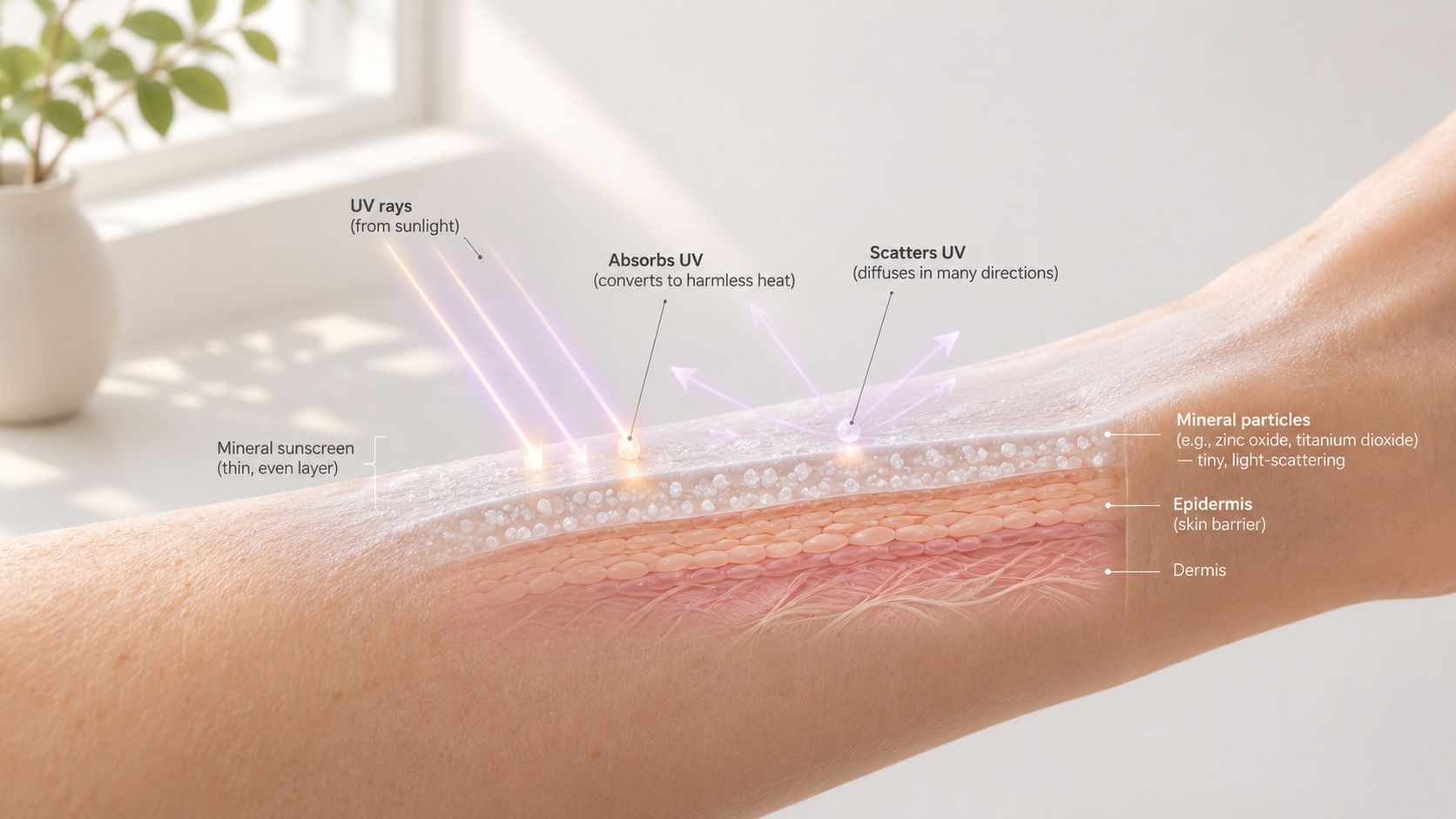
Think of a fine frosted film on a window. The protection comes from the film itself, not from the glass underneath, and the film only works where it's continuous. A mineral filter behaves the same way. The particles absorb and scatter within the layer they form, and any break in that layer is a break in the protection.
That's why application matters more than the percentage printed on the front. A thin or patchy layer leaves gaps that no ingredient list can reveal, so two people using the same tube can end up with very different real-world protection. Poor dispersion in the base, or clumps that never break down as you rub, produce the same problem before the product even reaches your skin.
If you want to see how a film behaves when it's spread rather than dabbed, this walkthrough is worth three minutes.
Then read the two terms that describe the testing. The FDA explains that SPF testing measures the UV exposure needed to cause sunburn with sunscreen compared with exposure without sunscreen, while broad-spectrum labeling requires protection against both UVA and UVB radiation, as set out in the FDA's guidance on how sunscreen protects your skin.
So the filter tells you what's in the film, and the SPF plus broad-spectrum claim tells you how well that film was tested. Neither one tells you the other.
Particle Size, Nano and What the Label Really Says
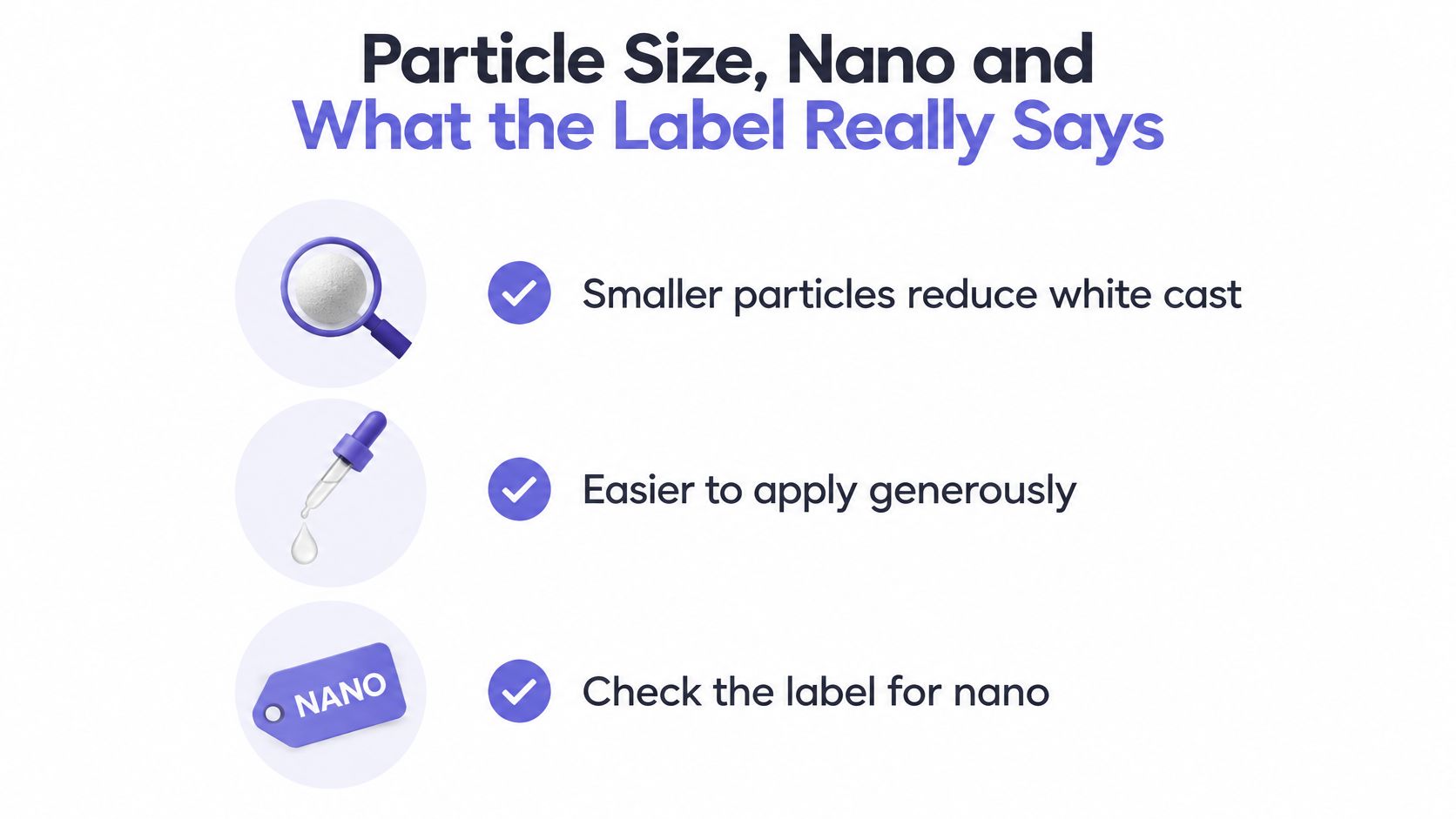
Does nano make a sunscreen unsafe, or better? It's the question readers ask most, and the honest answer is neither. Particle size is an engineering choice with trade-offs, and the label is where those trade-offs become visible if you know which words to look for.
Smaller particles reduce the visible white cast that conventional zinc oxide and titanium dioxide leave behind. That sounds cosmetic, and it matters clinically: a product people are willing to apply generously and evenly protects them better than a chalky one they ration. The appearance problem and the protection problem are the same problem.
How the EU makes nano visible on a label
In the European Union, nano isn't hidden. The European Commission's cosmetics legislation pages state that nanomaterials must be identified in the ingredient list by the word "nano" in brackets after the substance name, for example, "titanium dioxide (nano)." The Commission also lists four UV filters authorised as nanomaterials in cosmetics: methylene bis-benzotriazolyl tetramethylbutylphenol, titanium dioxide, zinc oxide and tris-biphenyl triazine.
What the marker does not tell you is the SPF. It describes the form and scale of the material, nothing more. Plenty of mineral products use non-nano forms, larger coated particles, or a mix designed to balance appearance against protection, and none of those choices is safer or weaker.
Concentration has limits too. A 2025 preprint study evaluated mineral sunscreen formulations with zinc oxide concentrations ranging from 0% to 30% when measuring visible white cast, according to the study authors. The lesson for a shopper is that a higher number on the tube doesn't automatically settle how the product looks on your face, in daylight, on your skin tone.
A label checklist you can run in the shop
- Find the filter name first. Zinc oxide, titanium dioxide, or both. If neither appears, it isn't a mineral formula whatever the front of the pack suggests.
- Check for the nano marker. A bracketed "(nano)" tells you the form, and that's all it tells you.
- Note a declared non-nano form. Some brands state it, and if the distinction matters to you, that's where to find it.
- Judge the finish yourself, in daylight. Swatch the jawline, walk to a window, and look at it in real light rather than shop lighting.
- Confirm the SPF and broad-spectrum claim. This is the only part of the pack that reports a measurement rather than an ingredient.
Tint, Dispersion and Photostability in Real Formulas
A tinted mineral sunscreen in the US DailyMed database lists 8% titanium dioxide and 3.8% zinc oxide, according to the National Library of Medicine. It pairs two mineral filters, with titanium dioxide as the larger share. The figures describe this formula, not a standard ratio for tinted sunscreens.
What tint does
Iron oxide pigments help mask the white cast and can make uneven tone look more even. They are a trade-off, not a guaranteed color match: a tint may shift on some complexions or look flatter indoors. Check the shade on your jawline in daylight, rather than judging it from a hand swatch.
Dispersion, coating and photostability
A well-dispersed formula spreads mineral filters evenly. Clumps can leave gaps in the sunscreen film, so the filter identity alone does not tell you how well the finished product applies. Coatings help particles mix with the surrounding emollients and polymers, and can reduce photocatalytic activity that affects stability, whitening and texture. Mineral filters also hold up in sunlight without the breakdown that some organic filters undergo, a feature that can suit reactive skin.
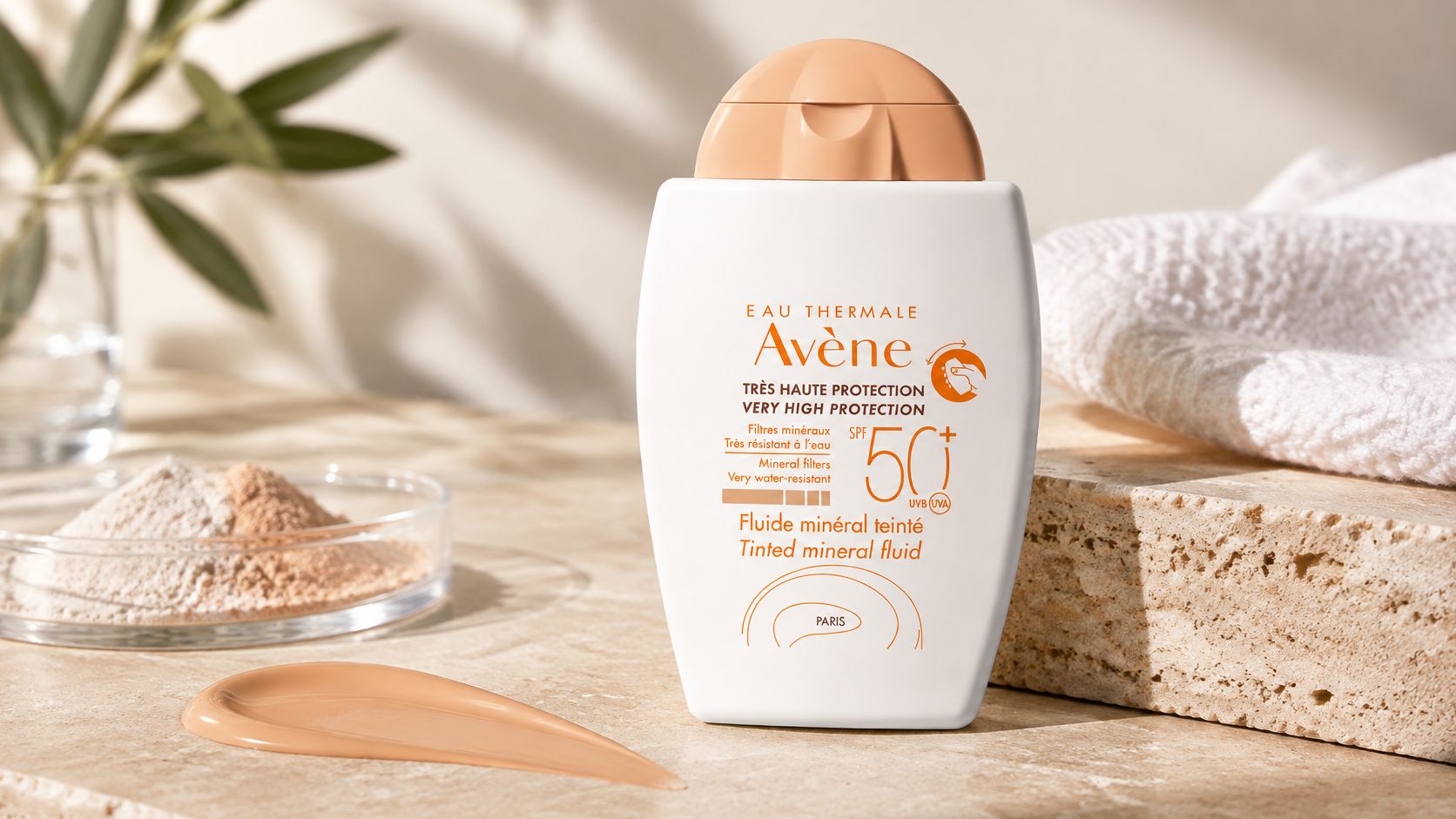
Two European formulas show different approaches. Avène Solar Mineral SPF50+ Fluid w/ Color is a tinted fluid with very high protection, no chemical filters and no perfume. It is photostable and very water resistant, and is indicated for skin intolerant or allergic to chemical filters and fragrance. Heliocare 360º Mineral Tolerance Fluid SPF 50 uses mineral-only filters in a light texture designed for an invisible finish, including on dark skin tones. It is aimed at sensitive, reactive and intolerant skin.
Product Avène Solar Mineral SPF50+ Fluid w/ Color — 40 ml Product Heliocare 360º Mineral Tolerance Fluid SPF 50 — 50 mlA tinted formula you enjoy wearing is more likely to be reapplied. An elegant untinted one you avoid because of the cast is not. Choose the one you will reach for at 2pm.
For more options, the Finding Favourites tinted sunscreen roundup gathers affordable tinted formulas. If you are comparing a tinted moisturiser with a dedicated sunscreen, this comparison of tinted moisturizers with SPF for different skin types explains the differences.
Sprays, Powders and Why Inhalation Changes the Risk
Skin and lungs are different exposure routes, and that distinction decides more than the ingredient name. The European Scientific Committee on Consumer Safety concluded that specified nano and non-nano forms of zinc oxide can be used as UV filters at concentrations up to 25% without an identified risk from dermal application, provided the formulation doesn't create inhalation exposure, as recorded in the EU authorisation for zinc oxide. The same logic runs through the titanium dioxide assessment, which found the specified nanoparticles safe on healthy, intact or sunburnt skin up to 25% but did not support nano titanium dioxide in sprayable products where consumer lung exposure could occur, per the EU entry for titanium dioxide.
In plain terms, a rubbed-in cream keeps the particles in the film. An aerosol or a loose powder puts them in the air. So:
- Choose a cream, fluid or stick for the face, where the particles stay in the layer you've spread.
- Spray into your palms, then rub in. Never spray directly at the face or near the mouth, and don't breathe in the mist.
- Keep loose powder formats away from children and out of the air you're breathing while you apply them.
- Don't read non-nano as higher SPF. It describes particle form, not measured protection.
If you use aerosols anywhere on the body, the facts about aerosol sunscreen worth knowing before you buy are a fair primer. Near a child's face, when you're unsure, use a cream or a stick. That single habit removes the whole question.
Environmental Concerns and Mineral Filters
A mineral label identifies the UV filters, not how much product reaches the water or how well the sunscreen stays on your skin. Zinc oxide and titanium dioxide can rinse off, so application and water exposure matter.
Give the formula time to form a film before swimming. Water contact can disrupt or remove that film, reducing the amount of sunscreen left on the skin. Apply the amount stated on the label; adding more before swimming does not prevent the film from washing away.
- Apply well before swimming to let the sunscreen form a film.
- Check the nano marker if you prefer to avoid nanomaterials, and choose a formula labelled non-nano.
- Cover up as well. Clothing, a hat and shade reduce how much sunscreen you need.
No label phrase alone establishes that a sunscreen is harmless to ecosystems. Treat filter identity as one part of the choice, alongside how the formula behaves on skin and whether you can apply it as directed.
Regulatory Status in the US, EU and Beyond
The word mineral on the front of the tube does not set the dose, the nano wording, or whether a spray is allowed. Regulators do that. The United States and the European Union land close together on concentration, then split on labels and formats.
In the United States, the FDA's proposed framework treats zinc oxide and titanium dioxide as ingredients with sufficient safety evidence, drawing on published literature, regulatory docket submissions and adverse-event reports. For zinc oxide the agency cites minimal skin absorption, low dermal irritation, low allergenic sensitization, low photoallergenicity and low phototoxic potential up to 25%, regardless of particle size, in its answers on sunscreen regulatory actions. For titanium dioxide it cites physical properties that prevent penetration into or through human skin.
In the EU, Regulation (EU) 2016/621 authorised zinc oxide in non-nano and nano forms, and Regulation (EU) 2016/1143 authorised titanium dioxide, including nano forms that meet the Scientific Committee on Consumer Safety's specifications. Both sit at that same weight ceiling, and both exclude uses that could expose the lungs through inhalation, as the EU legal text records.
| Market | Filter ceiling | Nano rule | Spray and powder limits |
|---|---|---|---|
| United States (FDA proposed GRASE framework) | Cited maximum for zinc oxide and/or titanium dioxide | Nano form not singled out in the cited FDA findings | Cited findings cover topical use, not inhalation |
| European Union (Reg. 2016/621 and 2016/1143) | Same weight ceiling | Nano must be named with (nano) in the ingredient list | Excluded where inhalation exposure is possible |
What that ceiling means on the shelf
That figure is the highest concentration the rule allows in the product. A well-tested 10% formula can outperform a poorly dispersed one sitting at the legal maximum, because protection depends on the film and the testing, not on how close the formula sits to the cap. I would read the tested SPF and the format before treating a higher percentage as stronger protection.
Across these markets the ceiling is similar. The label, the permitted format, and the SPF test tied to the country of sale are what change. Buy European sun care from outside the EU and you are still reading the label rules of the country of sale, so the format matters as much as the filter. This guide to Uriage sun cream shows how one brand lays out its protection claims.
Choosing a Mineral Sunscreen You Will Use Daily
A sunscreen that feels comfortable at breakfast is more likely to make it onto your face and neck before you leave. Start with your skin type, where you will apply it, and whether you need water resistance. These answers narrow the options before you compare finishes.
Ask yourself four questions: Is your skin oily, dry or reactive? Are you avoiding chemical filters or fragrance for a specific reason? Will you swim or sweat heavily? Do you need sunscreen for your face only, or for face and body? Match the formula to your answers, then choose a texture you can apply generously.
The application routine that decides the outcome
- Apply to dry skin in a generous layer. Aim for roughly a quarter to half a teaspoon for face and neck, and avoid rubbing it down to a sheen.
- Let it set for a few minutes before going into the sun.
- Reapply every two hours, and after swimming or heavy sweating. For more detail, follow this guide on how often to reapply sunscreen.
- Check the expiry date and keep the tube out of a hot car, where heat can affect its texture and stability.
Too little sunscreen is a common routine problem. A thin, uneven film leaves parts of the skin less protected, even when the product has a high SPF. Apply a generous, even layer rather than judging coverage by how glossy the finish looks.
Which formula for which skin
If you prefer a tinted finish or want to avoid fragrance, use those preferences to narrow the choices. For details on Avène Solar Mineral SPF50+ Fluid w/ Color, see the earlier discussion of tint and formula. If your priority is a light texture for darker skin tones, consider Heliocare 360º Mineral Tolerance Fluid SPF 50. Match the product to your skin and finish preferences, then check the stated SPF and broad-spectrum claim.
Choose a sunscreen you will use daily
Healtsy sells sunscreen products for concerns including actinic keratosis, dark skin, dark spots, and sun allergy and PLE, as well as after-sun, baby and kids, body, face, and lip sunscreen. Visit Healtsy to compare available options and choose a texture you will use regularly.
Visit Healtsy