


Champo Anti Caspa: A Practical Guide to Clearer Scalp
You spot the white flecks just before leaving for work, dusting off a dark jumper while checking the lift mirror. The first reaction is usually to reach for the harshest shampoo available, scrub harder, and wash again the next day. That often leaves the scalp tight and stripped, which can make irritation and visible flaking feel worse.
After 16 years advising customers on scalp and haircare, I believe the most useful advice is more practical than just choosing a “strong” bottle. You need to recognise whether you’re dealing with dandruff, dry skin, or product build-up, understand which active ingredient fits your scalp, and use the shampoo correctly. You also need a plan for the weeks after the flakes disappear. Champo anti caspa care is a maintenance routine, not a one-off wash.
That Familiar Flake on Your Shoulder
A customer once described the exact moment many people know well. She saw pale flakes on a navy sweater before a meeting, brushed at them in the mirror, and decided that her shampoo clearly wasn’t cleaning well enough. By the following wash, she was using more product, hotter water, and her fingernails instead of her fingertips.
That approach is common, but it confuses visible scale with dirt. Dandruff usually involves scalp inflammation and the yeast Malassezia, while dry skin may produce smaller, lighter flakes with a generally tight feeling. Product build-up can look similar, especially when styling creams, oils, dry shampoo, or heavy conditioners collect around the roots.

Practical rule: A stronger shampoo isn’t automatically a better shampoo. The right active, used consistently and tolerated by your scalp, matters more than the most aggressive cleansing feel.
The first useful check is the pattern. Itch, recurring flakes around the hairline or behind the ears, and greasy or slightly yellow scale point more toward dandruff or seborrhoeic dermatitis. Fine powdery flakes after a new styling product may suggest irritation or build-up instead. Redness, thick plaques, pain, or spreading scale deserve more caution because an anti-dandruff shampoo alone may not address the cause.
This complete guide to champo anti caspa care covers the active ingredients that earn their place, matching formulas to oily, dry, sensitive, curly, coily, dyed, or treated hair, and the lather-and-wait technique that many people skip. It explains how to continue sensibly after the scalp looks clear, so the bottle doesn’t become a short-term rescue followed by another frustrating flare.
What Dandruff Actually Is and Why It Happens
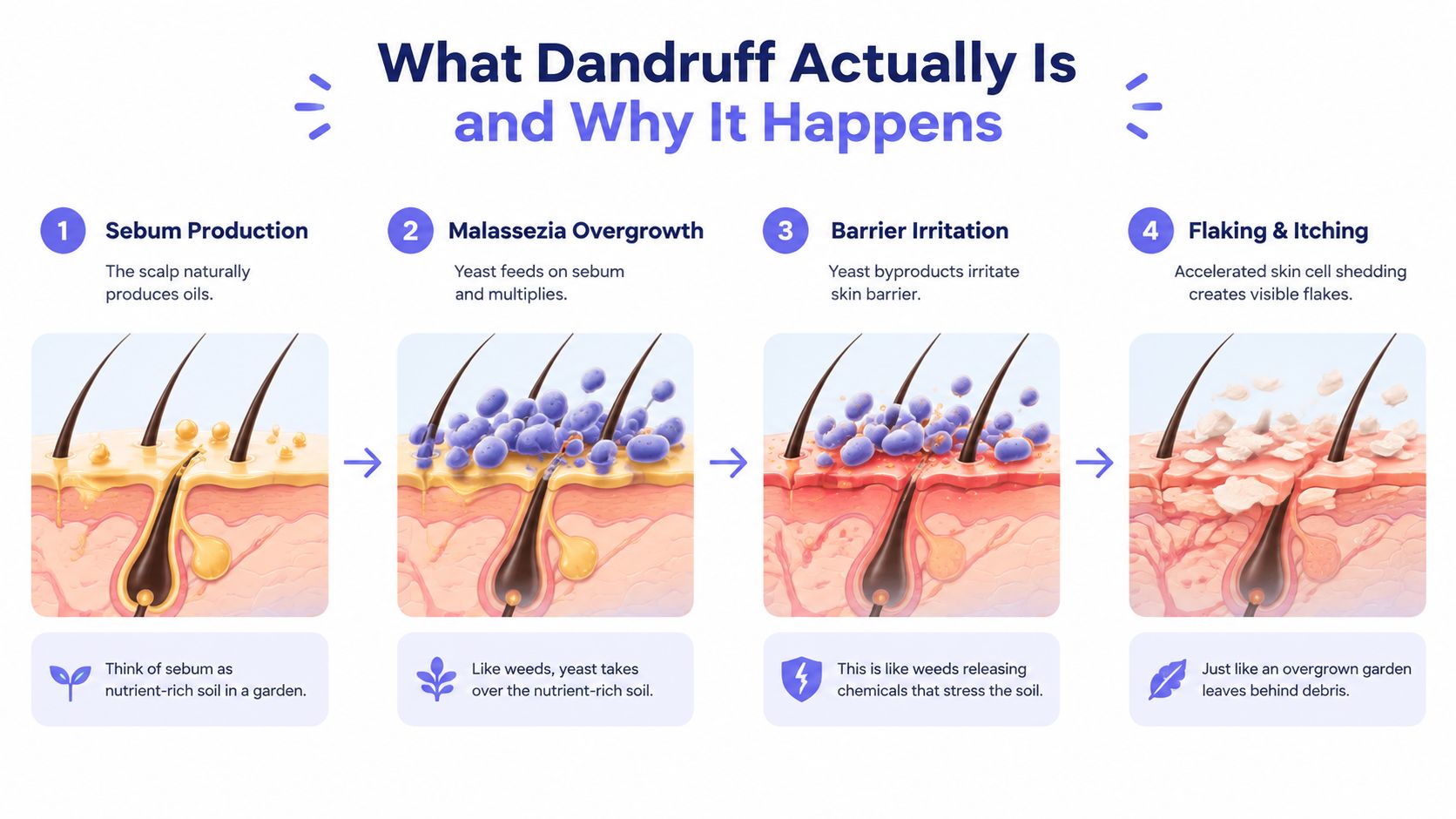
Dandruff is generally understood as a mild form of seborrhoeic dermatitis. The scalp naturally produces sebum, and Malassezia is a yeast commonly associated with dandruff. When the scalp environment favours it, the yeast and the skin’s inflammatory response can disturb the barrier and accelerate shedding.
A simple analogy helps. Think of the scalp as a lawn. Malassezia is like moss that returns when the soil, moisture, and conditions suit it. Removing the visible moss once doesn’t permanently change the lawn, and washing away one batch of flakes doesn’t necessarily prevent the next cycle.
The process usually feels straightforward to the person experiencing it:
- Sebum provides the environment. Oil is normal, but some scalps become more reactive to the by-products associated with Malassezia.
- The skin barrier becomes irritated. This can create itching, sensitivity, and redness.
- Cell shedding speeds up. The result is visible scale, sometimes oily and adherent rather than loose and powdery.
Cold weather, stress, and washing less often can coincide with flare-ups, although the trigger differs from person to person. Infrequent washing may allow more oil and scale to remain on the scalp, while overly hot water and harsh cleansing can irritate an already sensitive barrier. The practical answer isn’t to chase every trigger with a new product. It’s to use an appropriate active long enough to judge the response.
A 2020 clinical paper reported more than 90% reduction in adherent scalp flaking score and a 95.5% reduction in itch by day 21 for the anti-dandruff regimen studied (clinical paper on anti-dandruff treatment response). That doesn’t mean every person will see the same result, but it supports a useful expectation: visible improvement usually takes consistent treatment rather than an overnight transformation.
When the flakes aren’t simple dandruff
Dry scalp often feels tight and produces fine flakes, particularly after irritating cleansing or environmental exposure. Contact dermatitis may begin after a new fragrance, dye, preservative, or styling product, with burning or marked redness. Psoriasis can create thicker, more defined plaques that extend beyond the scalp margin.
If the pattern doesn’t resemble ordinary dandruff, changing shampoo repeatedly can delay the right diagnosis. A pharmacist can help you decide whether self-care is reasonable, while persistent or severe symptoms may need a dermatologist’s assessment. For a closer look at formulation choices, the anti-dandruff shampoo ingredients guide is a useful starting point.
The Six Active Ingredients Worth Knowing
The active ingredient determines what a shampoo can realistically do. Some target yeast, others loosen attached scale, and some slow excessive skin-cell turnover. Fragrance, foam, and a “fresh scalp” claim say far less about treatment value. Combination formulas can suit a flare that includes both yeast-related dandruff and thick scale.
Six Anti-Dandruff Actives Compared
| Active ingredient | Mechanism | Best for | Trade-off |
|---|---|---|---|
| Zinc pyrithione | Antifungal and antimicrobial support that reduces conditions linked with flaking | Mild to moderate recurring dandruff and people seeking a familiar, broadly tolerated option | Availability varies by region, and some formulas feel drying |
| Ketoconazole | Targeted antifungal action against yeast associated with dandruff | Persistent dandruff or seborrhoeic dermatitis that has not responded to milder products | May feel medicinal, with possible irritation, greasiness, or contact dermatitis |
| Selenium sulfide | Antifungal action that also affects excessive shedding | Oily scalps and more stubborn flaking | Can irritate and may alter the appearance of light hair if poorly rinsed |
| Coal tar | Slows excessive skin-cell turnover and reduces scale formation | Thick, persistent scaling when other approaches have not been adequate | Strong medicinal smell, staining risk, and regional restrictions |
| Salicylic acid | Keratolytic action that loosens and lifts scale | Thick, stuck-on flakes and scalp build-up | Does not target yeast as directly, and overuse can dry the scalp |
| Piroctone olamine | Gentle anti-yeast support used in many cosmetic-pharmacy formulas | Sensitive scalps, maintenance care, and people who prioritise cosmetic feel | May not be enough alone during a severe flare |
Ketoconazole needs careful use. 2% products are indicated for pityriasis capitis, or dandruff, and seborrhoeic dermatitis. Product directions commonly specify 3 to 5 minutes of scalp contact and twice-weekly use for 2 to 4 weeks, followed by maintenance once weekly or every 1 to 2 weeks (ketoconazole product directions). Follow the instructions for the product purchased, since formulations and regulatory status differ.
The vehicle matters as much as the headline active. Strong surfactants can clean an oily scalp effectively yet leave curly, bleached, or sensitive hair rough. A milder base usually gives better cosmetic feel, although thick scale may take longer to settle. The Conde Professional shampoo ingredients guide helps interpret the wider ingredient list, including cleansing agents and conditioning components.
Zinc pyrithione also differs between markets. The EU added it to Annex II of the Cosmetics Regulation with application from 1 March 2022, while the US permits it as an over-the-counter dandruff drug active under the FDA monograph, with listed ranges of 0.3% to 2% for rinse-off products and 0.1% to 0.25% for leave-on products (regulatory overview of anti-dandruff actives). A product sold in one country may therefore have no identical equivalent elsewhere.
For further practical context, these essential facts about antifungal shampoo explain selection and use considerations. Match the active to the scalp problem, hair condition, and tolerance rather than choosing the most intense-looking label.
How to Match a Shampoo to Your Scalp
Choosing a shampoo becomes easier when you assess four things separately: scalp behaviour, hair texture, severity, and tolerance. Customers often focus only on whether the flakes are visible, then discover that the product controls the scalp but makes the lengths unmanageable.
Start with the scalp. Oily scalps usually tolerate a more thorough cleanse, while dry or sensitive scalps need a balanced base and careful frequency. Combination scalps may need active treatment at the roots with conditioner kept away from the scalp and concentrated through the lengths.
| Profile | Best active | Why it fits | Watch out for |
|---|---|---|---|
| Mild everyday flakes | Zinc pyrithione or piroctone olamine | Broad support with a manageable cosmetic feel | Daily use may still dry a reactive scalp |
| Stubborn oily dandruff | Ketoconazole or selenium sulfide | Stronger antifungal positioning for recurring flares | Irritation, residue, and hair-feel changes |
| Thick adherent scale | Salicylic acid, sometimes in a combination formula | Loosens scale so other actives can reach the scalp | Dryness if used too frequently |
| Sensitive or colour-treated hair | Piroctone olamine or a gentle zinc pyrithione base | Prioritises scalp tolerance and reduced stripping | A severe flare may need a more targeted treatment |
| Curly, coily, or Afro-textured hair | A tolerated antifungal active in a conditioning base | Reduces the need for frequent full-length washing | Keep application focused on the scalp and protect the lengths |
Look at the INCI list, but don’t mistake the ingredient order for a complete treatment decision. The active may be displayed separately on a regulated product, while the rest of the list tells you about surfactants, conditioning agents, preservatives, fragrance, and pH adjusters. A heavily fragranced formula isn’t automatically unsuitable, but a fragrance placed prominently in the formula can be a poor match for a scalp that stings after washing.
Hair texture changes the trade-off. Fine hair may become limp with rich conditioning agents, while curly and coily hair often needs slip to prevent tangling. Dyed, bleached, and keratin-treated hair can lose cosmetic quality when repeatedly exposed to a stripping base, so apply the treatment mainly to the scalp and use conditioner on the lengths.
A combination formula makes sense when yeast control and scale removal are both needed. A co-wash or scalp serum may improve comfort between treatment washes, but neither should replace an active shampoo when true dandruff is the problem. For broader ingredient selection, the guide to what makes a good shampoo gives useful context. If you’re considering oil-based cleansing ideas, compare them carefully with DIY hair cleansing oil recipes, because heavy oils can be a poor fit for an oily, flaky scalp.
How to Use an Anti-Dandruff Shampoo Properly
You can use the right active and still get a weak result if the lather runs straight off the scalp. Apply it as a short contact treatment, not as a quick cosmetic wash. The method also needs to protect hair texture, especially with curls, bleached lengths, or dyed hair.
- Wet thoroughly. Use lukewarm water and saturate the scalp so the shampoo spreads evenly.
- Apply enough product. A coin-sized amount may cover short hair, while longer or denser hair needs more. Concentrate it on the scalp rather than coating the full length.
- Massage with fingertips. Work gently for around 30 seconds to loosen oil and scale. Fingernails can scratch and aggravate the skin.
- Wait before rinsing. Keep the lather on the scalp for the full 3 to 5 minute contact time recommended for many medicated products. Check the ketoconazole shampoo directions for product-specific use.
- Rinse carefully. Check the hairline and behind the ears, where leftover product can cause irritation.
Use medicated shampoo 2 to 3 times weekly during the initial phase, then reduce use as the scalp settles. Mayo Clinic dandruff treatment guidance also supports matching the active to the person, starting with several medicated washes each week, and stepping down later. Product instructions take priority, particularly with ketoconazole, selenium sulfide, or coal tar.
Milder zinc pyrithione or piroctone olamine formulas may work better in regular rotation. Ketoconazole, selenium sulfide, and coal tar usually suit intermittent treatment alongside a gentle shampoo. A clinical response may become noticeable around 2 to 3 weeks, while fuller control can take longer. Do not increase frequency because the first wash has not changed the scalp.
A visual reminder can help you repeat the method consistently:
A solid format can work if you prefer less packaging. The anti-dandruff shampoo bar guide explains what to check, but the practical rule stays the same: the active must reach the scalp, remain there for the stated time, and rinse away fully. Conditioner belongs on the lengths when cosmetic feel matters.
The Maintenance Phase Most People Skip
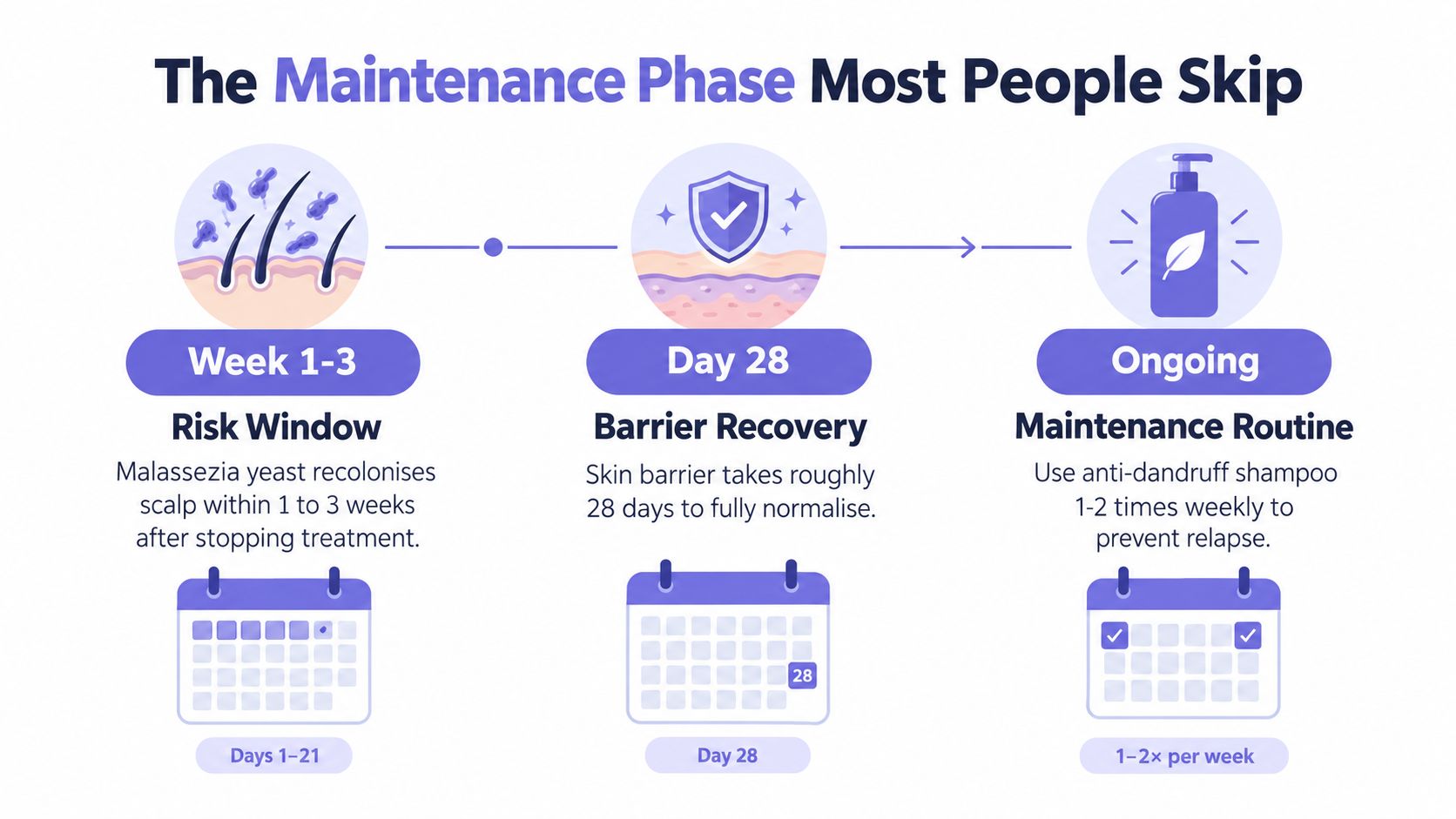
Many people stop the moment their shoulders look clear. That feels logical, but it treats dandruff like a stain rather than a recurring scalp condition. A July 2025 industry report described consumer questions about continuing treatment after visible flakes disappear, while reporting that measurable scalp changes can return days before dandruff becomes visible again (report on early dandruff-return biomarkers).
The useful framework is simple. Treat the active flare, then reduce the treatment rather than abandoning it. Once the scalp has remained clear for about a month, many people can move from several medicated washes each week to once weekly or once every 10 days, using a gentle shampoo on other wash days. Follow the product label or pharmacist’s advice where it differs.
Why rebound doesn’t mean treatment failed
Recent findings described in the same industry coverage point to scalp microbiome changes during treatment, including reductions in Malassezia and Staphylococcus alongside rises in Cutibacterium. That supports a more accurate explanation than “the shampoo killed everything.” The aim is to shift an unbalanced scalp environment and keep symptoms controlled without repeatedly over-treating it.
Aggressive daily use of a strong antifungal can create dryness and irritation, while stopping abruptly can allow the previous pattern to return. Alternating a targeted product with a mild formula is often more comfortable for long-term care, particularly for textured, dyed, or chemically treated hair.
A flexible maintenance plan
Reduce frequency gradually rather than stopping on the first clear wash.
Use a gentle, compatible shampoo and keep conditioner mainly on the lengths.
Resume the earlier treatment pattern if seasonal change, stress, hormonal shifts, or a new product brings back itching or scale.
Pay attention to itch, oiliness, and scalp texture, which may change before the jumper test does.
Maintenance isn’t a punishment or an invitation to use medicated shampoo forever without thought. It’s a way to use less product overall while responding early to the scalp’s actual behaviour.
Side Effects and When to See a Professional
A reaction is easier to assess when you connect it to the active ingredient rather than blaming the entire formula. Zinc pyrithione may leave some scalps dry, itchy, or tight. Selenium sulfide can sting, especially on scratched skin. Coal tar may produce a medicinal odour and stain hair or fabric. Ketoconazole can cause irritation, greasiness, or contact dermatitis in susceptible users.
| Active ingredient | Common side effects | Avoid if… | Typical resolution |
|---|---|---|---|
| Zinc pyrithione | Dryness, tightness, itching | Your scalp reacts repeatedly despite reduced frequency | Often improves after stopping or switching to a milder base |
| Ketoconazole | Stinging, irritation, greasiness, contact dermatitis | You develop a clear reaction or have broken skin | Stop and seek advice if symptoms persist |
| Selenium sulfide | Irritation, burning, altered hair feel | The scalp is inflamed or the product is difficult to rinse fully | Usually settles after discontinuation |
| Coal tar | Odour, staining, irritation | You dislike the cosmetic trade-off or the product isn’t permitted for your use | Can improve after thorough washing and stopping |
| Salicylic acid | Dryness, peeling, sensitivity | Thick scale isn’t the issue and the scalp is already dry | Usually settles when frequency is reduced |
| Piroctone olamine | Occasional irritation or sensitivity | Any product causes persistent burning | Often resolves after switching formula |
Regulatory status also varies by market. Zinc pyrithione has been restricted in EU cosmetics following its classification for reproductive toxicity, while US over-the-counter use remains permitted under relevant monograph conditions, as outlined in this zinc pyrithione regulatory overview. Check the local product label instead of assuming a familiar active has the same status everywhere.
Pause self-treatment if the scalp is broken, the user is a very young child, or pregnancy is a factor. A pharmacist or clinician can help select an appropriate option, particularly when dyed, textured, or sensitive hair makes irritation and cosmetic feel harder to balance.
Seek dermatology advice if scale spreads beyond the hairline, yellow crusting appears, hair loss develops, or bleeding occurs. Arrange a review after zero improvement after six weeks of correct use. Persistent symptoms may reflect a different scalp condition or require treatment beyond shampoo.
Shopping Smart and Buying Through Healtsy
I prefer pharmacy-grade anti-dandruff formulas when the problem looks like genuine seborrhoeic dermatitis rather than occasional dry flakes. A clear active ingredient, a stated concentration where applicable, understandable directions, and a tolerable base tell you more than a bright label or a strong mint fragrance.
Be wary of products that sell the shower experience instead of scalp treatment. Fragrance-heavy “natural” shampoos may feel pleasant while doing little for recurring yeast-associated flaking, and abrasive scalp scrubs can strip or scratch without correcting the underlying cycle. Scrubs have a role in limited situations, but they aren’t a substitute for an evidence-backed active.
Rotating different active classes can be reasonable when one formula loses cosmetic acceptability or no longer controls symptoms, but I wouldn’t change products constantly. Give a correctly used formula enough time to judge it, then adjust based on response, scalp tolerance, and hair condition. For a product-specific example, the Vichy Dercos shampoo guide can help you compare its intended use with your own scalp profile.
Healtsy sources products directly from EU pharmacies, with no parallel imports, free shipping over 70€, and tracked DHL delivery across Europe. Its stock is described as 100% genuine, with batch-traceable supply chains, and the skincare quiz can help narrow down a suitable scalp-care direction. Straightforward returns also matter when a formula proves incompatible with your hair texture or scalp tolerance.
My belief after years at the pharmacy counter is that the best routine is the one you can use correctly and maintain comfortably. Choose the active for the scalp, the base for the hair, and the frequency for your symptoms rather than buying the most forceful product on the shelf.
Clearer scalp, without the guesswork
If recurring flakes are making you avoid dark clothes or second-guess every wash, compare pharmacy-grade anti-dandruff options and use the skincare quiz for a more personalised starting point. Choose a suitable active, follow the contact-time directions, and build the maintenance wash into your routine before the next flare begins.
Visit Healtsy