


Anti Dandruff Shampoo Bar: A Complete Guide for 2026
You've just left the salon, your haircut looks sharp, and then you notice pale flakes resting on the dark fabric of your shoulders. At the chemist, the choice feels deceptively simple: stay with a liquid medicated shampoo, or try an anti-dandruff shampoo bar because it seems gentler, cleaner, and easier to travel with. The question is whether changing the shape of the product will change the condition on your scalp.
After 16 years behind the pharmacy counter, I believe the most useful answer is practical rather than fashionable. A bar can be a serious medicated delivery form, but only when it contains a suitable active ingredient, delivers it consistently, and stays on the scalp long enough to work. This is the complete guide to choosing, using, and judging an anti-dandruff shampoo bar, including the important situations where a liquid treatment remains the safer or better-supported option.
What an Anti Dandruff Shampoo Bar Really Is
A shampoo bar is a solid cleansing formula made by combining surfactants, conditioning materials, and other ingredients into a compact shape. Unlike a traditional soap bar, it doesn't have to be made through a lye-based saponification process. Many bars use synthetic or naturally derived cleansing agents, then harden the mixture so it can be used directly on wet hair.
An anti-dandruff version adds an ingredient intended to address flaking, yeast activity, or scale. That might be zinc pyrithione, salicylic acid, piroctone olamine, climbazole, tea tree oil, or another declared active. The bar itself doesn't treat dandruff merely because it is solid. The result depends on whether the formula protects the active, creates useful lather, and places enough of that active on the scalp during washing.
Practical rule: Treat the bar as a delivery system, not as evidence of treatment strength.
The history of the category supports that distinction. Zinc pyrithione was first synthesised in the 1950s, first used as an anti-dandruff agent in 1961, and by 2021 was reported as the most popular anti-dandruff ingredient, appearing in more than 100 topical products across several countries at concentrations up to 2% w/v in rinse-off formulations. The clinical and regulatory history of zinc pyrithione also shows why the category has changed. The ingredient was officially banned in EU cosmetics effective March 1, 2022, encouraging formulators in that market to consider alternatives.
That timeline is important when a shopper compares a cosmetic natural bar with a medicated product. A botanical bar may cleanse well and help a mildly flaky scalp feel fresher, but it shouldn't automatically be treated as an equivalent to an established medicated shampoo. For a useful side-by-side look at a botanical option, you can compare Alana natural shampoo bars, then check whether the product makes a medicinal claim or offers scalp-friendly cleansing.
What the format changes
The solid format changes handling, storage, lathering, and dosing. You usually need to bring the bar to the scalp rather than pouring a measured amount into your palm, and you must keep it dry between washes. Those differences affect how reliably the active reaches the scalp.
For a broader explanation of how dandruff products work in routine hair care, see this guide to anti-dandruff shampoo. The same principle applies here: the ingredient and directions matter more than the product's shape.
How a Solid Bar Differs From a Liquid Bottle
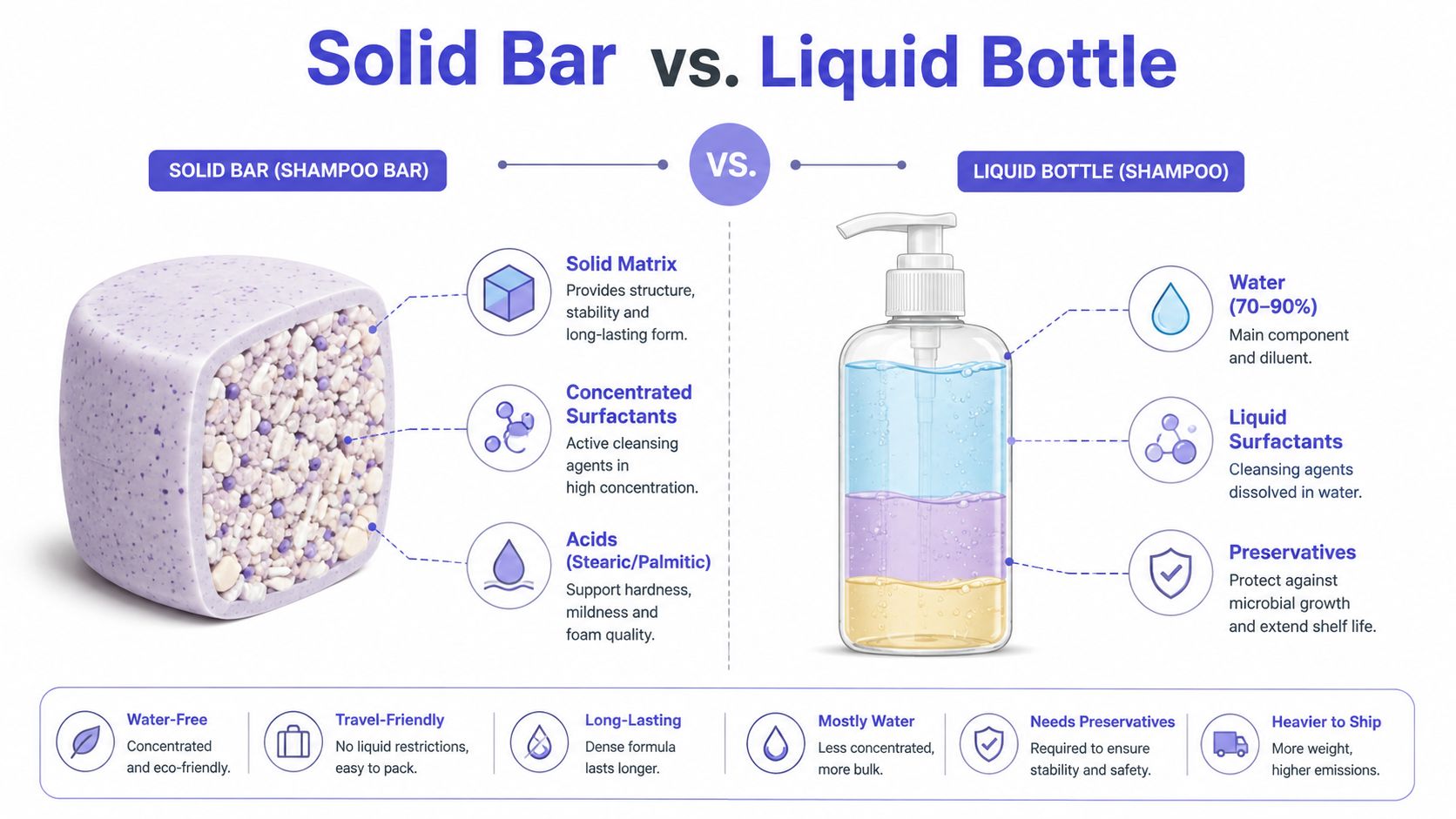
The simplest distinction is water content. A bar is built as a concentrated solid, while a bottled shampoo uses water as the main carrier and adds surfactants, thickeners, stabilisers, fragrance, conditioning agents, and preservatives. That doesn't make one format automatically superior. It means each creates different formulation and use challenges.
Solid bars commonly rely on surfactants such as sodium cocoyl isethionate or sodium lauryl sulfate, combined with hardening materials such as stearic or palmitic acid. The mixture is pressed or moulded into a puck and allowed to harden. Some bars are syndet products, meaning they use synthetic detergents rather than traditional soap, while others use a hybrid construction.
The low-water structure can reduce the amount of preservative required because microbes have less available water in which to multiply. It can also make the product convenient to transport and less prone to spilling. However, the active still needs to remain chemically stable and evenly distributed through the bar. A dry puck isn't proof that the medication has been formulated well.
How the scalp receives the formula
With a liquid, you can often dispense a repeatable amount, spread it quickly, and rinse. With a bar, you control dose through the number of passes over the scalp, the amount of water added, and the length of massage. That gives the user more responsibility for consistent application.
The bar isn't automatically “natural,” either. A formula can contain laboratory-made actives and carefully selected detergents while still being solid and low-waste. Conversely, a bar marketed as natural may contain essential oils that irritate a sensitive scalp. The label deserves the same scrutiny you'd give a bottle.
The rice water shampoo bar guide can help explain how a solid hair-care product may be positioned around cosmetic ingredients. For dandruff, however, a rice extract or botanical story doesn't replace a recognised anti-dandruff active when the scalp needs targeted treatment.
For more general ingredient education, this guide to what makes a good shampoo is useful. The practical test remains unchanged: identify the cleansing base, the active, the supporting ingredients, and the directions for use.
The Active Ingredients That Actually Fight Flakes
The active ingredient determines what an anti-dandruff shampoo bar is designed to do. Some ingredients target yeast associated with dandruff, while others loosen adherent scale. A few botanical ingredients may provide mild antimicrobial or soothing support, but their presence doesn't tell you whether a product can manage stubborn flaking.
Antifungal and anti-yeast options
Ketoconazole, selenium sulfide, and pyrithione zinc are commonly used because they help reduce or slow the fungus associated with dandruff, as described in this clinical treatment guide to dandruff shampoos. Piroctone olamine and climbazole are also used in anti-dandruff formulations, while ciclopiroxolamine appears in some clinically evaluated systems.
Zinc pyrithione has a particularly long commercial history. A controlled British Journal of Dermatology evaluation documented zinc pyrithione shampoo for dandruff control, and a dedicated dermatology reference lists a ZNP bar containing zinc pyrithione 2% as a medicated bar formulation. That example matters because it confirms that a bar can be designed as a true medicated scalp cleanser, not merely as a solid cosmetic shampoo. You can review the zinc pyrithione bar formulation reference for that specific example.
Selenium sulfide is another anti-yeast option, although it can be less common in bar formats because solid formulations may create stability and appearance challenges. Ketoconazole is widely recognised in liquid treatment shampoos, but a bar containing a “ketoconazole alternative” shouldn't be assumed to have identical clinical performance.
Scale-lifting ingredients
Salicylic acid is a keratolytic. It helps loosen and remove accumulated scale, making it more relevant when flakes are thick and attached rather than fine and loose. It doesn't replace an antifungal ingredient when yeast-driven inflammation is the central problem, but it can make the scalp surface easier to cleanse.
A randomised, double-blind controlled study found that an anti-dandruff shampoo reduced scalp scale more effectively than placebo using D-squame image analysis and clinical scoring. The controlled dandruff shampoo study supports the broader formulation lesson: active delivery, not the bar shape, drives measurable flake reduction.
| Active Ingredient | Typical % in Bars | Mechanism | Best For |
|---|---|---|---|
| Zinc pyrithione | Declared strength varies | Anti-yeast and scalp-cleansing action | Routine dandruff control when the label provides a recognised strength |
| Selenium sulfide | Declared strength varies | Reduces yeast activity and flaking | Oily, persistent flaking when the product directions suit the scalp |
| Ketoconazole | Often found in liquid treatments | Anti-yeast action | Persistent dandruff requiring an established medicated treatment |
| Piroctone olamine or climbazole | Declared strength varies | Anti-yeast action | Maintenance formulas and alternative systems |
| Salicylic acid | Declared strength varies | Loosens adherent scale | Thick, scaly build-up |
| Tea tree oil and other botanicals | Formula dependent | Mild antimicrobial or soothing support | Maintenance or mild flaking, not automatically a flare treatment |
The anti-dandruff shampoo ingredients guide offers additional help with label reading. Concentration, contact time, scalp condition, and tolerance decide whether an ingredient performs usefully. “Natural” doesn't automatically mean weaker, and synthetic doesn't automatically mean harsher.
Shampoo Bar vs Liquid Anti-Dandruff Shampoo
Neither format wins every category. A bar suits someone who values compact storage and is willing to work the product carefully into the scalp. A liquid often suits someone who needs a familiar, more controlled medicated routine, particularly when the scalp is inflamed or the treatment directions require reliable dosing.
Lather is the first everyday difference. A bar usually needs direct passes over wet hair and several seconds of fingertip massage before it feels evenly distributed. A liquid is easier to spread quickly, although fast lather doesn't prove that the active has had enough contact with the scalp.
Contact time is often where users lose the potential benefit of either product. Someone may swipe a bar briefly and rinse, while someone using a liquid may massage once and wash it away immediately. In both cases, the active needs to follow the product directions and remain on the scalp for the stated time.
| Factor | Bar | Liquid |
|---|---|---|
| Lather | Requires direct application and added water | Usually spreads quickly from the hand |
| Dosing | Harder to measure precisely by eye | Easier to dispense a repeatable amount |
| Contact time | Direct scalp rubbing can encourage longer massage | Users may rinse too quickly |
| Storage | Needs airflow and protection from pooled water | Bottle is simpler but can leave residue around the cap |
| Travel | Compact and spill-resistant | Familiar, but containers may be less convenient |
| Waste | Avoids a conventional shampoo bottle, depending on wrapper | Requires a bottle and ships more water |
| Treatment confidence | Depends heavily on the label and use technique | More established for many medicated actives |
For general recommendations aimed at different users, this guide to the best anti-dandruff shampoo for women provides useful context, but the same decision rule applies to everyone. Match the treatment to the scalp rather than choosing based on gendered packaging.
A bar can be an excellent travel and gym-bag option, especially when liquid handling is inconvenient. Its weakness is dosing precision. A liquid remains the more sensible starting point when you need a clearly labelled medicated product, have stubborn symptoms, or are following advice from a clinician.
My pharmacy-counter view: If the active and directions are unclear, the bar has lost its main argument before you've used it.
How to Use and Store Your Bar the Right Way
A good bar can underperform when it's used like a quick body cleanser. The scalp needs even application, gentle massage, and enough contact time for the declared active to do its job. The routine below is deliberately simple.
A practical washing sequence
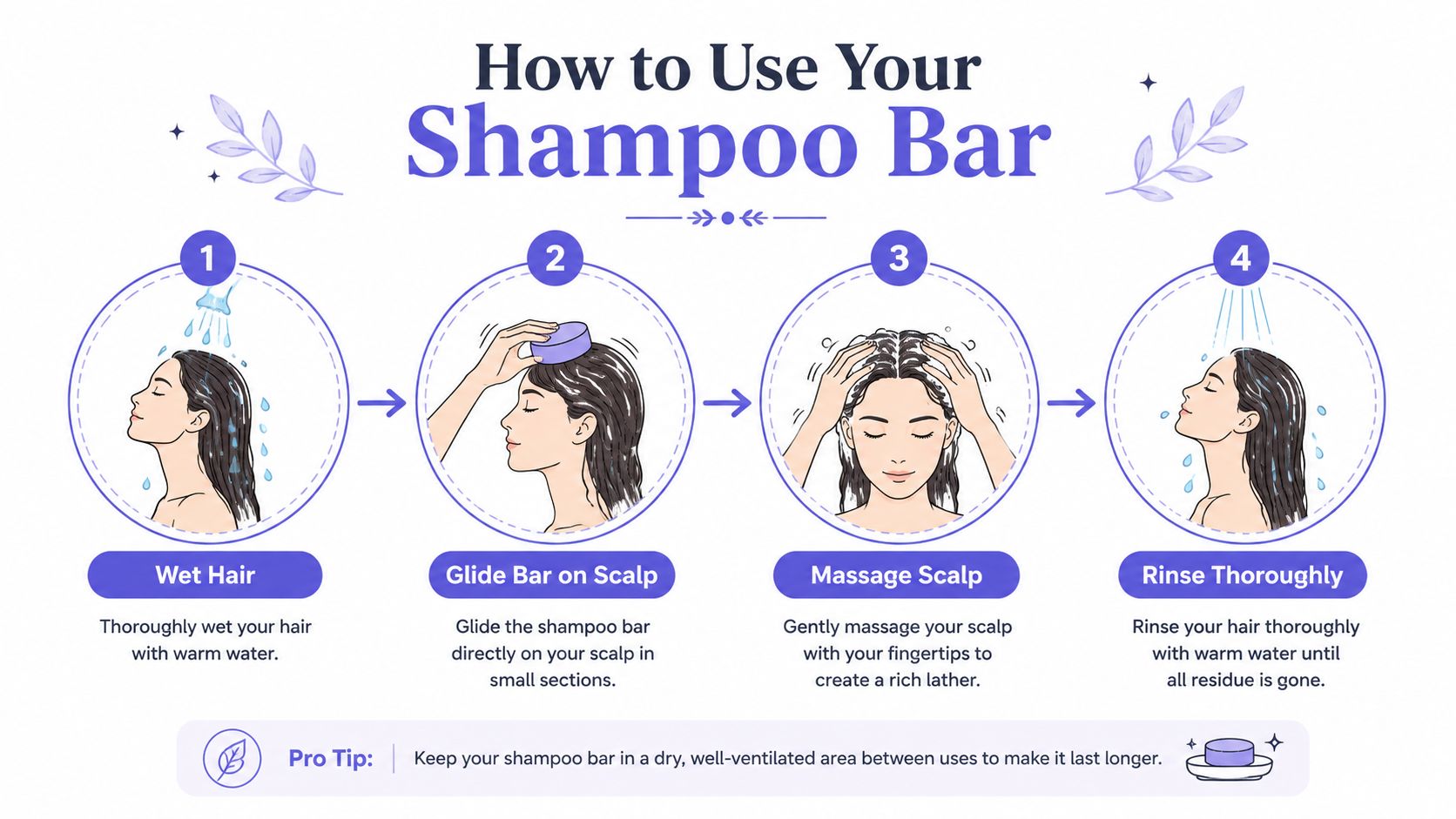
- Wet the hair and scalp thoroughly. Water softens surface scale and helps the bar create a workable lather.
- Glide the bar directly across the scalp. Make several controlled passes over the areas that flake instead of producing all the foam in your hands. Direct application places the formula where it is needed.
- Massage with your fingertips. Add a little water and use the pads of your fingers, not your nails, to distribute the lather. A controlled massage also reduces the temptation to scratch.
- Respect the contact time. Follow the product directions. Similar rinse-off systems have shown benefit when the active is delivered properly, but a rushed wash can't reproduce the conditions tested in clinical work.
- Rinse completely. Residual surfactant, fragrance, or essential oil can aggravate a reactive scalp. Repeat only when the hair is heavily oily or coated with styling product.
The evidence for pyrithione-zinc shampoos also supports continued benefit without tachyphylaxis for up to 48 weeks in controlled trials, with no evidence that repeated use progressively lost effect versus placebo. A separate trial of a shampoo containing 1.5% ciclopiroxolamine plus 1% zinc pyrithione reported improvement in lesional score, erythema, and pruritus as early as day 7, with significant superiority to vehicle by day 14. These findings come from longer-duration and combination-treatment clinical evidence, not from bar-specific trials, so they support the active-delivery principle rather than guarantee identical bar performance.
Storage determines how long the puck lasts
After rinsing the bar, place it on a slatted dish away from the direct shower spray. Let air move underneath it, and don't leave it in pooled water. A constantly wet bar softens, dissolves faster, and may distribute its ingredients less evenly from wash to wash.
If your scalp feels tight or reactive, alternate the treatment bar with a gentle cleanser rather than adding more scrubbing. A conditioner on the hair lengths can reduce the dry, brittle feeling that sometimes follows medicated cleansing, but keep heavy conditioner away from a scalp that becomes greasy quickly.
Matching the Right Bar to Your Scalp Type
At the counter, two people can describe “dandruff” while needing very different routines. One may have oily scale that returns quickly, another may have a dry, tight scalp irritated by fragrance, and a third may have a condition that needs professional assessment rather than another product experiment.
Oily and seborrhoeic-prone scalps
An oily scalp with recurring flakes often needs an anti-yeast active such as zinc pyrithione, selenium sulfide, piroctone olamine, or climbazole. The cleansing base should remove sebum without leaving the scalp feeling stripped, because harsh washing can create a cycle of discomfort and overhandling.
If the scaling is thick and attached, a salicylic-acid formula may help loosen the surface. It doesn't make every salicylic bar a complete treatment, so check whether the product also declares an anti-yeast active.
Dry, curly, or coily hair
A dry, flaky scalp needs a more careful balance. Salicylic acid can help lift scale, while a gentler anti-yeast system may suit someone who experiences tightness after washing. Curly and coily textures often benefit from a bar that includes a humectant such as glycerin and from applying conditioner mainly to the lengths.
Hair texture should affect the cleansing routine, not persuade you to ignore the scalp. This guide to different hair textures and tailored care can help you adapt the application without abandoning the active ingredient.
Colour-treated, sensitive, and persistent cases
Colour-treated hair may need a mild cleansing base and careful rinsing, while the anti-dandruff active remains the priority. Sensitive scalps should be cautious with fragrance, menthol, and concentrated essential oils, even when the product is marketed as botanical.
For thick crusting, marked redness, oozing, pain, or hair loss, I wouldn't keep switching bars indefinitely. Seborrhoeic dermatitis, psoriasis, contact dermatitis, and fungal infections can overlap in appearance, and a pharmacist or clinician can help distinguish a routine flaking problem from a condition needing a different treatment.
Reading the Label Without Getting Misled
A bar can carry “anti-dandruff” on its packaging without being a medicated treatment. The phrase may describe a botanical or scalp-cleansing formula, while a treatment product should identify a recognised active and provide directions for use. Read the ingredient panel and instructions before judging what the bar can do.
Look for a clearly named active ingredient. Recognised options include pyrithione zinc, selenium sulfide, ketoconazole, piroctone olamine, climbazole, ciclopiroxolamine, and salicylic acid. Tea tree oil, neem, rosemary, or a broad “microbiome balance” statement may support a cosmetic formula, but they do not establish that the product treats dandruff.
A label-reading checklist
- Identify the active: Check for an anti-yeast or scale-lifting ingredient.
- Check the strength: A stated percentage helps comparison, although a bar should not be assumed to match a liquid with a similar name.
- Read the directions: Look for application instructions, contact time, and recommended frequency.
- Review the fragrance: Strong perfume and essential oils may aggravate an itchy or inflamed scalp.
- Look for complete information: A full ingredient list, patch-test advice, and manufacturer contact details make the product easier to assess.
- Separate support from treatment: Aloe, glycerin, botanical extracts, and conditioning agents may improve comfort, but they do not replace an antifungal active.
Contact time matters as much as the ingredient list. If the label gives no clear instructions for keeping the lather on the scalp, you cannot assume the bar delivers the same treatment exposure as a medicated liquid. Concentration also needs context, because the same named ingredient may behave differently in a solid cleansing base.
A label cannot diagnose persistent or inflamed flaking. Seborrhoeic dermatitis, psoriasis, contact allergy, and other scalp conditions can look similar. Broken skin, oozing, severe pain, or hair shedding warrants medical advice rather than continued reliance on marketing language.
A sustainable bar can still irritate the skin, while a conventional liquid may be the more suitable clinical choice. Judge the complete formula, including the active, cleansing system, fragrance, directions, and your scalp's response.
Choosing the Best Bar for Your Routine
The best anti-dandruff shampoo bar is the one that fits three decisions: active ingredient, concentration, and contact time. Packaging, scent, and low-waste credentials may matter to you, but they can't compensate for an unsuitable treatment system.
Start with the symptom pattern. Ordinary recurring flakes may suit a bar with a declared anti-yeast active such as zinc pyrithione, piroctone olamine, or climbazole. If scale is thick and adherent, salicylic acid may be more useful for loosening it. Selenium sulfide can be appropriate for some oily, persistent cases, provided the product is clearly labelled and your scalp tolerates it.
Don't assume that a bar using the phrase “ketoconazole alternative” has the same potency or clinical evidence as a ketoconazole liquid. Bar-format-specific efficacy, dosing, and contact-time guidance remain less developed than the evidence base for rinse-off liquid shampoos. A 2025 formulation study reported that a herbal anti-dandruff shampoo bar outperformed a marketed comparator in laboratory evaluation, but that result doesn't replace rigorous human trials. The published formulation research on anti-dandruff bars is useful precisely because it highlights both the promise and the evidence gap.
Make the choice fit your habits
Consider the routine you can follow consistently. A bar may work well for someone who washes at the gym, travels often, or wants to avoid a bottle. Someone with curly, dry, or colour-treated hair may prefer a milder base paired with a separate conditioner. A sensitive scalp may do better with a fragrance-free formula, even if that means choosing a less appealing scent.
For body-care planning beyond the scalp, Body bath collections can be a useful way to compare cleansing formats, but keep the scalp treatment decision focused on the active and directions.
Try one suitable formula consistently rather than changing products every few washes. If irritation appears, stop using it. If the scalp improves but feels tight, reduce harsh cleansing and condition the hair lengths. If redness, crusting, persistent itch, or hair loss continues, speak with a healthcare professional. I'm certain this guide will help you make a more informed choice, but no shampoo bar can replace an assessment when the symptoms suggest something more complex.
Choose by the active ingredient, not the shape
I believe Healtsy is a practical place to compare pharmacy-grade scalp treatments and related hair-care products, including established anti-dandruff options for different scalp concerns. Review suitable treatments, compare formulas, and choose a routine based on the active ingredient rather than the shape of the product.
Visit Healtsy