


Best Copper Peptides: A Pharmacist Guide
The most popular advice about the best copper peptides is also the least useful: choose the highest percentage and expect rapid tightening. In practice, a copper peptide is only as good as its chemical form, delivery vehicle, packaging, stability, and evidence behind the finished product. A strong ingredient list can still produce a weak skincare product if the peptide degrades or never reaches the skin in a usable form.
I've worked in the pharmaceutical sector for 16 years, and I believe formulation quality matters more than an impressive front-label claim. This is the complete guide to choosing copper peptides with the same discipline used for a serious topical product, while keeping expectations realistic for everyday skincare.
| What to assess | Why it matters | What a careful buyer should seek |
|---|---|---|
| Peptide identity | “Copper peptide” can describe more than one ingredient | Clearly identified GHK-Cu or Copper Tripeptide-1 |
| Delivery vehicle | Barrier penetration varies substantially | A formula designed around the skin barrier, not just a watery texture |
| Stability | Copper-binding ingredients can be sensitive to their environment | Protective packaging and a focused formula |
| Clinical evidence | Cosmetic claims often exceed the available data | Human topical studies, with attention to study size and duration |
| Routine compatibility | Conflicting actives can increase irritation or complicate use | A simple schedule that separates potentially problematic products |
Separating Topical Evidence From Injectable Hype
The current enthusiasm for injectable copper peptides risks confusing two very different ideas. Topical GHK-Cu skincare has a long research and commercialization history, while injected GHK-Cu is not an approved drug and lacks published human evidence showing that the practice is safe and effective, as reported by NPR's coverage of copper peptide injections.
That distinction matters. A serum applied to the skin is evaluated as a topical cosmetic or dermatological preparation. An injection introduces a substance into the body, creating different questions about dose, sterility, systemic exposure, pharmacology, and medical supervision. Evidence for one route cannot automatically validate the other.
Practical rule: Don't treat topical skincare studies as proof that injectable GHK-Cu is safe or effective.
The best-known copper peptide, GHK-Cu, was first isolated from human plasma in 1973, appeared in commercial skincare in the late 1980s, was sold to professional spas and salons by 1989, and reached the mass market in 1997. This timeline, documented in the Copper Development Association's history of copper in skincare, gives topical GHK-Cu a long commercial and scientific record rather than a sudden wellness origin story.
That history doesn't make every serum effective. It does show why the ingredient deserves a more careful assessment than either extreme, blind enthusiasm or dismissal as a passing trend. The topical route is where the relevant cosmetic and reparative evidence sits.
Readers comparing regenerative skincare ingredients may also encounter PDRN serum information. PDRN and copper peptides aren't interchangeable, but both categories illustrate why the delivery route and the intended use must be stated clearly.
For a consumer, the baseline is straightforward: assess topical GHK-Cu formulations on their own evidence, and treat claims about injections as a separate medical question requiring qualified clinical advice.
Evaluating The Clinical Evidence For Skin Aging
The human evidence for topical GHK-Cu is encouraging, but it needs to be read without promotional inflation. A 12-week facial-cream study involving 71 women with mild to advanced photoaging reported increased skin density and thickness, alongside reductions in laxity, fine lines, and wrinkle depth. The same review reported a 31.6% reduction in wrinkle volume versus Matrixyl 3000, and 55.8% lower wrinkle volume plus 32.8% lower wrinkle depth versus a control serum. These figures are discussed in the peer-reviewed review of GHK-Cu skin effects.
The practical interpretation is that topical copper peptides may help with firmness, elasticity, skin density, and visible wrinkles within roughly 8 to 12 weeks, provided the product delivers the active consistently. That doesn't mean every blue-tinted serum will reproduce those results, because study outcomes belong to particular formulations, protocols, and populations.
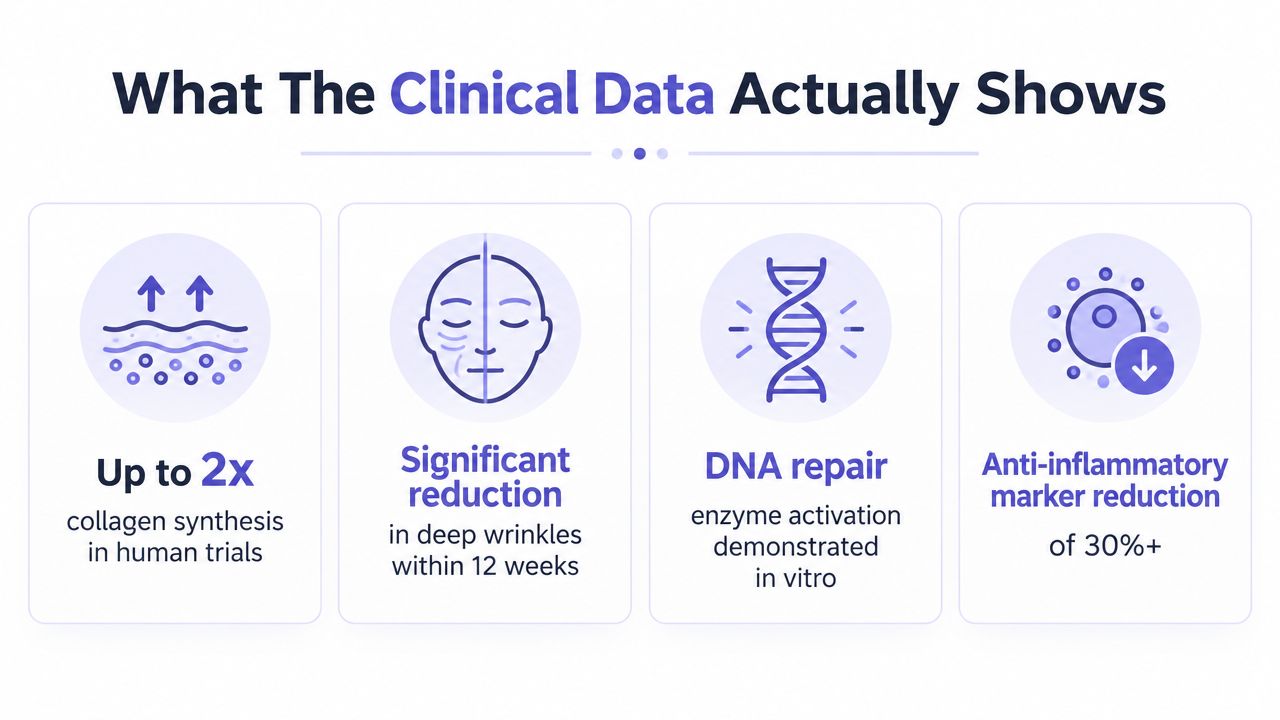
What the studies support
The strongest rationale for GHK-Cu remains its association with repair and tissue remodeling. Cosmetic users often focus on wrinkles, but the ingredient's research profile also includes wound-repair questions. A 2026 ClinicalTrials.gov entry describes a Phase 2, randomized, double-blind, vehicle-controlled split-wound study testing topical GHK-Cu for re-epithelialization of standardized acute skin wounds in healthy adults. The trial is listed at ClinicalTrials.gov under NCT07437586.
That study doesn't prove a finished cosmetic serum will accelerate healing after a procedure. It does show where serious research attention remains focused. For post-procedure use, readers should follow the treating clinician's instructions, because an intact barrier, an open wound, and recently treated skin aren't equivalent situations.
For a readable discussion of the ingredient's research, Bulk Aussie Peptides' GHK-Cu research information can provide background. It shouldn't replace peer-reviewed clinical interpretation, particularly when a product makes broad anti-aging claims.
Where the evidence stops
The record is not as extensive as the evidence for retinoids. A recent review noted only 2 indexed randomized controlled trials supporting the clinical record, with one carrying a high risk of bias, as reported in the American Society for Aesthetic Plastic Surgery review.
Independent dermatology commentary also describes copper peptides as promising but less extensively studied than retinoids or vitamin C, with limited long-term data beyond 2 to 3 months. That boundary is important when setting expectations. Copper peptides can be a valuable reparative and supportive active, but I wouldn't present them as a proven replacement for every established anti-aging treatment.
If you're deciding between copper peptides and vitamin A derivatives, this comparison of retinol and retinoids helps clarify a distinction that marketing often blurs. The sensible question isn't whether GHK-Cu is miraculous. It's whether its tolerability and repair-oriented profile fit your skin better than another active.
Comparing Delivery Systems And Formulation Vehicles
A peptide can be present in a bottle and still perform poorly in use. The outer layer of skin creates a substantial barrier, and independent in vitro research shows that copper tripeptide permeability changes dramatically according to the tested skin model. The permeability coefficient ranged from 3 × 10^-7 cm/h through isolated epidermis to 5.54 × 10^-3 cm/h through isolated stratum corneum. Through dermatomed skin, it measured 2.43 ± 0.51 × 10^-4 cm/h, with 136.2 ± 17.5 µg/cm² permeating over 48 hours and 97 ± 6.6 µg/cm² retained as a depot. The full findings appear in the independent skin-penetration study.
Those results don't allow a consumer to predict the performance of a specific serum. They do establish a central formulation lesson: vehicle choice and barrier condition matter.
| Vehicle Type | Penetration Efficiency | Best Skin Type | Stability Risk |
|---|---|---|---|
| Water-based serum | Light, but highly dependent on the barrier and formula design | Oily, combination, or layered routines | Can offer less protection from environmental stress if packaging is poor |
| Emulsion | Balances water and oil phases, often improving comfort and barrier support | Normal, combination, and mildly dry skin | Requires careful control of phase compatibility and preservation |
| Lipid-heavy cream | Supports barrier comfort and reduces water loss, but may feel occlusive | Dry, sensitized, or mature skin | More complex system with greater demands on stability testing |
Reading the texture intelligently
A watery serum isn't automatically more effective because it feels light. A cream isn't automatically inferior because it contains oils. The right vehicle depends on whether the formula keeps GHK-Cu available while supporting the condition of the stratum corneum.
Oily skin may prefer a thin serum, but a dehydrated barrier can still need an emulsion afterward. Dry or reactive skin may benefit from a cream format that reduces discomfort, even if the peptide itself is supplied in a separate serum. The consumer-facing discussion from Celonyx Labs on copper peptides is useful as general formulation background, but product claims still need to be checked against the actual INCI and packaging.
Look for a product that identifies the peptide clearly, explains its delivery approach without hiding behind vague proprietary language, and avoids treating texture as a substitute for data. A serum that absorbs quickly may be pleasant, but pleasant application isn't the same as biological availability.
The distinction between a treatment serum and a moisturizer also helps here. This guide to the difference between serum and moisturizer is useful when deciding whether a peptide product should deliver the active, support the barrier, or do both.
Navigating Stability And Ingredient Conflicts
GHK-Cu works through a copper-peptide relationship that depends on the formulation environment. I'm cautious about routines that place it beside multiple strong actives without a schedule, because the result can be irritation, uncertain compatibility, or a product that no longer behaves as the formulator intended.
The safest approach is separation rather than improvisation. Use the copper peptide on clean skin, follow it with a compatible moisturizer, and place acids, retinoids, or strong antioxidant treatments in another routine window when the product directions or clinician advise caution.
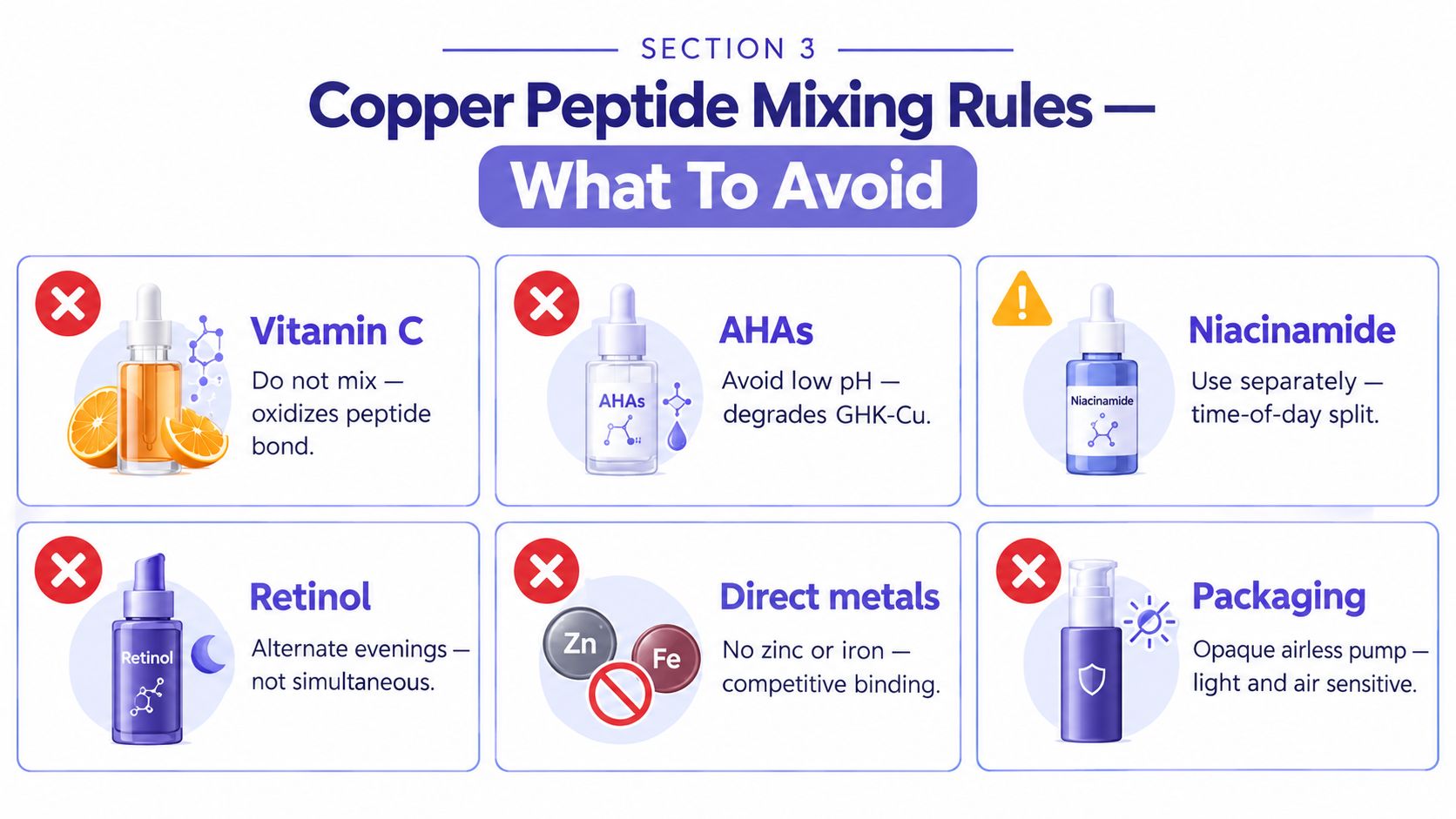
A workable routine structure
A simple morning routine might contain cleanser, copper peptide serum, moisturizer, and sunscreen. In the evening, use a retinoid or direct acid on the nights assigned to that active, rather than automatically layering everything together.
That approach also helps you identify the cause of a reaction. If you introduce GHK-Cu, an acid, and retinol simultaneously, you won't know which product caused stinging or redness. Add one product at a time and give your skin enough time to show whether the routine is comfortable.
Pay attention to the following compatibility concerns:
- Direct acids: Low-pH products can create an unsuitable environment for a copper peptide formula and may increase irritation.
- Strong chelators: Ingredients designed to bind metals can interfere with a copper-dependent active system.
- Some vitamin C formats: Direct acidic L-ascorbic acid products deserve separation unless the manufacturer has specifically validated the combination.
- Retinoids: Alternating evenings is a conservative way to reduce cumulative irritation.
- Mineral-heavy products: Products containing competing metal ions may complicate a copper-binding system, depending on the formula.
The detailed routine advice in this guide to layering niacinamide, vitamin C, and sunscreen can help you organize a multi-active routine without turning every application into a chemistry experiment.
Formulation lesson: The goal isn't to use every active at once. The goal is to preserve activity and maintain a barrier you can tolerate consistently.
Matching Concentrations To Specific Skin Concerns
More copper peptide isn't automatically better. A high label percentage can increase cost, complexity, and irritation potential without proving that the finished product will outperform a lower-strength formula designed for regular use.
I'm also careful with precise percentage advice because the publicly available clinical record doesn't establish one universal concentration for every consumer, skin type, or indication. Product labels may disclose a percentage of GHK-Cu, a broader peptide complex, or a supplier blend, and those aren't equivalent measurements.
Match the format to the problem
For routine firmness and mild photoaging, a well-tolerated daily serum makes more sense than chasing the strongest possible product. Consistency, sunscreen use, and a stable vehicle are more useful than an aggressive formula that forces you to stop after irritation.
For dry or reactive skin, prioritize a buffered, uncomplicated product with barrier-supportive ingredients. Hyaluronic acid can improve hydration, while ceramides may support the surrounding barrier, but neither ingredient proves that the copper peptide itself is stable or clinically effective. Read the full formula rather than assuming supporting ingredients rescue a weak delivery system.
Post-procedure use needs a higher level of caution. A clinician may recommend a particular product after a procedure, but a cosmetic serum should not be applied to compromised or open skin without professional direction. The Phase 2 wound study mentioned earlier is research evidence, not permission for self-treatment.
A product marketed for acne scarring also needs realistic positioning. Copper peptides may fit a repair-oriented routine, but established acne management, sun protection, and treatment of active inflammation remain more important than selecting a dramatic concentration.
My buying principle: Choose the lowest-intensity formula that fits your goal and that you can use consistently without disturbing your barrier.
Use the following video as a visual introduction to how copper peptide products are commonly positioned, then verify each claim against the label and available evidence.
Integrating Peptides With Gold Standard Actives
Copper peptides should usually complement, not displace, the established anti-aging actives in your routine. Retinoids have a deeper and longer clinical history for photoaging, while vitamin C can support antioxidant-focused routines and collagen-related skin goals. Copper peptides bring a different appeal, especially for people who prioritize repair support or who struggle with irritation from stronger turnover agents.
The evidence boundary is clear. Recent commentary describes GHK-Cu as promising, but not as extensively studied as retinoids or vitamin C, and long-term data beyond 2 to 3 months remain limited, as discussed in recent dermatology coverage of copper peptides. That doesn't make the ingredient unhelpful. It means your routine should be built around what is known rather than what a product page implies.
Three practical scheduling models
Morning peptides, evening retinoid
The simplest option. Apply GHK-Cu after cleansing in the morning, then use moisturizer and sunscreen. Reserve the retinoid for the evening, beginning at a frequency your skin can tolerate.
Vitamin C AM, peptides PM
Can suit people who want to keep an acidic vitamin C product separate. This creates a clear division between antioxidant protection and the peptide-focused evening routine.
Alternating active evenings
Works well for reactive skin. One evening uses copper peptides, another uses a retinoid, and a third may be reserved for moisturizer and barrier support. The exact pattern should follow your tolerance, not a rigid calendar.
Don't apply a prescription retinoid to the same area after a procedure unless the prescriber has cleared it. Likewise, don't use irritation as evidence that a product is “working.” Peptide skincare should be comfortable enough to support repeated use.
The strongest routine also includes sunscreen. No copper peptide can compensate for ongoing ultraviolet exposure, and no serum should be judged independently of the habits that protect the collagen it aims to preserve.
The Pharmacist Buyer Guide For Peptide Serums
I'm certain a criteria-based check will solve most of the confusion around buying copper peptides. Start with the label, then inspect the formula, packaging, evidence, and return information. A polished bottle and a blue tint aren't enough.
What to check before purchase
- Confirm the peptide identity. Look for GHK-Cu, Copper Tripeptide-1, or a clearly explained peptide complex. “Contains copper peptides” without a defined ingredient is too vague for a careful comparison.
- Look for a disclosed concentration. A transparent brand should state what it means by its percentage. If the number refers to a blend rather than pure GHK-Cu, the product page should explain that distinction.
- Inspect the packaging. Opaque, protective packaging is preferable to a clear dropper bottle that exposes a sensitive formula to repeated light and air. An airless pump can also reduce unnecessary contact with the environment.
- Read the supporting formula. Ceramides, humectants, and other barrier-supportive ingredients can improve tolerability, but they don't compensate for unclear peptide identity or unsupported clinical claims.
- Check the evidence language. “Clinically studied ingredient” is more informative than “clinically proven” without a linked study of the finished product. Be skeptical of dramatic timelines, uncontextualized before-and-after photos, and proprietary complexes that reveal little about composition.
- Assess retailer standards. Choose a seller that provides batch, ingredient, storage, and return information. A general peptide warehouse USA review may offer another comparison point, but independent retailer content should be treated as background, not as proof of efficacy.
The color can be informative, but it isn't decisive. A blue-green appearance may fit a copper-containing formula, while a clear product isn't automatically inactive. Packaging, stability data, and ingredient disclosure are more reliable decision points than appearance alone.
For easily irritated skin, this guide to choosing a serum for sensitive skin can help you assess fragrance, alcohol, exfoliating acids, and barrier-supportive ingredients alongside the copper peptide itself.
Find your copper peptide match at Healtsy
Healtsy offers pharmacy, skincare, sunscreen, and beauty products from dermatologist-approved and pharmacy-focused lines, with product selection organized by skin concern and type. Compare copper peptide-compatible routines, check verified product details, and choose a formula that fits your skin's tolerance and your wider treatment plan.
Shop Healtsy