


Best Acne Cleanser for Oily Skin: A Pharmacist's Guide
You wash your face before bed, wake up shiny, and still find new clogged pores around your nose, forehead, or jaw. Then the cycle starts again: a stronger cleanser removes every trace of oil, your skin feels tight, and irritation appears alongside the breakouts. By midday, the shine has returned, so it's tempting to wash again.
After 16 years in the pharmaceutical sector, I believe the best acne cleanser for oily skin isn't the product that makes your face feel the most “squeaky clean.” It's the cleanser that removes excess sebum and impurities while keeping the barrier comfortable enough for consistent use. I'm certain this complete guide to choosing an acne cleanser will help you separate useful formulation choices from harsh, short-term oil control.
| Cleanser approach | Best suited to | Main strength | Main caution |
|---|---|---|---|
| Salicylic acid cleanser | Oily skin with blackheads and clogged pores | Helps reach oil within pores | Can feel drying when overused |
| Benzoyl peroxide wash | Oily, inflamed acne | Targets acne-causing bacteria and inflammation | May cause dryness or peeling |
| Gel cleanser | Daily maintenance and combination skin | Cleans without a heavy residue | Effect depends on the active ingredients |
| Foaming cleanser | Noticeable surface oil, sweat, and sunscreen | Rinses clean and feels refreshing | Strong surfactants may irritate sensitive skin |
| Micellar cleanser | Sensitive or treatment-exposed skin | Gentle removal of daily residue | May not be enough alone after heavy sunscreen or makeup |
| Barrier-supporting active cleanser | Acne-prone skin that also feels dry or reactive | Balances acne care with comfort | Often costs more than basic formulas |
Why Oily Skin Needs a Smarter Cleansing Approach
A common pattern appears in the pharmacy. Someone has persistent shine, enlarged-looking pores, and recurring spots, so they choose the strongest foaming wash available. For a few minutes, the skin feels clean. Later, the face feels tight or itchy, and the person either applies several products to compensate or reaches for the cleanser again.
That approach confuses oil removal with acne control. Sebum can contribute to congestion, but the skin barrier also needs a reasonable level of lipids and hydration to remain comfortable. When cleansing becomes aggressive, the resulting dryness and irritation can make an acne routine harder to tolerate. A person may then abandon an otherwise useful active ingredient because the cleanser has made daily treatment unpleasant.
The tight-skin trap
Your skin's behavior after washing gives valuable information. If it feels comfortable and clean, your cleanser may be removing surface residue without excessive disruption. If it feels tight, itchy, stinging, or visibly flaky soon afterward, the formula may be too harsh for your current routine.
This doesn't mean oily skin needs a rich, heavy cleanser. It means the product should match the skin's condition. Someone with resilient, oilier skin and mostly blackheads may tolerate a well-formulated salicylic acid gel. Someone using a retinoid, living in a dry climate, or recovering from a procedure may need a gentler, lower-foam option even if the skin still looks shiny.
Shine alone isn't a reliable reason to increase cleansing frequency. Comfort, redness, flaking, and breakout pattern matter just as much.
A thoughtful routine can also include professional support when breakouts persist or when you're unsure whether acne is the right diagnosis. Readers looking for complementary care may find natural acne solutions in Peoria useful as a starting point for discussing broader options, while basic cleanser selection principles are also covered in this guide to why cleansing is your skin's BFF.
The central decision is simple: choose a cleanser for controlled cleansing, not maximum degreasing. The right formula should leave the face fresh, not stripped.
Key Active Ingredients Backed by Clinical Evidence
The active ingredient matters, but the vehicle, contact time, and cleansing system matter too. A rinse-off product behaves differently from a leave-on treatment, and a gentle surfactant blend can make the same active easier to use consistently.
Salicylic acid for clogged pores
Salicylic acid is a beta-hydroxy acid with an oil-compatible profile, which makes it especially relevant for oily, comedone-predominant skin. A foundational crossover study published in 1989 compared a cleanser containing 2% salicylic acid with a 10% benzoyl peroxide wash in 30 patients with acne vulgaris over four weeks. Only the salicylic-acid cleanser produced a significant reduction in comedones, and the study reported improvement during the salicylic-acid phase followed by worsening during the benzoyl peroxide wash phase. The PubMed record provides the study details.
That finding doesn't mean benzoyl peroxide is ineffective. It shows why the acne pattern matters. Blackheads and closed comedones often call for pore-focused treatment, while inflamed papules and pustules may require a different strategy. A later discussion of the distinction is available in this comparison of salicylic acid versus benzoyl peroxide.
Benzoyl peroxide for inflammatory breakouts
Benzoyl peroxide is commonly used when inflammation and acne-associated bacteria are prominent. It can be useful in a wash format, particularly when the person needs treatment without leaving a strong active on the skin all day. The NHS guidance on benzoyl peroxide advises that wash-off products should remain on the skin for no more than 1 to 2 minutes before rinsing, and that users should reduce frequency if dryness or peeling develops.
A multicenter randomized trial of a system for normal-to-oily skin used a 2% salicylic acid cleanser twice daily, alongside a 2% salicylic acid toner and 5% benzoyl peroxide gel, with outcomes measured over 10 weeks. The system reduced noninflammatory lesions by 23% at week 2 and 32% at week 4, outperforming benzoyl peroxide/clindamycin at those time points, while inflammatory-lesion reductions were comparable over time. The full trial is available through PMC.
Niacinamide and glycolic acid
Niacinamide is often selected for routines focused on oil balance, redness, and overall tolerance. Glycolic acid works mainly at the surface and may help with rough texture and buildup. However, the verified clinical evidence here is strongest for salicylic-acid and benzoyl-peroxide cleanser strategies, so I wouldn't choose either niacinamide or glycolic acid solely because the label sounds active.
This video can help visual learners understand how cleanser ingredients fit into an acne routine:
Comparing Gel, Foaming, and Micellar Formulations
Texture changes the user experience, and that experience affects whether a cleanser remains in the routine. A gel often feels clean without a dense lather. A foaming wash can be satisfying for someone with heavy sweat and surface oil. Micellar water is usually more useful when the priority is gentle removal of sunscreen, makeup, or daily residue.
None of these textures is automatically the best acne cleanser for oily skin. The formula must be judged by its surfactants, active ingredients, fragrance profile, rinse behavior, and the way your skin feels afterward.
Cleanser Formulation Comparison
| Formulation Type | Best For | Key Benefits | Potential Drawbacks |
|---|---|---|---|
| Gel | Daily oily or combination skin, especially congestion-prone areas | Lightweight feel, easy rinsing, can carry salicylic acid | Some gels still contain harsh surfactants |
| Foaming | Surface oil, sweat, sunscreen, and people who prefer a fresh finish | Efficient removal of residue, comfortable for many oily users | May leave sensitive skin tight if overly degreasing |
| Micellar | Sensitive skin, mornings, travel, and post-treatment cleansing | Low-friction removal and a gentle sensory profile | May leave residue or fail to remove heavier buildup alone |
Gel cleansers
Gel cleansers are often the most versatile starting point. They can provide a thorough wash without the heavy after-feel that makes some cream formulas unattractive to oily skin. A salicylic acid gel may suit someone whose main problem is recurring congestion, while a plain gel can work as a maintenance cleanser when a separate acne treatment already supplies the active ingredient.
The drawback is that “gel” describes texture, not gentleness. Check the complete formula and assess your skin after washing rather than relying on the product category.
Foaming cleansers
Foaming products make sense for people who regularly deal with sweat, sunscreen, pollution, or pronounced surface oil. They can rinse quickly and make the face feel refreshed, which is useful after exercise or a long day outdoors.
The trade-off appears when foam becomes a substitute for formulation quality. A cleanser that leaves the face tight may encourage over-application of moisturizer, repeated washing, or discontinuation of acne treatment. If you prefer foam, choose one that cleans effectively without stinging or persistent tightness.
Micellar cleansers
Micellar products use cleansing agents that gather oil-soluble and water-soluble residue, often with less rubbing than a traditional wash. They can be helpful in the morning, during travel, or when the skin is sensitive after active treatment. A micellar option such as the La Roche-Posay Micellar Foam Cleanser may fit a routine where gentle removal matters as much as oil control.
If you've applied substantial sunscreen, makeup, or water-resistant products, micellar cleansing may need to be followed by a suitable rinse-off cleanser. The best choice is the one that removes what you need removed without creating a second problem.
How to Choose Based on Your Skin Sensitivity
Oily skin can still be sensitive, dehydrated, or treatment-stressed. A practical choice begins with your current skin behavior, not with a generic label such as “for oily skin.”
Start with a tolerance check
Use the following framework to narrow your options:
- Low sensitivity: If your skin rarely stings, flakes, or reddens after cleansing, a daily salicylic-acid cleanser may be reasonable. The verified infographic guidance identifies 2% salicylic acid as an example for stronger tolerance, but your full routine still matters.
- Moderate sensitivity: Choose a gentler active approach, such as lower-strength salicylic acid or a mild benzoyl peroxide wash. Avoid introducing several new products at once, because you won't know which one caused a reaction.
- High sensitivity: Prioritize fragrance-free, low-foam, barrier-supporting formulas. If your face burns with water, feels raw, or develops persistent redness, pause aggressive acne cleansing and seek clinical advice.
- Climate and exposure: Humidity, winter dryness, sun exposure, hard water, pollution, and frequent sweating can all change how a cleanser feels. A formula that works during humid weather may feel too drying during winter or while you're using a retinoid.
- Patch testing: Test a new cleanser on a small jawline area for 3 days before applying it across the full face, as the practical checklist recommends.
Maintenance, flare control, and recovery
Think in phases. A maintenance cleanser should be comfortable enough for regular use. A flare-control cleanser can contain a stronger acne active and may be used with greater attention to frequency and contact time. A recovery cleanser is appropriate when the barrier feels compromised after active treatment, procedures, or environmental stress.
If your cleanser causes ongoing discomfort, stronger acne treatment won't necessarily improve the routine. Reduce the irritation first.
People with sensitive skin may benefit from reviewing principles for identifying and caring for sensitive skin. The aim isn't to avoid every active ingredient. It's to choose an active and delivery system your skin can tolerate consistently.
Pairing Your Cleanser with the Right Routine
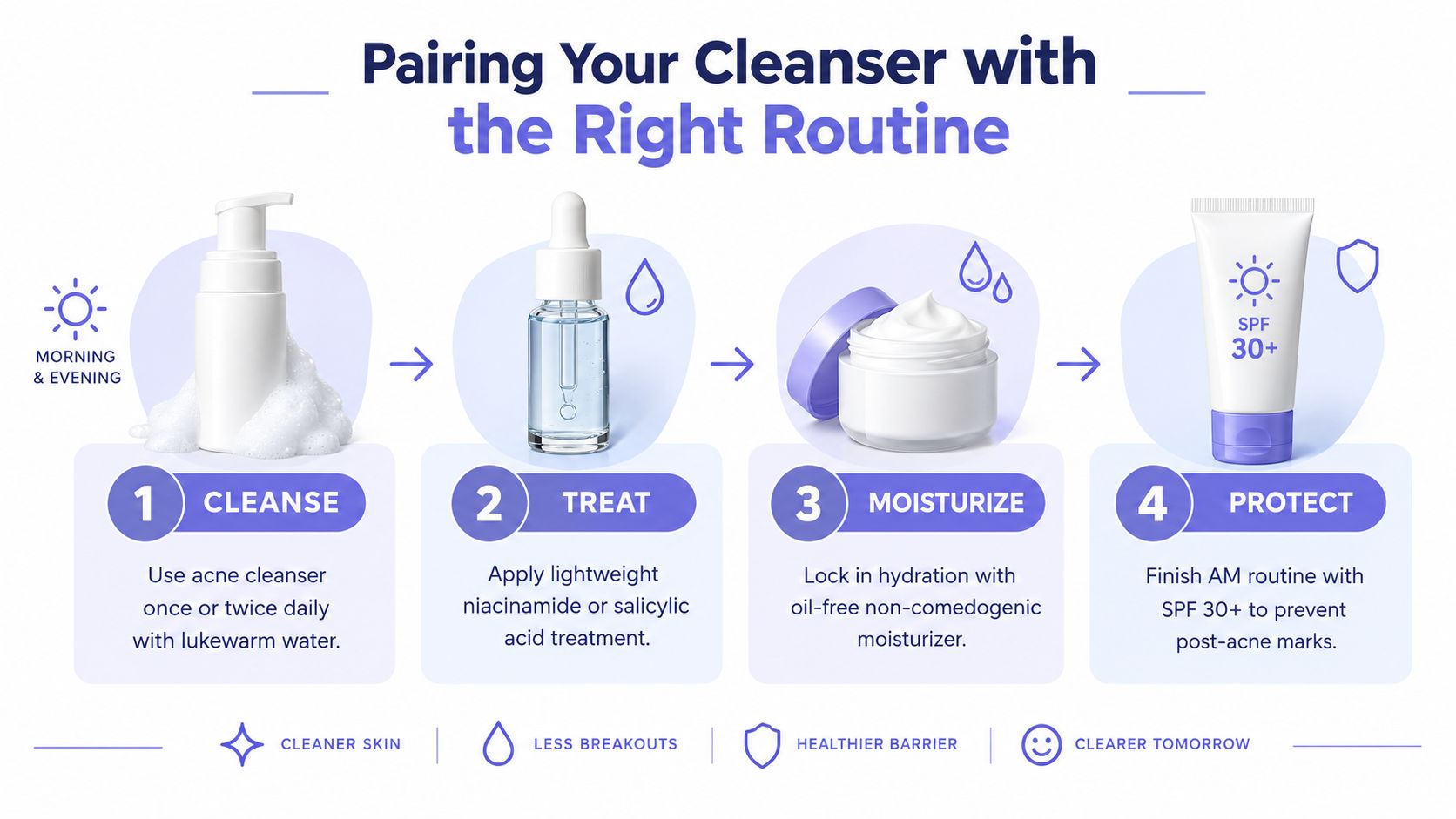
A cleanser is only one part of acne care. Its role is to remove residue and, when formulated with an active ingredient, provide short-contact treatment. Problems begin when users stack multiple strong products without considering irritation.
A practical morning structure
Start with a gentle cleanse or rinse that matches your overnight oil level. If you wake up comfortable and only mildly shiny, an aggressive acne wash may be unnecessary. Follow with a lightweight treatment if needed, then use an oil-free, non-comedogenic moisturizer.
Finish the morning routine with sunscreen. This is especially important when acne and post-inflammatory marks are concerns, because daily sun protection supports a more even-looking complexion while you manage active breakouts.
Keep evening treatment deliberate
At night, cleanse away sunscreen, sweat, makeup, and accumulated residue. Massage gently rather than scrubbing, and rinse thoroughly with lukewarm water. After drying, apply one targeted treatment that your skin already tolerates, then moisturize.
Mayo Clinic advises against using salicylic acid and benzoyl peroxide on the same area unless a doctor specifically recommends the combination, because combining peeling or irritating acne agents can increase discomfort. The relevant benzoyl peroxide safety information from Mayo Clinic supports a practical approach: don't turn every cleansing step into an active-treatment step.
Change the routine by treatment phase
During a breakout, a short-contact benzoyl peroxide wash may be useful for some people. During maintenance, a salicylic acid cleanser or simpler gel may be easier to sustain. During recovery from irritation, choose a bland, barrier-focused cleanser and temporarily reduce other active products.
For persistent or treatment-resistant acne, a professional evaluation adds value. Readers who want broader clinical context can review this acne treatment guide in Santa Barbara while deciding whether cleanser-only care is sufficient.
The Case for Barrier-Preserving Cleanser Technologies
The old assumption says oily skin must choose between effective cleansing and barrier comfort. Newer evidence challenges that trade-off. In my view, the most promising direction is not a stronger active ingredient, but a better delivery system that helps the ingredient work without excessive disruption.
A newer 2% salicylic acid cleanser using polymeric cleansing technology and a microgel complex showed better barrier preservation than a conventional salicylic-acid surfactant cleanser in preclinical testing. The testing reported higher TEER, lower IL-1α release, and less hyperkeratinization. In clinical testing, the formula reduced transepidermal water loss, dryness, and erythema, while acne lesions improved from week 4 and measures including tone, texture, post-inflammatory hyperpigmentation, and self-rated oiliness also improved, with no reported irritation. The clinical report is available through Wiley.
Delivery technology changes the decision
Salicylic acid alone doesn't tell you how a cleanser will behave. Surfactants, polymers, humectants, pH, and rinse characteristics influence the final experience. A product that cleans excess oil while limiting water loss may be more useful over time than a harsher cleanser that produces an immediate but uncomfortable result.
A separate 2026 study evaluated an amino-acid cleanser containing salicylic acid, glucuronolactone, and ceramides. After 4 weeks, it found significant improvements in barrier function, redness, moisture content, texture, and acne-related indicators, with no adverse events reported. The PubMed entry for this study supports the move toward formulas that combine acne-focused ingredients with barrier-supporting components.
Formulation insight: For oily skin, the better question isn't “How strongly does this cleanser strip oil?” It's “Can I use it consistently without provoking dryness, redness, or treatment fatigue?”
If your skin already feels overworked, this guide to repairing a damaged skin barrier offers useful foundational care principles. Barrier preservation doesn't mean accepting clogged pores. It means treating congestion without making the surrounding skin less resilient.
Usage Tips and Common Mistakes to Avoid
Even an excellent cleanser can disappoint if the application is too aggressive or the routine changes too quickly. I recommend treating cleanser use as a controlled pharmaceutical intervention, not as a scrubbing exercise.
Use the product as directed
Wet the face with lukewarm water, apply a modest amount, and massage gently with the fingertips. For benzoyl peroxide wash products, the NHS recommends a contact time of no more than 1 to 2 minutes before rinsing, and a U.S. DailyMed label for a 5% benzoyl peroxide cleanser gives the same massage duration while advising users to start with one daily application and increase only if needed and tolerated. Read the DailyMed instructions for the 5% cleanser.
The “start low, increase slowly” principle protects consistency. If dryness, peeling, or irritation develops, reduce use to once daily or every other day rather than forcing your skin through escalating discomfort.
Avoid the common traps
- Over-cleansing: Washing repeatedly to chase midday shine can increase discomfort without addressing the cause of comedones.
- Scrubbing: Brushes, rough cloths, and vigorous rubbing can irritate active lesions and make a cleanser harder to tolerate.
- Stacking strong actives: Don't automatically combine salicylic acid and benzoyl peroxide on the same area. Mayo Clinic recommends medical guidance for that combination.
- Ignoring pH: Skin-friendly cleanser guidance commonly places formulas around pH 4.5 to 5.5, while acne-specific discussions describe an optimal target around pH 5.4 to 6.0. This pH discussion for oily, acne-prone skin explains why overly alkaline cleansing may be an unhelpful choice.
- Expecting instant acne clearance: A cleanser can support the routine, but persistent acne may require leave-on treatment or professional assessment.
If you're dealing with irritation after a peel or another active procedure, information about clear skin after peel treatment may help you distinguish routine adjustment from a problem that deserves medical review. Stop a product that causes marked swelling, severe burning, or a worsening reaction.
The best acne cleanser for oily skin should leave you clean, comfortable, and able to continue the rest of your regimen. Based on my 16 years in the sector, that balance is more dependable than choosing the harshest wash on the shelf.
Build a routine around oil control and barrier comfort
Healtsy offers pharmacy-oriented skincare, including acne cleansers, moisturizers, sunscreen, and targeted products. Compare suitable formulas, read verified customer reviews, or use the skincare quiz for personalized recommendations.
Visit Healtsy