


Sun Protection
Sunscreen Serum for Face: A Pharmacist's Complete Guide
You're standing at the shelf, holding two or three elegant little bottles that promise “serum” on the front, and the question is annoyingly simple. Which one will protect your face, not just feel nice for 10 minutes? I believe that's the core decision, and it's the one most marketing skips.
I've spent 16 years talking people through sunscreen choices at the counter, and I'm certain this will solve the confusion around sunscreen serum for face products: stop judging by texture first, and start judging by filters, SPF, and how the formula behaves on real skin. If you want a broader sunscreen refresher first, the basics are well laid out in this sun protection guide, but the short version is this, elegant texture means nothing if the UV coverage isn't there.
Why I Think You Are Asking the Wrong Question About Sunscreen Serums
A woman once came to the pharmacy counter with three serum sunscreens in her hand and asked which one was “the strongest.” She was shopping by texture. I was looking at something more useful: whether any of them could give her the daily protection her face needed.
That question matters. If you want the plain-language basics, this sun protection guide covers the core ideas well. SPF measures sunburn protection, and broad-spectrum sunscreens are tested and labeled for UVA and UVB coverage, according to the FDA. So the question is simple: does the formula protect like sunscreen, or just feel like skincare?
Texture sells, filters protect
A serum texture can feel silky, weightless, and easy under makeup. That part is fine. Light feel does not mean weaker protection, and it does not mean better protection either. A serum is only the vehicle. The active filter system inside it, plus the way the label is tested and written, does the essential work.
If a sunscreen serum sounds polished but the label is vague about protection, treat it like any other sunscreen and keep reading.
That is the lens I use with patients, especially people who have been let down by greasy creams, white cast, or formulas that sting the eyes. The bottle's personality does not protect skin. The filters do.
What a Sunscreen Serum Actually Is
A sunscreen serum is a facial sunscreen built to feel fluid, spread easily, and sit more like skincare than a classic cream. In practice, that usually means lower oil content, lighter polymers, and a water or silicone base that gives a thinner, more elegant finish. Some formulas also use humectants like glycerin or hyaluronic acid, which are good label clues that you're looking at a serum-style architecture rather than a heavy cream.
The best way to read it is on the ingredient list. If you see humectants high up, a slim emollient base, and a texture described as lightweight, fluid, or airy, you're usually looking at a serum format. That doesn't tell you whether it's good, but it does tell you how it's built and what kind of skin it may suit.
The four texture families I compare in real life
Creams are thicker and often best for dry skin or anyone who wants more cushion. Lotions are lighter and easier to spread, which makes them a practical middle ground. Gel formulas often rely on more alcohol or fast-evaporating solvents, so they can feel crisp but may be less comfortable on very reactive skin. Serums sit at the thinnest end of the spectrum, and that's exactly why people who hate “sunscreen feel” keep gravitating toward them.
| Sunscreen Texture Families Compared | Typical Vehicle | Finish on Skin | Best For |
|---|---|---|---|
| Cream | Rich emulsion | Cushioned, often dewier | Dry, mature, or very dry skin |
| Lotion | Balanced emulsion | Light, familiar | Normal to combination skin |
| Gel | Alcohol-rich or fast-dry base | Clean, quick-setting | Oily skin, though not always sensitive skin |
| Serum | Fluid water or silicone base | Barely there, elegant | Oily, combination, makeup wearers, layered routines |
The right choice depends on tolerance as much as preference. A serum can be a smart daily option, but it's not automatically the safest or most nourishing. I'd rather see a patient choose a slightly less glamorous lotion that they will consistently use than a serum they under-apply because it feels “too light” to matter.
The Active Filters Inside a Face Sunscreen Serum
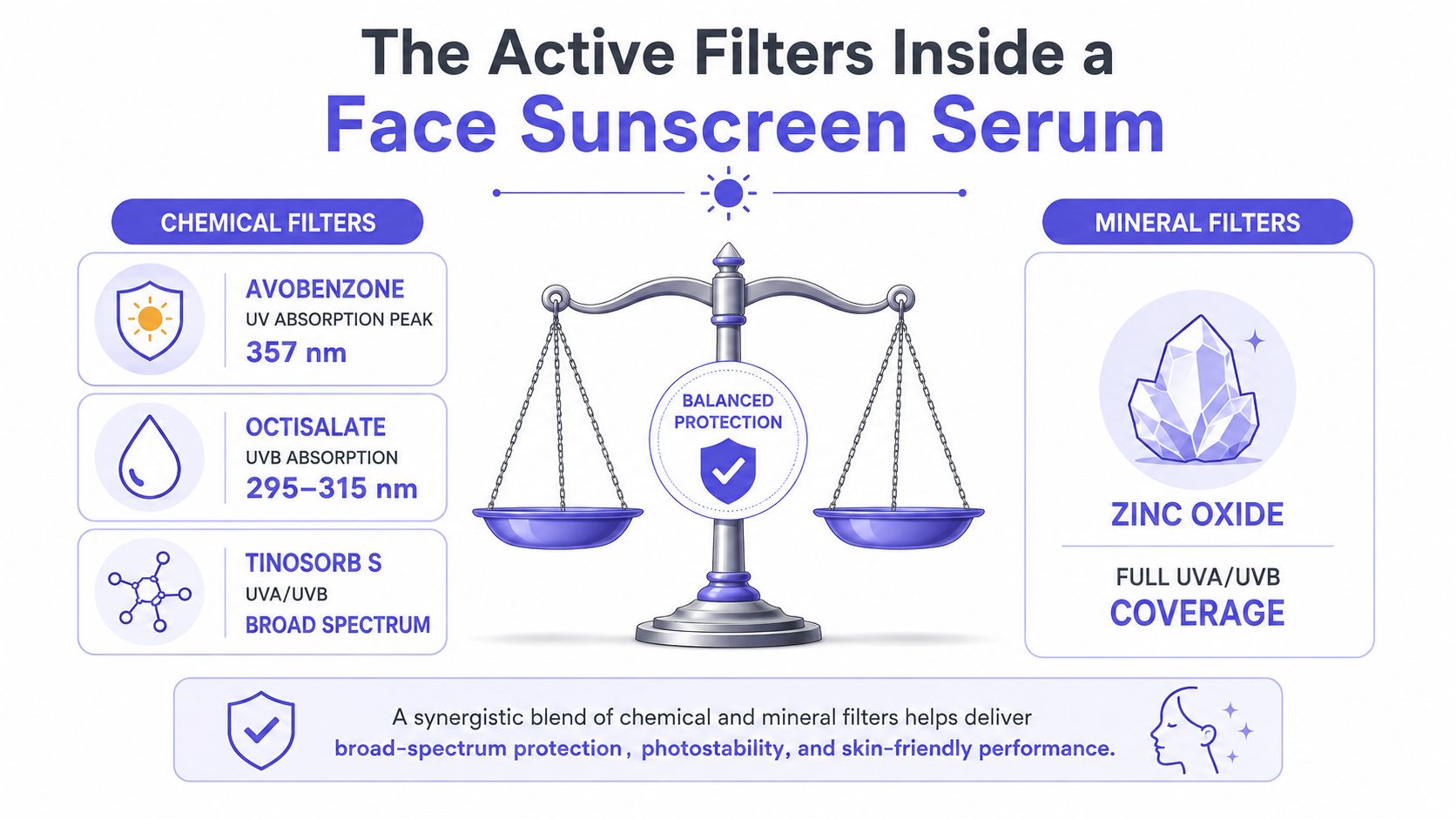
A sunscreen serum can be built around chemical filters, mineral filters, or a hybrid of both. The feel changes with the filter system, but so does the way the product behaves on skin. That's why reading the active ingredients matters more than assuming all serums are alike.
Chemical, or organic, filters such as avobenzone, octisalate, and filter systems like Tinosorb S absorb UV radiation and convert it into less harmful energy. Mineral, or inorganic, filters like zinc oxide and titanium dioxide work differently, they sit on the skin and help scatter and reflect UV. Hybrid formulas combine both approaches, which is often how brands balance elegance with protection.
A good label example makes this obvious. One serum sunscreen listed in FDA DailyMed uses avobenzone 3%, homosalate 13.5%, octisalate 5%, and octocrylene 10% at SPF 60 broad-spectrum, which proves the point that “serum” is about texture, not weak defense (DailyMed label). If you want the pharmacy-side comparison between filter families, this mineral vs. chemical sunscreen guide is a useful companion.
What serum formulas have to solve
Serum formats need filters that stay dissolved or evenly dispersed in a thinner base. That's harder than it sounds. Older filters can be trickier to stabilize, and some formulas work hard to reduce white cast or the sticky finish people hate. That is why a high-end serum can still sting, pill, or feel greasy if the formulation isn't balanced.
I don't judge a serum by the marketing word “clean” or “light.” I judge it by whether the active filters are photostable, broad-spectrum, and comfortable enough for daily use.
The practical takeaway is simple. Zinc oxide tends to be the easiest starting point for sensitive faces. Hybrid formulas often give the best compromise when you want elegance without sacrificing coverage. And if a serum contains a filter system that hasn't been clearly positioned for broad-spectrum use, I'd move on.
SPF and PA Numbers Explained Without the Jargon
SPF numbers confuse people because they sound more dramatic than they are. In the U.S., SPF 30, SPF 50, and SPF 50+ all measure UVB burn protection, but the label only tells part of the story unless the product also passes broad-spectrum testing (FDA sunscreen basics, FDA broad-spectrum labeling). For daily face wear, I care less about chasing the biggest number and more about choosing a formula you can apply correctly and keep using.
The European Union is more direct about UVA. Sunscreen guidance expects a UVA protection factor of at least one-third of the declared SPF, plus a critical wavelength of at least 370 nm to show coverage into the long-UVA range (EU sunscreen recommendation). That is the cleaner way to judge a facial sunscreen, because it ties the label to UVA performance instead of only burn prevention.
The label I prefer for everyday wear
| SPF and PA Ratings at a Glance | UVB Protection | UVA Protection | Standard |
|---|---|---|---|
| SPF 30 | Solid everyday UVB protection | Depends on broad-spectrum testing | U.S. or EU |
| SPF 50 | Higher UVB protection | Depends on broad-spectrum testing | U.S. or EU |
| SPF 50+ | Very high UVB protection | Depends on broad-spectrum testing | Common in EU categories |
| PA+ to PA++++ | Not used for UVB rating | UVA protection increases with more plus signs | Common in Asia |
The PA system is a UVA shorthand used in some markets. More plus signs mean stronger UVA defense. For routine office days, errands, and incidental daylight, I want a broad-spectrum label with at least SPF 30. For longer outdoor exposure, I prefer SPF 50 or 50+ with clear UVA confirmation, because SPF alone can make people think they are covered when they are not. If you need to plan reapplication around that higher exposure, this guide to when to reapply sunscreen keeps it simple.
Choose the highest protection you can comfortably wear every day, but never buy a serum just because the texture feels sophisticated.
Who a Sunscreen Serum Suits and Who Should Skip It
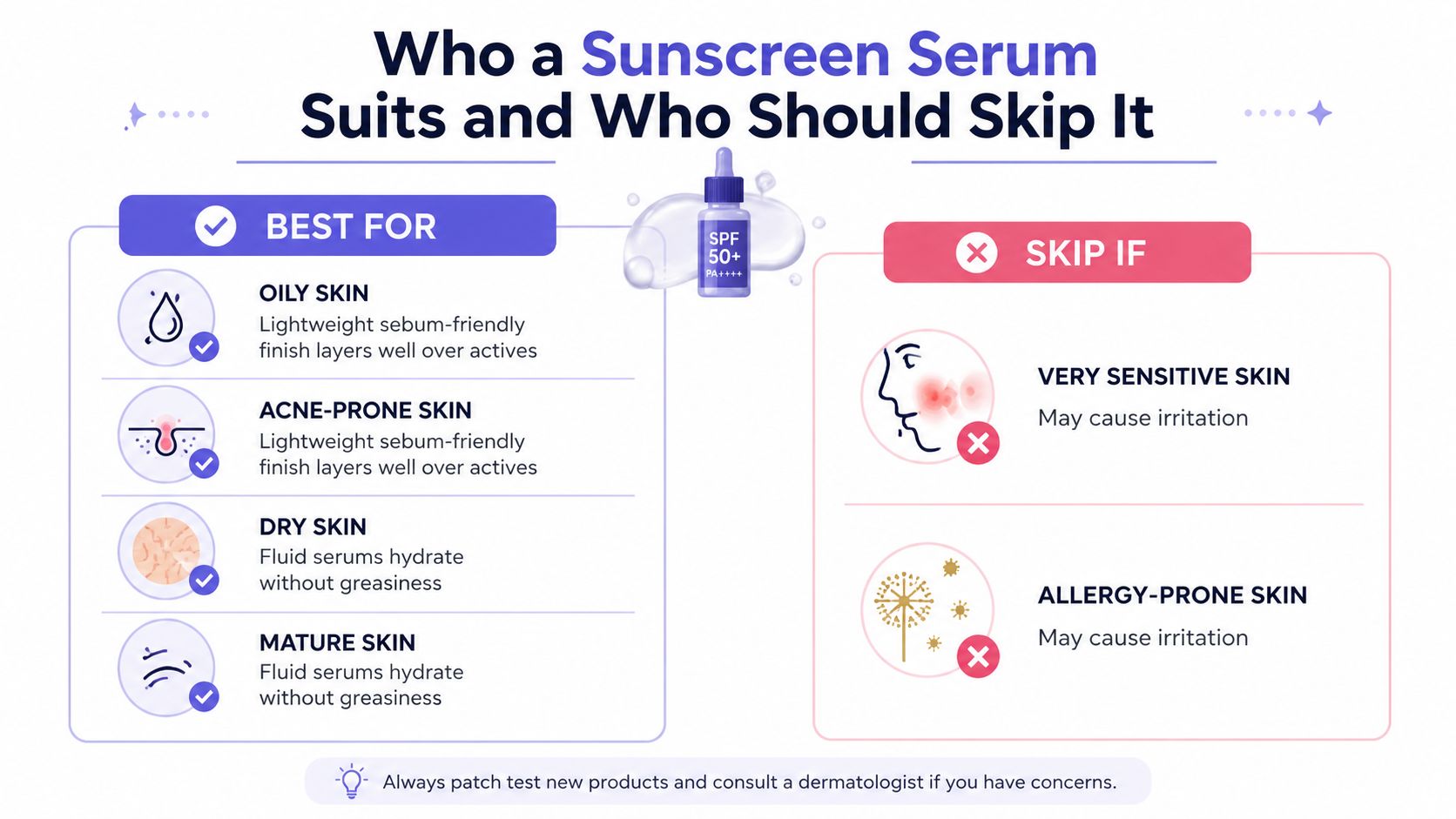
Serum sunscreens make the most sense for people who hate heaviness. Oily and acne-prone skin usually tolerates the lighter finish better, especially when the formula layers cleanly over treatment products. That's one reason a lot of people who wear niacinamide or vitamin C in the morning end up liking serum SPFs more than traditional creams.
Dry or mature skin can still use a serum sunscreen, but I usually tell those patients to treat it as part of a layered routine, not the whole routine. A fluid formula may not feel cushioning enough on its own, especially in cold weather or indoors with dry air. Sensitive or rosacea-prone skin needs more caution, and I'd steer those readers toward mineral or very short-ingredient hybrid formulas. The editorial gap here is real, because many SPF serums are loaded with alcohols, fragrance, botanicals, or essential oils, and those are exactly the ingredients that can bother reactive skin (CNN Underscored on SPF serums).
If you're considering a procedure like a facial chemical peel, or you've recently done one, I'd be even stricter about formula choice. The skin barrier is not the time to gamble on a heavily scented serum.
My practical decision framework
- Choose a serum if you want a light finish, wear makeup, or layer several morning actives.
- Choose a cream or richer hybrid if your skin feels tight, flaky, or weather-beaten.
- Choose mineral or fragrance-free hybrid if you flush easily, sting with products, or have a history of contact sensitivity.
- Skip serum as your only sunscreen if you swim, sweat heavily, or spend long periods outdoors and need a formula you can trust to stay comfortable and reapplied.
If you want a rosacea-specific perspective, I'd look at this sunscreen for rosacea skin guide. The bottom line is that serum texture should serve your skin, not seduce you into buying the wrong formula.
How to Layer a Sunscreen Serum in Your Morning Routine
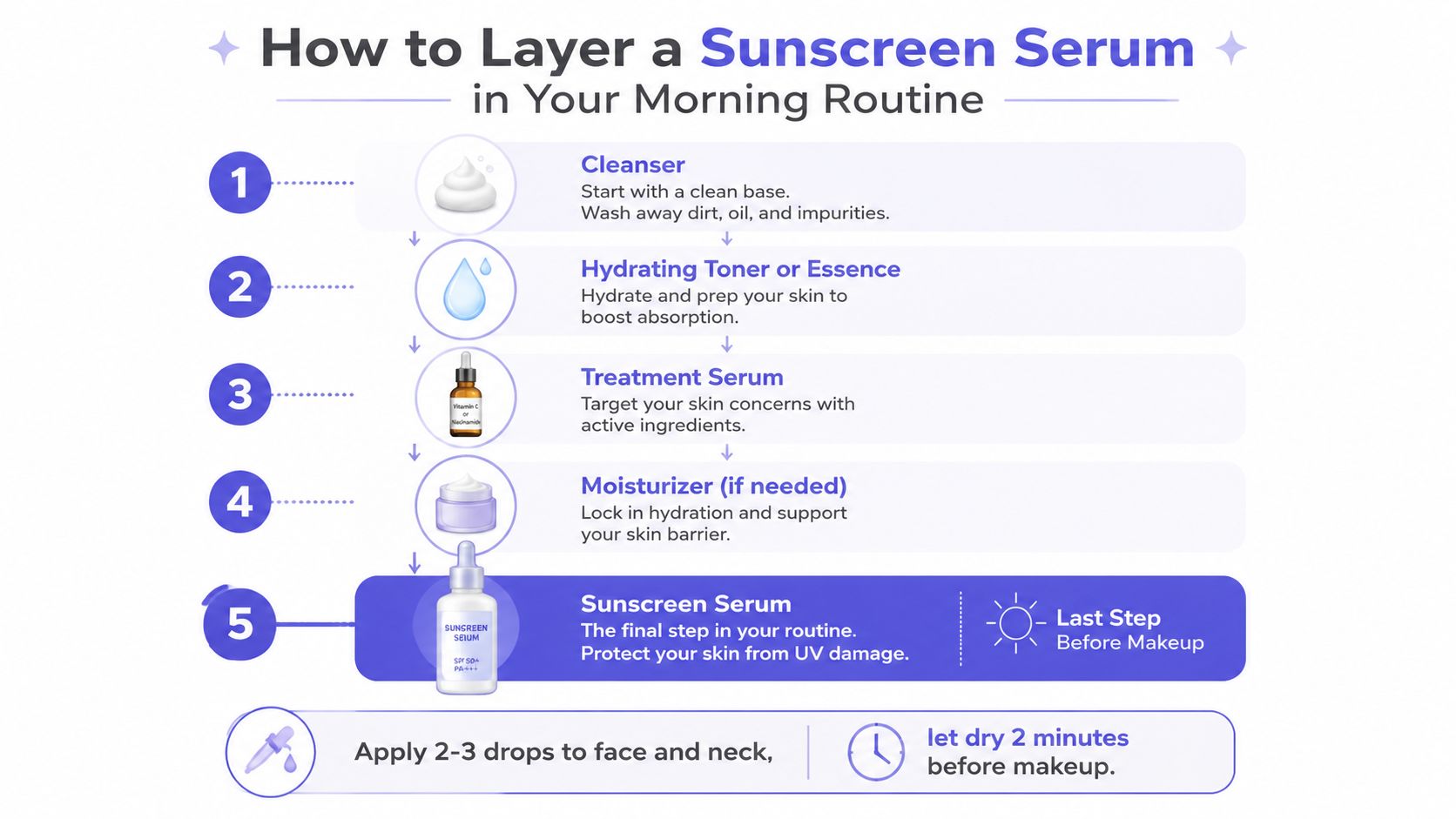
Start with cleanser, then use a hydrating toner or essence, followed by your treatment serum and moisturizer if you need it. Put the sunscreen serum on last, before makeup. That order keeps the SPF film on top, where it can do its job without being diluted by what came before. If you want a clean reference for layering, the order of skincare products Canada guide lays out the sequence plainly.
I tell people to give moisturizer a moment to settle before SPF goes on. That small pause helps reduce pilling and keeps the finish more even. Vitamin C and niacinamide sit well underneath a sunscreen serum for many users, and if you want a tighter guide on that pairing, use this niacinamide and vitamin C layering guide. Retinol stays out of the morning routine.
How much to use and when to reapply
The serum texture does not lower the application amount. Dermatologist guidance cited by Allure says a nickel-sized dollop, or roughly half a teaspoon for the face and neck, is needed to reach the labeled protection level, and using less can materially reduce real-world SPF performance (Allure sunscreen serum guidance). That is the amount I stand behind when someone says, “It feels so light, do I really need that much?” Yes.
- Apply enough: use the full amount needed for face and neck coverage.
- Let it set: wait about 2 minutes before makeup so the film can dry down.
- Reapply during sun exposure: reapply every 2 hours when you're outdoors or in direct daylight (reapplication guide).
- Don't mix it with foundation or retinol: mixing changes the formula's intended film and can compromise wear.
Keep the rest of the morning routine simple. Vitamin C and niacinamide are usually fine before SPF if your skin tolerates them. AHA/BHA exfoliants belong in routines where the barrier is calm, and if they sting in the morning, move them to another time of day. If a product pills under makeup, use less of the layer underneath, not less sunscreen.
Beliefs I Hear Every Week That Deserve a Second Look
The same three lines come up at the counter all the time. “SPF 50 blocks 98% of rays, so SPF 100 is overkill.” “Serums need less product because they're concentrated.” “Mineral is always safer for sensitive skin.” Each one has a kernel of truth, and each one gets misused.
SPF 50 does block about 98% of UVB, and SPF 100 blocks about 99%. That is a real difference, but it is a modest one, not magical armor, and it shrinks fast if you sweat, rub, or apply too little. That's why I keep bringing people back to application habits instead of chasing the biggest label on the shelf.
Myth and reality at the shelf
| Myth | Reality |
|---|---|
| SPF 50 means you can relax | Reapplication and proper amount still matter |
| Serum means less product | Serum texture still needs the full face amount |
| Mineral is always gentler | Mineral can still irritate, pill, or feel drying |
The “serum needs less” idea is the one I correct most often. Sunscreen testing is done at 2 mg/cm², regardless of texture, so a serum sunscreen still needs the same disciplined amount as a cream if you want the label to mean anything. That's the part glossy ads leave out.
Mineral filters do have real advantages. Zinc oxide and titanium dioxide can be easier around the eyes, and many people who hate chemical sunscreens tolerate mineral better. But mineral is not a guaranteed safe zone. A product can still pill, clog pores, or trigger contact dermatitis if the rest of the formula is not suited to the person using it. Some hybrid formulas with modern filters like Tinosorb S are better tolerated than people expect, and that matters more than the mineral-versus-chemical label alone.
My blunt advice: read the in vivo test data and the ingredient list, not the finish on your hand.
Build a sunscreen routine that fits your skin
Healtsy gives you pharmacy-grade skincare, sunscreen, and sensitive-skin options in one place, which is where this conversation belongs. Compare face SPF formats, filter systems, and skin-friendly routines without the marketing noise.
Visit Healtsy