


You've rinsed your hair, but your scalp still stings. There are flakes on the dark shirt you laid out, and your browser is full of results for shampoo para eczema capilar, all promising something similar. Before buying another bottle, the useful question isn't which shampoo sounds strongest. It's whether your scalp needs a gentler wash, a condition-specific active, or a professional assessment.
Why an Itchy Scalp Sends You Searching
A recurring wash-day flare can make every decision feel wrong. Wash more often and your scalp feels uncomfortable. Leave it longer and the flakes become harder to ignore. A shampoo that seems helpful during one flare may sting during another.
I believe this search usually begins with frustration rather than a confirmed diagnosis. People use scalp eczema to describe several problems, and those problems don't all respond to the same cleansing routine. Seborrheic dermatitis is particularly relevant, but it isn't interchangeable with atopic eczema or a reaction to a new product.
Common symptoms don't mean a single cause
Estimates illustrate how much the underlying condition and study population matter. Reviews place seborrheic dermatitis at approximately 3%–10% of the general population, with another estimate around 11.6%; differences in diagnostic criteria and populations help explain that variation, as outlined in this clinical review of seborrheic dermatitis. The same evidence summary reports an international scalp study with 3.3% overall prevalence, including 3.8% in urban, 2.1% in semi-urban, and 1.8% in rural populations, alongside atopic dermatitis estimates of 10%–30% of children and 2%–10% of adults in developed countries.
Those figures shouldn't encourage self-diagnosis. They explain why two people comparing flakes in the bathroom mirror may need different advice. A bottle intended for seborrheic dermatitis doesn't automatically suit someone with very dry atopic skin.
The starting point: Describe what happens before, during, and after washing before deciding what to buy.
Useful observations are more specific than “my scalp is sensitive.” Does the scale look greasy or dry? Did the discomfort begin after a new shampoo? Does burning start during the rinse, or does itching continue between washes?
This is a complete guide to choosing more safely, not a promise that one bottle will settle every flare. The practical sequence is simple: understand the scalp picture, read the whole label, use the chosen formula correctly, and recognize when shopping is no longer the right next step.
What Scalp Eczema Usually Means
“Eczema” on a shopping list isn't a diagnosis. The distinction matters most when you're standing under running water deciding whether to repeat a product that irritated you last time.
The concept map below separates the main eczema-related possibilities.
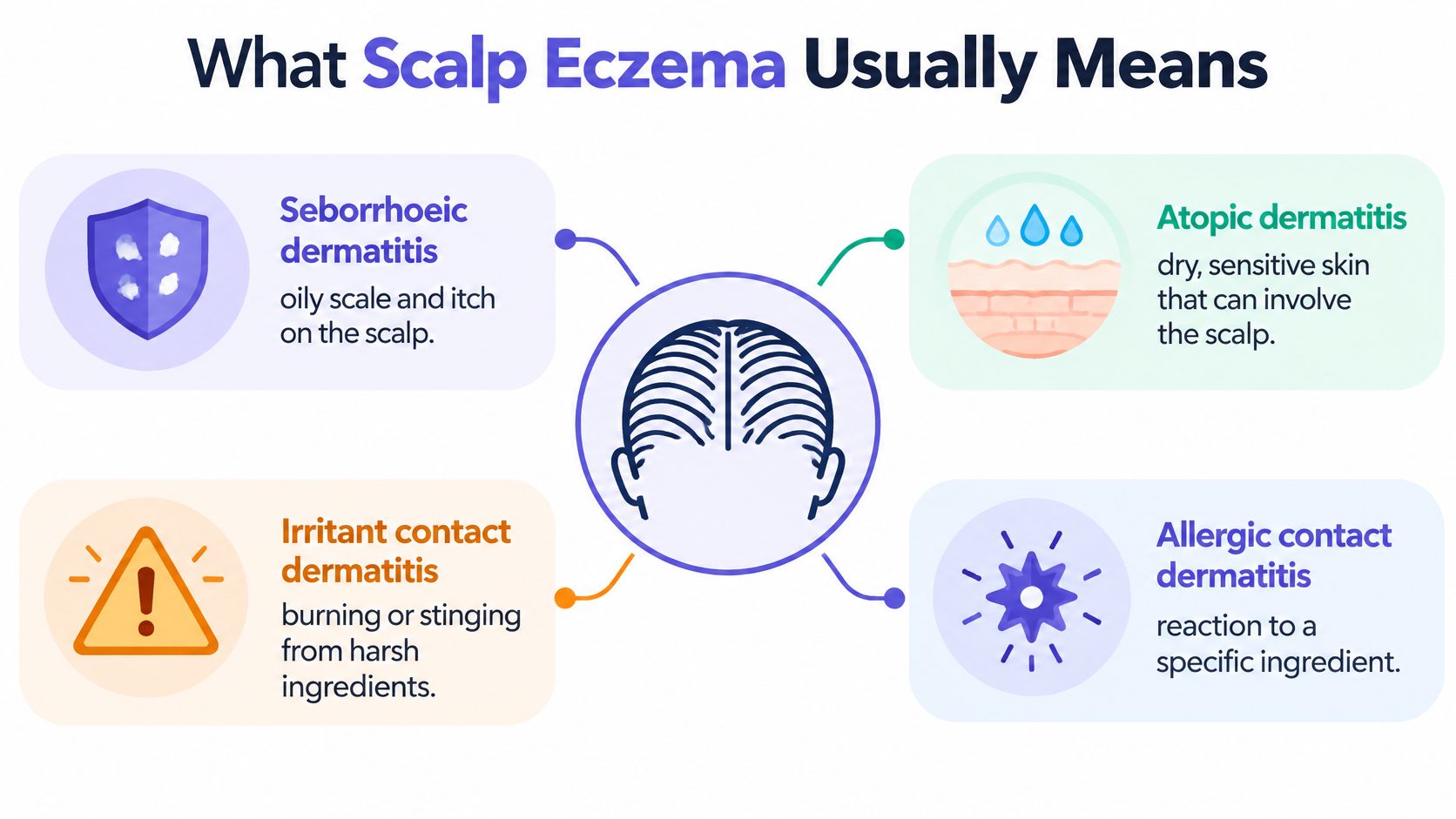
Describe the pattern without diagnosing it
- Greasy or yellowish scale: This can point toward seborrheic dermatitis, particularly when the problem recurs.
- Dry, cracked, intensely itchy skin: This deserves a different conversation from oily dandruff, including whether atopic dermatitis is involved.
- Burning after washing: Irritant contact dermatitis is a possibility, especially after a formula change.
- A reaction to a particular ingredient: Allergic contact dermatitis may require ingredient-level investigation rather than choosing a different active.
- Persistent, adherent scale: Psoriasis is another look-alike that shouldn't be folded automatically into an eczema routine.
These are clues to discuss with a pharmacist or clinician, not diagnostic rules. Our explanation of eczema and how to care for affected skin provides broader context beyond the scalp.
For seborrheic dermatitis, recognized shampoo options include ketoconazole, ciclopirox, selenium sulfide, zinc pyrithione, salicylic acid, sulfur, and tar. Mayo Clinic's seborrheic dermatitis guidance describes condition-specific treatment choices, rather than one universal eczema wash. A medicated schedule intended for this condition shouldn't be copied onto a very dry or contact-allergic scalp.
The cleansing base matters too
Medicated doesn't mean gentler. A suitable active can sit inside a formula that your skin doesn't tolerate. A surfactant such as coco betaine, rather than the headline active, can be relevant when contact allergy is being investigated.
That's why the complete ingredient list matters when reporting a reaction. Keep the bottle or photograph its label rather than remembering only the product name.
If you're also reviewing your bathroom environment, the discussion of skin and hair with Water Filter Advisor offers background on hard-water concerns. Treat that as context, not evidence that water explains your rash or that changing it replaces an assessment.
Ingredients to Seek and Ingredients to Skip
Turn the bottle around before concentrating on the claims across its front. I believe reducing irritant exposure is more useful than hunting for an ingredient vaguely described as an “eczema active.”
Use this label guide as a starting point, not a universal blacklist.
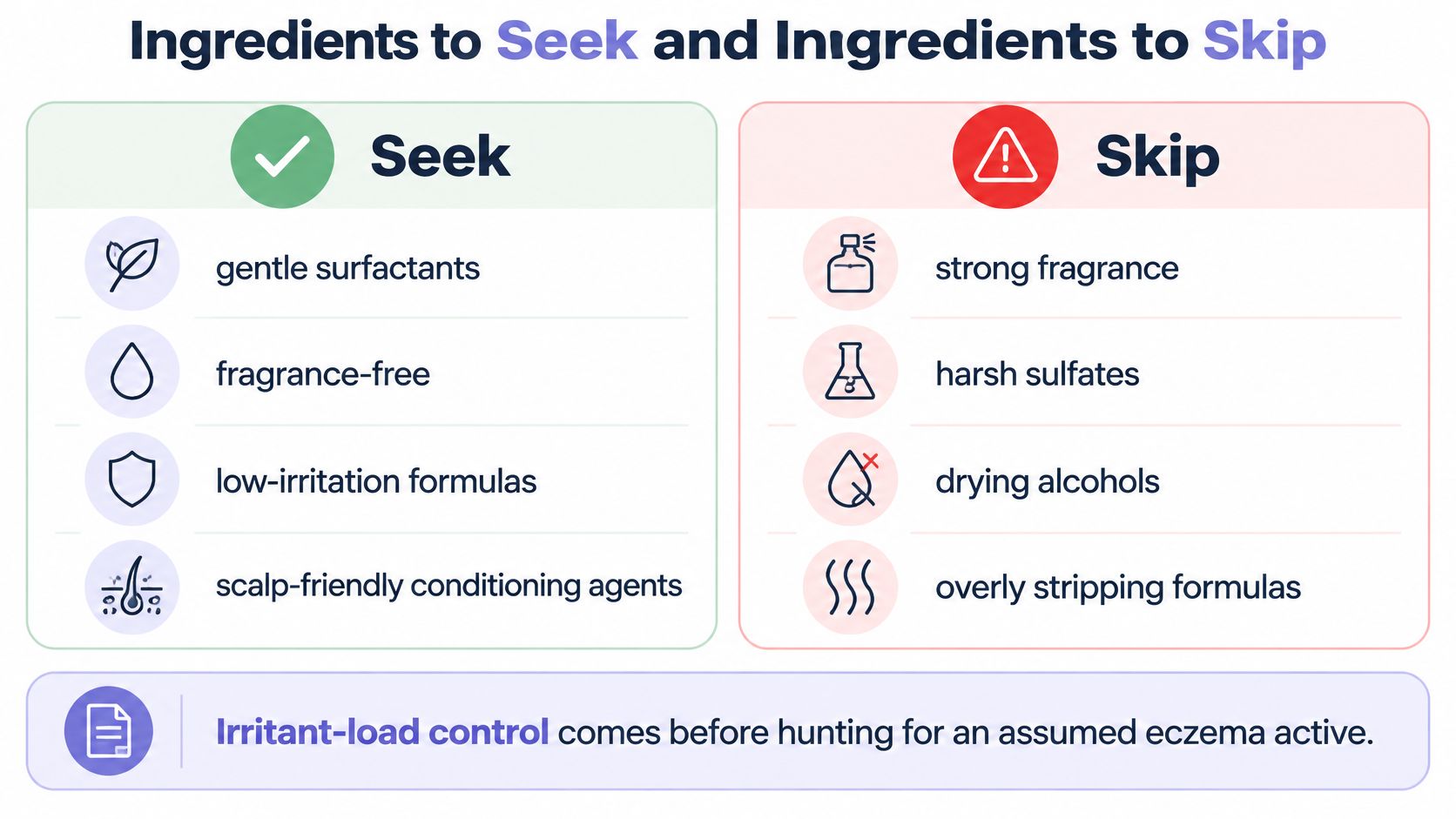
Read the cleansing base before the headline ingredient
The National Eczema Society's scalp eczema guidance identifies detergents, particularly sodium lauryl sulfate, and fragrance as potential aggravators. Anionic surfactants can remove surface lipids, while fragrance compounds and essential oils can sensitise susceptible users.
Think of the difference between cleaning a greasy pan and washing already sore skin. Strong grease removal can be useful in the kitchen, but an inflamed scalp may tolerate it poorly. The comparison explains the trade-off, not a reason to classify every sulfate-containing formula as unsuitable.
A practical label pass looks like this:
- Seek fragrance-free wording: Don't assume a botanical scent or essential oil is automatically kinder.
- Check the cleansing base: Prefer a low-irritant formula intended for sensitive skin, while remembering that individual tolerance still matters.
- Skip repeat offenders: Don't keep using a product that reliably causes burning because its marketing sounds reassuring.
- Read the directions: More lather time isn't necessarily more benefit, especially on irritated skin.
Our guide to anti-dandruff shampoo ingredients can help distinguish a cleansing ingredient from an ingredient intended to address flakes.
Accept the texture trade-off
If conventional shampoo repeatedly burns, an emollient wash may be better tolerated. The honest drawback is that it can leave hair greasy, so hair type and styling needs belong in the decision.
On an ordinary work morning, a theoretically gentle wash that leaves you unwilling to use it isn't a complete solution. Discuss a tolerable alternative rather than compensating with increasingly aggressive cleansing afterward.
The following video provides an additional visual resource alongside the written label checks.
Don't interpret the infographic's skip column as proof that every alcohol or sulfate is harmful. The complete formulation and your response matter. Persistent scale, marked redness, oozing, pain, or hair loss needs assessment rather than another round of ingredient elimination.
Matching a Formula to the Flakes You See
At the pharmacy shelf, two bottles can both promise "relief" while treating entirely different problems. A scalp shedding greasy yellowish scale is asking something different from one that feels tight and fissured after every wash, and I believe the flakes themselves are the first label worth reading. Antifungal shampoo earns its place mainly against seborrheic dermatitis. Atopic eczema is a separate problem, and a stronger anti-dandruff active may add irritation.
In a four-week comparison, ketoconazole 2% improved total dandruff severity by 73%, compared with 67% for zinc pyrithione 1%, with a statistically significant difference of p < 0.02, according to this review of ketoconazole shampoo evidence. The same review describes a trial in which ketoconazole 2% and selenium sulfide 2.5%, used twice weekly for four weeks, both outperformed placebo without a significant efficacy difference between them; selenium sulfide caused more adverse effects.
Which Scalp Picture Points to Which Shampoo Type
| What you notice | Ingredient family | How to use the clue |
|---|---|---|
| Recurring greasy or yellowish scale | Antifungals such as ketoconazole or ciclopirox | Ask whether seborrheic dermatitis is the likely diagnosis before choosing an active. |
| Heavy, stuck-on scale | Keratolytics such as salicylic acid | Scale removal may be relevant, and irritation plus the underlying diagnosis still matter. |
| A seborrheic pattern needing another option | Selenium sulfide or zinc pyrithione | Compare tolerance and label directions rather than front-label promises. |
| A situation where another listed option is appropriate | Coal tar | It's an option, rarely the automatic starting point. |
| Dry fissuring or washing-related burning | A low-irritant cleansing approach | A stronger anti-dandruff active may miss the problem entirely. |
DermNet's seborrheic dermatitis guidance lists these ingredient categories and notes that some Malassezia strains can resist azole antifungals. One unsuccessful active says little about the rest of the category. Switching or alternating products is still a conversation better held with a professional.
That last table row deserves a second look. When a medicated shampoo stings, the sting sometimes comes from the surfactant base doing the washing while the active itself is blameless. Trying the same active in a milder base is a different experiment from abandoning the active altogether, and reading past the front panel is how you tell the two situations apart.
Where a specialist cosmetic formula fits
The ingredient families above describe categories, and the step from category to specific bottle needs a boundary. For readers whose scalp symptoms have already been assessed as consistent with psoriasis or seborrheic dermatitis, one example of a specialist cosmetic wash is Boderm Bionatar Shampoo - 200ml, also sold as Boderm Bionatar Shampoo - 300ml. The formula combines ichthyol (sodium shale oil sulphonate) with Salix alba extract in a cleansing, exfoliating, and soothing base.
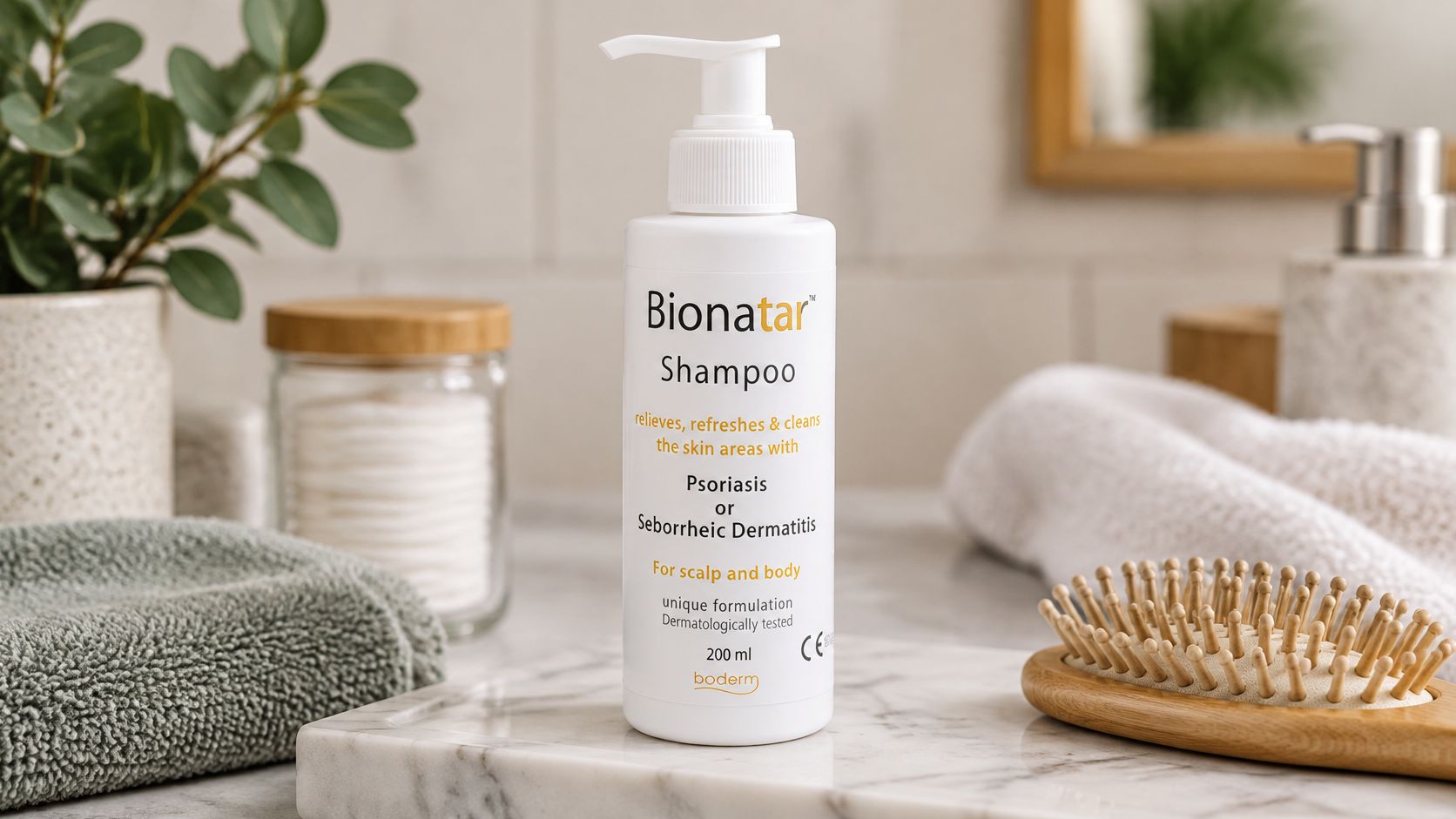
A formula like this fits an already identified pattern. It cannot settle which diagnosis an uncertain eruption belongs to, and it remains a cosmetic wash rather than a medicine or a cure for every eczema. Healtsy stocks this type of European pharmacy scalp care alongside brands such as Ducray and Klorane for shoppers who cannot find it locally.
When the flakes match no row cleanly, comparing the difference between eczema and psoriasis helps you arrive at an appointment with sharper questions. An uncertain scalp eruption still needs examination, since the bottle that calms one condition can aggravate its look-alike.
A Wash Routine That Reaches the Scalp
It's evening, you're tired, and the natural impulse is to wash quickly. The shampoo goes across the hair, produces foam, and disappears down the drain before you've checked whether it reached the affected skin.
Placement, contact time, and frequency are part of correct use. They aren't optional extras added after choosing a formula.
The routine below keeps attention on the scalp rather than the visible hair alone.
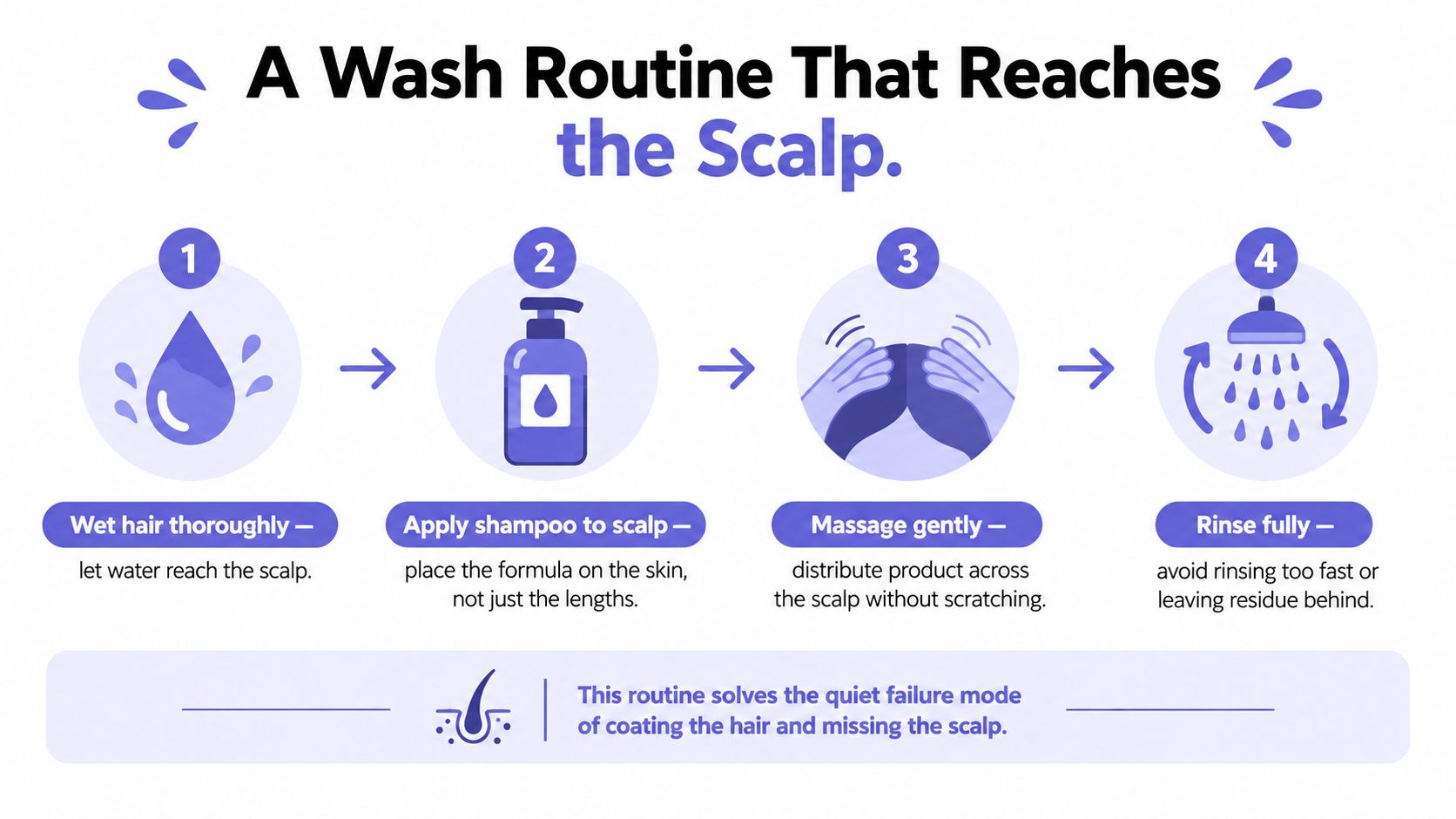
Use the bottle's clock
The American Academy of Dermatology's treatment guidance describes many patients using dandruff shampoo twice weekly for four weeks, with at least three days between washes. It also describes schedules of two to three times weekly for straight or wavy hair and potentially once weekly for curly or tightly coiled hair, with weekly maintenance commonly used after control.
These are examples of clinical schedules, not interchangeable instructions for every bottle. Hair texture, the active, the formulation, and your clinician's advice can change the plan.
Follow the package contact time rather than rinsing immediately or inventing a longer treatment. Leaving a product on beyond its directions isn't a sensible way to compensate for missed applications.
Make the application deliberate
- Wet the scalp thoroughly: Let water reach the skin beneath the hair before applying the formula.
- Place shampoo on the scalp: Distribute it across the relevant skin rather than concentrating everything on the lengths.
- Massage gently and time it: Use fingertips without scratching, and follow the labeled contact period.
- Rinse fully: Remove the lather thoroughly, including around the hairline and behind the ears.
Don't confuse a larger cloud of foam with better contact where the product is meant to work.
Keep fragrance-heavy styling products away from an already angry hairline while you're assessing tolerance. On other washing days, choose any accompanying cleanser according to your plan rather than automatically repeating the medicated product.
Our guide to what makes a good shampoo offers broader label-reading context. If irritation begins, the next move is to review the product and schedule, not extend the contact time.
Babies, Pregnancy, and a Shampoo That Burns
A parent looking at infant scalp scale isn't making the same decision as an adult with a diagnosed recurring condition. Nor is someone who's pregnant and uncertain about an active. The person using the bottle matters as much as the wording on it.
The baby at bath time
Don't copy an adult medicated schedule onto an infant. I believe the safest starting point is an age-appropriate label and advice from a clinician or pharmacist, particularly when the skin looks inflamed or the diagnosis is uncertain.
Our baby hygiene and care guide provides general care context. It isn't permission to substitute an adult scalp product for infant advice.
The pregnant shopper checking the label
Someone who used a shampoo before pregnancy may reasonably want to check it again. Confirm the exact product and active with a pharmacist or clinician rather than relying on a familiar brand name or a copied routine.
The evidence behind medicated scalp shampoos largely concerns antifungal care for seborrheic dermatitis. The Cochrane evidence review of scalp seborrheic dermatitis treatments found that ketoconazole shampoo improved scaling against placebo for up to 43 days and improved itching, redness, and dandruff at four weeks; it describes ketoconazole 2% as a first-line option, commonly studied twice weekly for four weeks, followed by once weekly or every other week for maintenance.
That evidence doesn't establish suitability during pregnancy for every formulation. It also doesn't turn a medicated antifungal shampoo and a gentle non-medicated cleanser into equivalent categories.
The adult whose shampoo makes things worse
You use the “eczema shampoo” again, hoping the discomfort was temporary, and the next wash burns more. Don't interpret worsening as proof that the product is working.
The Cochrane review also found selenium sulfide effective, but with a more limited evidence base and more reported burning and itching than ketoconazole. That makes tolerability a real part of the choice, not a minor inconvenience.
Stop the experiment: Worsening inflammation, pain, oozing, hair loss, or a spreading rash calls for professional assessment.
Evidence for seborrheic dermatitis shouldn't be presented as a treatment claim for atopic dermatitis, contact dermatitis, psoriasis, or unexplained irritation. Bring the product label and a description of what happened to the consultation.
Choose the Next Bottle with a Clear Plan
A useful search for shampoo para eczema capilar ends with a reason for choosing a formula, not a more persuasive product description. The scalp picture, the cleansing base, and any active need to make sense together.
Greasy recurring scale may justify a condition-specific or exfoliating approach. Dry cracking or burning that starts the moment the lather touches the scalp points to tolerance first, and in my experience the surfactant is just as often the problem as the active. A gentle active in a harsh cleansing base is still a harsh wash. If discomfort persists, that observation belongs in a consultation, not another order. "Medicated" and "gentler" aren't synonyms.
Make the purchase decision specific
Before placing an order, write down what you need the product to do and what made previous washes uncomfortable. That keeps the decision grounded in symptoms rather than bottle size or marketing language.
Record five things:
- The active you intend to use, and why it matches your assessment.
- The suspected condition that active is meant to address.
- The contact schedule, including how long the lather stays on the scalp.
- The ingredients you have reacted to, so the new label can be checked against them.
- The warning signs that should stop use, decided before the first wash.
If those five points do not support a clear choice, seek pharmacist or clinician advice before buying. If your assessment has identified psoriasis or seborrheic dermatitis as relevant, the ichthyol and Salix alba formula described earlier is one option to raise at that consultation.
Healtsy's catalogue includes scalp care alongside shampoos, conditioners, masks, leave-in products, and other hair care, and it addresses concerns including eczema and seborrheic dermatitis, with European pharmacy brands such as Dercos, Ducray, and Klorane among many others.
Know what you're ordering internationally
Our product information is pharmacist-reviewed, and products are original European pharmacy and parapharmacy items sourced through authorised distribution. Orders ship from Europe to international customers, including shoppers who can't find the same product locally.
- Check the exact presentation: Match the product name and formula to the one you intended to buy.
- Separate cosmetics from medicines: Healtsy sells no medicines, and cosmetic scalp care shouldn't be treated as a substitute for prescribed treatment.
- Keep safety ahead of quantity: Pain, ooze, hair loss, or a spreading rash means the next step is a dermatologist, not a larger size.
I believe the most helpful recommendation is one you can explain calmly: why this formula, why this routine, and what would make you stop. That's a better basis for wash day than another promise of universal relief.
Healtsy offers original European pharmacy and parapharmacy hair care with pharmacist-reviewed product information to help you compare formulas for specific scalp concerns. Visit Healtsy to check specialist shampoo ingredients, suitability, and directions before choosing your next bottle.