


Moisturizing Shower Gel: The Complete Pharmacy Guide
You step out of the shower feeling clean, then notice the familiar tightness across your legs, arms, or back. A few minutes later, the skin may feel itchy, rough, or uncomfortable under your clothes. If this happens regularly, your cleanser and shower habits may be removing more than dirt.
After 16 years in pharmacy, I've learned that the best body-care advice starts with realistic expectations. A moisturizing shower gel can support the skin barrier, but it shouldn't be treated as a complete replacement for a leave-on moisturizer in every situation. I believe the most useful approach is to choose a well-designed cleanser, use it gently, and understand exactly what it can and can't do.
Why Your Skin Feels Tight After Showering
A customer once described her evening routine to me: a long, hot shower, a strongly fragranced bar of soap, and no body lotion because she was too tired to apply one. Her skin felt comfortable while the water was running, but within minutes her shins became tight and itchy. She assumed the sensation meant the soap had worked thoroughly.
It didn't. Post-shower tightness is usually a sign that the skin has lost water or protective lipids, not proof that it's exceptionally clean. Traditional soap can be relatively harsh for dry or sensitive skin, particularly when combined with hot water, vigorous scrubbing, and frequent washing. Cleansing removes oils from the skin surface, and aggressive surfactants can disturb the intercellular lipids that help hold moisture inside the outermost layer of skin.
The result is familiar: rough texture, visible flaking, stinging when products are applied, and an urge to scratch. People with eczema-prone or winter-stressed skin often notice this pattern more intensely. Guidance on repairing a damaged skin barrier can help if dryness persists beyond the shower.
Clean skin should still feel comfortable
A moisturizing shower gel takes a different formulation approach. It combines cleansing agents with ingredients designed to attract water, soften the surface, or reduce the feeling of post-wash dryness. The aim isn't to leave a heavy film behind. It's to remove sweat, sunscreen, and everyday grime while causing less disruption to the barrier.
This distinction matters at the pharmacy counter. Someone with naturally oily skin may tolerate a strong foaming cleanser, while a person with atopic skin may find the same product leaves them uncomfortable for the rest of the day. The cleanser has to match the condition of the skin, not only the amount of lather it produces.
If your skin feels tight immediately after washing, treat that sensation as feedback and reassess the cleanser, water temperature, and follow-up care.
Key Ingredients That Make Moisturizing Shower Gel Work
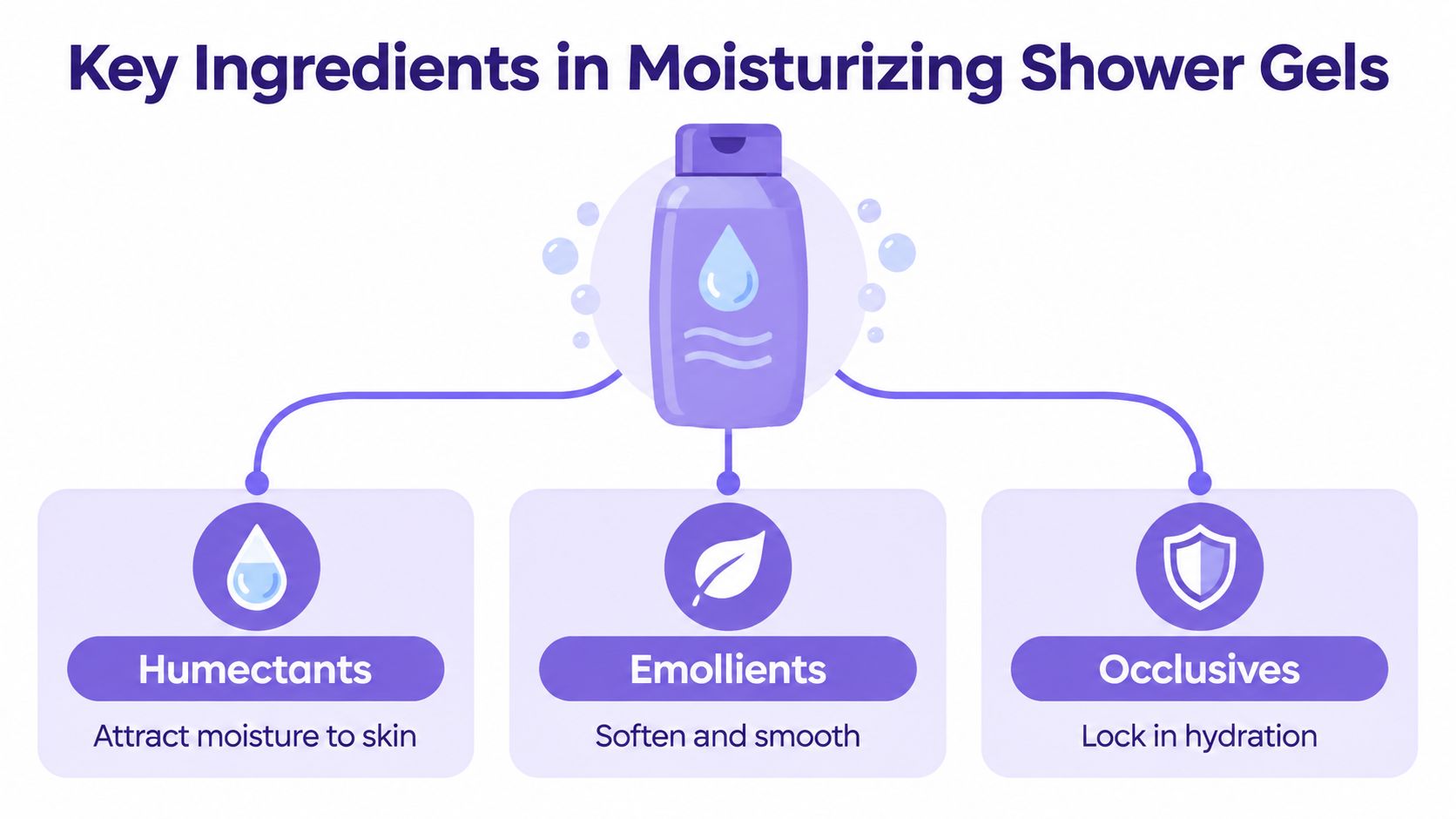
A good formula usually depends on three complementary groups of ingredients: humectants, emollients, and mild surfactants. Occlusive ingredients may also contribute by slowing water loss, although their role can be more noticeable in richer shower creams and oils.
Humectants attract water
Think of a humectant as a small water magnet. Glycerin is a familiar example, and Saccharide Isomerate is another ingredient used in hydration-focused cleansing products. These substances help bind water to the outer layer of skin, which can improve the immediate feel of softness.
The evidence for Saccharide Isomerate is particularly relevant to rinse-off products. In a shower-gel study, formulas containing 0.2% and 0.5% Saccharide Isomerate preserved and increased hydration for 24 hours after one wash, while TEWL measurements over 7 days showed barrier reinforcement as early as one hour after showering (DSM rinse-off study). That doesn't mean every product containing a humectant will perform identically, but it shows that a rinse-off format can provide more than a pleasant slip when the formula is engineered properly.
Emollients soften the surface
Emollients act like mortar between bricks. Skin cells form the bricks, while lipids and oils help fill spaces between them, smoothing roughness and improving flexibility. Ceramides, physiological lipids, petrolatum, paraffin, shea-derived materials, and selected plant oils may all support a more comfortable after-wash feel, depending on the formula.
Ceramides deserve special attention for dry and sensitive skin because they resemble substances naturally present in the barrier. However, the ingredient name alone isn't enough. Concentration, delivery system, cleansing base, and the amount that remains after rinsing all affect the final result.
Mild surfactants do the cleaning
Surfactants lift oil, sweat, and debris so water can carry them away. The practical difference is that mild surfactants are chosen to clean with less unnecessary disruption. A cleanser doesn't need to produce an enormous foam cloud to work, and rich lather can sometimes create false confidence.
When reading a label, look for a combination rather than a single “hero” ingredient. A product with glycerin but a very aggressive cleansing base may still leave dry skin uncomfortable. Likewise, a lipid-rich formula that doesn't rinse cleanly may feel greasy or encourage over-washing.
For a plain-language explanation of hydration ingredients, this guide to hyaluronic acid serum offers useful background on how humectant technology works in skincare, even though a serum is a leave-on product.
How Moisturizing Shower Gel Differs From Regular Soap and Body Wash
The words soap, body wash, and shower gel are often used interchangeably, but the formulations can behave very differently. Traditional bar soap is made through a soap-making process and is commonly more alkaline. Many liquid body washes are syndets, meaning they rely on synthetic detergents, surfactants, pH adjusters, preservatives, and sometimes refatting agents.
A moisturizing shower gel is best understood as a product goal and formulation style, not a guarantee. Some gels are gentle and barrier-supportive. Others mainly use the word “moisturizing” to describe a creamy texture or fragrance experience.
Cleanser Type Comparison
| Attribute | Traditional Bar Soap | Standard Body Wash | Moisturizing Shower Gel |
|---|---|---|---|
| Cleansing base | Soap salts and alkaline components | Surfactant blend | Mild surfactant blend selected for comfort |
| pH approach | May be considerably higher than skin's natural acidic environment | Often adjusted closer to skin-friendly conditions | Typically designed with barrier comfort in mind |
| Added moisturizers | May be limited | May include humectants or emollients | Often combines humectants, lipids, and soothing agents |
| After-wash feel | Can feel squeaky or tight | Varies widely | Usually aims for softness without residue |
| Best assessment | Skin comfort after repeated use | Ingredient list and tolerance | Formula quality, pH, cleansing mildness, and hydration evidence |
A laboratory study of 38 moisturizers and 6 liquid soaps found that 24 moisturizers, or 63%, and 3 liquid soaps, or 50%, had pH values above 5.5. The study also found that 12 moisturizers, or 32%, and 1 liquid soap, or 17%, exceeded pH 5.8, and the authors noted that higher pH values can hinder barrier repair and antimicrobial function (pH study). The lesson isn't that every higher-pH product will cause a problem. It's that pH deserves more attention than packaging language.
For shoppers comparing product textures and cleansing styles, you can also browse the Blushing Ivy cleanser guide, which provides broader body-wash context. For sensitive skin, these body-wash selection steps are especially useful.
What the Clinical Evidence Shows About Hydration Claims
A moisturizing shower gel can improve skin hydration, but its effect depends on the formula, contact time, and the condition of the skin. Cleansers are rinsed away quickly, so they cannot be expected to perform like a rich body cream. The practical question is whether the formula reduces cleansing stress and leaves enough supportive ingredients behind to improve comfort.
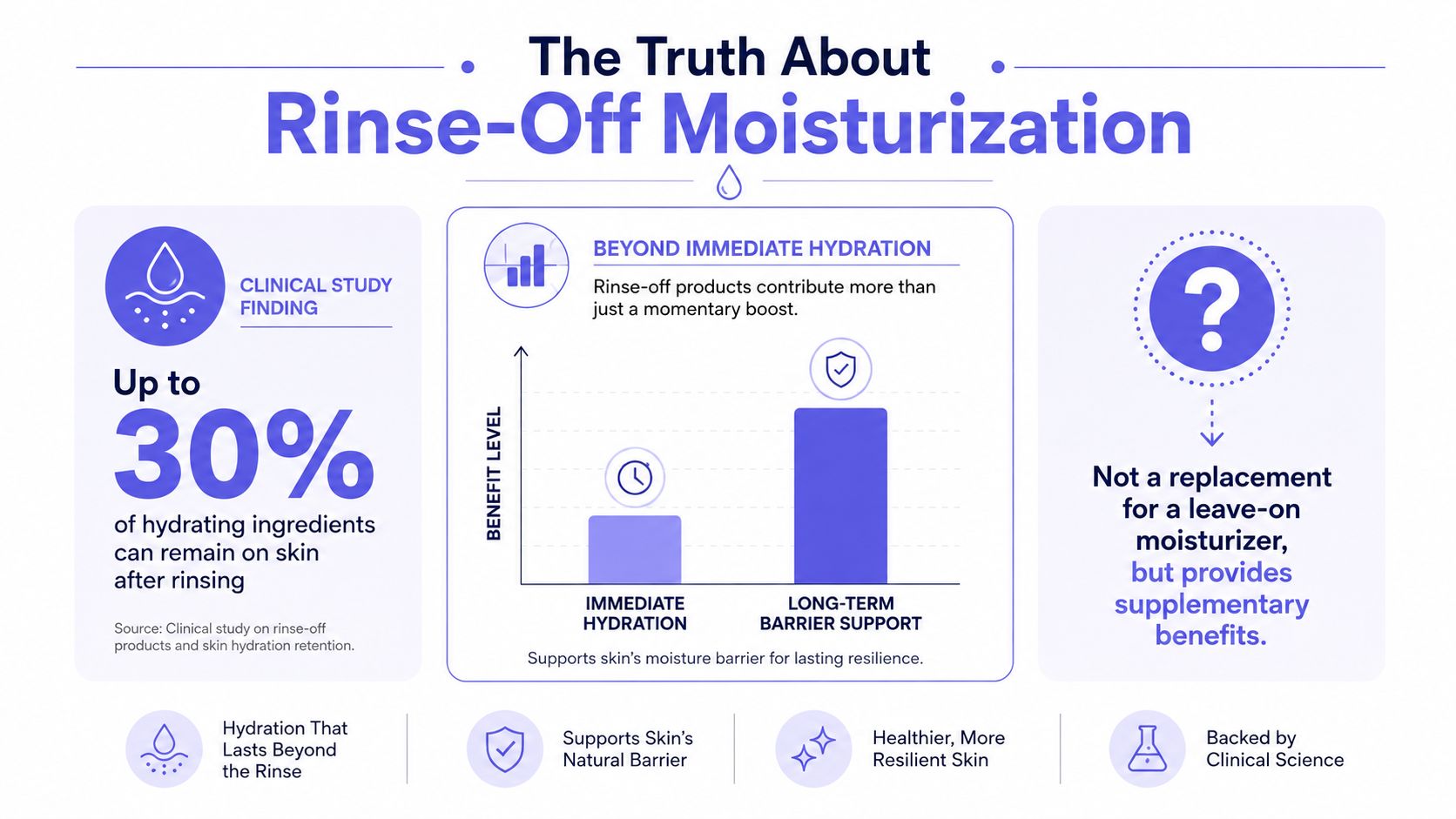
Evidence for rinse-off hydration is encouraging, though it should be interpreted carefully. Formulas containing 0.2% and 0.5% Saccharide Isomerate maintained or increased hydration for 24 hours after a single wash, while TEWL measurements over 7 days suggested improved barrier support as early as one hour after showering (DSM rinse-off study). TEWL measures water moving out through the skin, so better-controlled loss is consistent with more effective barrier function. These results support a hydration benefit, not equivalence with leave-on care.
The leave-on step still matters
A clinical study in people with atopic dry skin assessed a shower cream containing physiological lipids together with a lotion containing skin-identical lipids. The combination improved barrier function and moisture maintenance, including in severely dry skin (lipid shower cream study).
That pairing illustrates the trade-off between rinse-off and leave-on care. The shower gel can limit cleansing stress and deposit supportive ingredients, while the lotion remains on the skin to slow water loss. Mild, occasional dryness may respond well to the cleanser alone. Persistent itching, eczema, or a weakened barrier generally calls for a compatible leave-on moisturizer after bathing.
A moisturizing shower gel can support hydration, while severe or chronic dryness usually requires leave-on care.
Choosing the Right Formula for Your Skin Type
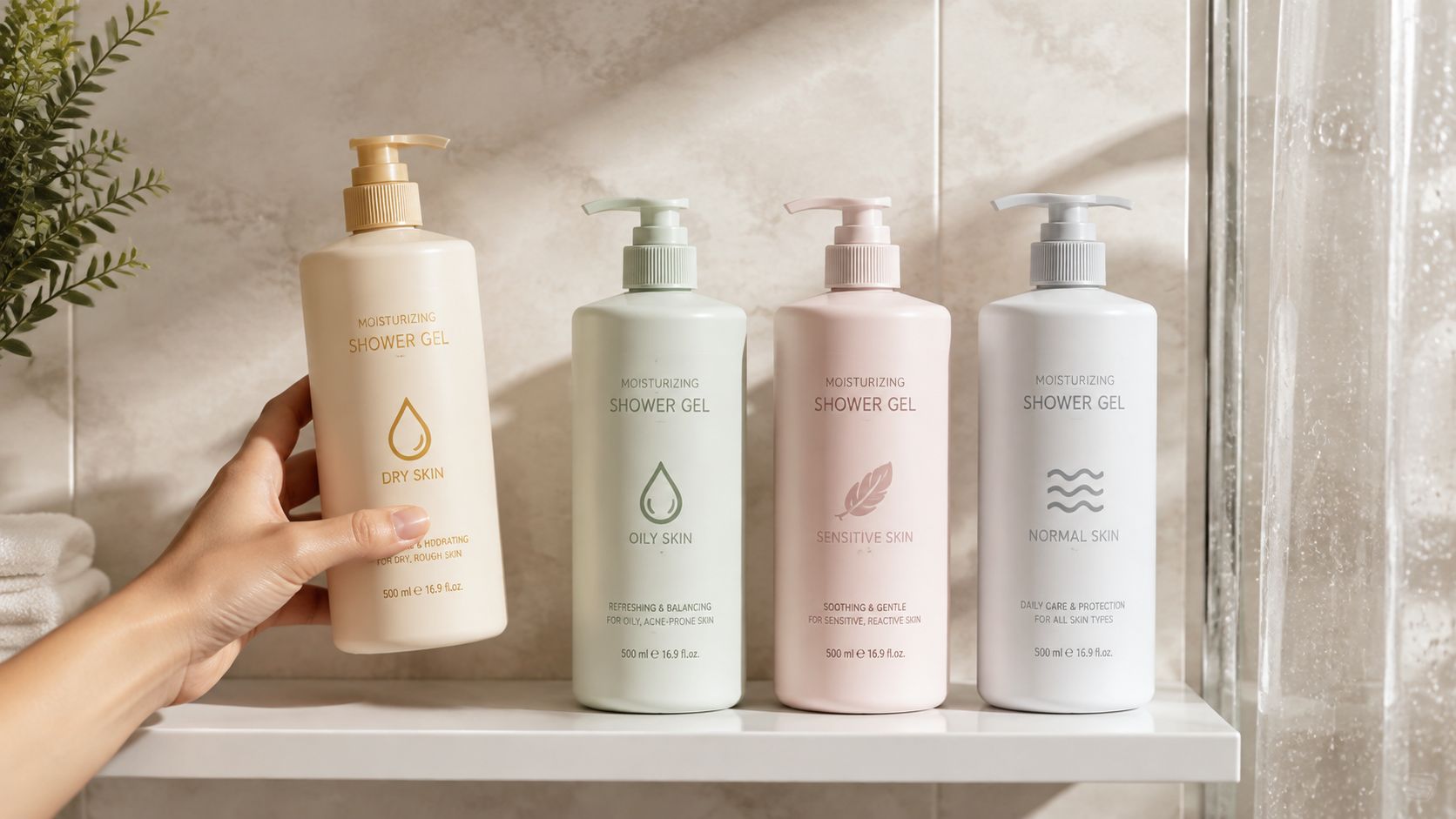
After years of helping people choose products, I'm certain the best decision usually comes from matching the formula to the skin's behavior rather than choosing the most luxurious bottle. The same creamy wash that comforts dry legs may feel too rich for someone prone to body breakouts.
Dry and very dry skin
Choose a cleanser with glycerin, emollient oils, ceramides, physiological lipids, or petrolatum-type ingredients. A high-emollient liquid cleanser containing mild surfactants, glycerin, Vaseline, and paraffin improved dryness and pruritus over 21 days in people with very dry and atopic-prone skin, while maintaining good tolerance (high-emollient cleanser evaluation).
For this skin type, low to moderate lather is often acceptable. The important test is whether the skin feels comfortable after rinsing, not whether the product creates a dramatic foam.
Sensitive or eczema-prone skin
Prioritize fragrance-free, soap-free, mild formulas with a short, purposeful ingredient list. Physiological lipids and ceramides are sensible choices, especially when followed by a leave-on moisturizer. You can also review ceramide moisturizers for sensitive skin to understand how the post-shower product can complement the cleanser.
If a wash stings, causes redness, or leaves itching worse, stop using it even if the label says “nourishing.” Marketing language cannot override your skin's response.
Acne-prone body skin
Acne-prone skin still needs hydration. A weakly acidic foaming cleanser paired with a moisturizing gel containing pseudo-ceramide and eucalyptus extract significantly reduced acne and dryness in a 4-week trial involving 29 post-adolescent Japanese women with mild acne and dry, sensitive skin. The regimen also increased endogenous ceramide in the stratum corneum, caused no adverse events, and 97% of participants rated it useful or slightly useful (acne and sensitive-skin trial).
Look for a lightweight, non-comedogenic formula and avoid assuming that a squeaky finish is beneficial. Over-cleansing can leave the skin irritated, which makes a routine harder to maintain.
Usage Tips That Maximize Your Shower Gel Benefits
Even an excellent moisturizing shower gel can underperform if the shower itself is too hot or too long. The routine should reduce cleansing stress first, then preserve the water already present in the skin.
Use this practical sequence:
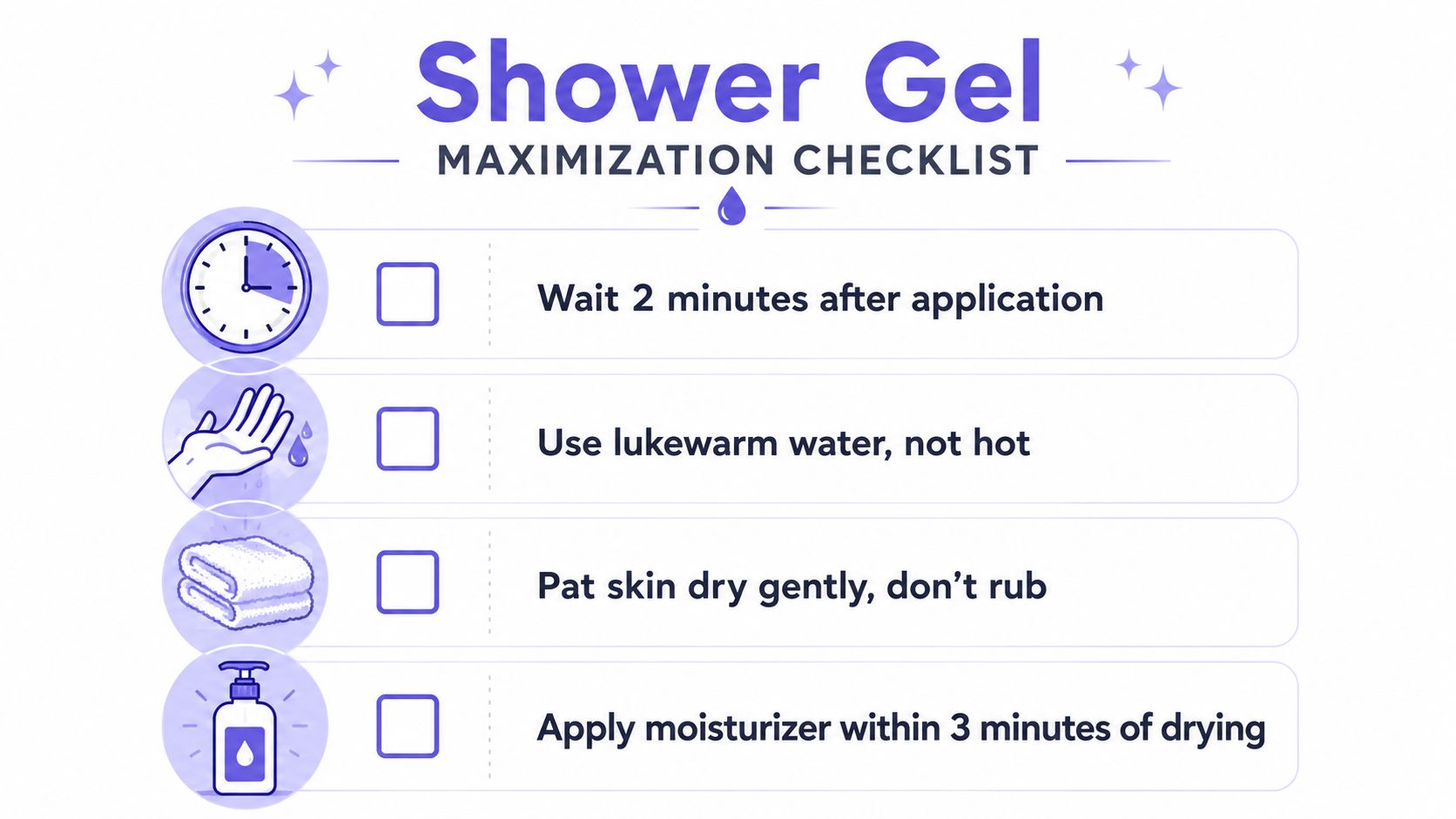
- Choose lukewarm water. Hot water can worsen dryness and itching, especially in already sensitive skin.
- Keep the wash focused. Apply cleanser to areas that need it, such as the underarms, groin, feet, and visibly sweaty areas. You don't need vigorous scrubbing over every centimetre of skin.
- Wait briefly after application. Let the product spread over the skin for around 2 minutes, as shown in the checklist below, without rubbing aggressively.
- Rinse thoroughly. Residue can feel uncomfortable, particularly in body folds or areas with dense hair.
- Pat dry gently. Don't rub the towel across already irritated skin.
- Apply leave-on moisturizer within 3 minutes of drying. This is particularly important for dry, atopic, or winter-stressed skin.
A small amount spread over wet skin is usually more effective than pouring a large quantity onto one area and scrubbing hard. If your bath or shower floor becomes slippery, reduce the amount and rinse the surface carefully.
Here's a visual demonstration to support the technique:
Building Your Complete Body Care Routine
The most reliable body-care routine has three parts: mild cleansing, supportive ingredients, and consistent leave-on moisturization. Select a moisturizing shower gel with a gentle surfactant system, useful humectants, and barrier-supportive emollients. Then judge it by your skin's response over time, not by the fragrance, foam, or promise on the front label.
A routine is working when your skin feels less tight after washing, flakes less, itches less, and stays comfortable between showers. If you continue to experience burning, marked redness, cracking, or persistent itch, speak with a pharmacist, physician, or dermatologist rather than repeatedly switching cleansers.
Consistency often matters more than adding another product. These simple self-care consistency tricks can help make the routine easier to maintain, while this body-care routine guide offers a practical framework for arranging your products.
I believe this is the complete guide to choosing and using a moisturizing shower gel with sensible expectations. It can make cleansing more comfortable and support barrier function, but the strongest plan for dry or atopic skin usually includes a leave-on moisturizer after the shower.
Find your gentle cleanser + moisturizer match
Healtsy offers pharmacy-grade skincare and body-care products for concerns including dryness, sensitivity, eczema, and acne, making it easier to compare gentle cleansers with compatible moisturizers.
Explore Healtsy