


Dry Skin Care Routine That Actually Works
You step out of a warm shower on a cold morning, get dressed quickly, and feel your cheeks tighten before you've even reached work. By lunchtime, the skin around your nose is flaky, your hands feel rough, and the moisturizer you applied seems to have disappeared. That pattern usually isn't solved by buying a richer cream alone.
After 16 years guiding patients through practical skincare routines, I believe the most reliable approach is measured rather than complicated. A useful dry skin care routine controls water loss, reduces irritation, supplies hydration and barrier-supporting lipids, and gives you a clear way to troubleshoot when the basics aren't enough. This is the complete guide to building that routine, with specific application timing, ingredient choices, and sensible limits.
Why Dry Skin Needs More Than a Good Moisturizer
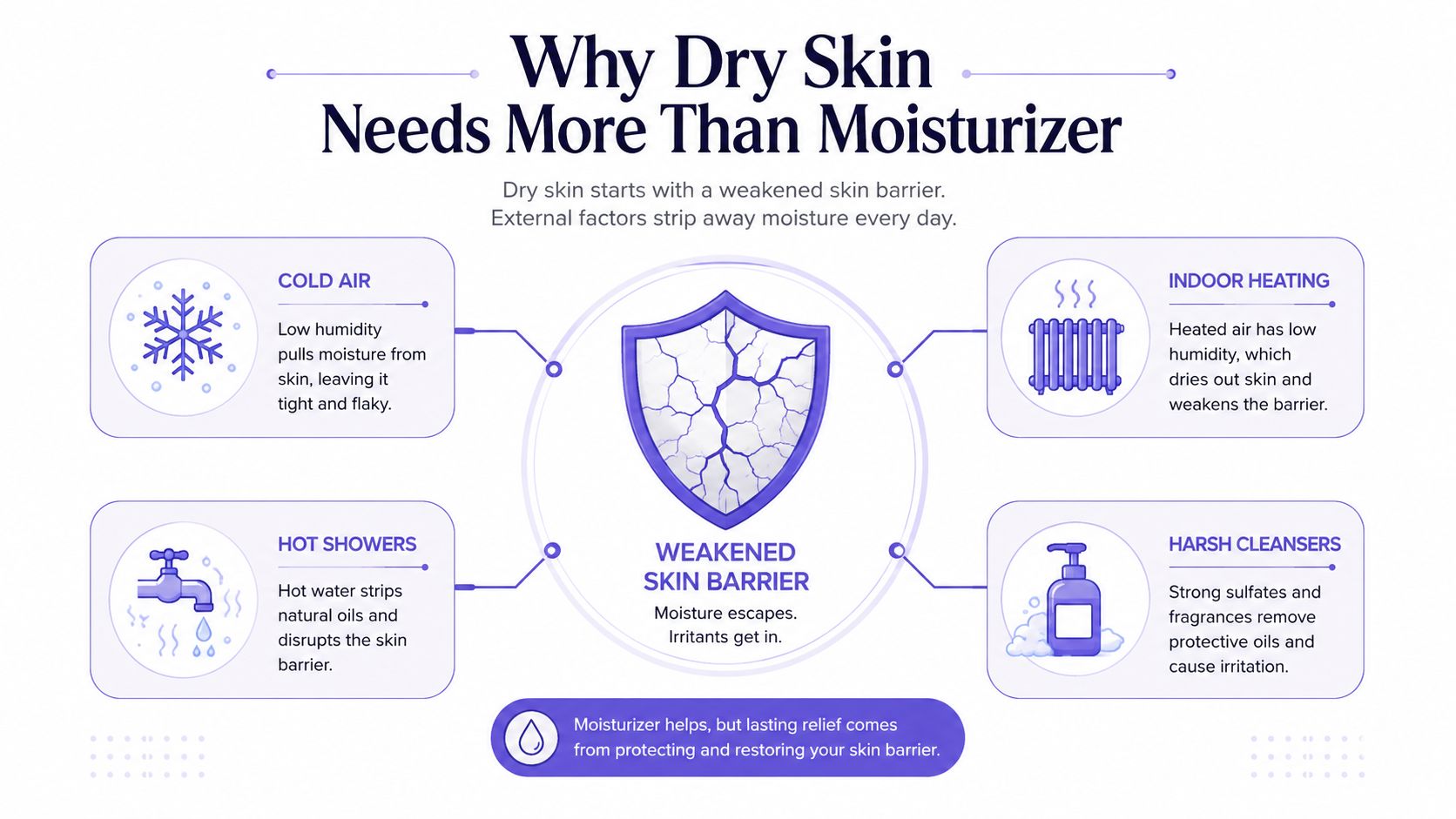
Dryness often begins before moisturizer touches your face. A long, hot shower, foaming cleanser, cold wind, indoor heating, frequent exfoliation, or a rough washcloth can remove protective surface lipids and leave the barrier less able to retain water. The result may be tightness immediately after cleansing, followed by roughness, flaking, itching, or stinging later in the day.
Dry skin is also common across adult populations, not a niche concern. A large German occupational survey of 48,665 adults examined between 2001 and 2005 found xerotic skin in 29.4% of participants, with prevalence slightly higher in men at 30.6% than in women at 28.0%. The study also noted that dry skin increased with age, making daily moisturization and gentle cleansing relevant across many adult routines. The survey data are available in the published research PDF.
What the routine is really repairing
I often see people judge a product by the first ten minutes after application. A dewy finish can feel reassuring, but temporary softness doesn't necessarily mean the barrier is functioning better. The routine needs to remove irritants without stripping natural lipids, add water-binding ingredients, and slow evaporation so comfort lasts.
That means examining the entire sequence, not just the final cream. If your cleanser leaves your face tight, your moisturizer has to work against that first loss. If a retinoid or acid causes persistent irritation, adding more products may make the problem harder to identify.
If skin is flaky, tight, itchy, or stinging, simplify first. Gentle cleansing, lukewarm water, and consistent moisturization usually provide a better foundation than adding another active.
Some life stages also change how skin feels and reacts. Pregnancy, for example, can bring broader skin changes that deserve context beyond a standard product list, so this guide to skin changes during pregnancy can be useful when dryness appears alongside other changes.
The same principle applies when the barrier has already been irritated. Rather than chasing a stronger formula, review the habits surrounding cleansing, bathing, fragrance, exfoliation, and climate. Healtsy's resource on how to repair a damaged skin barrier offers related guidance, but the practical foundation remains consistent: protect the barrier before asking it to tolerate treatment ingredients.
Your Morning and Evening Dry Skin Care Routine
A good morning routine should preserve water and protect the skin from the day ahead. Start with lukewarm water. If your face feels comfortable in the morning, water alone may be enough; if you need cleansing, choose a low-foam, cream, or milky formula and massage it lightly rather than scrubbing.
Apply a hydrating serum while the skin is still slightly damp. Useful humectants include hyaluronic acid, glycerin, and panthenol. These ingredients work best when they're followed by a moisturizer, because a water-based layer without a sealing step can leave some dry skin feeling tight again.
Choose a moisturizer containing barrier-supporting ingredients such as ceramides, fatty acids, cholesterol, or dimethicone. In the morning, finish with a broad-spectrum sunscreen labeled SPF 30 or higher. Let water-based layers settle for roughly 30 to 60 seconds between applications if pilling occurs, especially when combining a serum with a richer cream.
Evening care should remove, then restore
At night, remove sunscreen and makeup with a gentle cream cleanser or an oil-based cleanser that emulsifies with water. A second cleanse is optional, not automatic. Use it only when residue remains, because unnecessary cleansing can add irritation without improving the result.
On clean, lightly damp skin, apply the hydrating serum and then your moisturizer. If the area around your nose, lips, or mouth still flakes, press a thin layer of petrolatum or another occlusive over those zones. You don't need to coat the entire face if only a few areas need extra protection.
Introduce active ingredients one at a time. Stacking acids, retinoids, and scrubs at the beginning makes it difficult to tell which product is causing burning or peeling. Retinoids may be used cautiously as skin adapts, but people with irritated or eczema-prone skin often need a slower schedule or a clinician's advice.
The order is simple: cleanse gently, add water, replenish barrier lipids, seal where necessary, and protect during the day.
A practical explanation of sequencing and product order is available in this skincare routine steps guide. For a visual demonstration of the routine, you can also watch the video below.
Clinical routine research supports this structure. In a randomized, investigator-blinded trial involving 52 participants with moderate to severe dry skin, applying moisturizer at ≥1.0 mg/cm² twice daily, immediately after bathing at night and again in the morning, improved skin physiological function. A separate regimen using a mild cleanser once daily and a glycerin-rich lotion twice daily for two weeks also produced objective and subjective improvements. The clinical review and study details are available through PMC.
The Ingredient Layers That Actually Repair Dry Skin
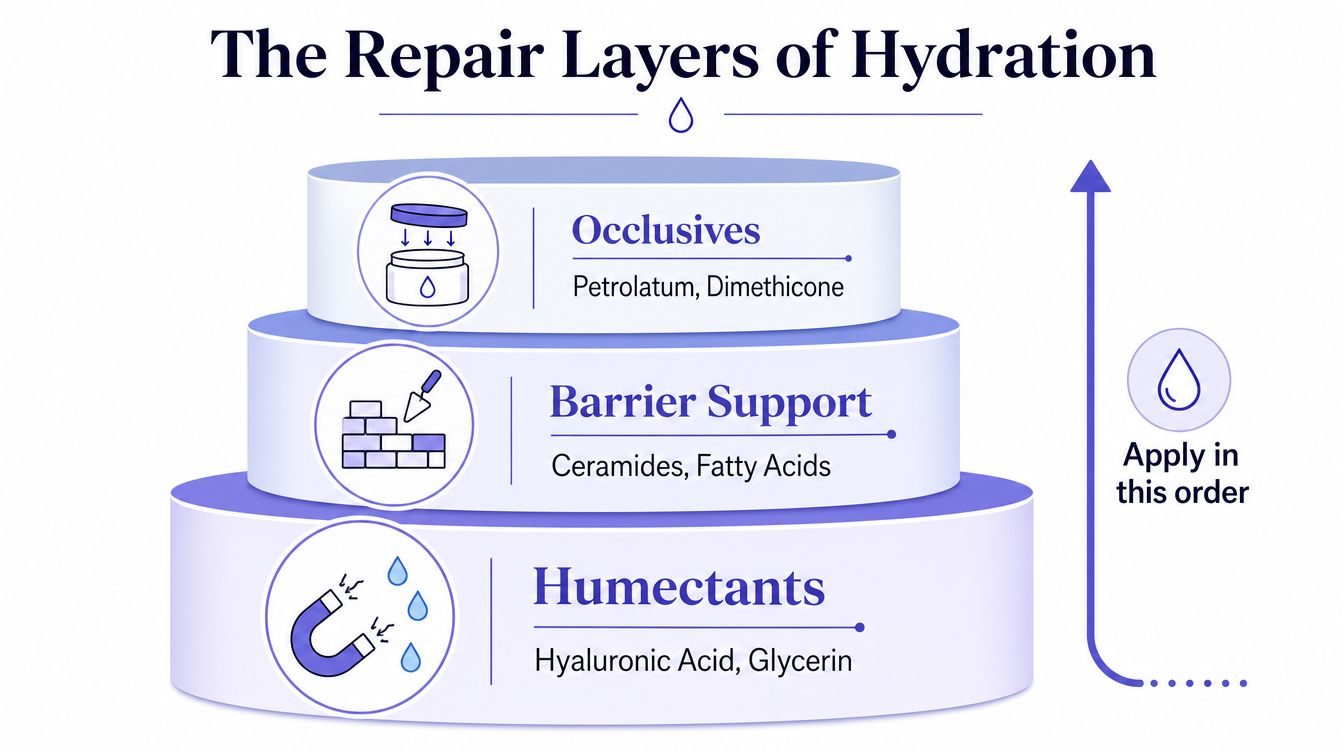
Hydration products work in categories, and each category has a different job. Humectants attract and hold water, emollients smooth roughness and fill surface gaps, while occlusives form a protective film that slows evaporation. The most comfortable dry-skin routine often combines all three rather than asking one ingredient to do everything.
Start with water-binding ingredients
Hyaluronic acid, glycerin, urea, lactic acid, and panthenol can soften the surface and improve hydration. Apply them to slightly damp skin, then follow promptly with a moisturizer. A humectant serum alone may feel excellent at first but can leave skin uncomfortable if evaporation continues unchecked, particularly in a dry indoor environment.
A serum isn't mandatory. If your moisturizer already contains glycerin or hyaluronic acid, adding a separate serum may increase complexity without adding meaningful comfort. I prefer one well-tolerated hydrating layer over several products that compete, pill, or encourage over-application.
For readers comparing serum formats, this resource on hyaluronic acid serum explains where that ingredient fits. The important point is application context, not the most elaborate formula.
Add barrier support, then seal selectively
Emollients such as ceramides, cholesterol, fatty acids, squalane, and plant oils smooth rough texture and support a more flexible lipid balance. Look for these in creams and lotions, particularly when the skin feels rough rather than thirsty.
Occlusives reduce water loss by creating a film. Petrolatum is highly effective, while dimethicone feels lighter. Shea butter and richer creams can provide a more substantial finish. A practical combination is glycerin or hyaluronic acid, followed by a ceramide-containing moisturizer, with petrolatum, dimethicone, or a richer cream over the driest areas.
The richest product belongs where the skin needs the most protection, not necessarily everywhere.
Urea and lactic acid can help with scaling, but they may sting compromised skin. Patch testing can help sensitive users identify tolerance. Apply a small amount behind the ear or along the jaw for several days, and stop any product that causes persistent burning, swelling, or a spreading rash.
Evidence favors consistency over chasing a particular moisturizer type. A prospective, randomized, double-blind controlled trial found that regular moisturizer use mattered more than the specific moisturizer, while a review concluded that basic emollients remain the mainstay for xerosis because they support hydration and barrier function with a favorable risk-benefit profile. The findings are summarized in this PubMed review.
Adjusting Your Routine for Winter, Summer, and Travel
Your core routine can stay recognizable while the textures change. Winter usually calls for more lipid-rich products because cold air, wind, and indoor heating make lightweight layers feel insufficient. Summer may allow a lotion or gel-cream, while travel often rewards the simplest routine you can apply consistently.
| Season/Trip | Cleanser | Hydrator | Sealant | Extra |
|---|---|---|---|---|
| Winter | Cream or cleansing oil | Glycerin or hyaluronic acid on damp skin | Rich cream, balm, or targeted petrolatum | Consider a humidifier set to 40 to 60 percent |
| Summer | Gentle low-foam lotion or cream cleanser | Light humectant layer | Lotion or gel-cream | Use broad-spectrum SPF 30 or higher and reapply outdoors |
| Travel | Gentle cleanser, with actives minimized | Hydrating serum on damp skin | Travel-size occlusive balm | Protect the areas that become tight during transit |
In winter, replace a lightweight lotion with a cream that contains more barrier-supporting lipids. A small amount of facial oil over moisturizer before bed can improve comfort, but oil alone isn't a substitute for a water-containing moisturizer. A humidifier may help when indoor air feels exceptionally dry, and the Kaiser Permanente handout recommends keeping bathing brief, using cooler or lukewarm water, and moisturizing immediately afterward. It also recommends reapplying moisturizer 2 to 3 times per day. See the Kaiser Permanente gentle skin-care handout.
Summer doesn't mean abandoning barrier care. Use lighter textures if richer creams feel uncomfortable, keep humectant layers modest, and maintain sunscreen use. Travel is different again. Cabin air and hotel rooms can make skin feel tight quickly, so simplify exfoliants and retinoids, apply hydration to damp skin, and carry an occlusive balm for dry patches.
For cold-weather planning, these winter skincare allies can help you think in terms of product types rather than brand lists. The useful swap is straightforward: lotion to cream in winter, gel-cream to balm for travel-damaged areas, and back to lighter textures when humidity and comfort allow.
When the Routine Is Right but Dryness Still Lingers
The assumption that gentle cleanser plus moisturizer solves every case is too simple. Those basics are an excellent starting point, but persistent dryness may reflect barrier damage, environmental exposure, medication effects, eczema, psoriasis, or another condition that needs assessment.
Use a decision tree rather than adding products at random.
Check for irritation first
If moisturizer stings, or if redness and tightness appeared after introducing acids, retinoids, scrubs, or a new cleanser, treat that as a warning. Pause exfoliating acids and retinoids for two weeks, then use a ceramide cream and a thin petrolatum layer at night while the skin settles.
Next, review timing. Moisturizer should go onto slightly damp skin promptly after cleansing. If you wait until the skin is completely dry, you may lose an important opportunity to trap surface water.
Add protection before adding complexity
If flaking continues without stinging or redness, place an occlusive over the final moisturizing step. Petrolatum is the most protective option for very dry patches, while squalane or dimethicone may feel more comfortable for people who dislike an ointment finish.
Then examine the surroundings and routine. Hot showers, low humidity, frequent washing, wind, and some medicines, including isotretinoin or antihistamines, can contribute to dryness. A neutral cleansing guide recommends lukewarm water, cleansing once daily at night when morning cleansing causes tightness, and applying moisturizer while skin remains slightly damp. It also identifies fragrance-free formulas as a sensible choice for dry, reactive skin. Read the guide to cleansing dry skin.
Harsh surfactants and fragranced products can also undermine an otherwise careful routine. A cleanser guide citing American Academy of Dermatology recommendations advises choosing fragrance-free, alcohol-free cleansers with emollients that replenish moisture during cleansing. Review the cleanser selection guidance.
Persistent itching, cracking, or eczema-like patches deserve clinical evaluation, especially when routine simplification and an occlusive don't restore comfort.
Mainstream routine advice often explains what to use but not when to stop experimenting. If symptoms remain after a sensible period of consistent care, seek a clinician's evaluation for conditions such as atopic dermatitis or psoriasis rather than continuing to stack products. Guidance on skincare for eczema may help you recognize why eczema-prone skin needs a different level of caution.
Putting Your Dry Skin Care Routine Into Practice
The most useful routine is the one you can repeat without negotiating with yourself every morning. Start tomorrow with a gentle cream or milk cleanser, a humectant layer if needed, a ceramide-rich moisturizer, and broad-spectrum sunscreen labeled SPF 30 or higher. Reapply sunscreen every two hours when you're outdoors, and adjust the moisturizer texture if your skin feels coated or still tight.
At night, remove sunscreen and makeup with a balm or cream cleanser. Add an optional hydrating essence, then use a compatible serum such as a peptide or niacinamide formula, followed by a richer moisturizer. Finish with a thin petrolatum layer on dry zones rather than covering the entire face automatically.
A routine you can monitor
Keep weekly habits restrained. Use one gentle exfoliating product, such as a PHA or low-strength lactic acid, only when your skin tolerates it. Replace sponges frequently, and clean phone screens and pillowcases so they don't repeatedly contact irritated areas.
Track the routine like a small treatment experiment. Photograph your skin in the same lighting each week, change one variable at a time, and record whether tightness, flaking, stinging, or itching improves. Clinical routine research shows that measurable dry-skin care depends on defined, repeatable application, including moisturizer twice daily and use after bathing, rather than occasional intensive treatment. The trial and regimen evidence are discussed in this clinical source.
Daily emollient use also has practical support beyond cosmetic preference. In a multicenter observational study of 319 cancer patients with xerosis, daily use of an emollient-plus balm significantly reduced xerosis severity in real-world conditions. Separate trials reported benefits from emollient cream for diabetic foot xerosis and from glycerol- and paraffin-based cream in elderly patients. The evidence is reviewed in this PMC article.
I'm certain this approach will give you a clearer way to solve common dryness problems because it replaces guesswork with observation. Give the barrier time to respond, resist changing several products at once, and treat persistent symptoms as information rather than failure.
Build a dry-skin routine that fits your life
Healtsy offers cleansers, moisturizers, sunscreen, and targeted skincare for concerns including dryness, eczema, and sensitive skin, with product options that can support a measured routine rather than a crowded shelf. Compare pharmacy-grade formulas and build a dry-skin routine that fits your skin and daily life.
Visit Healtsy