


A baby bath seat is a positioning aid that helps hold a sitting baby upright in the tub, not a safety device, and it never replaces an adult within arm's reach. Choosing one means checking the product's safety requirements, its fit with your bath, and your ability to supervise throughout, rather than relying on suction cups or a reassuring-looking frame.
The popular advice to find a sturdy seat and enjoy hands-free bathing misses the most important distinction: support isn't protection. I believe the most useful guidance gives you a workable routine, not another piece of equipment to buy.
Bath Time and the Question Every Parent Asks
Your baby is wriggling, the washcloth has slipped, and the towel suddenly seems much farther away than it did before you started. It's understandable to wonder whether a seat would make everything easier.
The question deserves a calm answer. A bath seat may help with positioning, but buying one doesn't transfer responsibility for your baby's safety to the product. The practical question isn't whether a seat looks secure. It's whether that particular design suits your baby, your bathtub, and the way you'll manage bath time.
Separate reassurance from protection
A wide base, supportive backrest, and suction cups can look reassuring. However, the CPSC's guidance for infant bath-seat buyers distinguishes product requirements from the continuing need to prevent drowning through close supervision.
That distinction needn't make bath time frightening. It makes the decision more manageable, because you can assess separate questions rather than search for a product that promises to solve everything.
- Product compliance: Is there identifiable, market-specific evidence that the seat meets the requirements applicable to it?
- Installation fit: Does the manufacturer permit its use on your actual bath surface, with your baby's current abilities and measurements?
- Caregiver attention: Can you wash your baby without leaving or becoming occupied with another task?
A useful seat should fit your bathing routine. Your routine shouldn't depend on the seat keeping your baby safe while you step away.
Keep the routine simple
You don't need an elaborate collection of accessories. You need appropriate equipment, a prepared bathing area, and a clear plan for interruptions.
For the surrounding care routine, our baby hygiene guide for the first months provides a broader starting point. Keep hygiene choices separate from equipment safety: a suitable cleanser can help with washing, but it doesn't change what a seat can safely do.
A good purchase is one you understand, can install correctly, and can stop using when it no longer fits. Choosing not to buy a seat is also a reasonable outcome.
What a Baby Bath Seat Actually Is
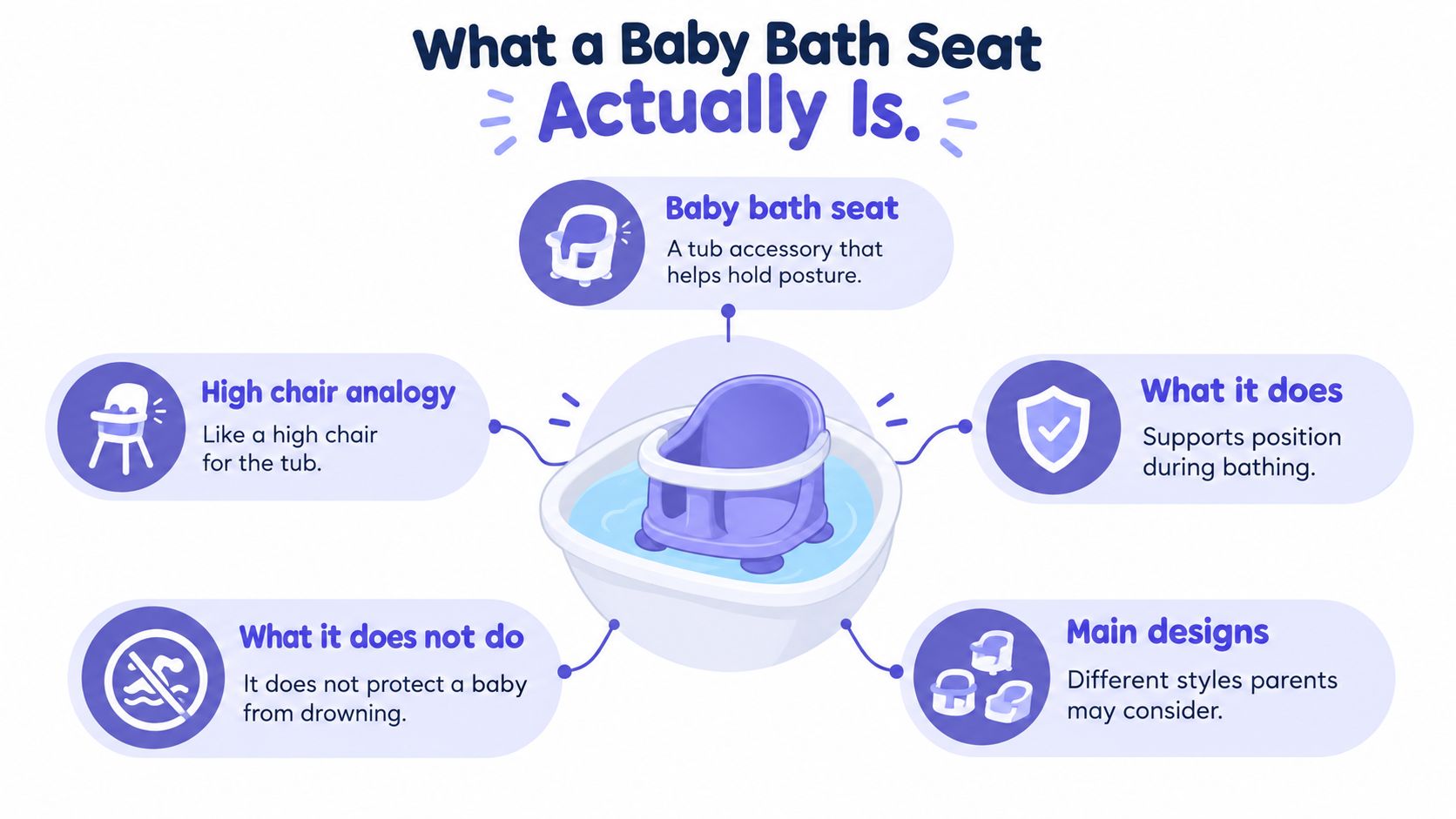
Think of a baby bath seat as something like a high chair for the tub, but only in the limited sense that it supports posture. The comparison stops there: it isn't a protective enclosure, and its appearance shouldn't suggest that a baby is secure against submersion.
This visual separates the product's intended job from the protection parents may mistakenly expect.
Recognize the design before choosing it
Ring-style seats generally surround a sitting baby, with leg openings and a support between the legs. Reclining bath supports and cradles position a baby differently and shouldn't be treated as interchangeable with an upright seat.
- Upright seats: Check the manufacturer's requirement for independent sitting and any other developmental conditions.
- Reclining supports: Follow the specific instructions for supported positioning, water level, and when to stop use.
- Bath cradles: Identify the exact product category and intended bathing arrangement rather than relying on the name alone.
An age printed prominently on packaging isn't enough to settle suitability. Developmental readiness and the product's stated limits matter together. A baby who slumps or can't maintain the required position shouldn't be made to fit by adding towels or other improvised padding.
Understand the limits of support
The historical evidence explains why that distinction matters. The CPSC's federal bath-seat safety announcement recorded 174 deaths and 300 nonfatal incidents from 1983 through November 2009, and described requirements addressing stability, restraints, static load, leg openings, installation components, suction cups, openings, and sharp edges.
Those controls address foreseeable product hazards. They don't turn a seat into a flotation aid, drowning-prevention device, or substitute caregiver. Even where a design includes restraints, those components aren't permission to leave.
For an additional visual reference, the following video can accompany, but never replace, the instructions supplied with your particular product.
Keep washing products in their own category, too. A bath-time product such as Mustela Bébé Multi-Sensory Bath Foam 750ml is separate from the equipment decision; its presence doesn't establish anything about a seat's suitability or stability.
Why Supervision Matters More Than the Seat
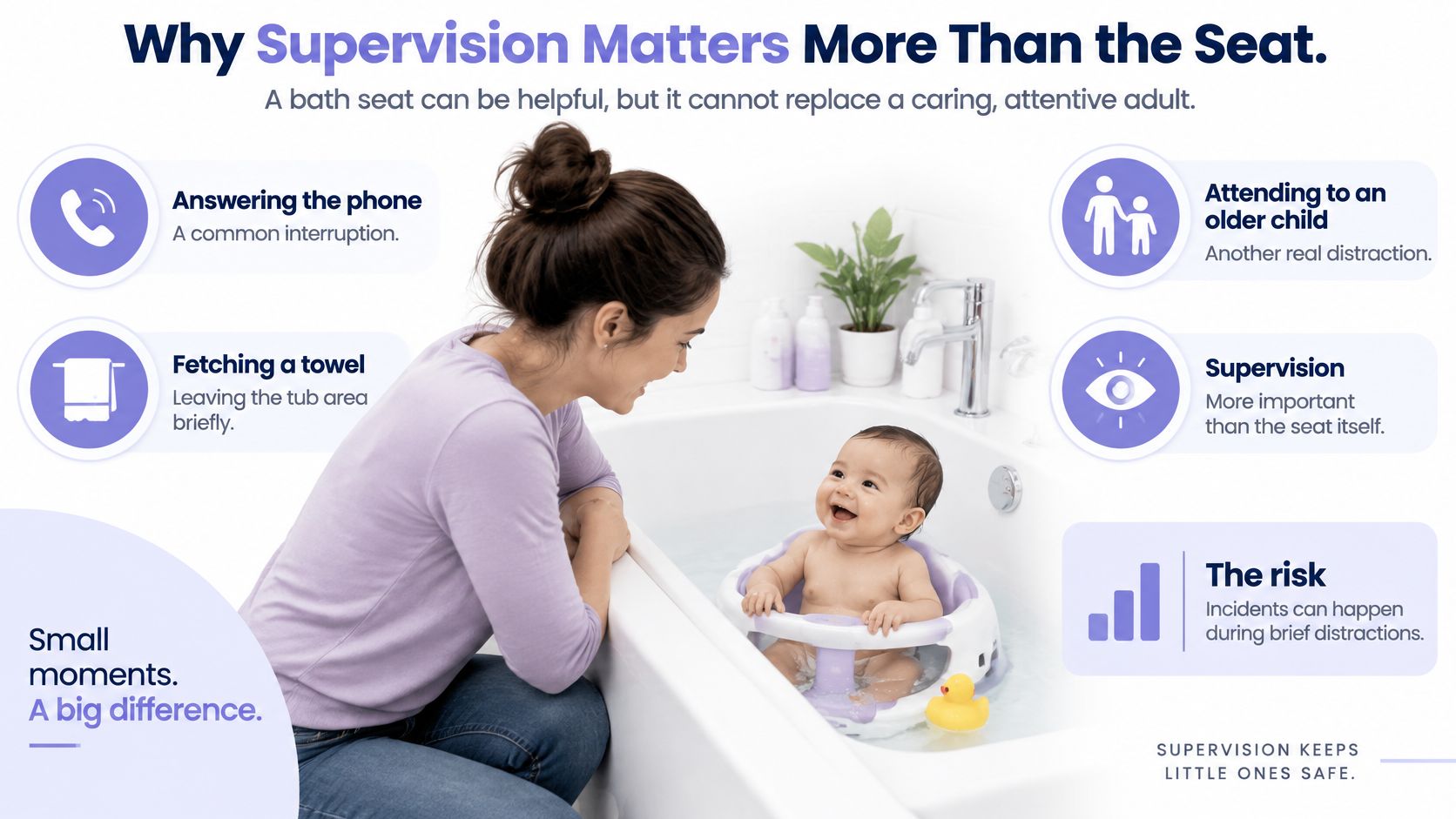
The towel is in the bedroom. The phone rings in the kitchen. An older child needs help with something that sounds urgent.
These are ordinary interruptions, not unusual parenting failures. That's why a useful bathing plan needs to account for them before they happen, rather than depend on a promise that nobody will become distracted.
The illustration below highlights the everyday moments that deserve a plan.
What the incident histories tell parents
A CPSC analysis of bath-seat drownings recorded 32 deaths between 1983 and 1995, involving children aged 5 to 15 months, with unsupervised periods averaging 6 minutes. In that analysis, 24% of caregivers left to use the phone, 24% attended to other children, 17% fetched a towel or clothes, and 17% did a household chore.
These historical figures don't predict what will happen in a particular home. Their practical value is showing how familiar the circumstances were. The interruption didn't need to feel risky for the caregiver to step away.
A stable-looking seat can encourage the thought that there's time to finish another task. Treat that feeling as a cue to pause, not as evidence that your baby is protected.
Interruption plan: If something requires you to leave the bathing position, take your baby out of the water first.
Make the response automatic
If the phone rings, let it ring. If answering can't wait, lift your baby out and bring them with you, securely supported and wrapped as appropriate.
If another child needs attention, don't appoint that child as the bath supervisor. End or pause the bath so you can respond without dividing responsibility. When another adult is present, make any handover explicit rather than assuming they're watching.
- A missing towel: Lift your baby out before retrieving it, then change where you store supplies for next time.
- A baby who slips or slumps: Support and remove them immediately, then reassess the product's fit and suitability before reuse.
- An unexpected water-temperature change: Remove your baby rather than trying to adjust the setup while they remain in it.
Don't wait for splashing or crying to tell you something is wrong. Drowning can be rapid and quiet, so listening from elsewhere isn't an adequate substitute for staying close.
I believe this is the most reassuring way to approach supervision: make the response to interruptions simple enough that you don't need to negotiate with yourself in the moment.
Safety Standards and How to Read a Label
Meets safety standards isn't a universal badge. The useful questions are which standard applies, whether the evidence identifies the exact model, and whether the documentation matches the market where you intend to use it.
In the United States, the mandatory framework is 16 C.F.R. Part 1215, incorporating the ASTM F1967 infant-bath-seat specification; the CPSC's bath-seat laboratory bulletin explains the stability-testing clarification for surfaces with and without safety tread strips, effective January 4, 2025. The corresponding update incorporates ASTM F1967-24 for products manufactured or imported from that date.
Baby Bath Seat Safety Standards by Market
| Market | Standard or Rule | What It Verifies | What It Does Not Cover |
|---|---|---|---|
| United States | 16 C.F.R. Part 1215, incorporating the applicable ASTM F1967 specification | Performance against prescribed bath-seat requirements, including relevant stability and mechanical tests | Compatibility with every household tub or protection during unattended bathing |
| Europe | EN 17022 for standalone bathing aids | Design and testing requirements for the bathing aid within the standard's scope | A substitute for supervision or automatic suitability for children with special needs |
| Cross-border purchase | Requirements applicable to the destination market | Documentation must establish which requirements the exact product meets | A foreign label alone doesn't establish destination-market compliance |
European documentation can be legitimate without answering every question a US buyer needs to resolve. Equally, a US compliance statement doesn't establish that suction cups will work on your particular bath.
Read the label as a set of conditions
Look for information you can apply, not just a prominent safety claim.
- Product identity and date: Match the model and manufacture or import information to the documentation.
- Applicable market: Identify the named rule or standard, rather than accepting an unexplained conformity claim.
- Child limits: Read maximum weight, developmental requirements, and stop-use conditions together.
- Installation conditions: Check permitted surfaces, positioning, assembly, and water-level instructions.
- Warnings and recall status: Confirm that you have the complete instructions and check whether the exact model is affected by a recall.
For families coordinating care with a nanny or another caregiver, the Superstar Nannies guide to childcare safety is a useful additional resource for a shared safety conversation. Keep the bath-seat manual alongside any household routine so caregivers aren't relying on memory or assumptions.
Compliance, installation fit, and supervision answer different questions. Passing a prescribed test doesn't mean a product fits every bath, and neither result permits unattended use.
Choosing Between Seats Supports and Alternatives
Start with your baby's abilities and your bathtub, not the product photograph. A seat that looks comfortable on a smooth showroom surface may be unsuitable for the bath you own.
The comparison below helps distinguish the options before you decide whether an upright seat belongs in your routine.
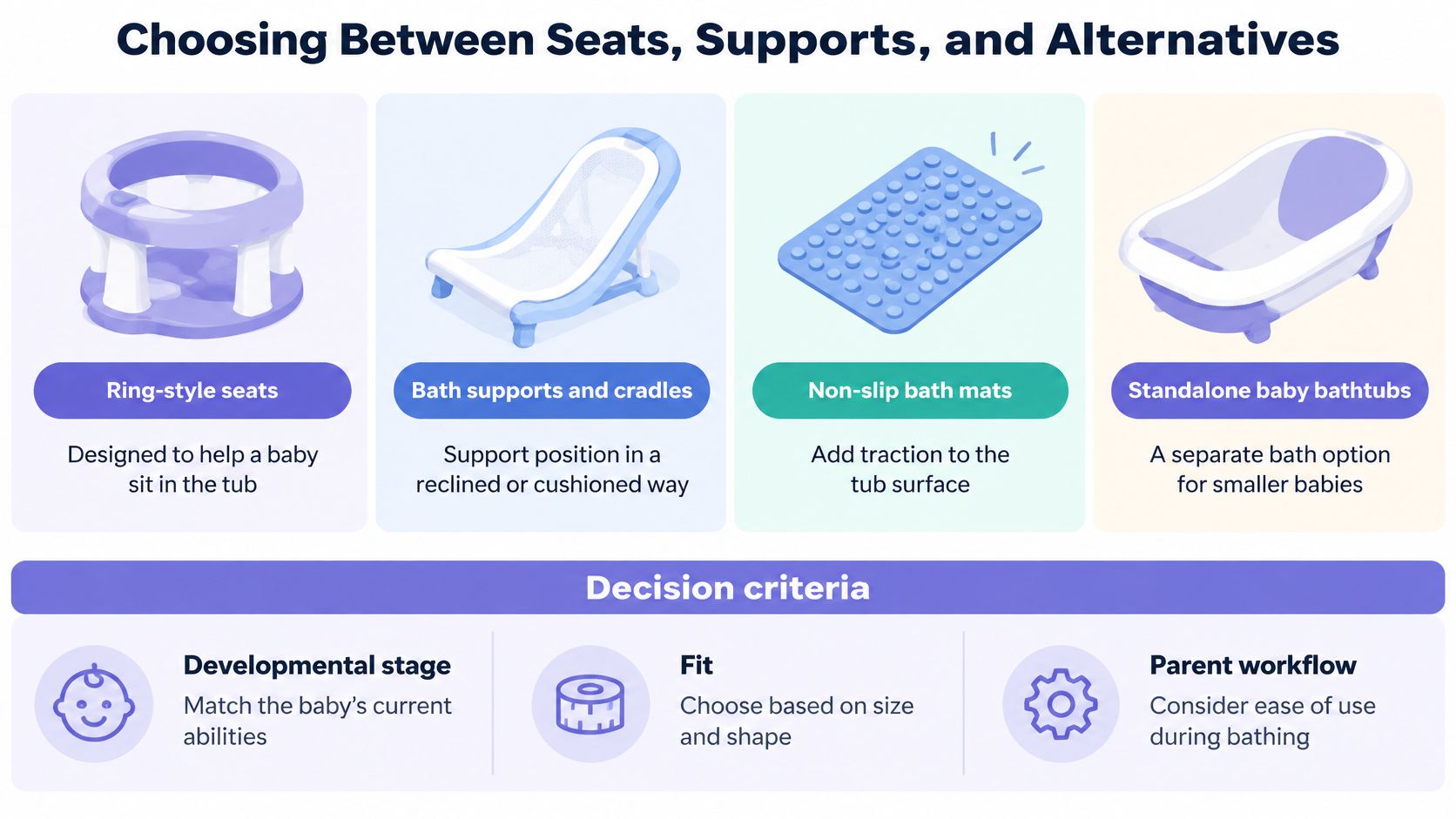
Match the option to the job
| Option | Potential practical benefit | Main trade-off |
|---|---|---|
| Ring-style seat | Supports the bathing position of an eligible sitting baby | Developmental and installation limits may give it a relatively short useful period |
| Reclining support or cradle | Offers a different supported bathing position | Suitability depends on the exact design and the baby's current stage |
| Non-slip bath mat | Adds surface traction where appropriate | Doesn't support posture or prevent submersion |
| Standalone baby bathtub | Provides a separate bathing space | Requires suitable placement, storage, and observance of its own limits |
There's no dependable universal age window that makes every seat appropriate. Use the manufacturer's limits rather than assuming that a baby is ready because another child of a similar age uses one.
The same applies to how long equipment remains useful. A mat or separate tub might fit a family's routine longer, but that depends on the product and child, not the category name.
Surface compatibility can decide the purchase
When the CPSC began strengthening bath-seat requirements in 2001, it described 78 recorded infant drowning deaths and identified tipping after inadequate suction-cup adhesion, particularly on non-skid surfaces, as well as slipping through leg openings and becoming trapped.
That history gives surface instructions real importance. If your bath is textured, curved, or non-skid, check whether the exact design permits that surface. Don't assume that pressing harder, adding a mat underneath, or finding a flatter corner solves an incompatibility.
Choose the setup that works without improvisation. If making a seat fit requires a workaround, skipping it is the better decision.
Water depth belongs in the same assessment: follow the product's specified limits rather than adding water to make washing easier. Also consider whether you can reach your baby comfortably without leaning awkwardly around the seat.
European pharmacy baby-care ranges are an option for international shoppers, but European origin alone isn't evidence of suitability. Our product-information review includes a pharmacist, while equipment decisions still require the manufacturer's model-specific instructions.
After bathing, skin-care choices remain a separate task. Our guide to fragrance-free baby lotion can help you consider that part of the routine without confusing a skin-care preference with an equipment-safety decision.
Everyday Use Cleaning and Common Mistakes
A practical bathing routine begins before you undress your baby. Set up the space so you don't discover a missing item after the bath has started.
Prepare before the baby goes in
- Gather supplies: Put the towel, washcloth, cleanser, clean nappy, and clothes where you can reach them without leaving.
- Check the water: Test the temperature before placing your baby in the bath, and follow the product's water-level guidance.
- Install as directed: Use only the specified surface and assembly method. Don't add padding, mats, or attachments unless the instructions permit them.
- Inspect the setup: Confirm that components are present, correctly fitted, and undamaged.
- Plan your position: Arrange yourself so you can reach and support your baby immediately throughout washing.
The American Academy of Pediatrics' parent guidance states that a baby should never be left alone in bathwater, including in a bath seat or ring, and calls for the supervising adult to remain within arm's reach. Being in the bathroom but absorbed in a phone isn't the attentive routine that rule is intended to create.
Clean and inspect before putting it away
Follow the manufacturer's cleaning instructions, then rinse and allow the product to dry as directed. Give attention to recesses, joints, and suction cups where water or product residue may remain; don't put equipment away wet in a closed space.
Check for cracks, damaged suction cups, loose joints, altered leg openings, and missing components. If something has changed or you can't confirm correct assembly, stop using the seat until the issue is resolved rather than testing it with your baby.
| Common mistake | Better habit |
|---|---|
| Trusting the seat for a brief absence | Use the interruption plan before leaving |
| Continuing after a stated limit is reached | Reassess suitability as your baby develops |
| Trying an unapproved bath surface | Follow the exact installation restrictions |
| Assuming a hand-me-down is ready to use | Identify the model, instructions, condition, and recall status |
A borrowed or second-hand seat needs more than a quick wipe. Without an identifiable model and complete instructions, you may not be able to establish its limits or whether parts are missing.
If your baby has eczema-prone skin, keep the care plan equally deliberate. Our guide to skincare for eczema addresses the skin-care side; it doesn't replace individual advice when irritation persists or the diagnosis is uncertain.
Bathing Your Baby Safely Every Time
The best decision isn't necessarily to buy a baby bath seat. It's to choose a bathing arrangement that suits your baby and that you can use correctly without relying on the equipment to manage an interruption.
A compliant product is a starting point, not a complete bathing plan. The installation instructions determine whether it belongs in your tub, while your baby's current abilities determine whether it still belongs in your routine.
Make the decision before shopping
Ask yourself whether you can identify the exact model, understand its limits, and follow its installation instructions without modification. If the answer is unclear, there's no need to hurry the purchase.
I believe useful guidance should leave you feeling prepared rather than pressured. You don't need the most elaborate setup, and you haven't missed an essential parenting milestone if you decide that a separate baby tub or another suitable arrangement works better.
- Keep the instructions accessible: Another caregiver should be able to check the same conditions you checked.
- Reconsider the setup when needs change: Equipment that suited an earlier stage may no longer be appropriate.
- Keep after-bath care ready: Drying, dressing, and nappy care should follow naturally without a search for supplies.
Our guide to managing diaper rash can help with that final part of the routine. Preparing after-bath care isn't about adding more products; it's about having the items your baby needs ready for use.
Buy for a defined need
For international purchases, establish suitability before considering delivery or brand preference. Authenticity and careful product information matter, but neither can make an incompatible accessory appropriate for your child.
Healtsy is based in Portugal, sources through authorised distribution, and ships European pharmacy and parapharmacy products worldwide. Product information is reviewed by a pharmacist, giving shoppers a clearer basis for reading suitability and use information rather than relying on a product image alone.
Your next step can be small: check your bath surface, gather the instructions for any equipment you own, and set out the towel before the next bath. That's a more useful foundation for confidence than an unsupported promise of hands-free safety.
Healtsy offers European baby and mom products, including baby care tools, baby atopic skin care, feeding products, and breastfeeding care. Visit Healtsy to explore bath-time essentials shipped from Europe worldwide, and check each item's stated suitability and instructions before deciding what belongs in your routine.