


Vitamin B12 · Dosage Guide
B12 1000 Mg Explained: Benefits, Dosage and Safety Guide
B12 1000 mg almost always means 1,000 mcg, or 1 mg, a common treatment-level dose that provides 16,667% of the daily value and is considered safe because no tolerable upper limit has been established. If you're holding a bottle marked “1000 mg” and wondering whether you've found a dangerously oversized dose, the first thing to check is the unit, not the number.
At a pharmacy counter, this is one of the most common vitamin B12 misunderstandings. A customer brings in a bottle, points to “1000,” and asks whether it's too much. In nearly every case, the label means 1,000 micrograms, not 1,000 milligrams. After 16 years working in pharmacy, I believe that clearing up this single distinction prevents more confusion than any complicated discussion about B12 forms or timing.
Introduction: What B12 1000 mg Really Means for You
The phrase b12 1000 mg is usually a search-language shortcut for a product labeled B12 1000 mcg. Technically, 1,000 mcg equals 1 mg. A genuine 1,000 mg amount would be dramatically different from the high-strength oral products discussed in clinical guidance, which is why you should read the Supplement Facts panel carefully before buying or taking anything.
The label can look alarming because the adult Recommended Dietary Allowance is only 2.4 mcg per day, while high-strength tablets commonly contain 1,000 mcg. That difference doesn't automatically mean the product is unsafe. B12 absorption is limited, especially at larger oral doses, so clinicians may use a high amount to ensure that enough reaches the body when deficiency or impaired absorption is a concern.
I believe this is the complete guide to understanding what the number means, who may benefit, how absorption changes the calculation, and when professional advice matters. I'm certain that once you separate milligrams from micrograms, the product becomes much easier to evaluate calmly.
If a B12 label says “1000 mg,” look closely for “mcg” or “µg” elsewhere on the panel. The intended product is usually 1,000 mcg, not 1,000 mg.
Fatigue, tingling, memory problems, or a restricted diet can all prompt someone to search for a high-dose supplement, but those symptoms have many possible causes. If you're considering injections because swallowing tablets isn't suitable or because a clinician has identified an absorption concern, this overview of B12 shots for energy may help you understand that route before discussing it with a healthcare professional. For broader nutritional context, you can also review this guide to the vitamin B complex.
Related Guide Vitamin B Complex Supplement →Understanding B12 1000 mg and the Microgram Truth
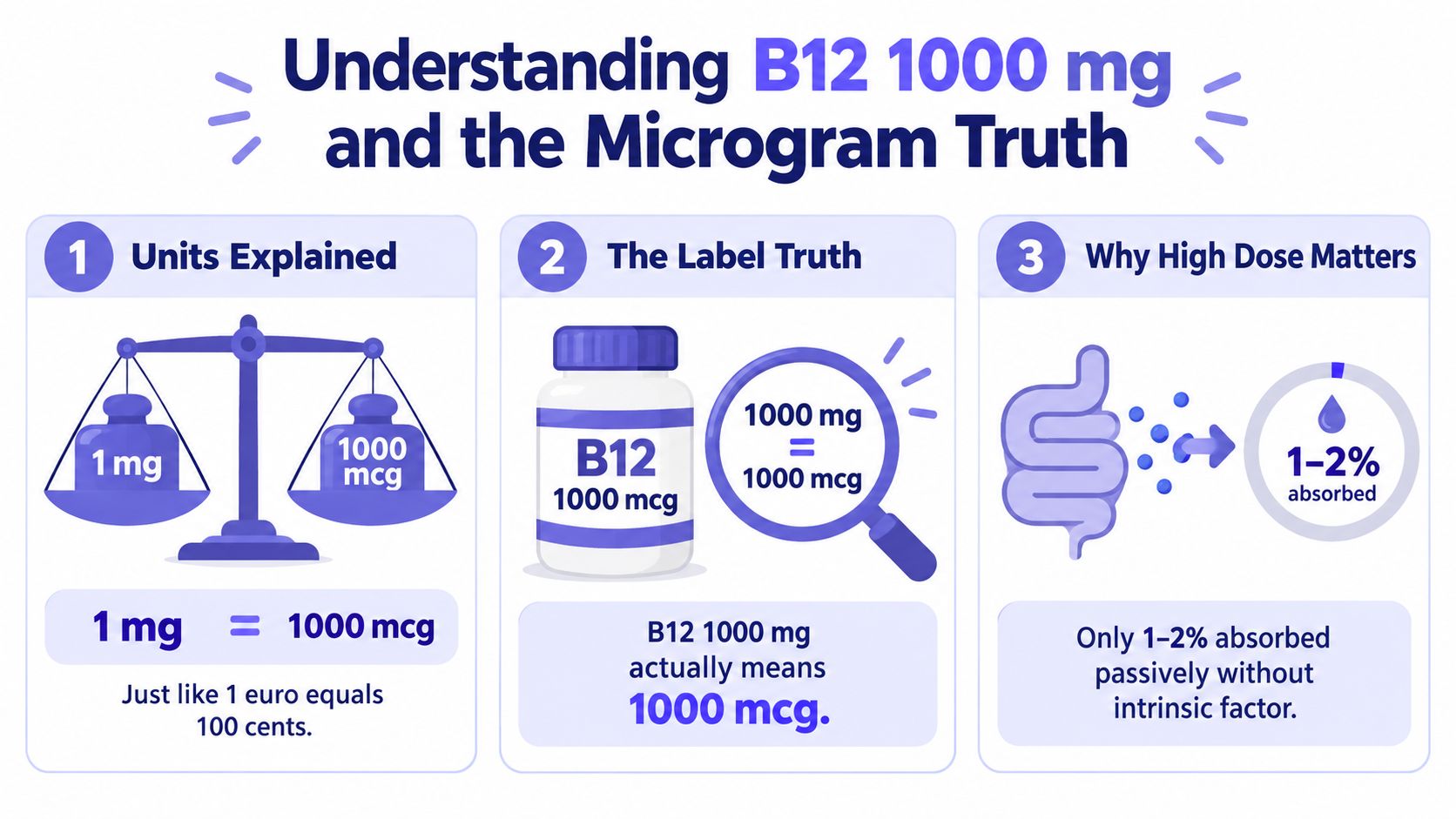
The easiest way to understand the label is to treat the units like currency. One milligram contains 1,000 micrograms, just as one euro contains 100 cents. Therefore:
1 mg = 1,000 mcg
When a product is described online as “B12 1000 mg,” the intended strength is usually 1,000 mcg, or 1 mg. The wording matters because 1,000 mg would not be the same dose. Don't rely on a product title alone. Confirm the unit on the bottle, the product page, and the serving information.
The high percentage on the label also has a straightforward explanation. The National Institutes of Health daily value information identifies 6 mcg as the daily value for vitamin B12, so a 1,000 mcg supplement provides 16,667% of the DV. That figure compares the supplement with a general daily nutrition reference. It doesn't mean the body absorbs the entire tablet or that everyone needs that amount every day.
The adult RDA is 2.4 mcg per day, increasing to 2.6 mcg during pregnancy and 2.8 mcg during breastfeeding, according to the clinical history and dietary guidance summarized by Chemistry Connected's vitamin B12 reference. A 1,000 mcg tablet is therefore far above ordinary nutritional maintenance. That's intentional in treatment settings, where the goal may be to compensate for limited absorption rather than match dietary requirements.
NIH explains that absorption is about 1.3% from a 1,000 mcg oral dose, compared with about 2% from 500 mcg, because absorption falls when the dose exceeds the capacity of intrinsic-factor pathways. Most of the tablet isn't delivered directly into circulation. The large number is partly a strategy for getting a useful amount through a narrow absorption route.
This is different from assuming that every high-dose vitamin is appropriate for everyone. A person taking B12 for a confirmed deficiency may have a clear reason for the amount, while someone seeking a general wellness product may need a much lower-strength formula. For comparison, readers exploring other high-strength nutrient labels may find this explanation of lysine 2000 mg useful, although lysine and B12 have different dosing considerations.
Related Guide Lysine 2000 mg — Reading High-Strength Labels →Who Benefits Most and Why Deficiency Is So Common
A 1,000 mcg tablet makes the most sense when a person has a meaningful risk of deficiency or a clinician has identified low B12. It isn't automatically the right choice because someone feels tired. Symptoms such as fatigue, tingling, weakness, or difficulty concentrating deserve proper assessment because several health conditions can produce them.
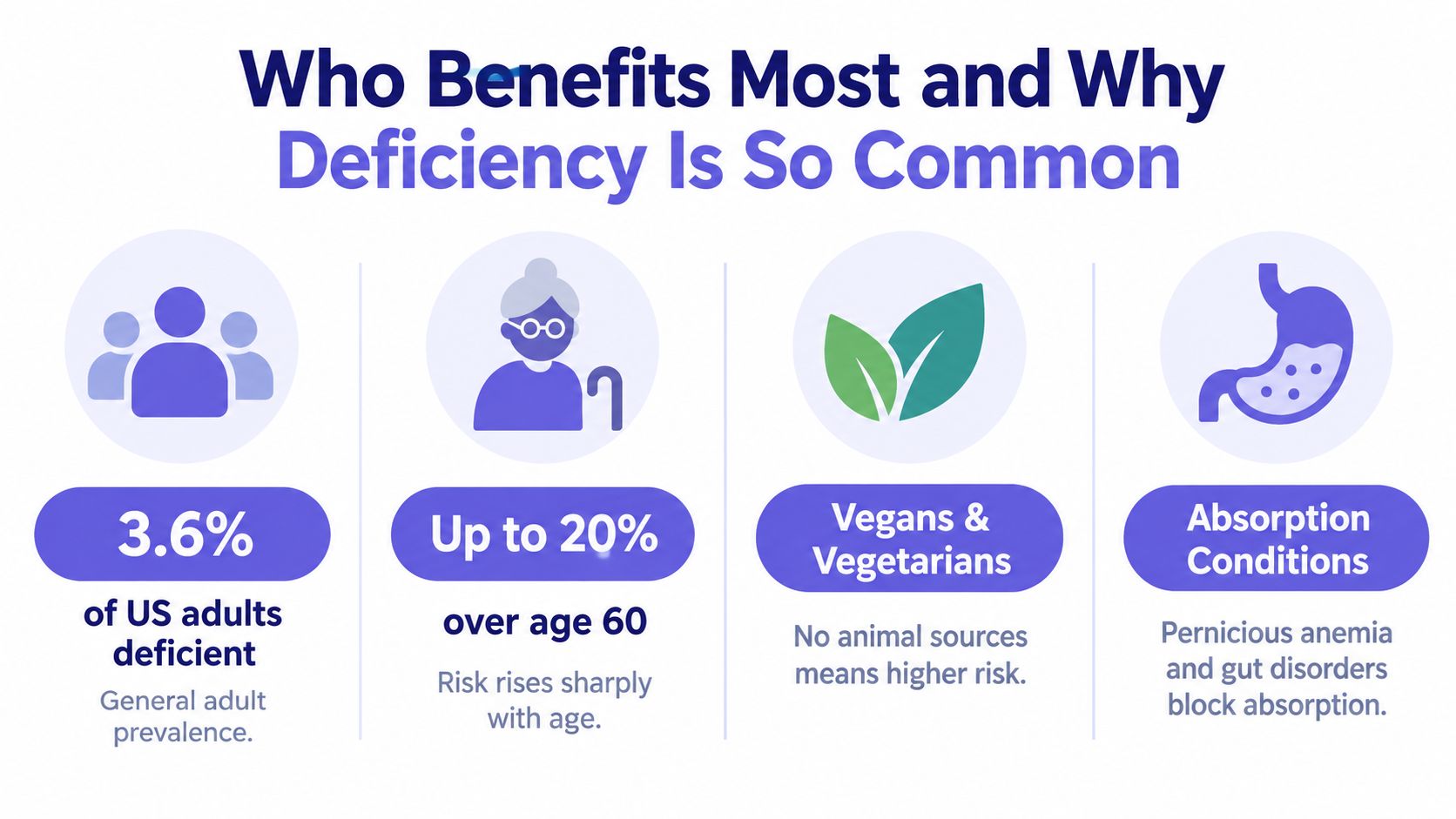
The U.S. picture shows why the issue deserves attention. An analysis of NHANES data from 2007 to 2018 found B12 deficiency in about 3.6% of adults aged 19 and older, with 12.5% having insufficiency. Among adults aged 60 and older, deficiency affected 3.7% and insufficiency affected 12.3%, according to the NIH professional vitamin B12 fact sheet. Broader clinical estimates report roughly 6% prevalence in people younger than 60 in the United States and United Kingdom, nearly 20% in people over 60, and around 40% in parts of Latin America.
The risk profile matters
Older adults may absorb B12 less efficiently. People who avoid animal-derived foods may also need reliable fortified foods or supplementation, since natural B12 sources are concentrated in animal foods. Pernicious anemia, gastrointestinal disorders, previous digestive surgery, and medicines that affect stomach acid or B12 handling can create another pathway to low levels.
A patient might describe months of tiredness and “brain fog,” while another notices pins and needles in the feet. Neither story proves B12 deficiency. A blood test and clinical assessment are needed, particularly when neurological symptoms appear, because delaying evaluation can allow a treatable problem to progress.
Use this risk checklist as a conversation starter rather than a self-diagnosis:
- Dietary pattern: Do you eat little or no meat, fish, eggs, or dairy?
- Age and digestion: Have you noticed digestive changes, or are you an older adult?
- Medical history: Have you been diagnosed with pernicious anemia or a gut disorder?
- Medication history: Do you use medicines that may interfere with B12 absorption?
- Symptoms: Are fatigue, numbness, tingling, weakness, or cognitive changes persistent?
You can also explore related nutritional considerations in this overview of vitamins for the immune system, but don't use a general wellness checklist as a substitute for testing. A high-dose B12 product is most useful when it matches an actual nutritional or absorption problem.
How Your Body Absorbs B12 and Choosing the Right Form
B12 absorption explains why a tablet can contain far more than the daily requirement. In the digestive tract, B12 normally uses intrinsic factor, a protein that helps the body absorb the nutrient. That route has limits. At larger doses, a small amount can also cross the intestinal lining by passive diffusion, which is why oral treatment may still work when normal absorption is impaired.
The numbers are useful here. NIH estimates absorption at about 1.3% from 1,000 mcg orally, compared with about 2% from 500 mcg, as described in its health professional B12 guidance. The body doesn't receive the full tablet. A high dose often compensates for the small fraction absorbed.
Comparing practical routes
| Form | Best For | Absorption Note | Practical Trade Off |
|---|---|---|---|
| Oral tablet | People who prefer a simple daily routine | High-dose oral therapy can use passive diffusion when absorption is limited | Easy to store and take, but adherence matters |
| Sublingual or chewable | People who dislike swallowing tablets | The main advantage is convenience and ease of use, not a guarantee of superior absorption | Pleasant for some users, while product directions and formulation vary |
| Intramuscular injection | Clinically significant deficiency or situations requiring supervised treatment | Plasma levels peak within 1 hour after intramuscular injection, according to DailyMed cyanocobalamin labeling | Requires a healthcare professional or injection plan |
Sublingual marketing can make the route sound automatically stronger, but the practical benefit is often that the product is easier to take consistently. A chewable option may suit someone who struggles with tablets. This guide to chewable B12 supplements can help you compare that format without assuming it replaces medical guidance.
Injections act differently, but fast movement into the bloodstream doesn't mean the whole dose stays there. DailyMed notes that within 48 hours, 50% to 98% of an injected dose of 100 or 1,000 mcg may appear in urine. That rapid clearance is one reason injection schedules are planned clinically rather than improvised.
The right form depends on the cause of low B12, symptoms, ability to absorb nutrients, comfort with injections, and likelihood of following the routine. A broader formula, such as a super B complex, also isn't interchangeable with targeted B12 treatment because it contains a wider mix of nutrients.
Related Guide Super B Complex (Igennus) →Recommended Dosages and How to Use B12 1000 mcg Correctly
The first practical distinction is between maintenance and treatment. Adults need 2.4 mcg daily as the RDA, while high-dose oral therapy commonly uses 1,000 mcg daily when deficiency or malabsorption is being treated. That makes 1,000 mcg a treatment-level dose, not a routine requirement for every healthy adult.
For confirmed deficiency or impaired absorption, guidance supports 1,000 to 1,500 mcg per day orally, or 1,000 mcg intramuscularly on a maintenance schedule, according to this clinical review of high-dose B12 treatment. A weekly 1,000 mcg oral dose is generally insufficient to correct low serum B12 in many deficient patients. The schedule needs to match the clinical problem, not just the convenience of the calendar.
Common treatment patterns
- Daily oral treatment: A clinician may recommend 1,000 mcg daily, particularly when the person can follow a consistent tablet routine.
- Higher oral treatment: Some guidance supports 1,000 to 1,500 mcg daily when absorption is reduced.
- Injection protocols: Published regimens may use 1,000 mcg daily for 7 to 10 days, followed by weekly treatment for one month, then monthly lifelong maintenance in some circumstances, as summarized in the vitamin B12 historical and clinical reference.
- Symptomatic presentations: British Columbia guidance describes 1,000 mcg every other day for about two weeks in some cyanocobalamin regimens for adults with symptomatic anemia, neurological or neuropsychiatric findings, or pregnancy, before monthly maintenance. The British Columbia cobalamin and folate guideline should be interpreted alongside individual medical advice.
Don't change from daily to weekly because the bottle is expensive or because a weekly pattern feels easier. A clinician may retest B12 and related markers after treatment begins, with the timing depending on symptoms, initial results, underlying cause, and treatment route.
Taking the supplement at the same time each day can improve adherence. Some people prefer the morning because it fits breakfast or their medication routine, while others follow the product directions. The key practical habit is consistency and avoiding duplicate B12 products without checking the combined label.
If you're comparing formulations available in Australia or elsewhere, Daily Powers vitamins offers additional label-reading context. The important question remains whether the dose and schedule fit your reason for taking B12.
Safety, Side Effects, Interactions and When to Seek Help
Vitamin B12 has a reassuring safety profile in high-dose use, and major nutrition guidance hasn't established a tolerable upper intake limit. That doesn't make every unexplained symptom a reason to self-treat indefinitely. A safe approach still includes checking the label, reviewing medicines, and identifying why B12 is being used.
Some people report headache, nausea, diarrhea, weakness, skin changes, or unusual sensations, although these reactions aren't the expected experience for most users. An allergic reaction requires prompt attention, particularly if there is swelling, breathing difficulty, widespread rash, or sudden worsening after a dose or injection.
What injections show us
Injectable cyanocobalamin labeling describes 100 mcg daily for 6 or 7 days by intramuscular or deep subcutaneous injection in a treatment context. Plasma levels peak within 1 hour after intramuscular injection, while 50% to 98% of a 100 or 1,000 mcg dose may appear in urine within 48 hours, according to the same DailyMed prescribing information. Rapid urinary clearance doesn't mean the injection failed. It means the body handles a substantial portion quickly.
Balance the benefit and the caution: High-dose B12 can be appropriate for deficiency, but it shouldn't conceal persistent neurological symptoms, anemia symptoms, or an unrelated medical condition.
Tell your pharmacist or clinician about metformin, proton pump inhibitors, and other long-term medicines that may affect B12 status. Don't stop a prescribed medicine on your own. Instead, ask whether monitoring or supplementation should be part of your care plan.
I'm certain you should seek medical help promptly if numbness or balance problems persist, if weakness is severe, if breathlessness or signs of significant anemia develop, or if you have symptoms of an allergic reaction. You can also review how vitamin D, magnesium, and K2 fit into a wider supplement routine, but keep each nutrient's purpose and safety profile separate.
Smart Buying and Daily Use Tips for Healtsy Customers
A sensible purchase starts with the label, not the headline on a marketplace page. Check whether the product says 1,000 mcg or 1 mg, identify the B12 form, review the serving size, and confirm the expiry date and storage instructions. Don't assume that “B12 1000 mg” in a search result accurately reflects the printed product label.
Use this short buying checklist:
- Confirm the unit: Look for mcg, µg, or 1 mg. Treat an unexplained 1,000 mg claim as a reason to pause and verify.
- Identify the ingredient: Cyanocobalamin and methylcobalamin are different forms, so follow the product information and professional advice.
- Review the whole stack: A multivitamin, B complex, and standalone B12 can all contribute to your daily intake.
- Match the dose to the purpose: A treatment-level strength may suit confirmed deficiency, while general nutritional support may not require it.
- Plan adherence: Choose a format you can take consistently, whether that's a tablet, chewable, or clinically supervised injection.
Healtsy lists nutritional products alongside pharmacy and wellness items, including broader formulas such as Absorvit Smart Neuro ampoules, which contain B vitamins among several other ingredients. That type of multi-ingredient product shouldn't be treated as identical to a single-ingredient 1,000 mcg B12 supplement. Compare the full formula before combining products.
My practical recommendation after 16 years in the sector is simple: verify the unit, understand the reason for the dose, and ask a healthcare professional to interpret persistent symptoms or abnormal blood results. I'm certain this approach will solve the most common confusion around b12 1000 mg while helping you build a routine based on evidence rather than a dramatic-looking number.
Compare B12 & B-Vitamin Options at Healtsy
Healtsy offers nutritional supplements and pharmacy products with clear product information, so you can compare standalone B12 with broader B-vitamin formulas for your needs. Review available options, check labels carefully, and choose a product that fits the routine you can follow.
Visit Healtsy