


Anti Aging Serum Vitamin C Complete Guide to Results
You look in the mirror one morning and notice several changes at once. Your complexion seems duller, a few fine lines look more settled, and uneven tone draws attention before your eyes do. Then you see a vitamin C serum promising brighter, firmer, younger-looking skin, but the label raises more questions than it answers.
After 16 years in the pharmaceutical sector, I believe the most useful way to judge an anti aging serum vitamin c is to look beyond the percentage on the front of the bottle. Formulation stability, pH, vitamin C form, packaging, tolerability, and consistent use determine whether the active ingredient remains available to your skin. A high number means little if the serum oxidizes quickly or irritates you so much that you stop using it.
This is the complete guide to choosing and using vitamin C intelligently. You'll learn what the ingredient does at skin level, how pure L-ascorbic acid compares with stabilized derivatives, what human studies measured, and how to build a routine that respects sensitive skin and skin of color. For broader ingredient context, Healtsy's guide to essential skincare ingredients for radiant skin is also a useful companion.
My promise is practical rather than dramatic. Vitamin C won't erase every wrinkle, replace sunscreen, or produce overnight structural change. Used in a well-designed formula and applied consistently, however, it can support brightness, tone evenness, firmness, smoothness, and the skin's response to environmental stress. I'm certain this approach will solve the most common confusion around vitamin C serums, because it puts real formulation science ahead of marketing language.
Introduction to Anti Aging Serum Vitamin C That Actually Works
Why the percentage isn't the whole story
Vitamin C has a legitimate place in an anti-aging routine, but the product has to deliver usable vitamin C to viable skin tissue. L-ascorbic acid is hydrophilic, charged, and unstable, which creates two practical problems. It doesn't cross the outer skin barrier easily, and it can lose activity when exposed to air, light, water, or unsuitable pH conditions. The formulation has to solve both problems, as described in this review of topical vitamin C formulation and skin penetration.
The common shopping mistake is to compare two bottles only by concentration. A serum with a lower stated percentage may be more useful if it uses a stable derivative, protective packaging, and a vehicle that keeps the active available. Conversely, a strong L-ascorbic acid serum may be scientifically sound but uncomfortable for reactive skin.
My professional rule: choose the formula you can use correctly and consistently, not simply the bottle with the largest percentage.
Visible aging usually has several causes working together. Oxidative stress can damage structural proteins, glycation can make collagen less flexible, inflammation can contribute to redness and tissue stress, and pigment irregularity can make the complexion look older even when wrinkles are modest. A carefully formulated vitamin C serum can address several of these pathways within one routine, although it still works alongside, not instead of, daily photoprotection.
The sections ahead translate the science into decisions you can make at the bathroom shelf. We'll consider pure vitamin C versus derivatives, realistic timelines, safe layering, storage, and the special questions that guides often overlook, including sensitive skin and darker phototypes. I believe this is the best knowledge I can give based on my 16 years of experience in the sector, and the recommendations are designed to be useful in real life, where routines must be comfortable enough to maintain.
How Vitamin C Fights Visible Aging at the Skin Level
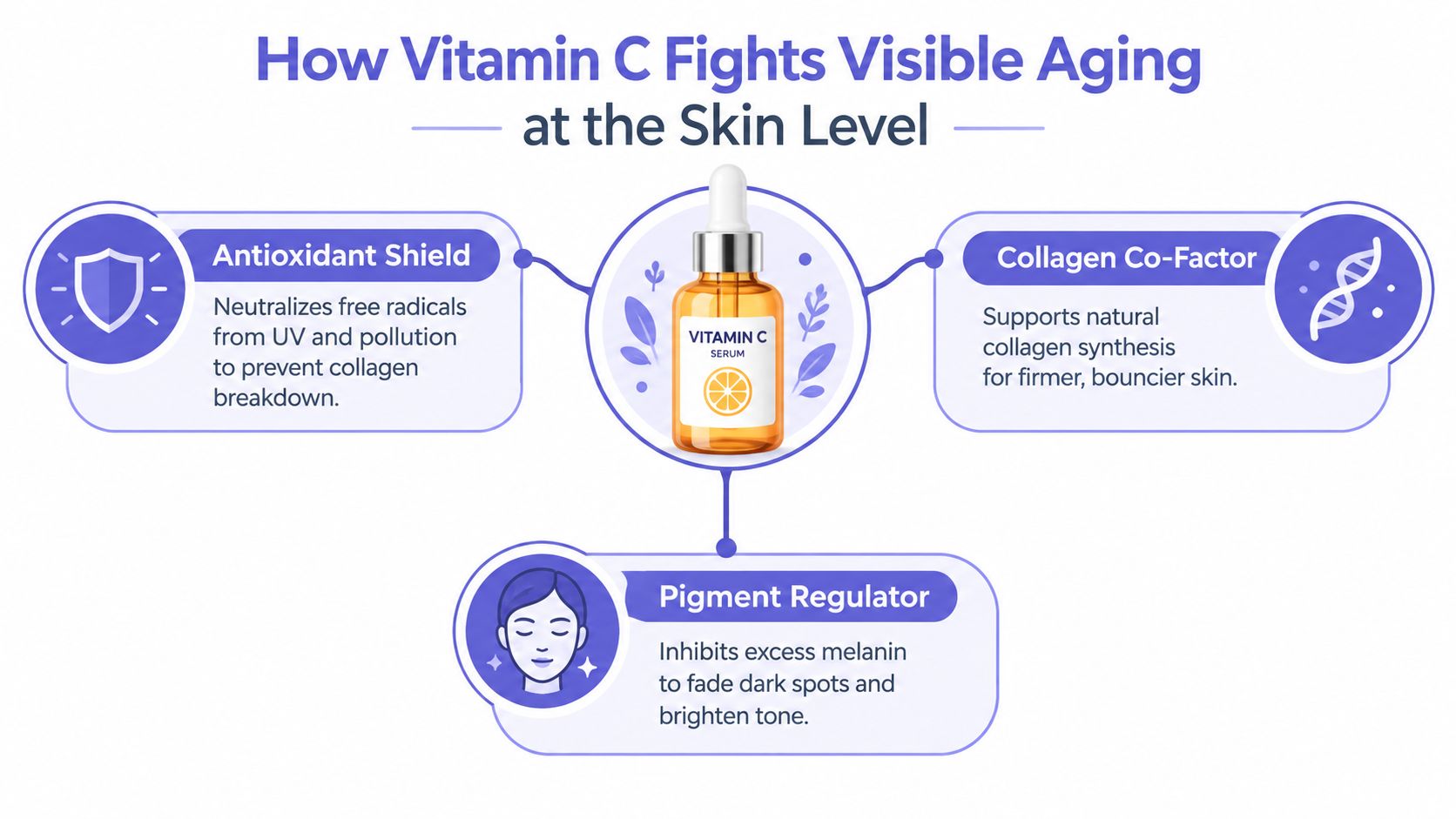
Vitamin C works through several related mechanisms. Thinking of it as a single-purpose brightening ingredient undersells what it can do, while treating it as a complete anti-aging treatment overstates it. Its value comes from combining antioxidant protection, collagen support, and pigment regulation.
The antioxidant shield
Free radicals form when skin encounters environmental stressors such as ultraviolet exposure and pollution. A simple analogy is metal beginning to rust when exposed to damaging conditions. Antioxidants help neutralize reactive molecules before they contribute to cellular and structural damage.
Vitamin C is especially relevant in a morning routine because the skin faces environmental exposure during the day. It doesn't replace sunscreen, but it can complement photoprotection. A review of antioxidant use in photodamaged skin describes how topical vitamin C, combined with vitamin E and related antioxidants, can reduce injury associated with ultraviolet irradiation in sun-exposed skin. The evidence is summarized in this review of vitamin C and photoprotection.
The collagen co-factor
Collagen gives skin much of its supportive scaffolding. Vitamin C participates in the biochemical processes that form and stabilize collagen fibers, so adequate topical availability can support the skin's own structural activity. The practical result isn't a replacement for an injectable treatment. It's gradual support for the appearance of firmness, elasticity, and fine texture.
That distinction matters at the mirror. A serum may help skin look smoother and more resilient over time, but it won't recreate lost volume or reposition lax tissue. The best candidates are often people who want to improve early fine lines, dullness, photodamage, and uneven texture with a topical routine.
The pigment regulator
Vitamin C can also help regulate the visible appearance of excess pigmentation by interfering with processes involved in melanin formation. This is why it may help a complexion look more uniform and why it's often considered for dark spots caused by environmental exposure or post-inflammatory changes.
Pigmentation concerns can be complex, particularly when spots recur or respond unevenly. For readers considering professional options as well as topical care, an overview of pigmentation treatments at Swiss clinics can provide useful context about how clinical approaches differ from home skincare. A serum remains a gradual cosmetic tool, not a diagnosis or a guarantee that every type of pigmentation will fade.
Glycation adds another layer. Advanced glycation end products can stiffen proteins and contribute to the visual character of aging skin, while oxidative stress and inflammatory signaling can affect tone and texture. A 2026 human clinical study of a 10% topical vitamin C serum reported, after 12 weeks, a 17.65% reduction in advanced glycation end products, a 49.22% drop in carbonylation fluorescence intensity, a 58.73% decrease in IL-1α, and a 12.14% increase in ABTS free-radical scavenging activity. The same study reported statistically significant reductions in skin yellowness and redness, with b* falling by 6.13% and a* falling by 16.46%. These findings are detailed in the 2026 clinical study of topical vitamin C.
For a product-specific discussion of a vitamin C and antioxidant combination, Healtsy also publishes information about SkinCeuticals C E Ferulic. The broader lesson is more important than any single product. Vitamin C can influence several visible-aging pathways, but the formula must preserve the active long enough for those pathways to matter.
Choosing the Right Vitamin C Form and Strength for Your Skin
The first decision is whether you want pure L-ascorbic acid or a stabilized derivative. L-ascorbic acid is the biologically active form and requires no conversion before skin can use it. Its weakness is practical: it's unstable and penetrates poorly unless the formula uses an acidic environment and a suitable delivery system.
For L-ascorbic acid, a pH below about 3.5 helps keep more of the molecule non-ionized, which improves passage through the stratum corneum. This acidity can make a serum more stimulating, especially if your barrier is dry, sensitized, or already exposed to retinoids and exfoliating acids.
Derivatives take a different route. Tetrahexyldecyl ascorbate, often called THD ascorbate, is lipophilic, more stable at a near-neutral pH, and designed to diffuse through the skin barrier before converting to active ascorbic acid in deeper layers. That can make it a sensible choice when tolerability and shelf life matter more than the immediate intensity associated with low-pH L-ascorbic acid.
Vitamin C forms compared for anti-aging use
| Form | Optimal pH | Stability | Best For |
|---|---|---|---|
| L-ascorbic acid | Below about 3.5 | Lower, unless carefully protected | Experienced users seeking a direct, well-studied active form |
| THD ascorbate | Near-neutral conditions | Higher than pure L-ascorbic acid | Sensitive, dry, or easily irritated skin |
| Other stabilized derivatives | Depends on the derivative and formula | Generally better than pure L-ascorbic acid | Users prioritizing comfort and longer product usability |
The evidence doesn't support treating percentage as a universal score. Clinical research has studied formulations around 10% to 15% L-ascorbic acid, while a review also reports measurable wrinkle-related and elasticity improvements with 3% ascorbic acid used for four months. At the other end, consumer-focused dermatology guidance notes that concentrations above 20% don't appear to improve delivery or effect and may increase irritation. Those points support a moderate, formulation-first approach rather than an automatic race toward the highest strength. See the clinical review of topical vitamin C for photoaged skin for the lower-concentration evidence and the systematic dermatology review of vitamin C for the tolerability and representation concerns.
A practical decision matrix
Start with a stabilized derivative, especially if low-pH products sting or leave persistent redness.
L-ascorbic acid may be suitable if you tolerate acidic products and can protect the serum from oxidation.
A derivative or a lower-irritation L-ascorbic acid formula paired with a barrier-supportive moisturizer may be easier to sustain.
Introduce cautiously and prioritize tolerability. Irritation can worsen the appearance of uneven tone, and clinical trial data specifically focused on darker phototypes remain limited.
For more practical guidance on irritation, see Healtsy's resource on using vitamin C safely for sensitive skin. I believe the right question isn't “What is the strongest serum?” It's “Which formula gives my skin a useful dose without disrupting the barrier?”
What Clinical Results to Expect and When You Will See Them
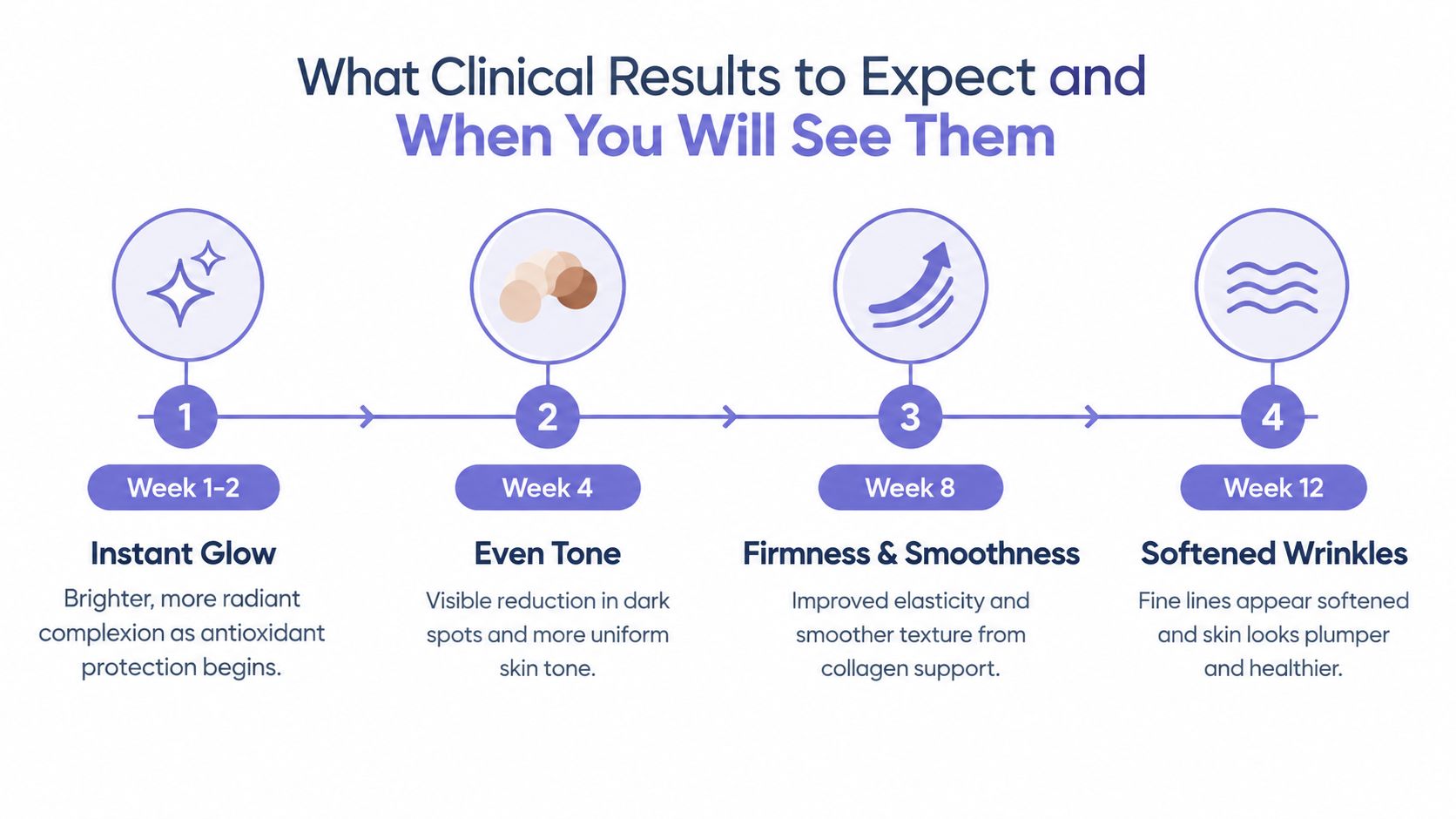
Vitamin C results tend to arrive in layers. Radiance and tone can look fresher before structural changes become noticeable, because surface appearance responds sooner than collagen remodeling. If you expect a serum to soften a deep wrinkle within a few mornings, you'll probably abandon a sound product too early.
What controlled human testing measured
A clinical study of a stabilized 12% vitamin C serum followed 80 women aged 45 to 70 across 56 days. Participants showed progressive improvements in glow, tone evenness, radiance, firmness, softness, and smoothness. Fine lines and deep wrinkles also decreased among the 26 participants who had deep wrinkles at baseline. The study included skin phototypes I through VI, which gives the findings broader relevance across skin tones, although it doesn't remove the need for individual caution. The results are reported in the clinical study of stabilized vitamin C serum.
A separate 2026 study of a 12% pure vitamin C serum in 49 women found a 16.4% increase in epidermal thickness after 84 days, along with significant improvements in collagen fiber quality, firmness, elasticity, radiance, oiliness, and pores. No treatment-related adverse events were reported in that study. These findings suggest that modern vitamin C products can support more than a temporary glow when the formulation is controlled and use is sustained.
A double-blind half-face study lasting 12 weeks also reported statistically significant improvement in wrinkling with biopsy evidence of new collagen formation. That kind of evidence is more meaningful than a before-and-after photograph alone, because it connects a visible change with a biological measurement. The clinical review of vitamin C and aging skin discusses this evidence and the role of formulation quality.
Judge radiance and tone first, then assess texture, firmness, and fine lines after sustained use.
The timing is not a rigid calendar. Some people notice a fresher appearance relatively early, while firmness and wrinkle softening require patience. In practice, compare photographs taken under the same lighting and inspect whether makeup sits more smoothly, whether tone looks more uniform, and whether fine lines appear less pronounced at rest.
Vitamin C also makes the most sense within a photoprotective routine. The antioxidant combination of vitamin C and vitamin E can support the skin against ultraviolet injury, but no serum substitutes for sunscreen. If pigmentation is your main concern, continued sun exposure can keep creating the very unevenness you're trying to reduce.
How to Use Vitamin C Serum in Your Daily Routine Safely
A simple routine is usually more successful than an elaborate one. Apply vitamin C after cleansing, before moisturizer, and finish with daytime sunscreen. That order gives the serum direct contact with clean skin while the moisturizer helps reduce dryness and the sunscreen handles the primary external defense.
A calm morning sequence
- Cleanse gently: Remove overnight oil and residue without leaving the skin tight.
- Apply the serum: Use the amount directed on the product label, keep it away from the eye area, and avoid rubbing aggressively.
- Moisturize: Choose a texture that supports your barrier without making the routine uncomfortable.
- Finish with sunscreen: Use broad-spectrum sunscreen every morning. Vitamin C supports photoprotection but doesn't replace it.
- Close and store the bottle: Reduce air exposure immediately after use.
Low-pH L-ascorbic acid products usually work best as a short, direct application before moisturizer. If your skin burns, remains red, becomes unusually flaky, or feels raw, reduce frequency or change to a derivative. A mild temporary sensation can occur with acidic products, but persistent irritation is a reason to adjust rather than push through.
Layering with other actives
Niacinamide can fit into the same general routine when both products are well formulated and your skin tolerates them. It may be useful to separate strong exfoliating acids or retinoids from an acidic L-ascorbic acid serum if combining them causes stinging. Many people prefer vitamin C in the morning and a retinoid in the evening, which also keeps the routine easier to monitor.
For a detailed sequence involving these products, Healtsy's guide to layering niacinamide, vitamin C, and sunscreen offers a practical reference.
An evening routine can remain simpler: cleanse, use a retinoid if appropriate, and apply moisturizer. If you want vitamin C at night instead, use it on a separate evening from irritating actives until you know your tolerance.
Sensitive skin and darker phototypes
A 2026 dermatology review found that clinical evidence specifically focused on topical vitamin C in darker phototypes remains limited, with many studies relying on antioxidant blends and insufficient representation of skin of color. This gap matters because irritation can leave visible discoloration, particularly in people prone to post-inflammatory hyperpigmentation.
Patch-test a small area before applying a new serum broadly. Begin with intermittent use, choose a derivative if pure L-ascorbic acid feels harsh, and avoid introducing several new actives at once. For adults in their 20s, the focus may be prevention and daily photoprotection. In later decades, the same ingredient can be used alongside moisturizer, sunscreen, and carefully selected retinoids to address accumulated tone and texture changes.
I believe this approach will solve most routine confusion: start with one well-tolerated product, use it consistently, and adjust only after you can identify how your skin responds.
Smart Buying and Storage Tips to Keep Your Serum Potent
The most useful buying framework begins with stability, not the front-label percentage. Vitamin C has to remain chemically available from the first application through the last. A beautifully designed formula can't help if repeated exposure to air and light causes rapid oxidation.
Read the bottle before the claim
Look for the vitamin C form, the packaging, and any information about pH or stabilization. For L-ascorbic acid, an acidic formula is expected because low pH supports penetration. For a derivative, near-neutral pH may be appropriate and can improve comfort.
Packaging deserves equal attention. A dark or opaque airless container limits light and air exposure more effectively than a clear bottle with an open dropper. A 2026 stability study found dark, opaque airless packaging consistently outperformed clear or open-dropper bottles, and recommended using open-dropper products within about 8 weeks after opening. The findings are discussed in this vitamin C stability and packaging analysis.
Storage rule: keep the bottle tightly closed in a cool, dark place, away from direct sunlight and repeated heat.
Inspect the serum when you open it and pay attention to changes over time. A marked shift toward a darker yellow, orange, or brown appearance can signal oxidation. An unusual smell is another reason to stop using it. Don't try to rescue an oxidized formula by applying more product, because the original concentration no longer tells you what remains active.
A shopping page such as Healtsy's information on Sesderma vitamin C products can help you compare named formulations, but the same checklist applies wherever you shop. Check the form, packaging, intended use, and suitability for your skin. A stable, comfortable serum that you finish is usually a more rational choice than an impressive percentage in a vulnerable package.
Your Next Steps to Brighter Firmer Skin With Confidence
The central lesson is simple. Vitamin C can support brighter tone, smoother texture, firmness, and visible anti-aging improvement, but formulation and consistency determine the experience. Choose the form your skin can tolerate, protect the serum from oxidation, apply it regularly, and use sunscreen every morning.
I believe the knowledge shared here is the best I can give from 16 years in the pharmaceutical sector. I'm certain you'll make better decisions when you stop treating percentage as the only measure of quality and start assessing pH, packaging, derivative choice, and your own barrier. If you're building a mature-skin routine, you can also review how retinoids and peptides support aging skin before deciding which active belongs in your evening routine.
Keep your first routine deliberately small. Take photographs in comparable lighting and review radiance, tone, texture, and comfort at 4, 8, and 12 weeks rather than checking the mirror several times a day. Persistent burning, worsening redness, or stubborn hyperpigmentation deserves a consultation with a dermatologist, particularly if you have a history of eczema, rosacea, or post-inflammatory discoloration.
Start with one serum, store it properly, protect your skin from ultraviolet exposure, and give the formula enough time to show what it can do.
Build a stable routine you can use consistently
Healtsy offers anti-aging vitamin C serums, moisturizers, sunscreens, and pharmacy-grade skincare for different concerns and skin types. Compare suitable formulas, check ingredient details, and build a stable routine you can use consistently.
Visit Healtsy